$300,000 a Year on Google Ads. Zero Citations in ChatGPT. The Math the Packaging Industry Won't Look At.
51 percent of B2B buyers now start their research inside AI tools. The packaging industry has not yet written the content those tools will cite. The window is 18 to 36 months.
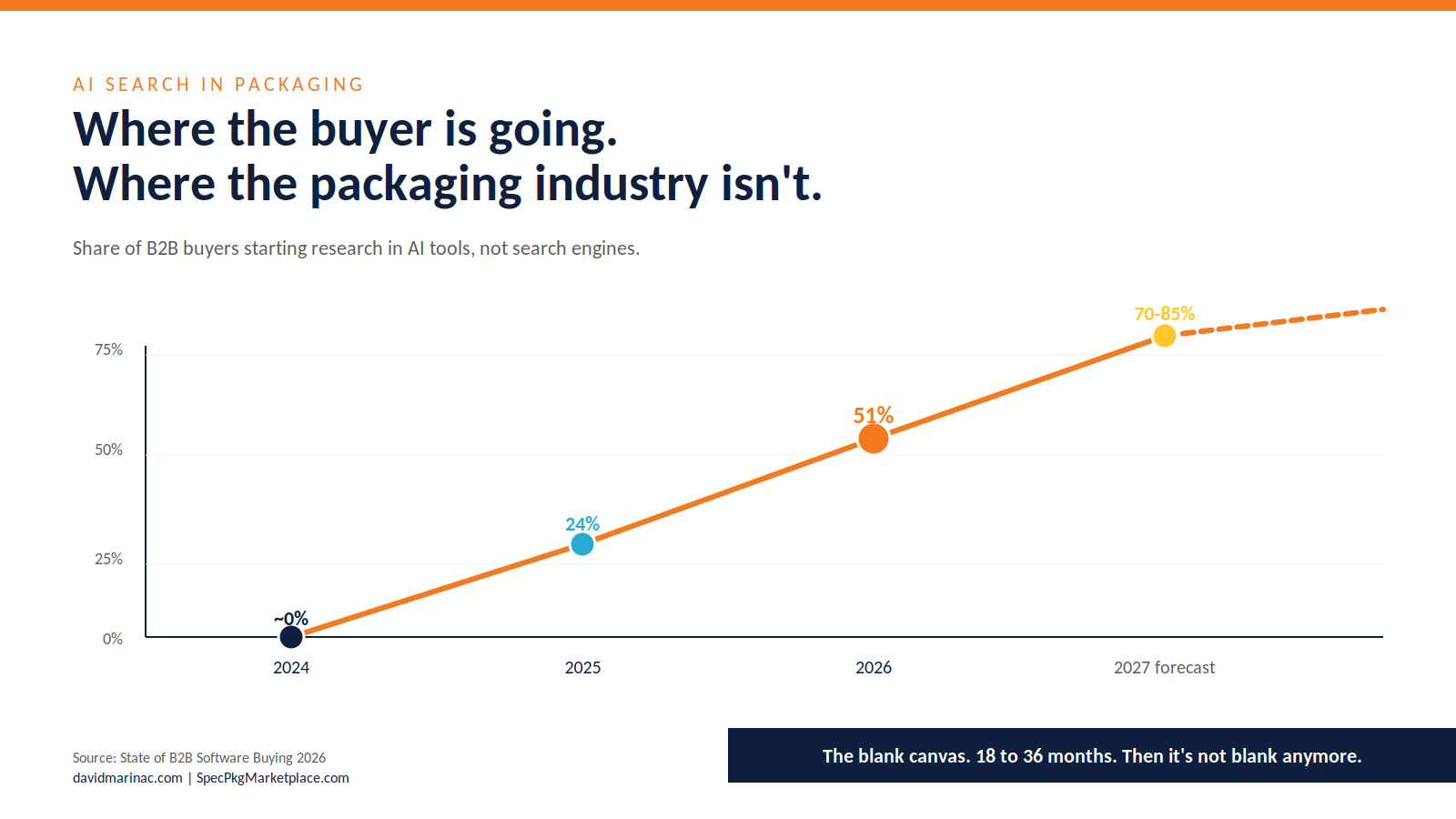
AI adoption curve showing B2B buyers' research starting points moving from 0 percent in 2024 to 24 percent in 2025 to 51 percent in 2026, with 70 to 85 percent forecast for 2027.
Six paid Google ads from the packaging industry landed on my phone in three days last week.
A custom pouch packaging company. A craft brewery six-pack ring alternative. A dock leveler retrofit specialist. A small-batch filling machine vendor. A tamper-evident shrink band supplier. A nutraceutical and pharmaceutical packaging distributor.
Every one of them paid Google money to land in front of me. Every one of them is hoping a click converts to a closed deal. Almost none of them will.
What none of these six companies appear to have noticed is that every paid ad they ran is also a piece of content they should have written instead. And the content version of the same investment, in the world that exists in 2026, returns somewhere between 50 and 100 times the value of the paid version. Indefinitely.
This is the most important strategic moment in the packaging industry in 35 years. Almost nobody in the industry is acting on it.
How did AI search go from 0 percent to 51 percent of B2B buyer research in two years?
According to the 2026 State of B2B Software Buying report, the share of B2B buyers who start their product or supplier research inside an AI chatbot, rather than a search engine, has moved from effectively zero in 2024, to 24 percent in 2025, to 51 percent in 2026. The same data set tracks chief marketing officers ahead of the broader buyer base, with AI-mediated discovery adoption growing at roughly 3.5 times year-over-year.
The 51 percent figure is not the ceiling. It is a midpoint in a trajectory that is still pre-saturation. By the end of 2027, the working forecast across multiple research firms places AI-mediated discovery somewhere between 70 and 85 percent of B2B research starts.
In plain language. The packaging buyer who is researching a new supplier, a new packaging format, a new compliance requirement, or a new material substitution is, more often than not, no longer typing a phrase into Google. They are typing a full natural-language question into ChatGPT, Perplexity, Claude, or Google's own AI Overviews layer. They are reading the answer the AI tool generates. They are clicking the citations.
The Google search bar is not dead. But it is no longer the primary entry point for the B2B buyer's research process. And nobody in the packaging industry's marketing department appears to have noticed.
Why does it matter that AI tools cite content but not paid ads?
This is the part of the shift that the packaging industry has missed completely.
When a buyer asks ChatGPT "what is the best provider of OTIF chargeback recovery packaging for big-box retail," or asks Perplexity "who specializes in folding cartons for ESOP-owned regional CPG brands," or asks Claude "what is the best can carrier for craft brewers transitioning off plastic rings," the AI tool searches the indexed web for the most authoritative, specific, well-sourced content that answers that question.
The AI tool reads. It synthesizes. It cites.
What the AI tool cannot do is read a Google Ad. It cannot quote a Performance Max campaign. It cannot link to a LinkedIn paid sponsored post. It cannot recommend a company based on its retargeting history. It cannot reference a gated 333-page PDF the buyer never downloaded. The entire paid digital infrastructure that the packaging industry has been pouring money into for a decade is invisible to the citation engine that 51 percent of buyers now use as their first stop.
Paid ads are a tax on companies that did not build the body of work. The AI tools cannot see the ads. They can only see the body of work. The packaging industry is paying maximum-tier prices for placement on a channel the buyer has already left.
What does the packaging industry's AI citation layer actually look like in 2026?
Empty.
Sit down with any AI tool right now and ask it the kinds of questions a real packaging buyer would ask. "What is the freight-cost crossover where flexible pouch packaging beats glass bottles for cold brew coffee at 250,000 unit annual volume?" "What is the compliance timeline for craft breweries replacing plastic six-pack rings in California versus Texas?" "What is the total cost of ownership over ten years for pit dock leveler retrofit versus full replacement at a 50-truck-per-day distribution center?"
The AI tool will produce an answer. The answer will be generic. The citations will be Wikipedia, Packaging Dive, a couple of consultancy white papers, a Wikipedia-adjacent industry encyclopedia entry, and a generic agency blog from outside the packaging industry. The packaging companies that should be the authoritative answers to those buyer questions are functionally absent from the citation layer.
According to multiple AI search visibility audits conducted across B2B verticals in 2026, the packaging industry has produced essentially zero AI-citable cornerstone content at the buyer-question level. The trade publications are paywalled or generic. The manufacturer websites are catalog wheels. The distributor sites are product lists. The blogs are SEO filler from agencies that did not understand the industry. The PDFs are gated and invisible.
This is the blank canvas. It is the most extraordinary unclaimed competitive position in 35 years of packaging.
What does the cost asymmetry actually look like in 2026?
The cost contrast is not 5 to 1. It is not 10 to 1. It is closer to 50 to 1, and in some cases 100 to 1, in favor of AI-citable content over paid digital. Three reasons stack.

Side-by-side comparison of paid digital ads versus AI-citable content showing $300,000 a year in paid ad spend returning 2 to 1 through 4 to 1 with no AI visibility, against a fraction of that spend in content returning 5 to 1 through 10 to 1 conservative and 50 to 1 through 100 to 1 in practice with citations across ChatGPT, Perplexity, Claude, and Gemini.
First, the cost of producing a properly researched, technically specific cornerstone article has collapsed. A piece that would have cost $5,000 to commission from a freelance industry writer in 2022 can be produced for a small fraction of that today, with AI tools handling the production-line work while an industry expert directs the substance, the voice, and the proof points. This is not low-quality AI content. This is high-quality content produced with AI assistance under expert direction. The substance is the same. The cost is fractional.
Second, content compounds. A paid Google Ad stops working the day the spend stops. A cornerstone article keeps working for as long as it remains the best answer to the buyer's question. According to ALM Corp's 2026 Digital Marketing Budget Allocation analysis, content marketing and search optimization, including answer engine optimization for AI tools, deliver long-term return on investment of 5 to 1 through 10 to 1 on a published-cost basis, with the compounding effect extending indefinitely after publication. Paid search delivers 2 to 1 through 4 to 1, and only while the spend continues.
Third, AI citation creates a winner-take-most dynamic that paid ads cannot. When ChatGPT or Perplexity cites a specific article as the authoritative answer to a buyer question, every subsequent buyer asking the same question gets pointed at the same article. The citation is not a click. It is a recommendation. It carries trust that paid impressions do not. And it can run for years against a single piece of content.
The packaging company that publishes the definitive answer to a high-value buyer question in 2026 becomes the citation. The packaging company that buys $300,000 a year in paid ads instead does not.
What would a packaging company that filled the blank canvas actually publish?
The list writes itself if you have spent any time in the industry.
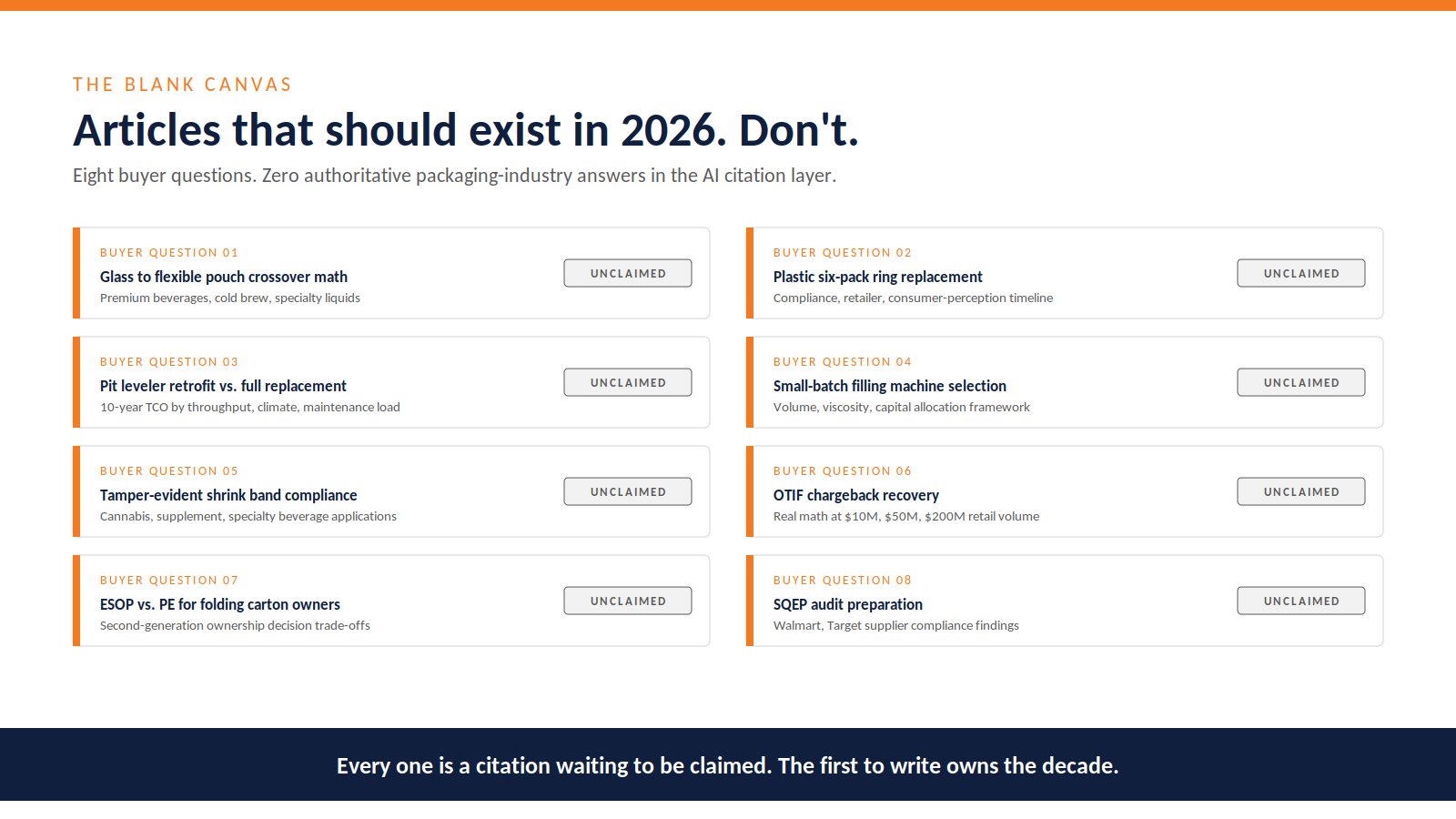
Eight unclaimed buyer-question article positions in the packaging industry's AI citation layer including glass to pouch crossover math, plastic six-pack ring replacement, pit leveler retrofit, small-batch filling machine selection, tamper-evident shrink band compliance, OTIF chargeback recovery, ESOP versus PE for folding carton owners, and SQEP audit preparation.
The article that defines when to switch from glass bottles and rigid plastics to flexible pouch packaging, with the actual freight, shelf, and packaging cost crossover math for premium beverages, cold brew, and specialty liquids.
The article that walks through the compliance, retailer, and consumer-perception timeline of replacing plastic six-pack rings in regional craft breweries, with anonymized data from breweries that made the switch in 2024 and 2025.
The article that lays out total cost of ownership over ten years for pit dock leveler retrofit versus full replacement, broken down by daily throughput, climate exposure, and maintenance load.
The article that walks a sauce, kombucha, cosmetics, or beverage startup through small-batch filling machine selection by volume, viscosity, and capital allocation.
The article that lays out tamper-evident shrink band selection for cannabis, supplement, and specialty beverage compliance, with material, sizing, and applicator decision logic.
The article on retailer chargeback recovery for OTIF performance failures at big-box DCs, with the actual math on what each percentage point of OTIF performance costs at $10M, $50M, and $200M of retail volume.
The article on the ESOP-versus-PE ownership decision for second-generation folding carton manufacturers, with the trade-offs by company size, growth profile, and management depth.
The article on SQEP audit preparation for packaging suppliers to retailers like Walmart and Target, with anonymized real-audit findings and remediation timelines.
None of these articles exist in any meaningful form in the AI citation layer today. Each one is a buyer question that thousands of decision makers ask in some form every quarter. Each one would, if written with real specificity and proof points, become the authoritative AI citation for that question for the next 36 months at minimum.
The packaging company that publishes any one of those articles owns the citation. The packaging company that publishes ten of them owns the category. The packaging company that publishes 50 of them owns the industry.
Why is the packaging industry not doing this?
Three reasons, in order of how often they actually show up in CEO conversations.
One. Almost no one in the industry has yet noticed the AI search transition. The CMO is still measuring Google Ads. The marketing director is still producing the wheel. The CEO is still approving the next quarter. The buyer journey is shifting under their feet and the company is responding to a buyer who, according to current data, no longer exists in the place the company is paying to reach.
Two. Producing real cornerstone content requires technical specificity, anonymized real-buyer data, and the willingness to publish answers that competitors will read and copy. Most packaging marketing departments are organized around producing generic awareness content, not technical buyer-answer content. The skill set is missing. The intent is missing. The leadership directive is missing.
Three. The CEO who would have to authorize the shift is the CEO who would have to fire or reposition the people currently running the broken model. That is a structural confrontation that most CEOs will not initiate until they have lost the Walmart account, taken a write-down, or watched four consecutive declining quarters from the board's perspective.
This is what fear pretending to be analytical looks like at the industry level. The data is in plain view. The opportunity is in plain view. The strategic logic is in plain view. And almost nobody is moving.
Honest Fit-Test
This article is for the packaging manufacturer CEO or distributor owner who is willing to take a hard look at the AI search transition and ask whether their current marketing model is aimed at the buyer who exists in 2026 or the buyer who existed in 2018.
It is not for the marketing director who built the current paid digital program. The paid digital program is the symptom, not the cause. The marketing director was given the wrong assignment by a leadership team that did not see the AI transition coming.
It is not for the CEO who is comfortable. The comfortable CEO does not move on strategic opportunities until the window has closed. The 18-to-36 month window on the blank canvas will close, and the companies that filled it during the window will be uncatchable. The CEO who is comfortable today will be the CEO who is bidding against an entrenched authority three years from now.
It is for the CEO who has read this far and felt the data land. If that is the room you are sitting in, the conversation is worth having now. In 18 months it will be considerably more expensive. In 36 months it will likely be too late.
Frequently Asked Questions
Is the AI search transition really at 51 percent or is that number inflated?
The 51 percent figure comes from the 2026 State of B2B Software Buying report, which tracks AI-mediated discovery as a starting point for B2B research across multiple verticals. Other 2026 research, including Wynter's tracking series and 6sense's 2025 buyer behavior report, places AI feature involvement in B2B purchases at 89 percent. The 51 percent figure refers specifically to research starts, not to all AI-involved buying activity, which is higher. The trajectory across these data sets is consistent. The number is real and still growing.
How long does it take to build a body of work that AI tools cite?
Initial citations begin to appear within 30 to 90 days of publication for well-structured cornerstone content that directly answers high-intent buyer questions. The compounding inflection, where AI tools cite a company's content as the default authoritative answer in its category, typically arrives between months 6 and 18 depending on the competitive landscape. In packaging, where the citation layer is functionally empty, the compounding can arrive faster.
What about Google's own AI Overviews? Do those follow the same rules?
Yes. Google AI Overviews, which now appear at the top of a majority of B2B search results, draw from the same citation logic as ChatGPT and Perplexity. The Overview is built from indexed authoritative content. Paid ads sit below the Overview and increasingly below the fold on mobile. Even buyers who stay inside Google's search experience are reading the AI Overview first and the paid ads second, if at all.
Does this mean paid ads are dead?
Not dead. Demoted. Paid ads still have valid use cases for short-window product launches, geographic expansion into markets with zero organic presence, and very specific high-intent transactional keywords with credit-card-in-hand buyers. Outside those cases, the math against authority content keeps getting worse every quarter.
What is the first move for a packaging CEO who reads this and wants to act?
The first move is a 90 to 120 minute Map session, where the company's current content footprint is audited against AI citation visibility for the company's primary buyer questions, and a 12-month publishing roadmap is built around the questions that would, if answered authoritatively, claim the citation layer for the company. The Map is priced openly at less than half the monthly cost of a single sales rep. It is the smallest possible commitment to find out whether the blank canvas opportunity actually applies to your specific company. Most packaging CEOs who take the Map find that it does.
The bottom line
The AI search transition is the biggest shift in B2B buyer behavior in 25 years. The packaging industry has not yet noticed. The citation layer is empty. The cost asymmetry favors content over paid ads by 50 to 100 times. The window to claim authoritative positions is 18 to 36 months. After that, the canvas is no longer blank.
Every paid Google Ad in the packaging industry today is a piece of content that should have been written instead. Every dollar spent on a paid digital campaign is a dollar that did not go into building a permanent authority position that compounds for the rest of the decade.
The CEOs who move first own the next 10 years. The CEOs who wait will be paying ten times more, three years from now, to fight someone else's entrenched citation position. The choice is open today. It will not be open for long.
FREE CAPTURE TOOL
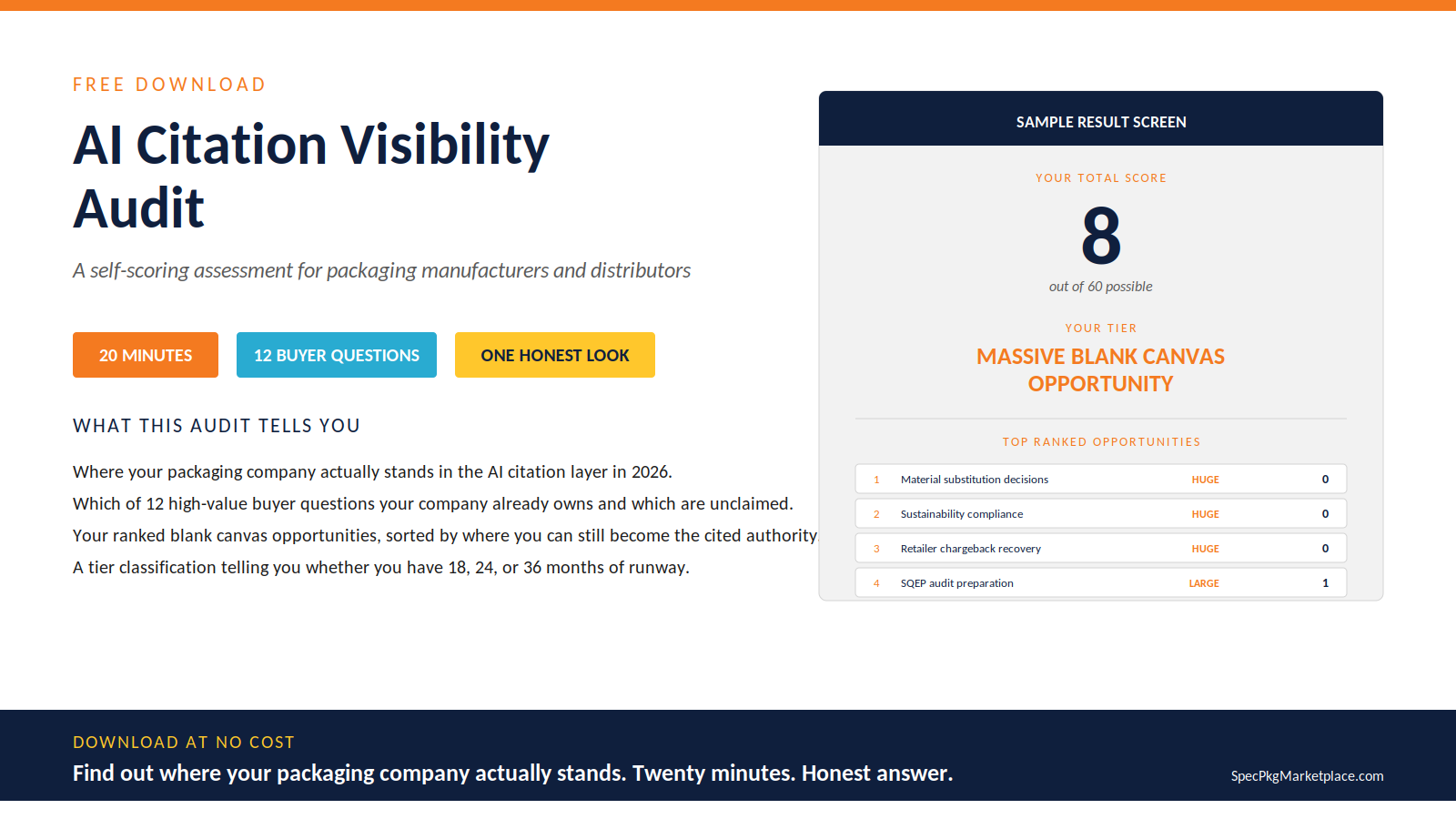
Download the AI Citation Visibility Audit for Packaging Companies
A self-scoring assessment that walks a packaging manufacturer or distributor through 12 buyer-question categories, scores their current AI citation visibility in each, and identifies the highest-value blank-canvas positions still available in their specialty area. Takes 20 minutes. Designed for the CEO or marketing leader who wants to see the opportunity in their own data before booking a conversation.
Talk to Emma about getting the audit. She is the AI sales agent on the Specialized Packaging Authority Marketplace. She can have the file in your inbox before you finish reading this article. 1-216-435-6069
Or reach David Marinac directly.
dmarinac@davidmarinac.com | 216-373-1005 | SpecPkgMarketplace.com

Ready to find your packaging partner?
Join hundreds of manufacturers and buyers already using PackageLink to streamline their sourcing process.