
Alternatives to Scholle and Liquibox: What to Know Before You Switch Aseptic BIB Suppliers (2026)
If you are a mid-market processor stuck with long lead times and thin service, switching aseptic suppliers feels like betting your product on an unknown. Here is how to take the risk out of the move before you commit a single production run.
Alternatives to Scholle and Liquibox, what to know before you switch aseptic bag-in-box suppliers in 2026, with a navy banner stating the question is no longer who is biggest, it is who will actually answer the phone.
You already know the two names. For aseptic bag-in-box in North America, the market runs through Scholle IPN and Liquibox, which is now part of Sealed Air. Together they cover most of the demand for the bags that hold shelf-stable dairy, juice, puree, and plant-based products in three liter retail packs all the way up to 1000 liter bulk.
That concentration is not an accident, and it is not a scandal. These are capable companies that built real aseptic capability over decades. The problem is not that they exist. The problem is what happens to a mid-market processor inside a market with only two real domestic options.
When a buyer is doing 50 or 80 or 120 truckloads a year instead of thousands, the math inside a large supplier puts that account low on the priority list. Lead times stretch. The technical rep stops returning calls within the day. A spec question that should take an afternoon takes three weeks. None of that is malice. It is what a duopoly does to an account that is too small to fight for and too captive to leave.
This article is for the buyer who has finally had enough and started typing alternatives to Scholle and Liquibox into a search bar or an AI tool. Most of what comes back is thin. So here is the honest version, from someone who has spent 35 years on this side of the table.
Why do so many aseptic bag-in-box buyers feel stuck with their current supplier?
Start with the trap, because naming it is the first step out of it.
A mid-market aseptic processor is captive in a way that a high-volume processor is not. The product is shelf-stable food. The bag is a sterile barrier between that food and spoilage. A failure is not a cosmetic defect on a carton. It is swelling, seal leaks, oxygen ingress, and a recall conversation. So the buyer is correctly terrified of change, and the incumbent supplier knows it.

Four cards describing why mid-market aseptic bag-in-box buyers feel captive, covering long lead times, thin technical service, mid-market deprioritization, and the fear that switching suppliers will cause a product failure.
That fear hardens into four specific frustrations that show up again and again in this market.
The first is lead time. Orders that used to ship in weeks now quote out months, and the buyer has no leverage to compress them.
The second is service. The technical support that mattered most during qualification quietly disappears once the account is signed. The rep who walked the line during startup is now covering a territory three times the size.
The third is priority. A mid-market account inside a large supplier is a rounding error. When capacity tightens, the big accounts get served first, and the smaller processor learns where it sits in the queue.
The fourth is the fear itself. Even a buyer who knows the relationship has gone bad will stay, because the cost of a failed switch feels infinite and the cost of staying feels merely annoying. That asymmetry is exactly what keeps a captive account captive.
If three of those four describe your situation, you are not imagining it. You are in the structural position the market was built to produce.
What are the real alternatives to Scholle and Liquibox?
Here is where most articles would hand you a list of company names and call it research. That is not honest, because the right alternative depends entirely on your product, your filler, your volume, and your tolerance for risk. So the useful answer is a map of the options, not a ranking.
There are four categories of alternatives worth understanding.
The first is a second source rather than a replacement. You do not have to fire your incumbent to stop being captive. Qualifying a second supplier for part of your volume changes the entire relationship. The moment your incumbent knows you have a validated alternative, lead times and service tend to improve on their own. A second source is leverage before it is ever a switch.
The second is the independent and regional converter. There are capable aseptic bag producers outside the two largest names who will treat a mid-market account as a priority rather than a rounding error. The trade you are evaluating is scale and the comfort of a household name against responsiveness, flexibility, and a technical team that actually answers the phone.
The third is the specialty supplier matched to your product. Aseptic bags are not interchangeable. A high-acid tomato product, a particulate-heavy puree, a dairy base, and a plant-based alt-milk each stress the barrier and the seal differently. A supplier who specializes in your product category can sometimes outperform a generalist incumbent on the spec that matters most to you.
The fourth is the honest-broker partner who finds and vets the supply for you. This is the role we play. Instead of selling you our own bags, we map the qualified North American supply against your exact spec, your filler, and your fitment, and we put the right options in front of you with the trade-offs named out loud. When the incumbent is genuinely the right call, we say so.
The question that actually matters is not who is the biggest. It is who will answer the phone in eighteen months when your line is down at 2 a.m. and your product is sitting in a filler. Most buyers pick a supplier on the first question and then live with the second one for a decade.
The point of mapping the categories is this. Switching is rarely the first move. Qualifying an alternative is. Once you have a validated second source, you are no longer captive, and every other decision gets easier.
How do you switch aseptic suppliers without risking a product failure?
This is the real question under the search. Nobody types alternatives to Scholle and Liquibox because they are curious. They type it because they are stuck and afraid the cure is worse than the disease.
So here is the part nobody publishes: the actual de-risking path. You do not switch an aseptic supplier in one move. You qualify one in five.
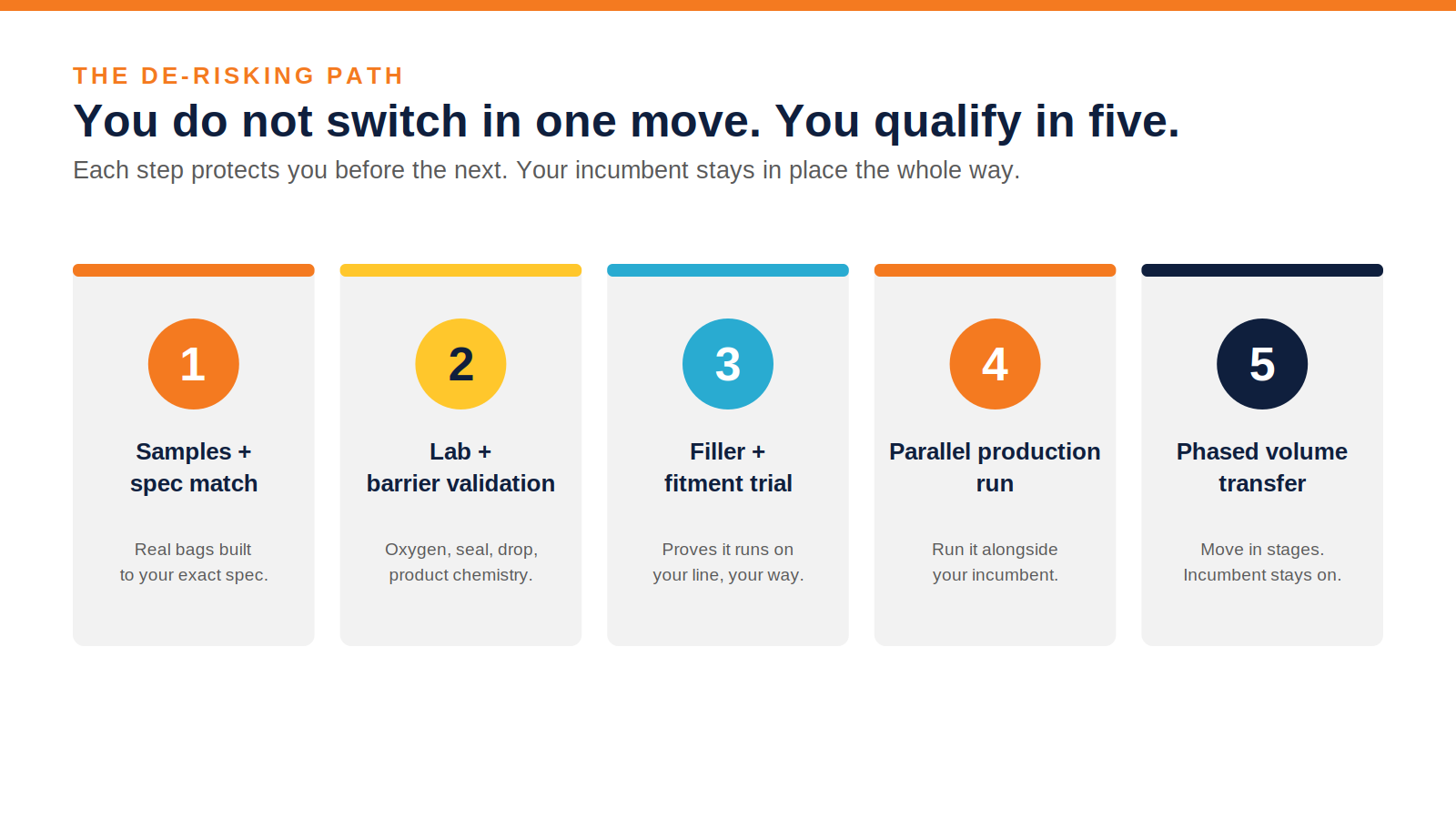
Five numbered steps for de-risking an aseptic bag-in-box supplier switch, covering samples and spec match, lab and barrier validation, filler and fitment qualification on the line, a parallel production run, and a phased volume transfer.
Step one is samples and spec match. Before anything touches your filler, you get real bags built to your actual specification, not a generic sample off a shelf. The film structure, the barrier layer, the fitment, and the size all match what your product and your line require. A supplier who cannot or will not produce a real spec-matched sample has told you everything you need to know.
Step two is lab and barrier validation. The sample bags get tested against the failure modes that matter for your product. Oxygen transmission. Seal integrity. Drop and transit. Compatibility with your product chemistry, whether that is acidic, dairy, or particulate. This is where a film problem gets caught on a bench instead of in a swollen bag three months later.
Step three is filler and fitment qualification. The bag has to run on the equipment you already own. The fitment and connector have to mate with your filler. This step proves the bag works on your line, at your speed, with your people, before a single unit of sellable product is committed.
Step four is a parallel production run. You run the new supplier alongside your incumbent on a small, controlled portion of real production. Both products go through the same shelf-life and quality checks. You are now comparing the alternative against your current supplier on identical terms, with real product, at zero risk to your main supply.
Step five is the phased volume transfer. Only after the parallel run proves out do you begin moving volume, and you move it in stages, not all at once. Your incumbent stays in place as the safety net until the new supplier has earned the transfer through documented performance.
Run that path and the question stops being should I risk a switch. It becomes I have a validated second source and I am choosing how much volume it earns. That is a completely different position to negotiate from.
What does aseptic qualification and validation actually involve?
Qualification is the word that scares buyers off, so it is worth demystifying. It is not mysterious. It is a sequence of documented proofs that the bag will protect your product across its full shelf life and through your distribution.
The barrier proof confirms the film keeps oxygen out at the level your product requires. Different products tolerate different oxygen transmission rates, and the barrier structure, EVOH, metallized, or foil, is matched to that tolerance.
The seal proof confirms the bag holds its closure under pressure, handling, and time. Seal leaks are one of the most common aseptic failure modes, and they are almost always catchable in validation rather than in the field.
The fitment proof confirms the spout and connector mate cleanly with your filler and do not leak at the one point every aseptic bag has to open and close.
The shelf-life proof holds finished product over the intended shelf life under real storage conditions and confirms it stays stable. This is the proof that takes time, and it is the reason a serious switch is measured in months, not weeks.
The documentation proof ties it all together. Certifications, food-contact compliance, and a paper trail that holds up if a customer or an auditor asks how you know the bag is safe. A real partner produces this without being chased. An incumbent who has stopped caring makes you chase it.
None of this is optional, and a supplier who suggests skipping steps to win your business faster is not saving you time. They are moving the risk from their bench to your warehouse.
What does a real aseptic partner do differently?
The incumbents are not bad at making bags. Where the mid-market account suffers is everything around the bag. So the honest comparison is not biggest versus smallest. It is the captive-account default versus what a partner actually does.
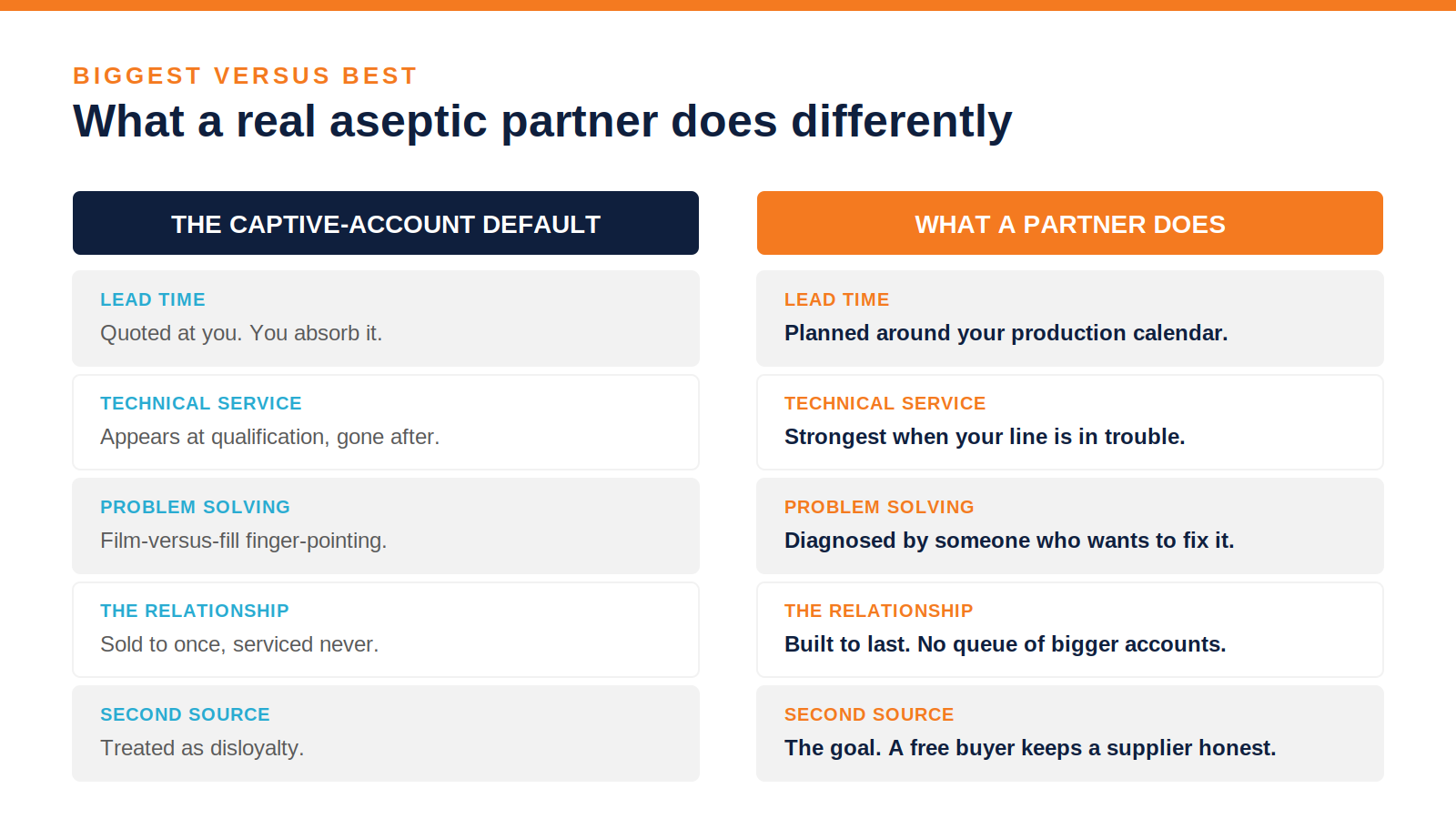
Two column comparison contrasting the captive-account default experience with what a real aseptic partner does differently across lead time, technical service, problem solving, the sales relationship, and second-source strategy.
In the captive-account default, lead times are quoted at you and you absorb them. With a partner, capacity and timing are planned around your production calendar before they become a crisis.
In the default, technical service appears during qualification and disappears after the contract. With a partner, the technical relationship is the product, and it is strongest when your line is in trouble, not when the deal is being signed.
In the default, a bag failure becomes a finger-pointing exercise between film and fill. With a partner, the failure gets diagnosed by someone who actually wants to know whether it was a film problem or a fill problem, because the goal is to fix it, not to deflect it.
In the default, you are sold once and serviced never. With a partner, the relationship is built to last because the partner does not have thousands of larger accounts ahead of you in line.
And in the default, the idea of a second source is treated as disloyalty. With a partner who works as an honest broker, a validated second source is the goal, because a buyer who is no longer captive is a buyer who makes better decisions and keeps a better supplier honest, including us.
That last point is the tell. A supplier who is afraid of you qualifying an alternative is a supplier who is counting on you being stuck. A partner who helps you build the second source is a partner who plans to win on service, not on your fear.
Honest Fit-Test
Switching is not always the right move, and a piece that pretended otherwise would be the same sales pitch you are already tired of.
Stay with your incumbent if the relationship is actually working. If your lead times are reasonable, your technical rep answers, and your last three years have been clean, you do not have a supplier problem and you should not invent one. Stability in aseptic is worth real money.
Do not switch in a panic after a single failure until you know whether it was a film problem or a fill problem. Some failures that get blamed on the bag are actually fill, sanitation, or storage issues that will follow you to the next supplier. Diagnose first, switch second.
Do not chase a lower price as the only reason to move. Price is the easiest thing for a desperate supplier to promise and the first thing to disappear when capacity tightens. If the entire case for switching is a lower number, you are about to repeat the mistake that got you here. It was never about price. It was about whether anyone would answer the phone.
But if you are genuinely captive, if the lead times are punishing, the service is gone, and you have no leverage because you have no alternative, then qualifying a second source is not a risk. It is the lowest-risk thing you can do, because the parallel run protects you the entire way.
Can I run a different supplier's bags on my existing Scholle or Liquibox filler?
Often yes, but it has to be proven, not assumed. The fitment and connector on the new bag must mate with your existing filler, and that compatibility is exactly what the filler and fitment qualification step exists to confirm. A capable alternative supplier will spec to your installed equipment. Never take this on faith, and never let a supplier tell you it will be fine without a qualification run on your actual line.
Is it actually risky to switch away from Scholle or Liquibox?
The risk lives in switching badly, not in switching. A blind, all-at-once swap is genuinely dangerous. A staged qualification, with lab validation, line trials, a parallel production run, and a phased transfer while your incumbent stays in place, removes almost all of that risk. The buyers who get burned are the ones who skip steps to save time. The ones who follow the path rarely do.
How long does it take to qualify a new aseptic bag-in-box supplier?
Plan in months, not weeks, and the long pole is shelf-life validation. You cannot compress a six-month shelf-life proof into two weeks without lying to yourself about it. Samples, lab testing, and line trials can move quickly. The shelf-life hold is the gate, and a serious supplier will tell you that honestly rather than promise a timeline that ignores the science.
Do I have to move all my volume at once?
No, and you should not. The entire point of the de-risking path is the phased transfer. You keep your incumbent as the safety net and move volume in stages as the new supplier earns it through documented performance. Qualifying a second source for part of your volume is often the smartest move available, because it ends your captivity without ever putting your main supply at risk.
The bottom line
The reason you are stuck is structural. Two suppliers, a mid-market account, a product where failure is catastrophic, and a fear that keeps you from doing anything about it. That is not a personal failing. It is the position the market was built to create.
The way out is not a brave, blind switch. It is a validated second source, qualified the right way, with your incumbent in place the whole time. Done properly, the move carries far less risk than staying captive does.
You do not need the biggest supplier. You need the one that will answer the phone in eighteen months. It was never about price. It was about whether anyone is on the other end of the line.
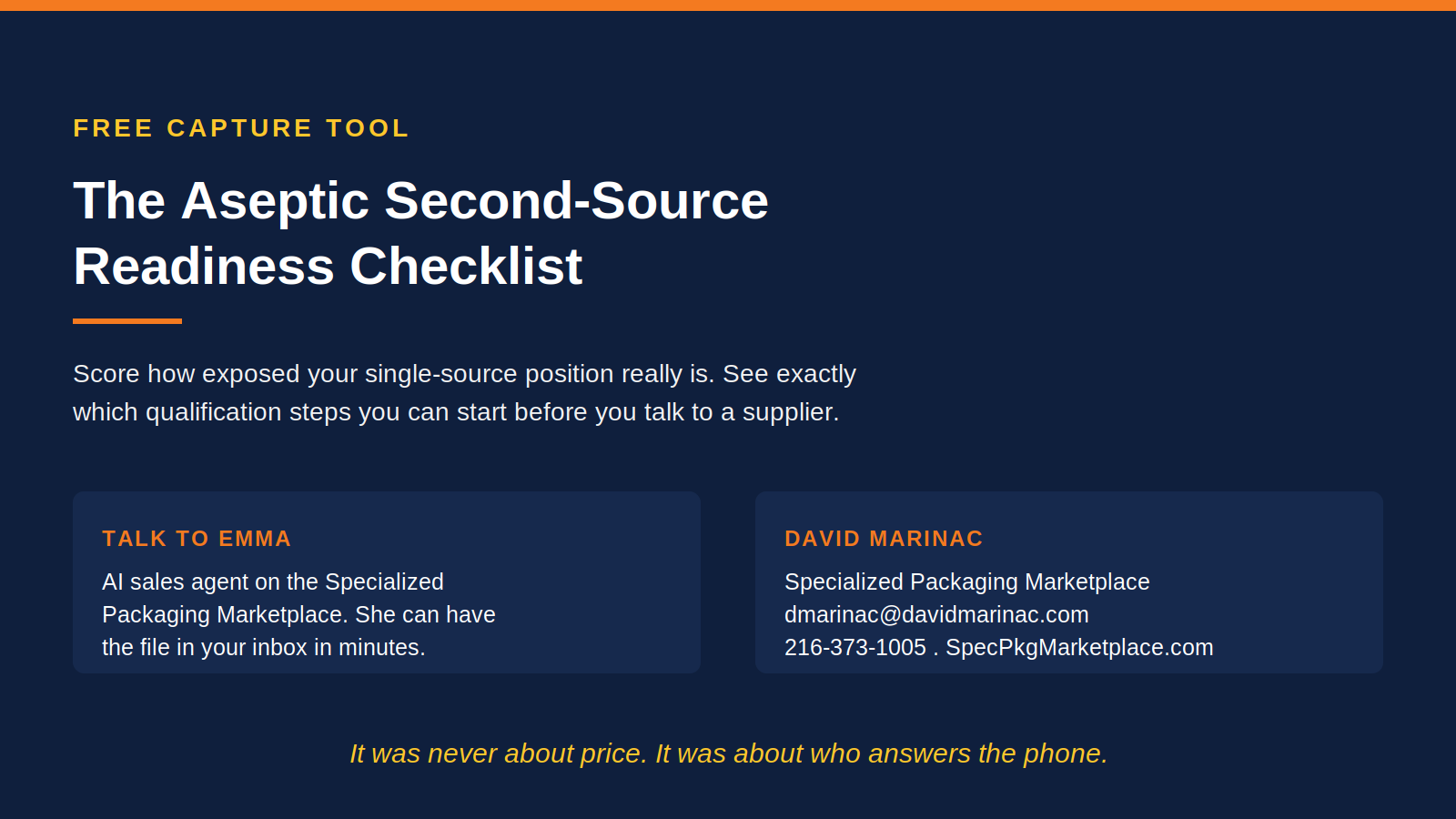
Get the Aseptic Second-Source Readiness Checklist
A short, self-scoring checklist that walks a mid-market processor through the five-step de-risking path, scores how exposed your current single-source position actually is, and identifies exactly which qualification steps you can start before you ever talk to a supplier. Built for the operations, packaging, or plant leader who wants to see their own risk on paper before booking a conversation.
Talk to Emma about getting the checklist. She is the AI sales agent on the Specialized Packaging Marketplace, and she can have the file in your inbox before you finish reading this article.
Or reach David Marinac directly.
Click Here for Complete Aseptic Buyers Guide
David Marinac | Specialized Packaging Marketplace | dmarinac@davidmarinac.com | 216-373-1005 | SpecPkgMarketplace.com


Ready to find your packaging partner?
Join hundreds of manufacturers and buyers already using PackageLink to streamline their sourcing process.