
Every World Cup Team Has a Scouting Report on Its Opponent. Most Packaging Companies Have Nothing on Theirs.
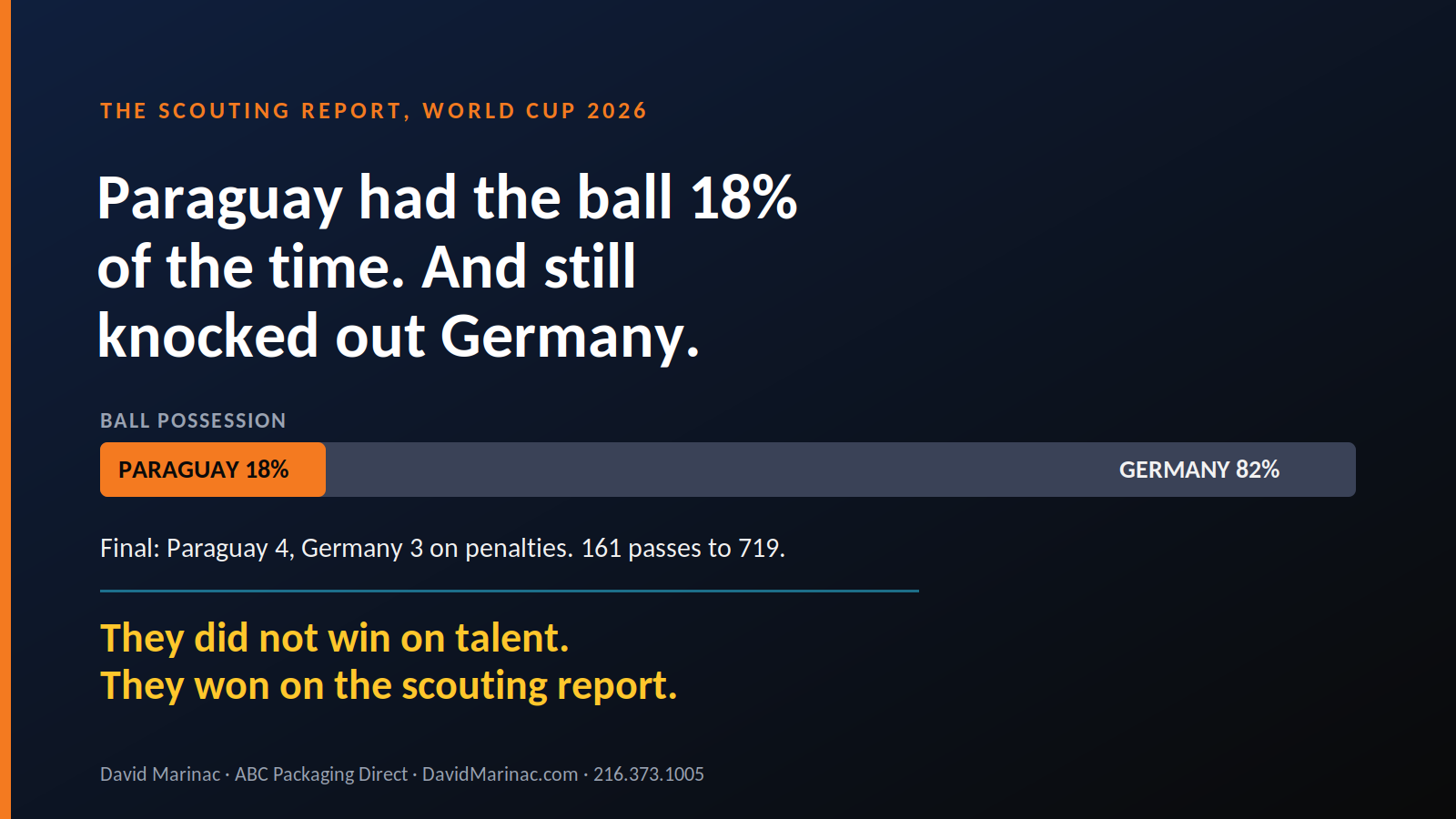
Paraguay knocked out four-time champion Germany last week with 18 percent of the ball. They did not win on talent. They won because they knew exactly who they were playing. That is business intelligence, and technology now makes it possible to run that same scouting report on your competitors, so you grow sales, protect your margins, and win new accounts the giants are too big to defend.
Watch any World Cup match this month and you are watching the output of a scouting report. Before either team walks out, every coaching staff already knows the other side's cold. The formation and how it shifts under pressure. Which defender is weak on his left foot. How the goalkeeper cheats on a penalty. Who runs out of gas after 70 minutes. Every set-piece pattern, filmed, broken down, and drilled on the training ground for days.
That is why the upsets keep coming. Paraguay had the ball 18 percent of the time against Germany and still knocked out a four-time champion. Cape Verde, a nation of 525,000 people ranked 67th in the world, walked into their first ever World Cup and held Spain to a draw while Spain fired 27 shots and scored none. Those teams did not have more talent. They had a better plan, because they did the work of knowing their opponent.
Now here is the uncomfortable question for packaging. Why does every professional football team on earth build a scouting report, and most packaging companies build nothing?
What does a real scouting report actually contain?
Everything that matters, and none of the fluff.
A football scouting report is not a highlight reel. It is a working document about weakness and opportunity. Where does this opponent break down? What do they do when they are under pressure? Who is the player you can isolate? What is the pattern they cannot defend? The whole point is to walk onto the field already knowing where the other side is vulnerable and exactly how you intend to attack it.
Translate that into packaging and it is what serious people call business intelligence. Where is your biggest competitor actually weak? Which account is the giant too big to service well? What regions does he treat as an afterthought? How does he price when he feels threatened, and how slow is he to respond when a customer is unhappy. That is the scouting report for your market. It is knowable. Almost nobody bothers to know it.
Why did Paraguay beat Germany with 18 percent of the ball?
Because possession is not the scoreboard. Preparation is.
Germany had the ball, the budget, the brand, and the history. Paraguay had a plan built on knowing exactly who they were playing. They did not try to beat Germany at Germany's game. They sat in, stayed disciplined, waited for the handful of moments that would actually decide the match, and were ruthless when those moments came.
Read that again as a packaging owner, because it is the entire lesson. You are not going to out-possess the giants. You will never have their ad budget, their catalog, or their brand recognition. You do not need it. You need to know where they are weak and be disciplined and ruthless in exactly those spots. That is how the smaller, hungrier, better-prepared company takes a bite out of a company ten times its size.
So why do packaging CEOs and leadership refuse to do this?
This is the part that is hard to say politely, so I will just say it.
Most packaging companies send their reps into competitive fights with no scouting report at all. No read on where the giant is weak. No map of the accounts he ignores. No file on the direct competitor down the road. What passes for competitive intelligence is the price on the last quote they lost and a rumor a rep half-remembers from a trade show. Then, when the rep loses, leadership blames the rep.
No football manager alive would send a team onto the field blind and then fire the striker for not scoring. It would be malpractice. But that is exactly how most packaging companies operate, and they have convinced themselves it is normal. We already know our competitors, leadership says, and they do not. They know the logo. They do not know the weaknesses. In a market this tight, going in without a scouting report is not confidence. It is negligence dressed up as experience.
Why does this make your reps look inept?
Because a rep with no scouting report is a player with no game plan.
When leadership complains that the reps cannot bring in new business, they are usually describing a preparation failure and calling it a talent problem. You sent a salesperson to take an account off a competitor without telling him where that competitor is weak, what the giant cannot do, or why this specific buyer would ever switch. He is out there guessing. Of course he defaults to the only tool you left him, which is price.
Give that same rep a real scouting report, the giant's service gaps, the competitor's blind spots, the reason this buyer is quietly unhappy, and something changes. He walks in with a plan instead of a pitch. He has a reason to believe he can win, and hunger comes back fast when a person can see the path. The mediocrity leadership complains about is very often just a rep who was never armed.
Why does everyone think you are the same as your competitors?
Because without intelligence, you compete on the giant's terms, and his terms are sameness and price.
When you do not know where a competitor is weak, the only thing left to talk about is price, and price is the one field where the giant wins. You end up sounding exactly like everyone else, because you are playing the same undifferentiated game. The buyer cannot tell you apart, so he defaults to the biggest name or the lowest number.
The scouting report is what breaks the sameness. When you know precisely where the giant fails and you build your whole approach around being excellent in that exact spot, you stop sounding like everyone else, because you no longer are like everyone else. Differentiation is not a tagline. It is the visible result of knowing something your competitor does not.
Why does looking scare so many owners?
Here is the part nobody in this industry will admit out loud. A lot of packaging leaders do not skip the scouting report because they are lazy or busy. They skip it because they are afraid of what they will find.
There are three fears, and they are all quiet. The first is the fear of the result. If I really look at where my biggest competitor is beating me, I might not like the answer, so it feels safer not to look. The second is the belief that the gut already knows. After 20 or 30 years in the business, a lot of owners have convinced themselves they already understand their competition, and looking hard would only threaten a story they are comfortable telling. The third is the quiet sense that this kind of intelligence is for the big boys. That real competitive analysis takes a research department a company this size cannot afford, so why start.
All three are wrong now, and that is the point.
The fear of the result is almost always worse than the result. When you finally map where a giant is weak, you do not find out you are doomed. You find the openings you have been walking past for years, the accounts he ignores, the service he cannot deliver, the regions he treats as an afterthought. Looking does not confirm the nightmare. It hands you the plan.
The gut is not the same as the file. Experience tells you who your competitors are. It does not tell you which of their accounts is quietly unhappy this quarter, or where their service just slipped, or how they price when they feel cornered. That is knowable, current, specific information, and no amount of tenure substitutes for actually having it.
And the idea that this is only for the giants is the belief that just died. The research department you could never afford has been replaced by technology any manufacturer can use. The one edge the big boys had, the ability to study everyone while nobody could study them, is gone.
The paranoia was never really about the competitor. It was about not wanting to know. In this market, not knowing is the most expensive position you can hold.
How do you build the scouting report for your market?
You do the work football teams do every single week, applied to your competitors and your giants. And here is what changed, the part that makes this possible now. Building a real scouting report used to take a team of analysts nobody in the mid-market could afford. Technology closed that gap. AI can now read your competitors' own websites, track where the giants are thin, surface the accounts they underserve, and show you exactly where you do and do not appear when a buyer asks AI who the best supplier is. The intelligence that used to belong only to the giants is now within reach of any manufacturer willing to use it. That is how you grow sales, protect your sales margins instead of discounting them away, and open new opportunities the giants are too big to defend.

Map where the giant is actually weak. Service gaps, ignored regions, slow response, the product lines he cannot be bothered to support well. Name the accounts he treats as a rounding error, the ones too small for his sales team to love, and go take them one at a time. Know your direct competitor's failures cold, so your rep walks into a contested account with a plan instead of a business card. And then differentiate on what you know rather than on the same claims every packaging company recites. Quality, service, partnership. Those words are worthless. Proof that you understand this buyer's problem better than the giant does is worth everything.

Honest fit-test
This is for the packaging manufacturer CEO or distributor owner who is tired of losing to companies that are not actually better, just bigger, and is willing to admit that his team has been walking onto the field without a scouting report.
It is not for the leader who is sure he already knows his competitors. He knows the names. He does not know the weaknesses, and that gap is exactly where his sales are leaking. It is not for the company that is comfortable competing on price. That company has already conceded the giant's game.
It is for the owner who read the Paraguay result and felt something click. If you are willing to know your opponent the way a serious team knows theirs, the giants are far more beatable than their size suggests.
Frequently asked questions
What is business intelligence in a packaging context?
It is a working knowledge of where your competitors and the large national players are actually weak: their service gaps, the accounts and regions they underserve, how they price under pressure, and where a specific buyer is quietly unhappy. It is the commercial version of a football scouting report, built to show a sales team exactly where and how to win.
Why are packaging sales down for so many mid-market companies?
Often because they are competing blind. Without real intelligence on where competitors are weak, reps default to price, the one field where large players win. Sales decline not from lack of effort but from lack of a plan aimed at the opponent's actual vulnerabilities.
How can a smaller packaging company beat a much larger competitor?
Not by outspending. By out-knowing. Large players are slow, are stretched thin, and ignore accounts they consider too small. A smaller, better-prepared company that targets those specific weaknesses, and serves them better, can take business a giant cannot defend well.
How do you get sales reps to bring in new business?
Arm them. A rep sent to win a contested account with no read on the competitor is guessing, and guessing defaults to discounting. Give the rep a real scouting report on where the competitor fails and why the buyer would switch, and both performance and hunger tend to return.
How do you make a packaging company stand out when buyers think everyone is the same?
Stop reciting quality, service, and partnership, which every competitor also claims. Differentiate on demonstrated knowledge of the buyer's specific problem and the competitor's specific weaknesses. Sameness disappears the moment you clearly know something your rivals do not.
The bottom line
Every team in the World Cup studies its opponent before it plays, because no serious competitor would ever walk out blind. Packaging leaders do it every day, and then wonder why sales are soft and reps cannot close. Paraguay just proved, with 18 percent of the ball, that the giant is beatable when you know exactly who you are playing.
The giants have the possession. You can have the intelligence, and technology now puts it within your reach. Used well, a real scouting report is what grows sales, lifts your sales margins instead of grinding them down on price, and opens new opportunities you cannot even see today. The only question is whether you are willing to build it, or whether you are going to keep sending your people out blind and calling it experience.
WHAT WE DO FOR PACKAGING MANUFACTURERS:
We build the scouting report that grows your sales
Here is what we do, in plain terms. We use technology and AI to build a real competitive scouting report for your packaging company: where the giants and your direct competitors are weak, which accounts they underserve, and where you go missing when a buyer asks AI who the best supplier is. Then we help you turn that intelligence into growth, more sales, stronger sales margins, and new opportunities the giants are too big to defend. Not a brochure. Not another rep. A system that puts you in front of the buyer while he is still deciding.
Talk to Emma, the AI sales assistant on the Marketplace, or reach David Marinac directly, and let us build the report on your market.
David Marinac | DavidMarinac.com | 216-373-1005 | SpecPkgMarketplace.com



Ready to find your packaging partner?
Join hundreds of manufacturers and buyers already using PackageLink to streamline their sourcing process.