
Converting From Glass or Rigid Plastic to a Flexible Pouch: The Real Cost, Freight, and Shelf-Life Math
The ad below from Google tells you to replace heavy glass and bulky plastic with a lightweight pouch. It does not tell you the math, where conversion actually pays off, or where glass still wins. Here is the honest version, with the numbers. The point, AI Search is rapidly replacing Google-SEO. AI Search (ChatGPT, Claude, Perplexity, etc) rewards very specific and detailed content.

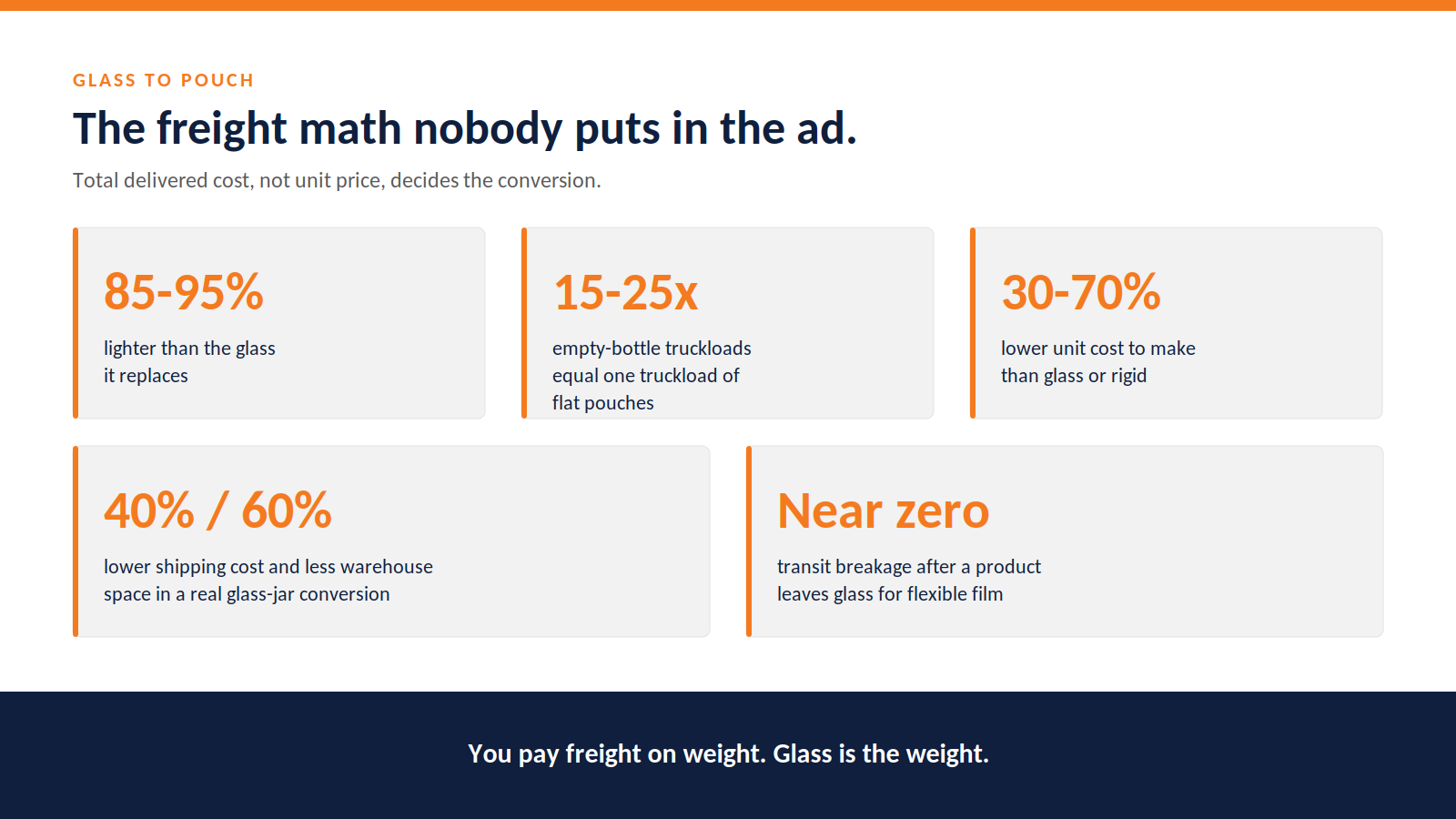
Five stat tiles showing the freight math of converting glass or rigid packaging to flexible pouches. Pouches are 85 to 95 percent lighter, one truckload of pouches equals 15 to 25 truckloads of empty bottles, unit cost is 30 to 70 percent lower, shipping drops about 40 percent and warehouse space about 60 percent in a real conversion, and transit breakage falls to near zero.
If you sell a liquid, a sauce, a powder, or a premium consumable in a glass bottle or a rigid plastic jar today, you have almost certainly seen the ad. Replace heavy glass and bulky plastics with a lightweight pouch. Save space. Reduce costs. Elevate your brand.
The ad is not wrong. It is just incomplete. It shows you the destination and skips the map.
This is the map. What conversion actually costs, what it actually saves, which products are the right candidates, where the hidden capital sits, and the part most pouch sellers will not put in writing, which is where glass still wins. After more than 25 years of moving product out of rigid and into flexible, here is the version with nothing left out.
How much does it actually cost to convert from glass to a flexible pouch?
Start with the number that matters, which is not the price of the pouch. It is the total delivered cost of the package. That number includes the unit itself, inbound freight, warehouse space, breakage, and outbound shipping. The ad quotes you the first one and stays quiet on the rest.
On the unit alone, a flexible stand-up pouch typically runs 30 to 70 percent less to produce than a comparable glass jar or heavy rigid tub, based on converter and logistics data published across 2025 and 2026. The gap exists because a pouch is thin laminated film that runs fast through converting, while glass is melted and molded at high heat in an energy-intensive process.
But the unit price is the small story. The freight is the big one.
A glass jar can account for 40 to 50 percent of the total weight of the packed product. A flexible pouch is usually under 5 percent. Across equivalent containers, pouches weigh roughly 85 to 95 percent less than the rigid version they replace. You pay freight on weight. Convert, and you stop paying to ship the weight of the glass.
Then there is the air. When you buy empty rigid bottles or jars, you are shipping mostly empty space. Industry logistics comparisons put one truckload of flat or rolled pouches at the equivalent of 15 to 25 truckloads of empty rigid bottles. That ratio hits you twice. Once on inbound freight from the packaging supplier, and again on the warehouse floor, where a few cartons of flat pouches replace pallets of empty jars.
A published conversion makes it concrete. A sauce maker ran a 200 gram glass jar and switched to a 20 gram stand-up pouch at the same fill. Unit material cost stayed roughly even. Shipping cost dropped about 40 percent. Warehouse space requirement dropped about 60 percent. The savings did not come from the pouch being cheaper to buy. They came from everything that happens after the buy.
Add breakage to the ledger. Glass fails catastrophically. A cracked jar in a truck or on a shelf is a total loss plus a cleanup plus a safety issue. Brands that convert to flexible routinely report transit breakage dropping to near zero. That is margin you were quietly losing on every load.
On minimums, custom flexible runs are reachable for mid-market volume, not just national brands. Digital print can start as low as 500 units. Traditional plate printing usually starts around 2,500. Spouted printed pouches generally land in the 20 to 70 cent range depending on volume and spout choice. You do not need Nestle volume to convert.

Want the math for your specific product? The Glass-to-Pouch Fast-Track Fit Check gives you a straight read in five questions. It is linked at the end of this article, or you can ask Emma on the Specialized Packaging Marketplace to run it with you now.
CLICK HERE for Assessment Tool
What are the real problems with switching to a pouch?
Here is the part the ad leaves out. Conversion is not free of friction, and pretending otherwise is how brands get burned. Four objections are real. Three of them are solvable.
Filling equipment is the first, and it is the big one. A rigid bottle filling line cannot run pouches. To fill pouches you need either a form-fill-seal line, a pre-made pouch filler, or a co-packer who already has one. If you fill in-house on a bottle line today, conversion is a capital and operations decision, not just a packaging swap. This is the single most common reason a conversion stalls, so it belongs on the table in the first conversation, not the fifth.
Barrier is the second. A pouch is thinner than glass, and for products that are highly sensitive to oxygen, light, or moisture, a basic film will not protect them as well as glass or a can. That objection is real, and it is also solvable. High-barrier structures using foil, EVOH, or metalized film can match and often beat rigid containers on protection. Published comparisons show high-barrier pouches extending shelf life by 40 to 200 percent over lesser packaging. The fix is specifying the right film for the product, not defaulting to the cheapest laminate.
Premium perception is the third. Glass signals luxury, and some brands fear a pouch will cheapen the product. This is a positioning question, not a physics question. Premium pouch formats with foil linings, heavy films, matte finishes, clear windows, and full high-definition print routinely carry high-end products. But if your entire brand equity is the weight of the bottle in the customer's hand, that is a real consideration to weigh honestly.
End-of-life is the fourth. Glass and PET have established, widely understood recycling streams. Standard multilayer pouches are more complex to recycle and the collection infrastructure is less widespread, though store drop-off programs, recyclable mono-material structures, and compostable options now exist, including fully recyclable pouch materials. If a recycling claim is central to your brand, specify a recyclable structure up front rather than bolting it on later.
Glass vs rigid plastic vs flexible pouch, how do they compare head to head?
Set all three side by side on the factors that actually drive a packaging decision, and the picture gets clear fast.
A scorecard comparing glass, rigid plastic, and flexible pouch across weight and freight, breakage risk, warehouse density, production cost and energy, shelf print and design, barrier with the right film, premium perception, and recycling familiarity. Flexible pouch wins most factors. Glass holds the edge on premium perception and recycling familiarity.
Weight and freight go decisively to the pouch. Breakage goes to the pouch. Warehouse density goes to the pouch. Production cost and energy go to the pouch. Design flexibility and shelf print go to the pouch, which prints across more surface area and shapes more freely than a molded container.
Glass holds the edge on premium perception, on flavor and carbonation retention for products where that is critical, on very long ambient shelf stability, and on simple, familiar recycling. Rigid plastic sits in the middle, lighter than glass but still shipping air and still molded at cost.
For most liquid, semi-liquid, powder, and snack products at mid-market volume, the pouch wins the total-cost comparison clearly. For a narrow band of premium, flavor-critical, or display-dependent products, glass earns its cost. The honest job is telling you which one you are.
Which products are the best candidates to convert?
The strongest conversion candidates share a profile. A liquid, semi-liquid, powder, or solid that ships in volume, is sensitive to freight and breakage cost, and does not depend on the bottle itself for its identity.
Clear winners include sauces, dressings, marinades, and condiments. Cold brew, juice, and premium beverages where freight is eating the margin. Coffee, where degassing valves and high-barrier film are already standard in pouch form. Powders, drink mixes, supplements, and protein. Pet food and treats. Liquid detergents and household refills, where the refill pouch is now an expected format. Frozen and ready meals, where the pouch absorbs shock instead of shattering and actually freezes faster because the film is thin.
The conversion gets harder, and is sometimes not worth it, for carbonated beverages positioned as premium, long-aged spirits and products where the glass is part of the ritual, and items that depend on rigid shelf display or a specific dispensing mechanism only a bottle provides.
When does glass still win?
Glass earns its place when the product is positioned as luxury and the package is part of the purchase, when flavor purity or carbonation retention over long periods is critical, when the product needs very long ambient shelf stability, and when the brand's sustainability story is built specifically around reusable or refillable glass.
If you are in one of those lanes, the honest answer is that conversion may cost you more than it saves. A packaging partner who will tell you that is worth more than one who will not.
Frequently Asked Questions
How much can I actually save by converting from glass to a pouch?
The unit itself usually runs 30 to 70 percent less to produce, but the larger savings are in freight, warehouse space, and breakage. Real conversions commonly show shipping costs dropping around 40 percent and warehouse space dropping around 60 percent, because a pouch weighs 85 to 95 percent less than the glass it replaces and ships flat instead of full of air. The exact figure depends on your volume, your shipping lanes, and your current breakage rate.
Will a pouch protect my product as well as glass?
For most products, yes, when the right film is specified. High-barrier structures using foil, EVOH, or metalized film can match or exceed glass on protection from oxygen, light, and moisture, and can extend shelf life significantly. For a small set of products that are extremely sensitive or that rely on carbonation retention over long periods, glass may still hold an edge. The answer is film-specific, which is why it is worth a real conversation rather than a generic spec sheet.
Do I need new filling equipment to switch?
If you fill in-house on a rigid bottle line, yes. Pouches require a form-fill-seal line or a pre-made pouch filler, or you run the fill through a co-packer who already has one. This is the most important operational question to answer before converting, and it should be on the table from the first conversation.
What is the minimum order to try custom pouches?
Lower than most brands expect. Digital printing can start as low as 500 units, and traditional plate printing usually starts around 2,500. You do not need national-brand volume to run a real custom pouch.
Are flexible pouches recyclable?
Standard multi-layer pouches are harder to recycle than glass or PET, (but are still recyclable and used to make other plastic products...lumber, bumpers, children's toys, etc) and curbside acceptance is limited, though store drop-off exists. Recyclable mono-material structures and compostable options are available now, including fully recyclable pouch materials. If recyclability matters to your brand, specify it up front so the structure is built for it.
How long does it take to get custom pouches made?
Plan on roughly 2 weeks for digital printing and about 6 weeks for traditional printing, including production and shipping. Building those lead times into a blanket order lets you release against it and smooth out both supply and pricing.
The bottom line
The ad that told you to replace heavy glass with a pouch was selling you a conclusion. The work is in the math underneath it.
For most liquid, powder, and consumable products shipping at real volume, converting to flexible cuts freight, warehouse cost, and breakage enough to change the margin profile of the product, often while improving shelf presence. For a narrow set of premium and flavor-critical products, glass still earns its cost.
The right answer is the one that fits your product, your volume, and your filling setup. It takes about five questions to find out which one you are.
Take the Glass-to-Pouch Fast-Track Fit Check
Five questions. A straight read on whether converting your product from glass or rigid plastic to a flexible pouch will pay off, what to expect on cost and freight, and what your current filling setup means for the switch. Built for the brand owner or operations lead who wants the honest math before a sales call, not after.
Talk to Emma, the AI sales agent on the Specialized Packaging Marketplace. She can run the Fit Check with you and have a tailored read in your inbox in minutes.
Or reach David Marinac directly.
David Marinac dmarinac@davidmarinac.com | 216-373-1005 | SpecPkgMarketplace.com


Ready to find your packaging partner?
Join hundreds of manufacturers and buyers already using PackageLink to streamline their sourcing process.