

The Weight, Temperature & Compliance Factors That Change Everything
Published by the Specialized Packaging Marketplace
Pet subscription is one of the fastest-growing segments inthe subscription economy and one of the most operationally complex.
Unlike a beauty box with lightweight samples or a coffee subscription with standard pouches, pet subscription fulfillment comes with a unique set of cost drivers that most brands don't fully understand untilthey're already committed to the wrong partner or the wrong pricing model.
The problem: Most fulfillment cost calculators and "per-box" quotes don't account for the realities of pet products.Heavy bags of kibble. Temperature-sensitive fresh food and treats. FDA compliance for supplements. Durable packaging for chew toys that dogs will tryto destroy before they're even out of the box.
This guide breaks down what pet subscription fulfillment actually costs and where the money goes that nobody tells you about upfront.
The Baseline: What "Normal" Subscription Fulfillment Costs
Before we get into pet-specific factors, let's establish a baseline.
For a typical subscription box lightweight products, standard kitting, ambient temperature, no special compliance fulfillment costs generally break down like this:
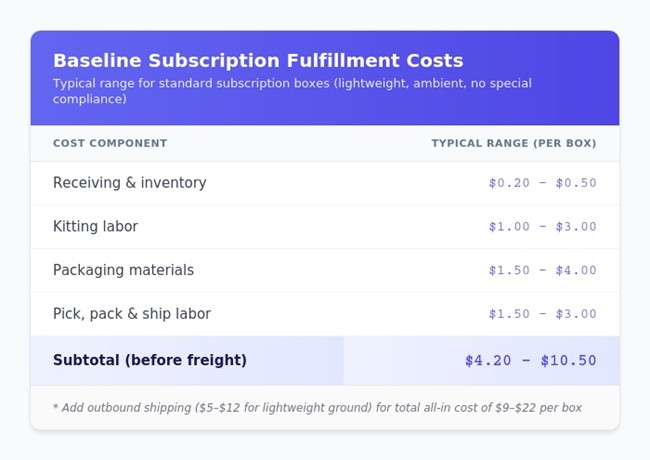
Then add outbound shipping typically $5–$12 for alightweight box going ground and you're looking at $9–$22 per box all-in for basic subscription fulfillment.
Here's the problem: Pet subscription boxes are rarely "basic."
Cost Factor #1: Weight Changes Everything
Pet products are heavy. A 5-lb bag of dog food. A 10-lb bag of kibble. Multiple cans of wet food. Bags of treats that add up fast.
And in fulfillment, weight costs money at every stage.
The Weight Tax
Receiving: Heavy products take longer to unload, require equipment (forklifts, pallet jacks), and increase labor time per unit.
Storage: Dense, heavy products require stronger racking and more careful inventory management. You can't stack 30-lb bags of dog food five high on standard shelving.
Kitting: Workers fatigue faster handling heavy items. Ergonomic considerations slow down the line. You can't maintain the same units-per-hour on heavy kits as light ones.
Shipping: This is where weight really hurts. Carriers charge by dimensional weight OR actual weight whichever is greater. A 15-lb box of pet food ships at a fundamentally different rate than a 2-lb beauty box.
What This Means for Your Costs
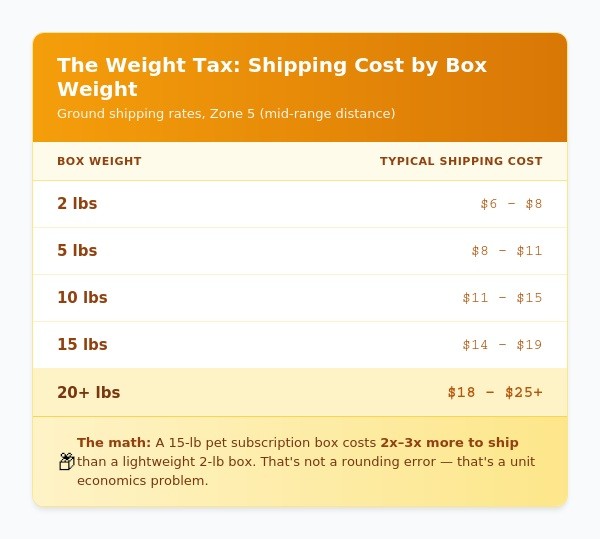
The math: A 15-lb pet subscription box costs roughly 2x–3x more to ship than a lightweight subscription box. That's not a rounding error that's a fundamental unit economics problem.
What Smart Pet Brands Do
- Ship from the middle: A Midwest fulfillment location reduces average shipping distance to customers nationwide. Shipping a 15-lb box from Chicago to either coast costs less than shipping it coast-to-coast.
- Optimize box size: Dimensional weight pricing means an oversized box with empty space costs the same as a smaller, denser box. Right-sizing packaging matters more for heavy products.
- Negotiate carrier rates: Volume discounts on heavy shipments are steeper than on lightweight ones. Your fulfillment partner's carrier relationships directly impact your margins.
Cost Factor #2: Temperature Control for Fresh & Frozen
The pet food market has shifted dramatically toward fresh, refrigerated, and frozen options The Farmer's Dog, Ollie, Nom Nom, Just Food For Dogs. Pet parents want "human-grade" food for their dogs.
But fresh and frozen fulfillment is a completely different cost structure.
The Cold Chain Premium
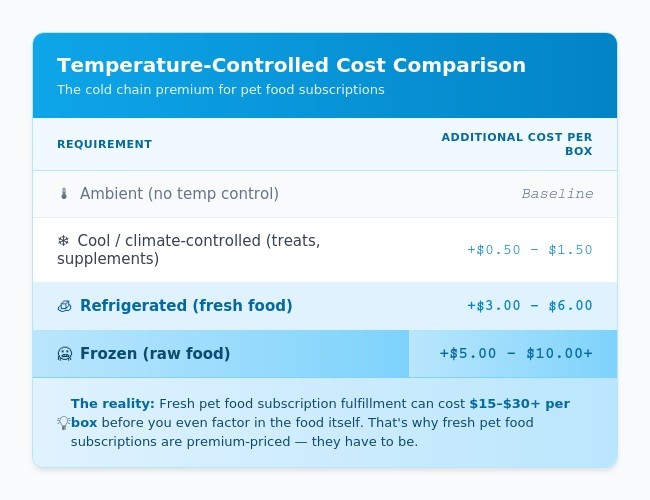
Facility costs: Temperature-controlled warehouse space costs 2x–3x more per square foot than ambient storage. Your fulfillment partner is passing that cost through.
Packaging costs: Insulated boxes, insulated liners, gel packs, dry ice these add $3–$8+ per shipment depending on the temperature requirements and transit time.
Spoilage risk: Temperature excursions during storage or transit mean product loss. Someone's paying for that either through higher pricing or through your margin.
Carrier limitations: Not all carriers handle temperature-sensitive shipments well. Premium services (2-day, overnight) are often required to maintain cold chain integrity.
Temperature-Controlled Cost Comparison
What Smart Pet Brands Do
- Partner with facilities that have temperature-controlled rooms: Not retrofitted areas with portable units, but purpose-built cold storage.
- Design packaging for realistic transit times: Over-engineering insulation for 2-day shipping when 4-day is realistic just burns money.
- Consider Midwest distribution: Shorter transit times mean less time in the cold chain, which means less insulation required, which means lower packaging costs.
Cost Factor #3: FDA Compliance for Pet Supplements
Pet supplements are booming joint health, calming chews, digestive support, CBD products. But unlike a bag of kibble, supplements come with regulatory complexity.
The Compliance Burden
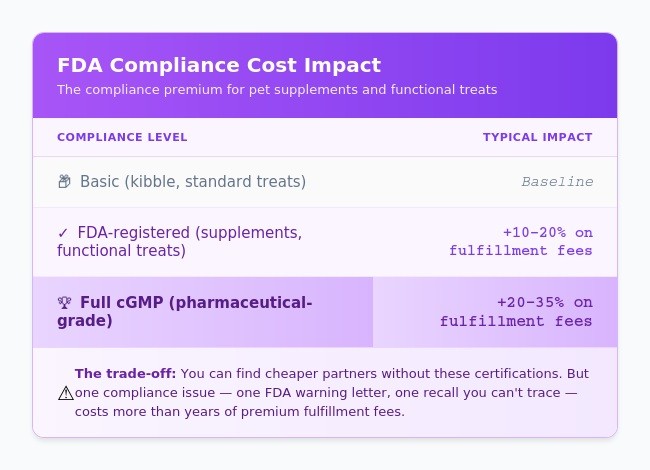
FDA registration: Facilities handling pet supplements(and in some cases, treats with health claims) need FDA registration and must follow Current Good Manufacturing Practices (cGMP).
Lot traceability: Every batch needs complete chain of custody documentation. If there's a recall, you need to know exactly which products went to which customers.
Label compliance: Health claims, ingredient lists, and nutritional information must meet FDA standards. Non-compliant labels can trigger enforcement action.
Testing and documentation: Certificate of Analysis(COA) requirements, stability testing, and ongoing documentation add overhead.
What This Means for Your Costs
Facilities with FDA registration, cGMP certification, and supplement-handling experience charge more because maintaining compliance costs money.
What Smart Pet Brands Do
- Verify certifications: Don't assume. Ask for documentation. Visit the facility.
- Lot traceability is non-negotiable: If your fulfillment partner can't tell you exactly which lot numbers went to which customers, you're exposed.
- Plan for audits: FDA can inspect facilities handling pet supplements. Your fulfillment partner needs to be audit-ready at all times.
Cost Factor #4: Packaging Durability for Pet Products
Here's something beauty subscription brands never worry about: will the product survive a dog trying to chew through the box before the customer even opens it?
Pet subscription packaging has to be tougher.
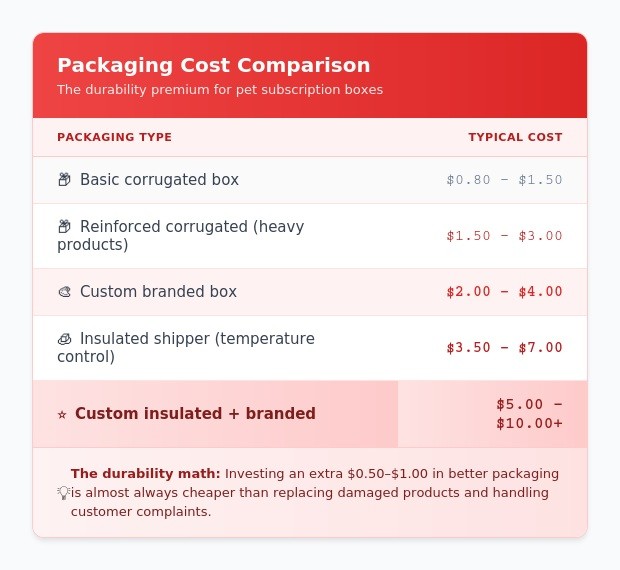
The Durability Premium
Chew toys and treats: These often arrive in packaging that dogs can smell. The box needs to withstand excited paws and teeth during the "porch to kitchen" journey.
Heavy products: A 15-lb bag of kibble shifting during transit can destroy a flimsy box. Corrugate grade and construction matter.
Multi-product kits: Pet boxes often combine heavy items (food) with fragile items (supplements, treats). Internal packaging needs to protect both.
What Smart Pet Brands Do
- Test packaging with ISTA protocols: Don't guess whether your box survives transit. ISTA testing simulates drops, vibration, and compression.
- Work with fulfillment partners who manufacture packaging: If your fulfillment partner can design and produce your boxes, you eliminate a vendor handoff and often get better pricing.
- Factor durability into unit economics from day one: Don't design your margins around cheap packaging and then discover you need to upgrade.
Cost Factor #5: The Hidden Costs Nobody Quotes
Beyond the direct costs, pet subscription fulfillment has hidden costs that don't show up in the initial quote.
Returns and Replacements
Pet parents are passionate. If their dog doesn't like the food, they want it fixed. If a treat arrives crushed, they expect a replacement.
- Return processing: $3–$5 per return, plus restocking (if the product is even resell-able)
- Replacement shipments: Full shipping cost again, plus labor
- Customer service: Time spent resolving issues
Budget 2–5% of fulfillment costs for returns/replacements, depending on your product type.
Seasonal Volume Swings
Pet subscriptions see spikes around:
- Holidays: Gift subscriptions surge in November/December
- National Pet Day / Month: April promotions
- New pet adoption seasons: Spring and summer
If your fulfillment partner doesn't have surge capacity, you'll pay rush fees or miss ship dates.
Subscription Management Complexity
Pet subscriptions often involve:
- Customization: Different sizes, flavors, protein preferences
- Skip/pause options: Customers going on vacation
- Frequency changes: Monthly to bi-monthly
Each of these creates fulfillment complexity that costs money to manage.
Putting It All Together: What Pet Subscription Fulfillment Really Costs
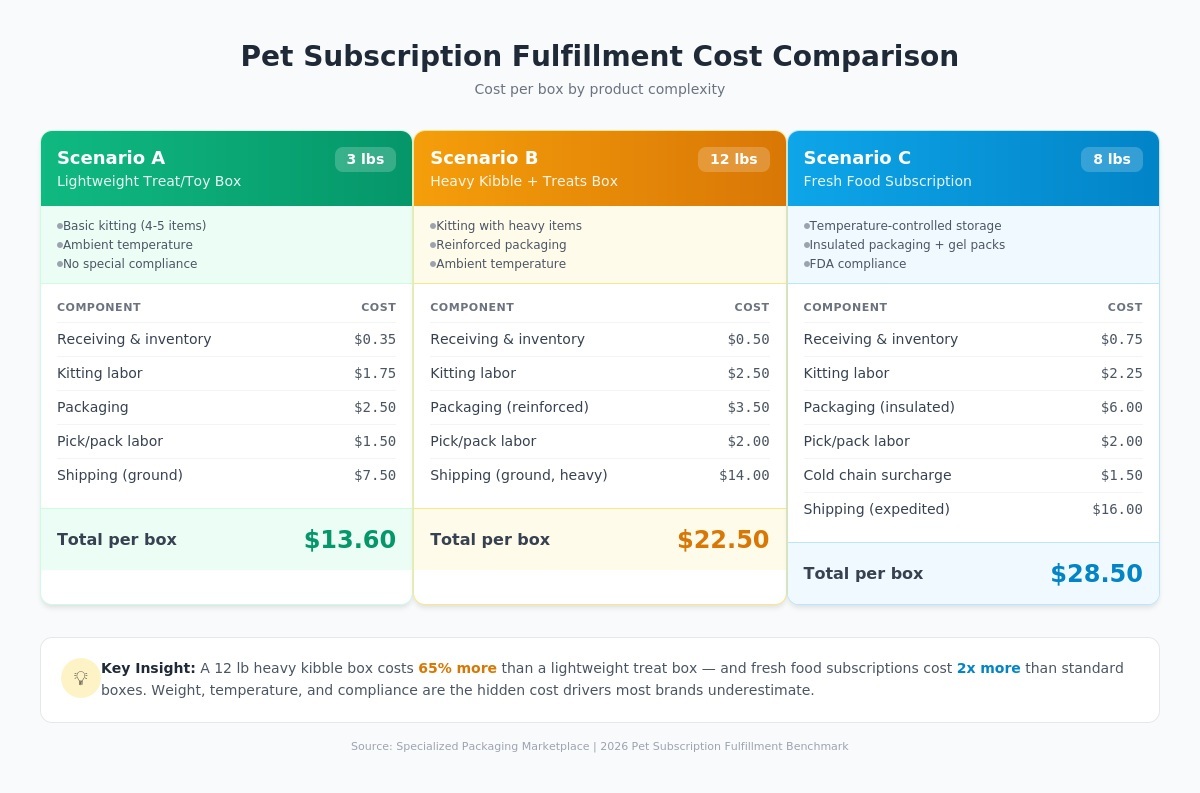
Let's build a realistic cost model for three types of pet subscription boxes:
How to Evaluate Pet Fulfillment Partner Pricing
When you're comparing fulfillment quotes, here's what to watch for:
Red Flags
- "Per-piece" pricing that doesn't account for weight: A 15-lb bag of food is not the same as a packet of treats
- No mention of temperature capabilities: If they don't bring it up, they don't have it
- Missing compliance certifications: FDA, cGMP, lot traceability
- Shipping "estimates" without carrier details: Actual rates vary wildly
Questions to Ask
- How do you price heavy items? Per-piece, per-pound, or tiered?
- Do you have temperature-controlled storage? Dedicated rooms or portable units?
- What certifications do you hold? FDA registration, BRC, cGMP?
- Can you provide lot-level traceability? How is it documented?
- What are your carrier relationships? Can I see rate cards?
- Where are you located? What's the average transit time to my customer base?
- Do you manufacture packaging? Or will I need a separate vendor?
The Bottom Line
Pet subscription fulfillment costs more than generic subscription fulfillment and it should. The weight, temperature requirements, compliance burden, and packaging durability demands are fundamentally different.
The brands that succeed don't try to force pet products into a lightweight fulfillment model. They find partners who understand the category, price accordingly, and build those costs into sustainable unit economics from day one.
The math matters. A fulfillment partner who's $2/box cheaper but can't handle temperature control, doesn't have compliance certifications, or ships from the wrong location will cost you far more in damaged products, compliance issues, and lost customers.
Find a partner who gets pet. The margins will thank you.
Looking for a pet subscription fulfillment partner?
The Specialized Packaging Marketplace connects pet brands with vetted kitting, assembly, and fulfillment partners who understand theunique requirements of the category. Search by capability, certification, and location.



Ready to find your packaging partner?
Join hundreds of manufacturers and buyers already using PackageLink to streamline their sourcing process.