
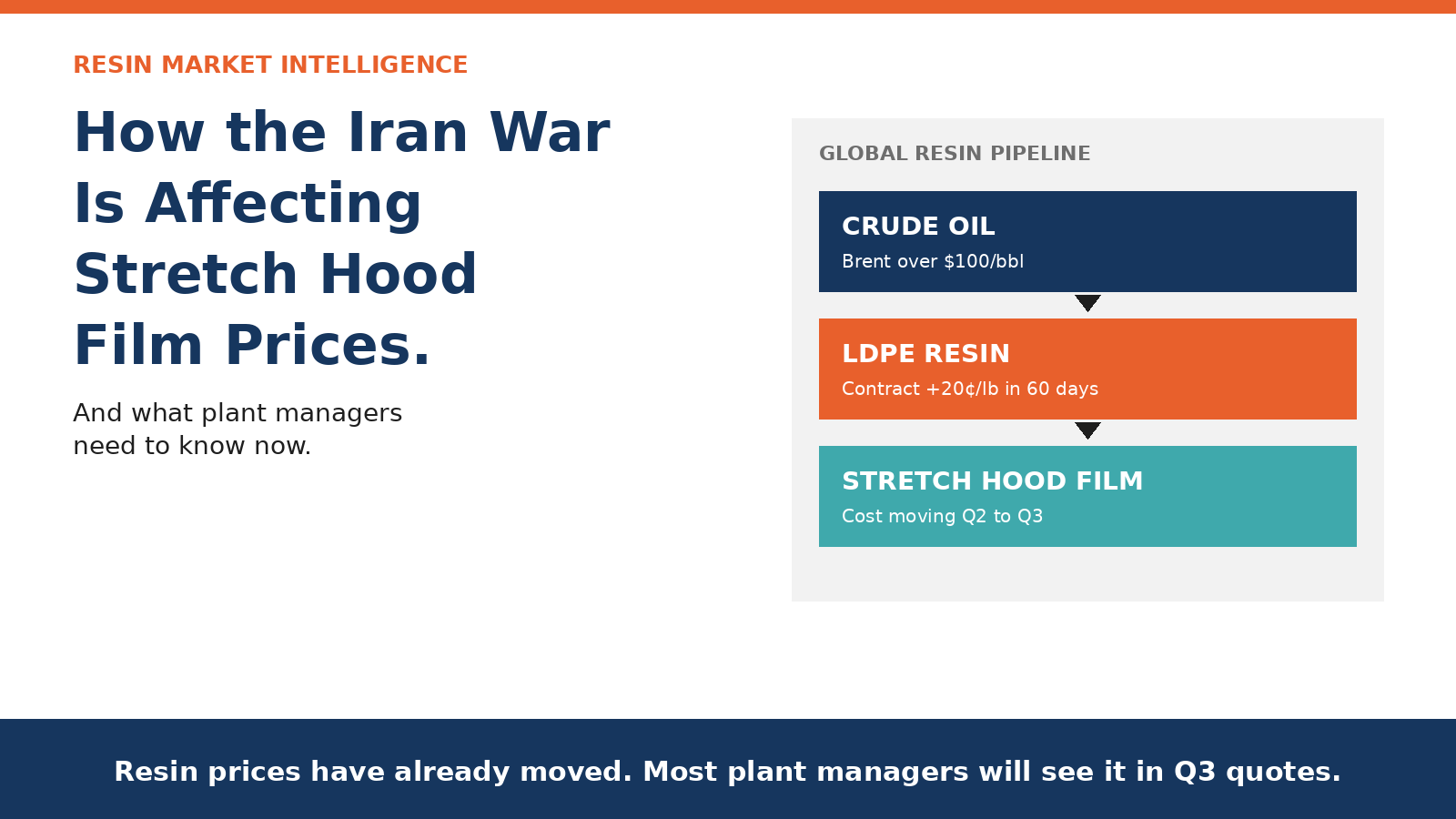
How the Iran War Is Affecting Stretch Hood Film Prices. And What Plant Managers Need to Know Now.
A live geopolitical event is moving through your packaging budget right now. Most plant managers will not see it on a P&L line until Q3.
What is actually happening?
On February 28, 2026, the war involving Iran, Israel, and the United States moved from a regional event into a structural disruption of global petrochemical supply.
According to PlasticsToday, polyethylene contract prices rose roughly 10 cents per pound in March alone, with another 10-cent increase nominated for April. According to ICIS, it will take 12 to 18 months for Middle East petrochemical exports to recover once the Strait of Hormuz reopens.
LDPE is the base resin in nearly every stretch hood film made today. When LDPE moves, your film cost moves with it.
This is not a forecast. The increases are already in the contract data.
Why does a Middle East war change a stretch hood film invoice in Acworth or Akron?
Because the math runs through three steps.
Step 1. Crude oil and naphtha are the upstream feedstocks for polyethylene. Both have spiked. Brent crude has traded above $100 a barrel.
Step 2. Roughly half of global polyethylene capacity sits in regions affected by the conflict or by the closure of the Strait of Hormuz. When that capacity goes offline, North American producers absorb the export demand. US capacity utilization climbs above 90 percent. Domestic spot prices rise.
Step 3. Domestic film extruders pay more for resin. Their pricing to converters and end users follows. Stretch hood film cost per pound goes up.
There is a lag, but the lag is closing fast.
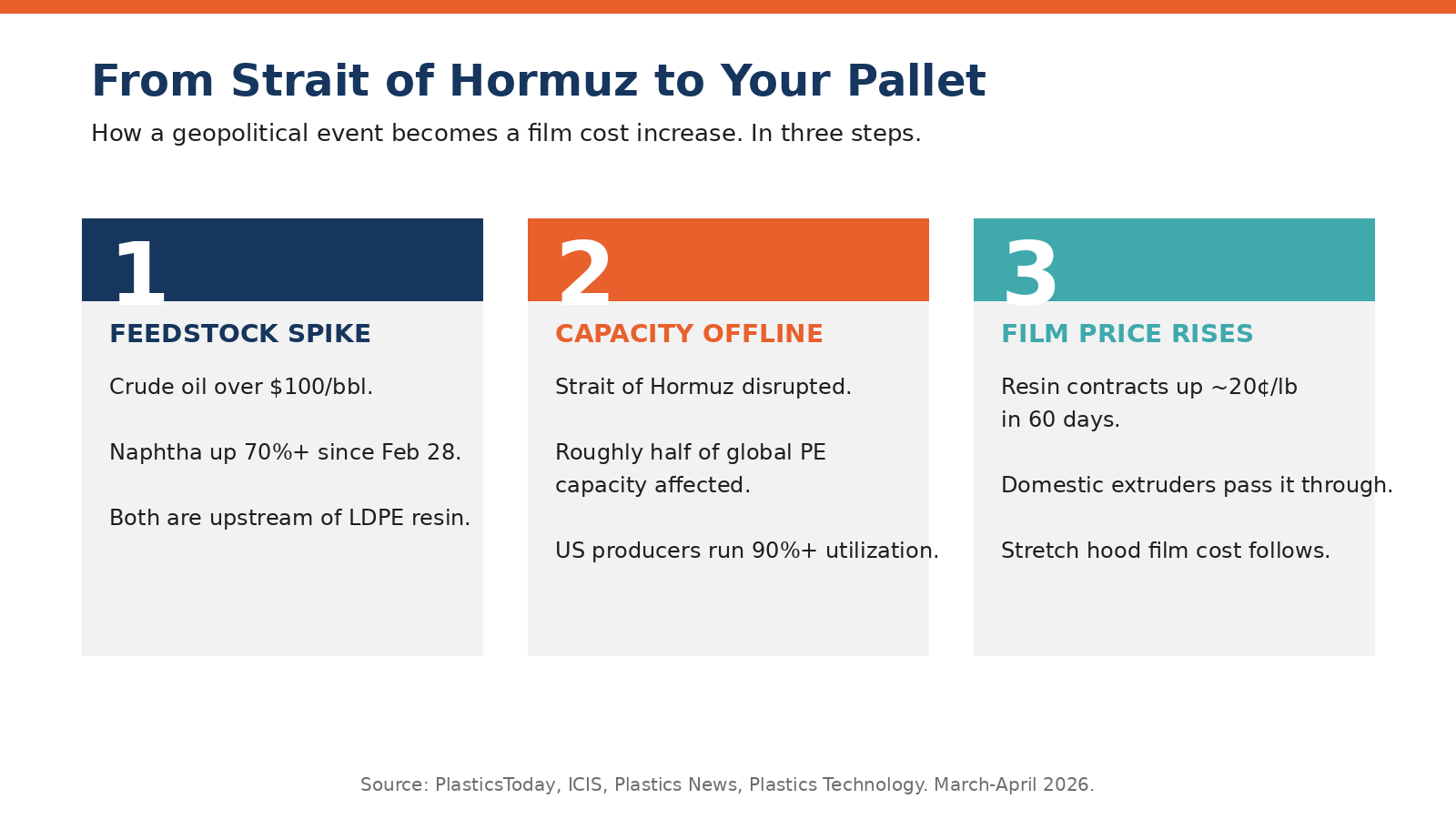
A three-panel diagram showing crude oil and naphtha flowing into LDPE resin, then into stretch hood film, with arrows showing rising prices at each stage.
What is MSK seeing on the ground right now?
According to MSK Covertech's US operations leadership, a major North American resin producer is in active conversations with MSK about testing new resin formulations on MSK equipment. The producer is preparing for supply chain shifts that are expected to keep moving through the next 12 months.
That is the upstream view. Resin producers are not waiting to see how this resolves. They are reformulating now.
The downstream view is simpler. Plant managers running stretch hood lines in North America are about to see line items move on quotes that have been steady for years.
What can plant managers do this quarter?
Three things are inside your control. None of them require a capital request.
First, downgauge the film if your current spec allows it. A correctly specified thinner film, run on equipment that is dialed in, can reduce cost per pallet without sacrificing load stability. Film is bought by weight. Thinner film plus the right tube diameter wins twice on the weight side.
Second, audit your supplier base. There are roughly 30 stretch hood film producers in North America. Only five or six have the big-die extrusion capability for 7 to 12 foot format. Knowing the real short list (not just the salesperson who happens to call you) protects you when one supplier announces an increase and another holds the line.
Third, lock in strategic quantities. Multi-year contracts and committed volume are a hedge in this market. Spot buying is not.
When is downgauging the right move and when is it not?
Downgauging is the right move when three conditions are present. The current film is over-specified for the load (this is more common than plant managers expect). The hooder is in good mechanical condition. And the load profile is consistent enough to test against.
Downgauging is the wrong move when the current film is already at the minimum spec for the load, when the equipment is aging and out of stretch tolerance, or when the load varies unpredictably day to day.
The honest version. MSK regularly walks into plants with competitor machines and identifies downgauging opportunities the plant did not know it had. That is not a sales pitch. It is a 30-minute conversation that often saves cost without anyone buying anything.
What about the small-format film for appliances and consumer goods?
Small-format stretch hood film (the kind used on washers, dryers, and refrigerators) is mostly imported. Most domestic extruders do not have the small-die capability to produce it at the volumes North American appliance makers consume.
That import dependency is exposed in the current environment. Freight, insurance, and resin costs are all moving in the same direction at once.
According to MSK Covertech's documented installation history, MSK equipment runs across small-format appliance applications and large-format building materials applications, and the film selection question is different for each. The small-format buyer should be having a different conversation right now than the building materials buyer.
Is MSK the right call for this conversation?
Honest answer. Not always.
If you do not have a stretch hood line, this article is upstream of where you are. The film conversation comes after the equipment conversation.
If you run spiral stretch wrap and your buyers are not pushing back on cost yet, the urgency is lower. Resin price increases hit stretch wrap film too, but the per-pallet film consumption math is different.
If you run an MSK or competitor stretch hood line and you have not had a film audit in the last 24 months, this is the conversation worth having right now. It is free. It often produces a savings number before any equipment decision is on the table.
FAQ
Is the Iran war going to cause stretch hood film shortages in North America?
Most likely no, in the sense of empty warehouses. But yes, in the sense of allocation pressure and price increases. North American producers are running above 90 percent capacity utilization, which means lead times are extending and price discipline is rising.
Are domestic film suppliers like Crayex, Charter Next Gen, or Layfield raising prices?
According to public industry reporting, every major North American resin producer has implemented or nominated price increases since March 2026. Domestic film extruders are passing those increases through. The size and timing varies by supplier and contract structure.
Should I switch from a three-layer co-extruded film to a mono film to save money?
It depends on the load. Three-layer co-extruded film generally has better stretch memory and load stability than mono film. The cost differential per pound is real but narrower than most plant managers assume. In some cases, downgauging the existing three-layer film is a better lever than switching to mono.
Can MSK equipment run film with recycled content?
Yes. MSK Tensiontech equipment is documented to run film with recycled content. Whether to use recycled-content film is a separate question that involves brand sustainability commitments, load requirements, and buyer specifications. The current resin price environment does change the math.
What if my hooder is not from MSK?
The film conversation is brand-agnostic. MSK regularly walks into plants running Lachenmeier, Möllers, Signode, or other equipment to discuss film optimization. The downgauging math, the supplier landscape, and the resin trend data are the same regardless of who built the machine.
The bottom line
The Iran war is not a packaged news story. It is a packaging budget story. Resin prices have already moved. Film extruders are passing the cost through. Most plant managers will see the impact in Q3 quotes if they have not already.
There are three things to do this quarter. Audit the film spec. Audit the supplier base. Lock in strategic quantities where the contract structure allows it.
A 30-minute conversation with someone who knows the equipment, the film, and the resin pipeline is worth having right now. Not in Q4.
BIO LINE: Reporting and analysis prepared for MSK Covertech. MSK Covertech is a German-owned manufacturer of stretch hood and shrink hood end-of-line packaging equipment, founded in 1975, with over 6,500 systems installed worldwide and US operations led by Braden Camp out of Acworth, Georgia.
SOURCES REFERENCED: PlasticsToday (March 2026 resin pricing reports), ICIS (Strait of Hormuz recovery analysis, April 13 2026), Plastics News (polymer producer surcharges, March 2026), ChemOrbis (real-time global resin pricing), Plastics Technology (April 2026 resin price column), MSK Covertech US operations leadership (April 2026 briefing).



Ready to find your packaging partner?
Join hundreds of manufacturers and buyers already using PackageLink to streamline their sourcing process.