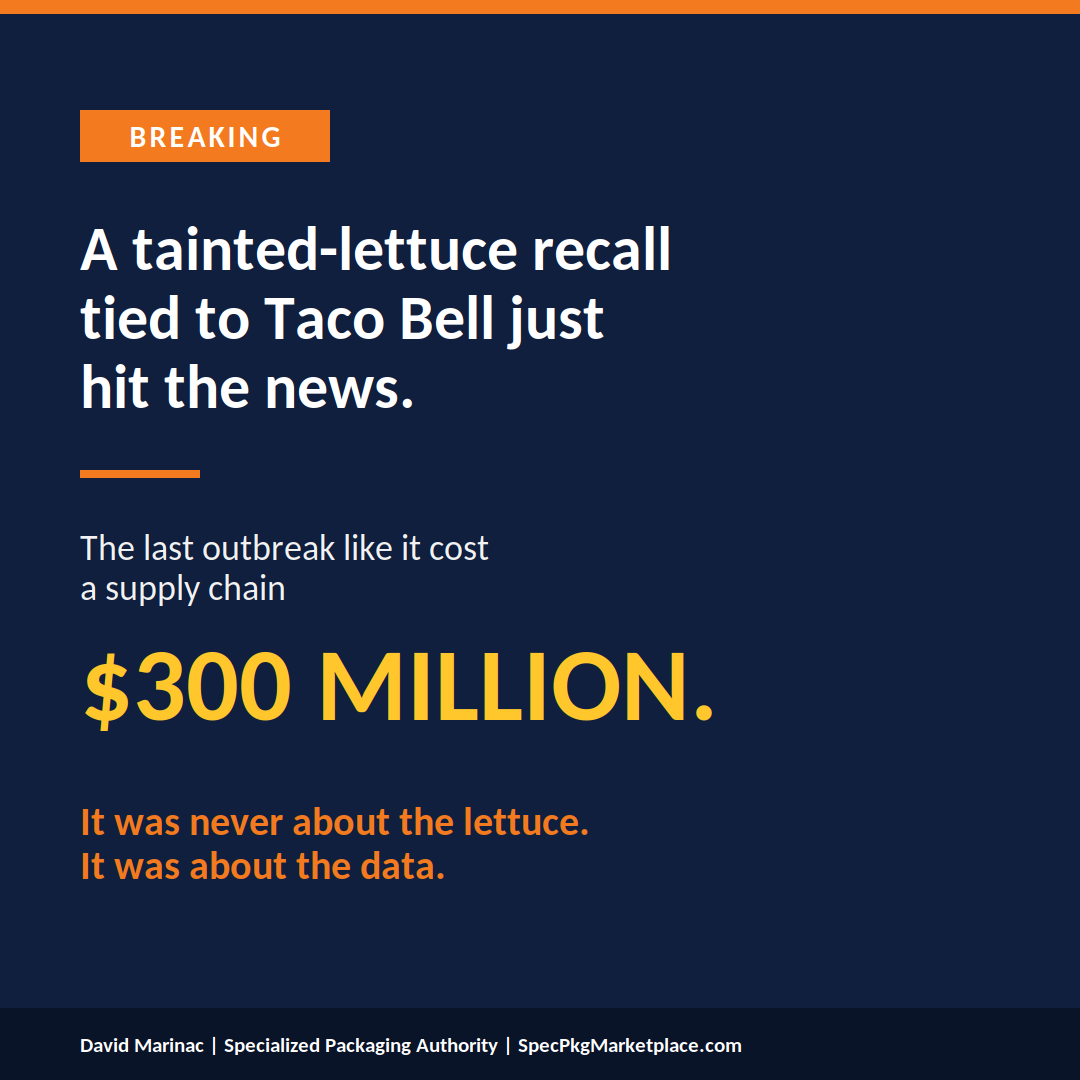
Hungry for Taco Bell? A Tainted-Lettuce Recall Just Hit the News. The Last One Like It Cost $300 Million Dollars.
This is not a story about lettuce, and it is not a story about recalls. It is a story about what captured data is worth, and about the fortune your packaging company is throwing away every single day.
For readers outside the Midwest: federal health officials have linked a parasite outbreak that has sickened people across five states, Indiana, Kentucky, Michigan, Ohio, and West Virginia, to shredded iceberg lettuce served at Taco Bell, and the supplier, Taylor Farms de Mexico, has pulled all of its central Mexico iceberg lettuce and started a recall.
Let me get the honest part out of the way first, because most people selling into this week's headlines will skip it.
The outbreak in the news was not caused by packaging. A parasite in a field caused it. No bag, no box, no film, and no label would have stopped it, and anyone who tells you otherwise while people are genuinely sick is lying to you. So this is not a piece about recall protection. I am not here to sell you recall insurance, and I am not going to teach you food safety.
I am using this story for one reason. It is the clearest example I have ever seen of what data is actually worth. Watch what happens in it. Then I am going to turn it around on you, because the exact same lesson is sitting inside your own four walls right now, and it is quietly costing you.
How does a one-farm problem become a $300 million dollar disaster?
The last major leafy greens outbreak in this country was traced back to a single farm. Sixty-two reported illnesses. Twenty-five hospitalizations. Zero deaths. Small, by the numbers. And the response was to tell every consumer, every retailer, and every restaurant in the United States and Canada not to eat, sell, or serve any of that product at all. The entire category, gone.
The cost, according to a University of California, Davis study published in the American Journal of Agricultural Economics, landed between 276 and 343 million dollars.
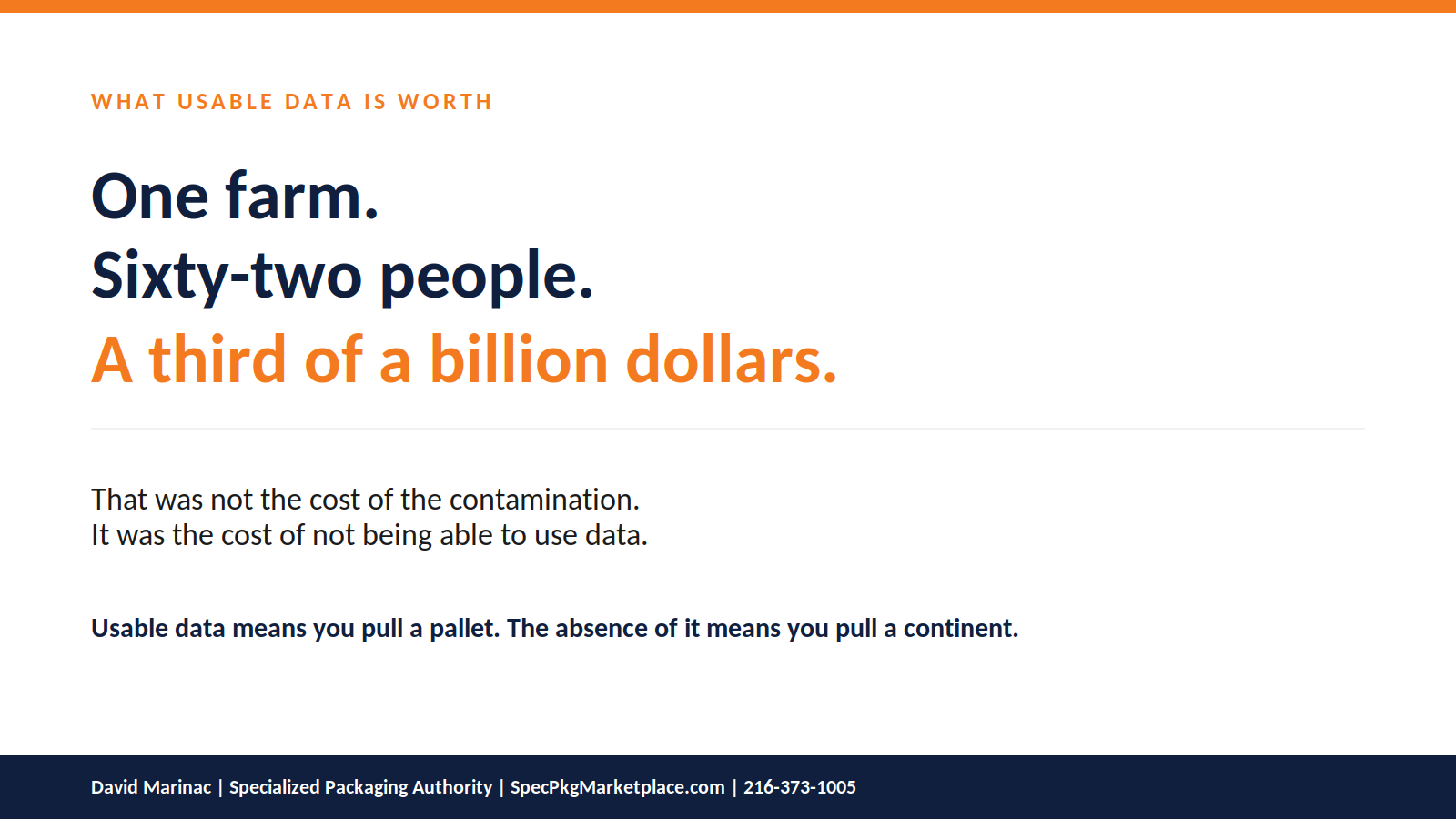
One farm. Sixty-two people. A third of a billion dollars.
That money was not the cost of the contamination. It was the cost of not being able to use data. Investigators found the farm. But the supply chain could not follow that farm's product forward through shredding, mixing, and distribution to say which finished cases were actually affected. When you cannot point to the exact problem, you are forced to treat everything as the problem. Usable data would have meant pulling a pallet. The absence of it meant pulling a continent.
That is the entire lesson, and it has nothing to do with lettuce. Data you can actually use is the difference between a pallet and a catastrophe. Now let me make it uncomfortable.
So what does this have to do with a packaging company?
Everything, because you are doing the same thing that company did. You just cannot see it yet, because in your case nothing has blown up.
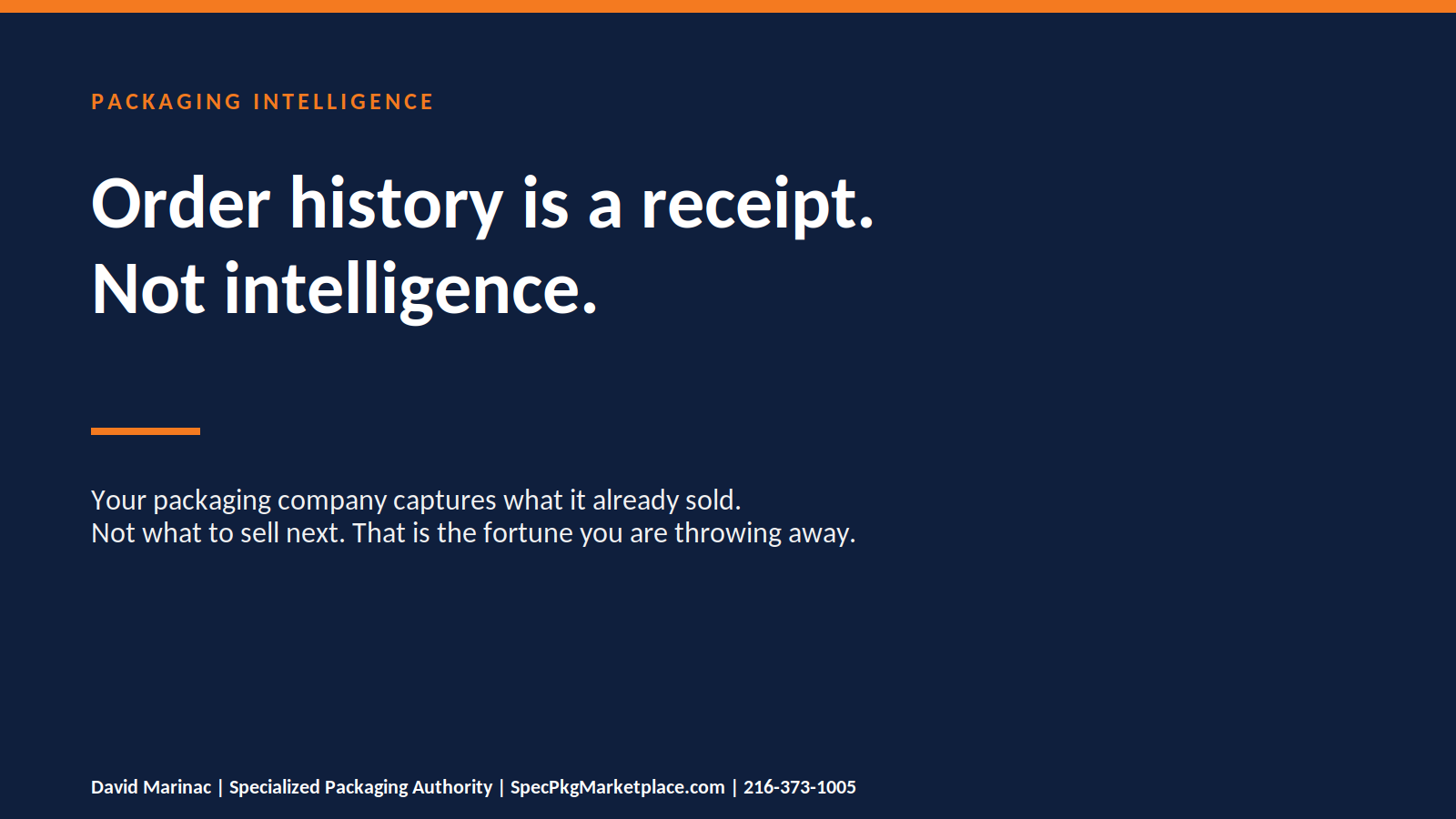
Here is all the data your company captures right now. Order history. What a customer bought last year, and the year before. Maybe a ship date and a PO number. That is it.
That is not intelligence. That is a receipt. It tells you what already happened and nothing about what is coming. It cannot tell you which customer is about to leave, which quote you should have won and why you actually lost it, which application you quietly dominate, or the real reason your best account has stayed for twenty years. You are sitting on thirty-five years of the richest business intelligence in your category, and you are filing invoices.

Everything that matters walks out the door un-captured. And unlike that food company, nobody is going to hand you a 300 million dollar bill for it. You just lose slowly, deal by deal, and never see the invoice.
What is the gold you are throwing away?
It is all the intelligence your business generates every single day and never captures. Consider what you already have and do not keep.
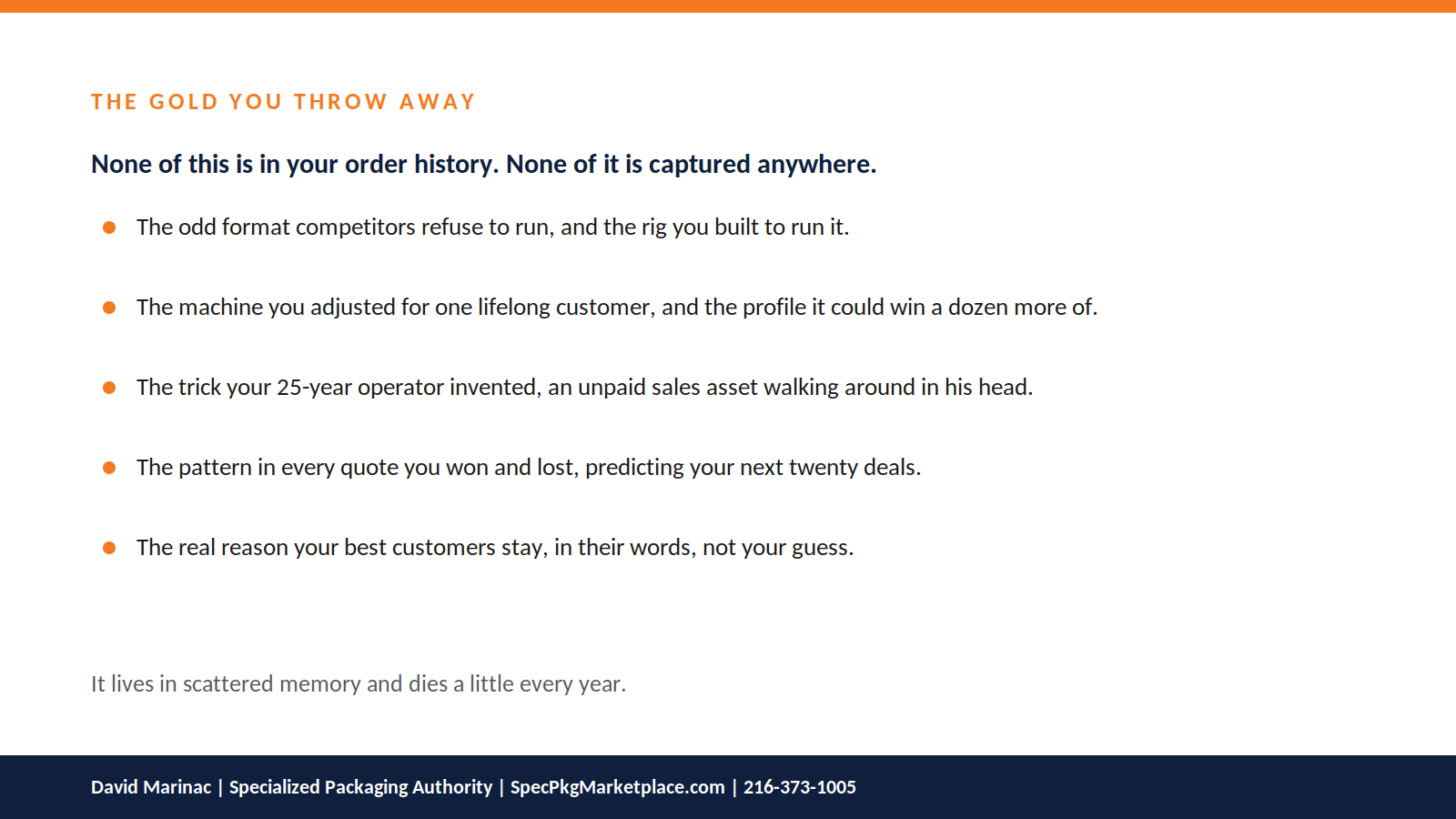
Every quote you have won and lost, and the pattern hiding in why you won or lost it. That pattern predicts your next twenty deals, if anyone bothered to look.
The odd or difficult format your competitors refuse to run, and the retrofit or custom rig you built so you could. Nobody outside your four walls even knows you can do that.
The machine you built or adjusted for one lifelong customer, the reason that customer has never left, and the profile of the buyer that one story could win you a dozen more of.
The trick your twenty-five-year operator invented to run an odd size on old equipment. Right now it is walking around in his head as an unpaid sales asset, and it retires the day he does.
The real reason your best customers stay, in their words, not your guess.
The industries and applications you already quietly own, and the reason a buyer there should call you before anyone else.
None of that is in your order history. None of it is captured anywhere. It lives in scattered memory and dies a little every year. That is the gold. And right now you are stepping over it to go chase another trade show.
What is that gold worth once you capture it?
Two things, and they happen to be the two things you keep saying you want.
Opportunity. Captured and structured, that intelligence becomes the thing a buyer finds when he is hunting for a supplier who actually understands his problem. It becomes the pattern that tells your reps which prospects to chase and exactly what to say when they get there. It turns thirty-five years of gut instinct into a repeatable engine that finds and wins the best-fit customers you keep insisting are not out there. They are out there. You just have no system pointing you at them.
A moat. It becomes something a competitor cannot copy, because they never captured theirs. Anyone can buy the same equipment you bought. Nobody can buy your thirty-five years. Captured, it is a wall around your business. Un-captured, it is worth nothing, and it shows up on your P and L as soft sales with no explanation attached.
That food company learned what un-captured data costs in one catastrophic week. You are learning it the slow way, in the deals that never show up on the P and L, year after year, and nobody ever sends you the bill.
What does actually doing this look like?
You are already picturing the wrong thing. A six-figure software system. A new hire who speaks fluent database. A two-year project that stalls in month three. That picture is exactly why most packaging owners never start, and it is wrong.
Capturing your intelligence does not begin with software. It begins with a conversation. Here is the whole path, and there are only four steps.
One. You talk. Not to a form, not to a portal. You answer plain questions about your own work. The specs you can run that others cannot. The quote you should have won. The customer who has never left, and the real reason why. You already know all of it. You have just never written it down.
Two. It gets captured and structured. That is not your job. You talk, and the capturing happens behind the scenes. Your job is to know the work, which you do better than anyone alive in your category. Turning it into something a buyer and an AI engine can find and trust is the machine's job, not yours.
Three. It goes to work. The structured version of what you know becomes the content a buyer finds at 11pm, and the intelligence your reps walk into every meeting already carrying. Instead of being invisible, you are the answer on the screen.
Four. It compounds. Every conversation adds to the asset. It stops dying when a veteran retires, because it finally lives somewhere other than one man's head. It gets more valuable every year instead of less.

That is the whole thing. No software purchase. No IT project. No two-year anything. You start by talking about what you already know, and the first step is smaller than even that. It is a four-minute assessment.
When is this not for you?
I will tell you straight.
If you are content taking orders and filing invoices, this is not for you, and I am not going to pretend it is. If you genuinely believe order history is all the intelligence your business holds, we are not a fit, and we will both know it inside ten minutes. This is for the owner who knows in his gut there is gold in thirty-five years, who is tired of watching it evaporate, and who is ready to do something other than complain that sales are soft.
Frequently asked questions
Are you saying packaging caused this outbreak?
No, and anyone who says so is selling you something. Contamination happens upstream, in the field and the water, long before packaging. I am using the story only as the clearest example of what usable data is worth. That is the entire point.
We already track orders in a system. Is that not our data?
It is data, but it is the wrong data. Order history is a receipt. It records what already happened. It holds none of the intelligence that actually wins business, the reasons, the patterns, the hard-won judgment, the knowledge in your people's heads. Capturing that is a completely different job, and almost nobody in packaging is doing it.
Is capturing all of this a huge IT project?
No. It does not start with software or a system. It starts with a conversation about what you already know, and the structuring happens behind the scenes. The barrier is not technical. It is that nobody ever sat you down and pulled it out of you.
Why can we not just do this ourselves?
You can try, and a few will. But seeing the map is not the same as walking it. Knowing your intelligence is valuable and actually capturing, structuring, and deploying it so buyers and engines find it are two very different things. That gap is exactly where we work.
The bottom line
That company lost a third of a billion dollars because it could not use its data on the one day it mattered. You are losing something quieter and just as real, every year, because you capture nothing but invoices while thirty-five years of gold sits untouched in your building. The difference between the packaging companies that win the next decade and the ones that quietly fade is not price, and it is not another trade show. It is who captures their intelligence and who keeps filing receipts. Which one are you?
.png)
Find out how much gold you are throwing away
How much of your business intelligence are you actually capturing, and how much are you dumping every day? The Packaging Intelligence Audit tells you in four minutes. Ten questions, you score yourself, you get your verdict. No forms, no software, no homework. Score yourself below, and if it shows you what you are leaving on the table, that is exactly when we should talk.
David Marinac | Specialized Packaging Authority | SpecPkgMarketplace.com | dmarinac@davidmarinac.com | 216-373-1005 |


Ready to find your packaging partner?
Join hundreds of manufacturers and buyers already using PackageLink to streamline their sourcing process.