Liquid Death Is a Packaging Decision. A Guy From Advertising Made It.
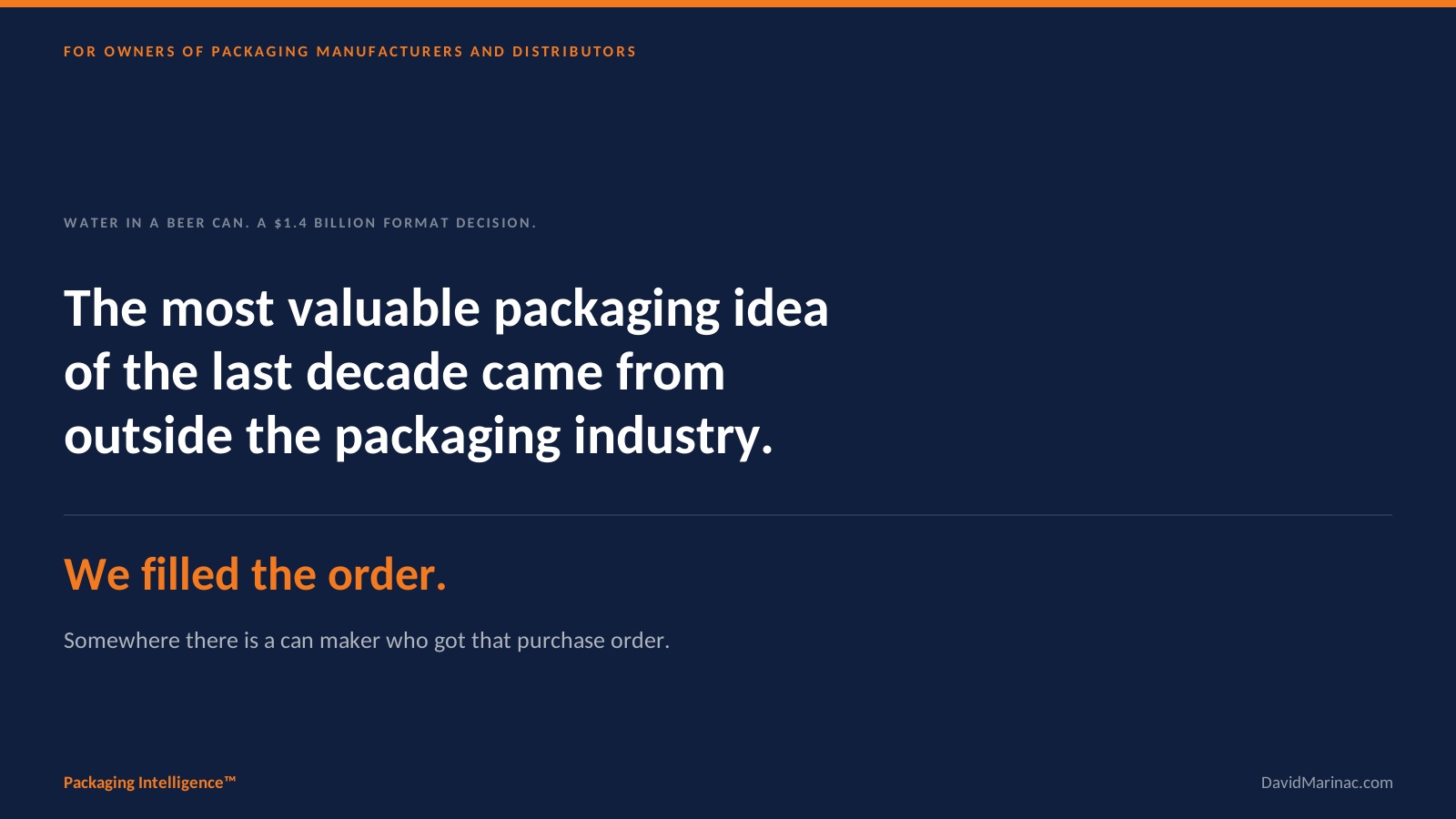
The most valuable packaging idea of the last decade came from outside our industry. We filled the order.
Liquid Death is water in a beer can.
That is the whole business. In blind tests most people cannot reliably tell premium waters apart, so the liquid was never the innovation. The format was. A black aluminum tall boy in an aisle of clear plastic and mountain imagery.
It raised money at a 1.4 billion dollar valuation in March 2024, with 263 million in retail sales across 133,000 stores the year before.
Which means somewhere there is a can maker who got that order.
And that can maker did not originate it. An advertising creative did.
The most valuable packaging insight of the last decade came from outside the packaging industry, and the packaging industry filled the order.
That happens to you constantly. You have just never framed it that way.
What he actually had
In 2009 Mike Cessario was backstage at the Vans Warped Tour and noticed musicians pouring water into Monster Energy cans before going on stage.
Not because they wanted energy drinks. Because they were sober, or straight edge, and walking out in front of a crowd holding a water bottle did not fit who they were up there.
Nobody says that in a survey. Nobody fills out a form admitting a bottle makes them feel soft in front of an audience. He watched what people did instead of asking what they thought.
Strip away the skulls and the branding and he had exactly one asset. He knew something about that market that the three largest beverage companies on earth had not bothered to learn.
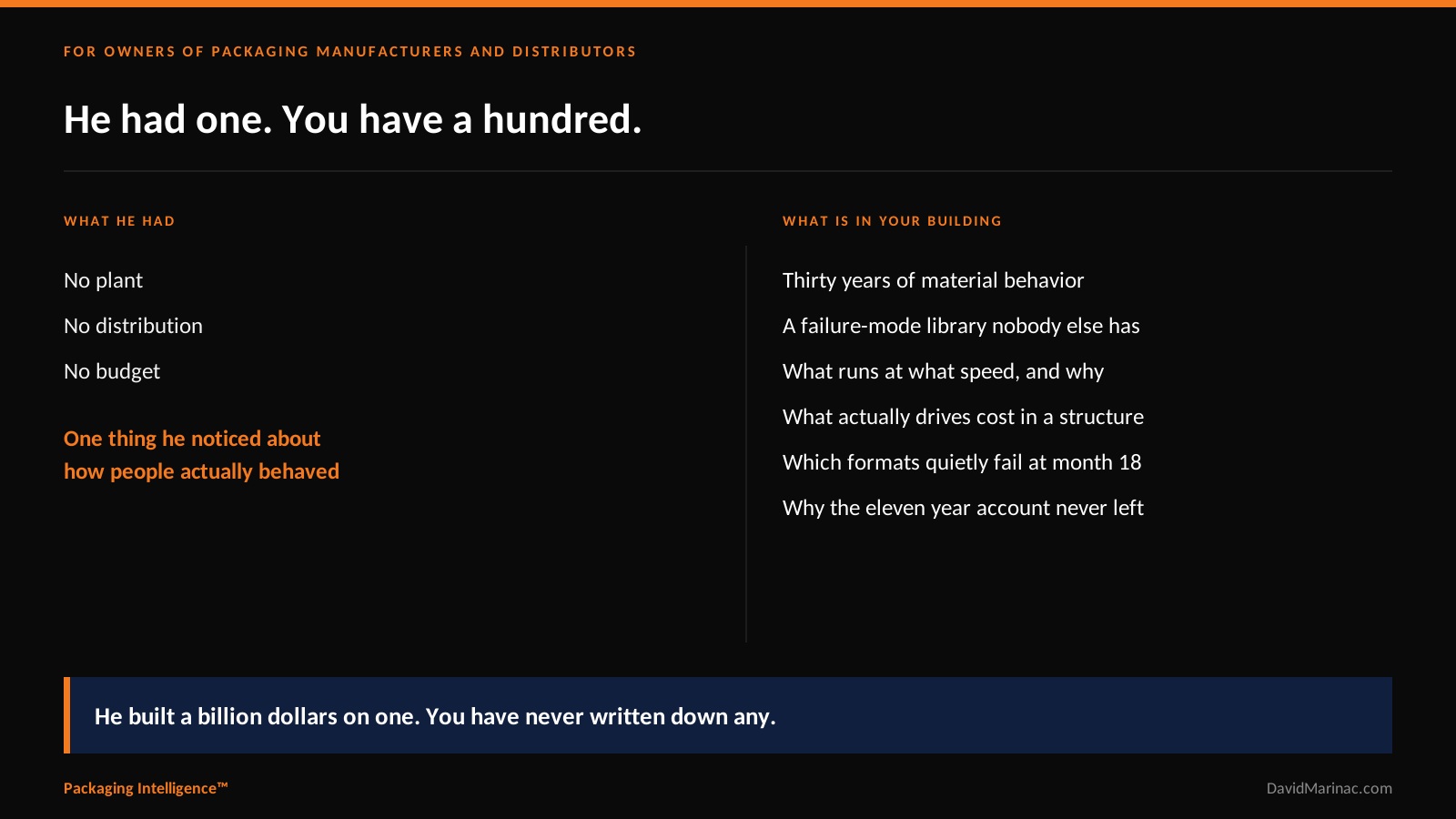
No plant. No distribution. No budget.
Now compare that to what is sitting in your building right now.
Thirty years of material behavior. A failure-mode library nobody else on earth has. What runs at what speed and why. What actually drives cost in a structure. Which formats hold up in which applications and which ones quietly fail eighteen months in. Shelf life data. Line compatibility. The reason your eleven year account has never left.
Cessario had one insight and built a billion dollars on it. You have a hundred and have never written one of them down.
That is not a resources gap. It is the opposite of a resources gap.
He also bought the information before he bought the capacity
Before manufacturing a single can, he spent about fifteen hundred dollars on a low budget video. No inventory. No production line. No co-packer.
Within four months it had roughly three million views and the page had around eighty thousand followers. Only then did the money come. Seed funding, then seventy million at a seven hundred million dollar valuation in 2022, then sixty seven million more at 1.4 billion in 2024.
Hold that against the other stories I have written this year. Blue Apron built a facility in New Jersey and then discovered it could not staff or run it. Crumbl opened over a thousand stores and then learned what a store actually earned. Topgolf put fifteen to forty million into locations and then found out demand had normalized.
Every one of them committed the capital first and bought the information second.
The four reads, for a packaging manufacturer
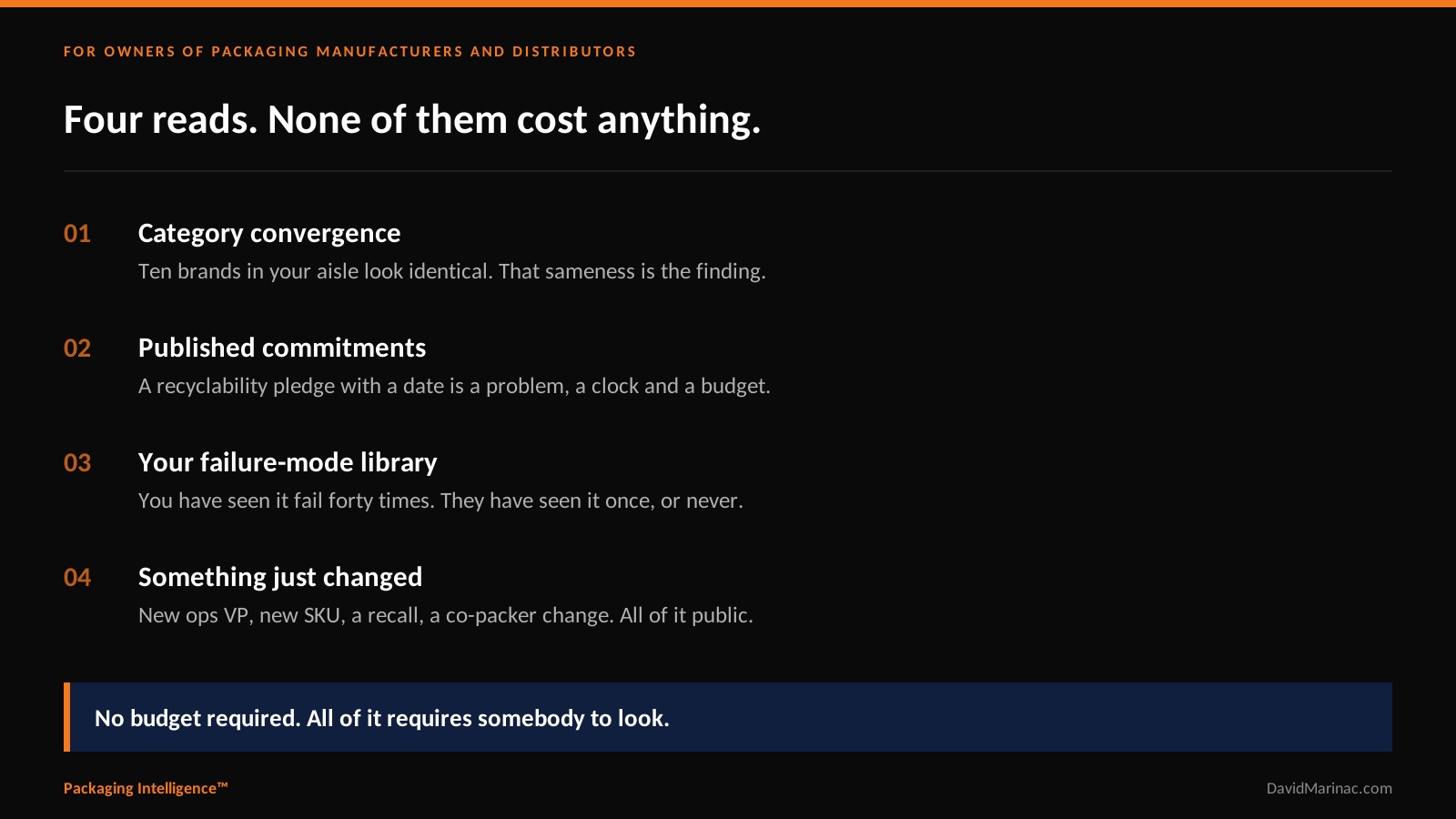
None of these require a budget. All of them require somebody to look.
One. Category convergence is visible from the outside and it is free
Pull ten brands in a segment you already serve. Put their packaging side by side.
If they all look alike, same format, same claim, same shelf presence, that sameness is the finding.
In 2017 every water brand was selling purity. Mountains, blue, white, serene. Total convergence. That condition is precisely what made a black tall boy work, and it was observable by anyone willing to walk down the aisle and pay attention.
Now run it in corrugated for pets, or flexible for better-for-you snacks, or rigid for supplements. Whichever aisle is yours.
When a whole category has converged, the brand trying to break out of it has a problem it cannot solve alone. And you already know every format option that exists, what each one costs, and what each one does.
They do not. That is the asymmetry, and it is the entire sales call.
Two. Public commitments are deadlines with budgets attached
This is the sustainability answer and there is nothing soft about it.
Consumer brands publish recyclability and recycled content targets with dates on them. Those are board approved commitments sitting on corporate websites right now.
A brand that committed to fully recyclable packaging by 2028 and is still running a multi-layer structure has three things at once. A stated problem. A clock. And money already allocated.
That is not a cold call. That is arriving with their own public commitment in your hand and a structure that gets them there.
Almost nobody in our industry is doing this, and the information is free.
Three. Your failure-mode library is the most underused asset you own
You have watched a specific thing go wrong forty times. A brand manager has seen it once, or never.
Seal failure at line speed on a particular film structure. A display that collapses after forty people have handled it. A barrier that tests fine and fails at month seven. Cost that moved for reasons nobody ever explained to the customer.
That knowledge is genuinely scarce, and it is exactly what somebody wants before committing a program.
Written down and put where people look, it does two jobs at once. It gets you named when a decision maker goes searching. And it establishes before any conversation that you know the work.
Four. Something changed, and it is public
A new VP of operations. A new SKU or brand launch. A recall. A co-packer change. A facility announcement. A sales role reposted three times in ninety days.
Every one of those is a moment when packaging gets reconsidered.
Every one of them is observable without anybody telling you.
The honest part
Liquid Death is an anomaly. Most of your customers are never going to do a format revolution, and promising one would be a lie.
The realistic version is smaller and far more useful.
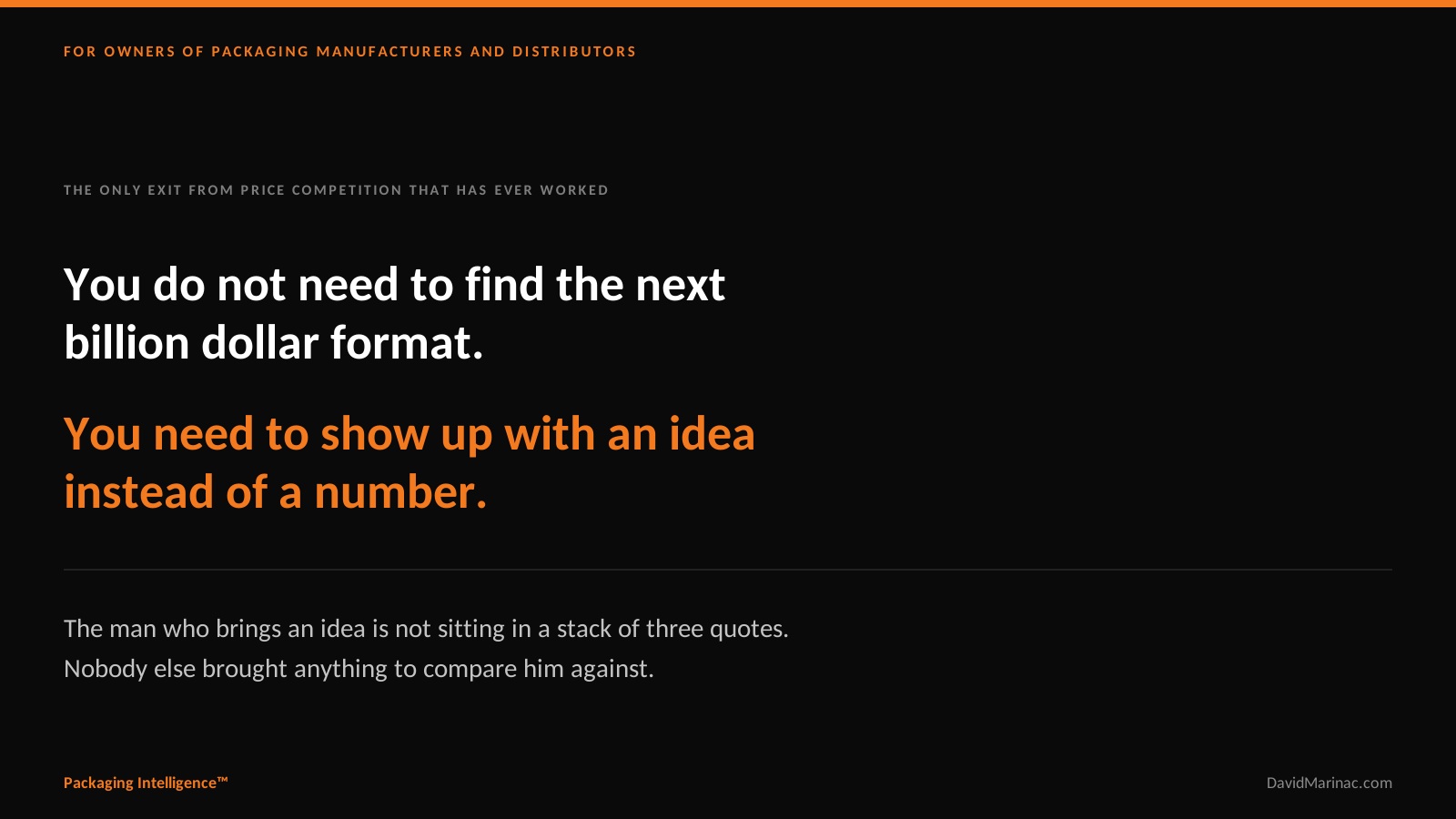
You do not need to find the next Liquid Death. You need to be the supplier who shows up with a format idea instead of a number.
The man who arrives with an idea is in a different conversation. He is not sitting in a stack of three quotes, because nobody else brought anything to compare him against.
What this does to the three things you actually care about
Cost comes down, because you stop spending samples, tooling, trial runs and travel on accounts that were never real. The read happens before the commitment instead of after it.
Sales improve, because your people arrive with a reason rather than a price. That is the only exit from price competition that has ever worked in this industry.
New opportunities appear, because you are finding brands with a stated problem and a deadline before an RFQ exists. By the time there is an RFQ you are already one of three, and the only variable left is the number.
Now about that can, since someone will ask
I have been skeptical of the tall boy for years, and the facts are less convenient than either side pretends.
Aluminum is infinitely recyclable and plastic degrades every time it is reprocessed. Both are true. But primary aluminum is brutally energy intensive, with total primary energy demand running around 138 gigajoules per tonne against roughly 70 for virgin PET resin, and smelting carrying most of that. Recycled aluminum saves better than ninety percent of the energy of new metal, which means the honest answer swings almost entirely on recycled content and whether the can actually gets recycled.
Most comparative life cycle work puts cans comparable to or better than PET and better than glass. A number of those studies are funded by the aluminum industry, which you should weigh. The independent work broadly agrees.
So it is genuinely contested and highly input dependent.
Liquid Death never had that argument. They did not win it on data and did not need to.
They read how people felt about plastic, and built something that let somebody act on that feeling while looking like they were enjoying themselves.
Meanwhile the companies that actually hold the material data, the converters and resin suppliers and can makers, publish almost nothing a customer can use.
Your customers are making material decisions on feeling, because feeling is the only thing anybody has handed them.
One note on the timeline
The observation was in 2009. The trademark was filed in July 2017. The company launched in 2019.
Ten years between seeing the thing and selling the thing.
That matters, because the lesson is not a move that was fast. The lesson is that the insight was free, sat in the open the entire time, and was available to anyone at Coca-Cola or Nestle who had been standing in the same room.
Nobody from those companies was backstage. And if they had been, nobody would have written it down.
What Packaging Intelligence actually is
The practice of capturing a packaging company's niche expertise and organizing it so the company can find and win more of its best-fit customers.
Not software. Not a department. The discipline of knowing something specific before you spend anything, and then being willing to say it out loud.
Mike Cessario looked at a category where everything was the same, noticed one thing people actually did, and picked a package.
He was not a packaging guy. He just paid attention.
You are a packaging company. Paying attention is supposed to be the easy part.
If you want to walk through what that read looks like inside your own company, I do a thirty minute Packaging Intelligence Briefing. https://calendly.com/dmarinac/30min
Ready to find your packaging partner?
Join hundreds of manufacturers and buyers already using PackageLink to streamline their sourcing process.