Off the Spec Sheet: The Questions Food Plants Ask About Dual Ovenable Film
A conversation with MannPak, a Baltimore, Maryland printer and converter of flexible packaging film.
By David Marinac, Specialized Packaging Marketplace
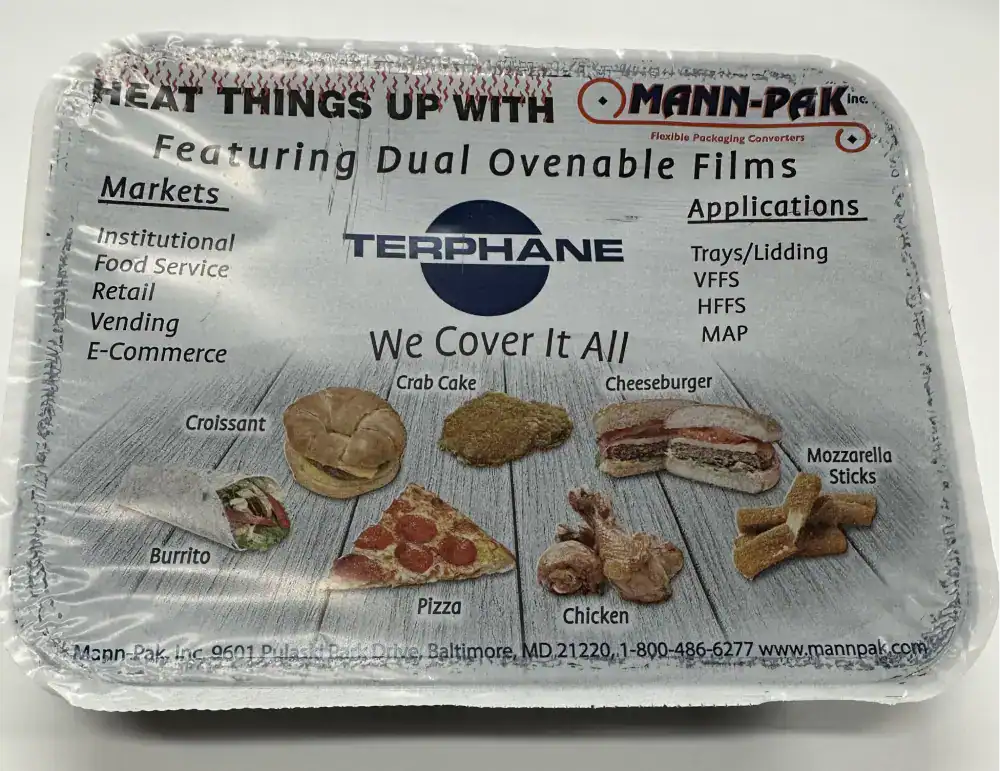
If you package food that gets heated in its own wrapper, you already know the film matters. A single slice of pizza in a school cafeteria, a burrito in a convenience store case, a tray that goes from the freezer to the oven. The film has to seal, survive the heat, let the steam out, and come off the food clean. When it does not, the line hears about it first.
What is harder to find is a straight answer about the film itself. Spec sheets get written once and copied for years. Plenty of plants are still told that only one company can make the film they run, and nobody goes back to check. So we asked a manufacturer to answer the questions plant managers and packaging engineers actually ask, including the ones that do not make the manufacturer look perfect.
MannPak prints and converts dual ovenable lidding and overwrap film in Baltimore. The answers below are theirs. The notes in between are ours.
WHY THIS PAGE EXISTS: Dual ovenable film is a small category with very little written about it in plain language. Buyers end up comparing part numbers instead of performance, and the questions that decide whether a switch works out rarely get asked until the film is already on the line.
TRYING IT, AND GETTING STARTED
Can we run a trial before we commit to a production order?
Yes, and we require it. Any material you have not run before gets qualified on your own product and your own equipment first. If it works on your line, we move to a production run. If it does not, we find out before you have a warehouse full of film that does not do the job. We would rather do it this way than have you find out the hard way.
What is your minimum order?
We do have minimums, but we always start with your project, not a number. Tell us what you are packaging, how many SKUs you have, and roughly how much you run, and together we will dial in the right quantity. Our goal is to find a way to help.
We run a lot of SKUs at fairly low volume. Can you work with that?
Tell us about your project. We will always try to work with you. Sometimes the answer is a mix: one printed film that carries your brand across every SKU, with a small label for the flavor or variant. We would rather talk it through than turn anyone away on a number.
What do you need to know before you can quote us?
The first question is always what equipment the film will run on. After that: what you are packaging, how many SKUs, how often you reorder, what film you are using now, and whether it needs to be printed or plain. If you have a current spec sheet or a sample roll, that helps too.
What is your standard lead time?
Once the base film is in house, printing and converting typically takes four to six weeks. Repeat orders move faster, especially on a blanket order where we can plan ahead. For comparison, a lot of large converters are quoting eight to twelve weeks.
Why does the first order take longer?
Because the first order is where we make sure everything is spot on: your artwork, your materials, your roll specs, and how the film runs on your machine. As they say, measure twice, cut once. Once that is locked in, reorders are a lot simpler.
Can we visit the plant?
Yes. Customers are welcome in Baltimore. The first thing most visitors say is how clean and organized it is.
OUR NOTE: In our experience, a film switch rarely starts in purchasing. It starts on the line, when production keeps complaining about the same problem and somebody finally gets asked to find an alternative. That is why the trial matters more than the quote. A qualification run on your own equipment answers the question a price sheet cannot.
THE FILM IN THE MICROWAVE AND THE OVEN
What does dual ovenable actually mean?
It means the package can go from the freezer into either a microwave or a conventional oven without moving the food to another dish. For the film, that is four jobs at once: hold the seal cold, survive oven heat, vent steam instead of ballooning, and release from the food instead of sticking to it. A film rated for microwave only is not dual ovenable.
Will the film release cleanly from melted cheese?
Yes. The dual ovenable film we print is designed to release cleanly from melted cheese when it is heated in the microwave, and it self vents so the package does not balloon. It is running today on microwaved pizza for a customer who chose us specifically because the cheese would not stick. Every application is qualified on your own product before production.
Why does self venting matter?
When food heats up in a sealed package, steam builds. Without a way out, the package balloons, the seal can blow, and you get a mess in the microwave. A self venting film lets the steam out in a controlled way during heating.
What temperatures can it handle?
The published range for the film family we print runs from minus 40 F in the freezer up to 410 F in the oven.
What trays does it seal to?
The published compatibility covers APET, mono CPET, APET/CPET, modified CPET, PETG, rPET and PVC trays, and the film seals to itself for overwrap. Full spec sheets and data sheets are available for every film we offer.
Peelable or lock seal?
Both are available. Peelable opens by hand. A lock seal is permanent and has to be cut. It is worth deciding before you finalize the tray, not after.
What gauge should we be running?
We run from half a mil up to three mil. Pizza and burrito overwrap usually lands around 60 to 75 gauge. Heavier gauges are for things like whole birds, where puncture resistance matters. We see a lot of product that is packaged in a heavier film than it needs, simply because that is what it has always been. A thinner film that still does the job gives you more film per pound, which adds up over millions of feet.
OUR NOTE: "Microwavable" and "dual ovenable" get used as if they mean the same thing, and on a lot of spec sheets they do not get checked. If your product might ever go in a conventional oven, in a school kitchen or a food service line, it is worth confirming which one your film is actually rated for.
PRINTING, LABELS AND ARTWORK
How many colors can you print?
Up to eight. That can be four color process plus four spot colors, or all spot colors, depending on the design.
We only need a logo. Is printing worth it?
Often, yes. A lot of institutional and food service film carries nothing more than a one or two color logo. And even plain film needs a printed eye spot, the mark that tells the packaging machine where to cut, so you are already printing something.
We use applied labels today. Should we switch to printed film?
It depends, and we will tell you honestly. Printed film usually costs less than film plus a label. It takes the labor of applying labels off the line, and it gets rid of the waste when a label goes on crooked or with an air bubble. It also looks better on the shelf. But if you have fifteen flavors and each one moves a couple hundred units a month, plain film and a label is probably the right call. A middle path that works for a lot of brands: print the brand on the film, and use a small label for the variant.
What if we need to change our artwork in the middle of a program?
We have worked through artwork changes many times. What is involved depends on how many colors change and how much printed film is already on hand. Tell us what you are planning and we will give you a specific answer.
Will your film run on our machine?
We supply roll stock for horizontal and vertical form fill seal equipment, including Doughboy machines, which are among the most common we see. Standard finished rolls are around 10 to 12 inch OD on 3 inch cores, sized so a person can handle them. Tell us what you run and we will match it.
OUR NOTE: Applied labels are one of the most undercounted costs in food packaging. The label has a price, but so does the labor to apply it, the slower line speed, and every package that gets scrapped for a crooked label or an air bubble. Most plants never add those up. The ones that do are usually the ones that switch.
ORDERING AND SUPPLY
Do you only do truckload quantities?
No. We are built for programs well below what the large film producers will schedule, and we are set up to grow with you as your volume grows.
Can we set up regular reorders?
Yes. For repeat programs, a blanket order with scheduled releases is the best way to keep lead times short. Rather than printing every month, we will typically run a larger quantity on a set schedule, quarterly for example, so the film is ready when you need it.
Will you hold safety stock for us?
For committed repeat programs, in some cases, yes. We already hold safety stock for a couple of customers so they are never left waiting. It depends on the program, so it is worth raising early.
Is recycled content available?
Yes. Post consumer recycled content options are available in the film family we print, FDA approved for food contact. Tell us about your application and we will match the right film.
Where is the film printed and converted?
In our own plant in Baltimore, Maryland. We are SQF certified, second generation and family owned, and veteran owned.
PRICE AND THE ALTERNATIVES
What does dual ovenable film cost?
There is no single number, and anyone who gives you a per unit price before seeing your tray, your equipment and your volume is guessing. What actually drives it: material volume, film gauge, number of print colors, number of SKUs and the print repeat, lead time and time of year, freight, and whether you pick up or we deliver. Rush work in December does not cost what the same order costs in March.
Is it as good as DuPont film?
Same performance. Where we are better is everything around the film: cost, run sizes that fit your program, and flexibility on scheduling. Do not take our word for it. Qualify it on your own product, which we require anyway.
OPEN, David: you asked for "same or better." Scott said on the 9/3 call that the film does not outperform DuPont and the performance is the same. This wording keeps "better" on cost, run size and service, which Scott can back. Change only if Scott or Oben can show test data.
We were told only one company makes film that does this. Is that true?
We hear that a lot. One of our customers, a pizza producer, was told exactly that about the film they had run for years. We sent a trial roll, they ran it, the cheese released, and they switched, at a lower cost than they had been paying. That is not a knock on anyone. It just means it is worth asking the question again.
Why buy from a converter instead of straight from the film producer?
The companies that make base film generally do not print it, and most do not call on food plants directly. A converter takes that film and turns it into what your line actually needs: printed, slit to your width, wound on your core, in quantities that fit your program. That is the part we do.
OUR NOTE: A lot of ovenable lidding specs still name DuPont. In 2024, DuPont Teijin Films rebranded globally as Mylar Specialty Films, and its website moved to mylar.com. If your spec was written around an old part number, it is worth knowing who makes that film today and whether anything changed underneath it.
WHERE THIS LEAVES YOU
Most plants that run dual ovenable film have never had a reason to question it. The film works, the spec is on file, and the supplier is the supplier. That changes when lead times stretch, when a run size does not fit, or when somebody on the line keeps fighting the same problem.
The lowest risk next step is simple: ask for a qualification run on your own product. Heat it the way your customers will. Check the seal, check the venting, and check whether the cheese comes off clean. Then decide.
Ready to learn more, request a trial, or talk to the MannPak team? Click Here Click Here
OPEN, David: the new MannPak form link goes here once it is built.
Ready to find your packaging partner?
Join hundreds of manufacturers and buyers already using PackageLink to streamline their sourcing process.