Private Equity Is Paying 13.7x For Packaging. Panera Shows You What Gets Cut To Pay For It.
Sealed Air. Pactiv Evergreen. ePac. What happens inside a packaging company after the wire clears, and the one read almost nobody runs first.
If you own a packaging company doing eight to eighty million, you have already taken the call, or you will.
Look at what has closed this year. CD and R took Sealed Air private. Novolex took Pactiv Evergreen private in a 6.7 billion dollar deal. American Industrial Partners bought International Paper's global cellulose fibers business for 1.5 billion. ProAmpac, owned by Pritzker Private Capital, closed on TC Transcontinental's packaging business for 2.1 billion Canadian in March. CD and R and its lenders put 889 million into Multi-Color coming out of a prepackaged Chapter 11. Butterfly Equity bought ePac in January.
That is one year, in our industry, and it is not slowing down.
Two numbers, and the space between them is the whole story
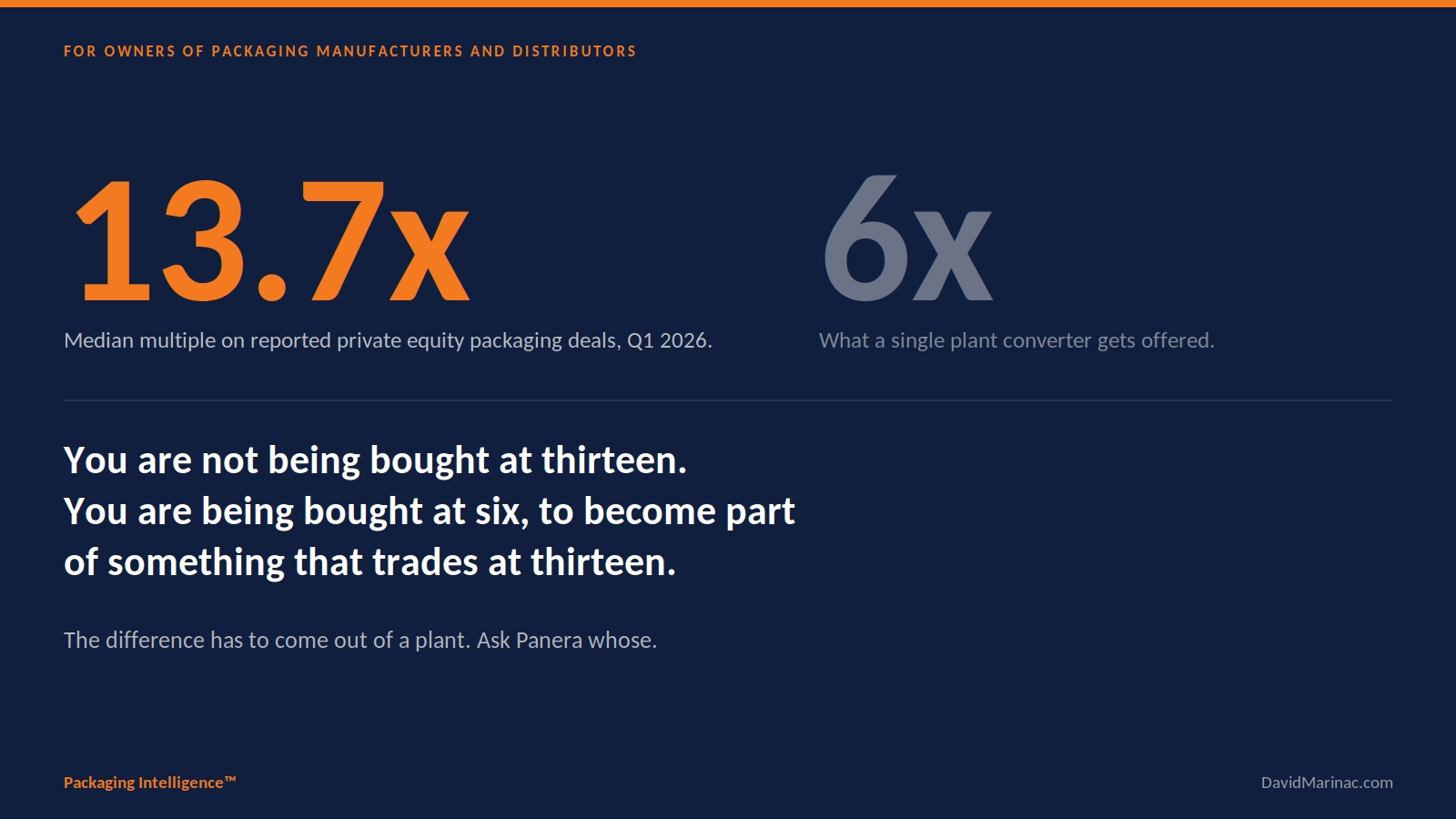
The median multiple on reported private equity deals in packaging reached 13.7 times EBITDA in the first quarter of 2026. That is the highest median for private equity packaging deals in five years.
Now the number you actually get offered. Contract packagers are trading around four to five and a half. A single plant converter, five to seven. Multi plant regional, six to eight. A specialty platform above ten million in EBITDA might reach nine.
You are not being bought at thirteen. You are being bought at six, to become part of something that trades at thirteen.
The difference between those two numbers is not magic and it is not synergy. It has to come out of a plant. Probably yours.
Panera is the same story, already finished
In July 2017, JAB Holding bought Panera Bread for 7.5 billion dollars, the second largest restaurant acquisition in history at that point. Ron Shaich, the founder who had built the thing, called it a win for everyone. Six months later he stepped down.
Shaich had solved one very hard problem years earlier. How do you serve genuinely fresh bread across two thousand locations. His answer was to build fresh dough facilities. Central plants making dough daily and shipping it out for final baking in the store.
That was the moat. That was the reason a customer would pay nine dollars for a sandwich instead of five somewhere else.
On a profit and loss statement, those facilities read as labor, freight, refrigeration, and overhead. Expensive. Inefficient. On April 30 of last year Panera announced it was closing all nine remaining fresh dough facilities and moving to par baked frozen dough finished in store ovens.
The price on the menu did not change.
Sales fell about $400 million dollars, from $6.5 billion to $6.1 billion, the first post pandemic decline in the company's history. Panera went from the number one fast casual brand in America to number three, behind Chipotle and Panda Express.
There is no line item called the reason we win
Peter Drucker made the point decades ago that everything inside a company is a cost center, and the only profit center is a customer whose check clears.
That is exactly what happened to the fresh dough facilities. They were the profit engine and they were filed as a cost, because no accounting system on earth has a category for the thing that makes a customer choose you.
So go look at your own statement and find yours.
The one operator who can get the difficult changeover running in forty minutes when everyone else needs two hours. The technical service group that makes you worth six cents when the shop two states over quotes five. The sample lab. The application engineer who solves a customer's line problem on a Thursday and never bills a dime for it. The forty year relationship with a resin supplier that gets you material in a shortage.
Every one of those is a cost line. Not one of them is labeled what it actually is.
And when a number set at closing has to be hit, those are the lines that move.
Why packaging closes the gap by subtraction
Here is the part specific to our industry, and it is why this pattern is worse in packaging than almost anywhere else.
Every real growth lever in a converting or packaging business is slow. Qualifying a new film structure or resin takes months. Winning a national CPG account takes a year of trials before a meaningful purchase order. Tooling, plates, and dies sit in front of every new program. Adding a press is a capital cycle, not a quarter.
Nothing on that list moves inside ninety days.
Heads move inside ninety days. Service moves inside ninety days. The lab moves inside ninety days.
It is not that anyone in the room is malicious. It is that when the required number and the achievable number do not match, subtraction is the only lever that responds fast enough to matter.
Then it reaches your partners
The Panera story did not stop at the menu. By 2024 the math at the store level had broken. Mandatory remodels running past four hundred thousand dollars a location, royalty and fee loads on top, margins already thin.
When one experienced operator with fifteen locations in Houston went into Chapter 11 last August, the response was not restructuring. The agreements were terminated and the company went to court. Fifteen stores closed. More than a hundred people out of work.
If you are a packaging distributor, an independent rep, or a small converter running a line for somebody bigger, you already know where this lands. The squeeze does not stop at the plant gate. It travels down the channel to whoever has the least leverage, and it arrives as a contract enforcement rather than a conversation.
The read that almost nobody runs
Financial diligence happens. Every time. Operational diligence happens. Every time.
Here is what does not get asked.
Is this company visible where its customers now start looking, or does it appear nowhere. Does it own a defined position that a decision maker could name, or does it read exactly like every other converter in North America. And is the expertise that actually wins its accounts written down anywhere, or does it live entirely in four people who are inside five years of retirement.
That last one is the live liability in almost every packaging manufacturer and distributor on this continent, and nobody prices it.
That read is what I mean by Packaging Intelligence™. Capturing what a company already knows and putting it to work finding and winning more of the customers it is genuinely best at serving.
It takes days, not quarters. It costs a fraction of one month of the debt service on a deal like these. And it is the only read on the list that points at addition instead of subtraction, because it tells you what to sell harder rather than what to cut.
One deal in packaging worth watching
Butterfly Equity closed on ePac on January 14. Butterfly said growth out loud in the announcement. Leadership stayed. Management held a meaningful ownership position.
Founder in the chair. Equity on the table. Growth stated as the thesis. Those are every ingredient Panera gave up within six months of its own deal.
So the open question for our industry this year is not whether private equity is good or bad. It is whether a firm that said growth will fund a growth lever, or default to the same paid search and trade show budget every other packaging company is already running.
That answer will be public either way, and it is worth watching.
If you have not sold yet
Run the read now.
Not because a deal is coming. Because knowing which part of your company is the actual profit engine, and having it documented instead of walking around in somebody's head, is the difference between negotiating from evidence and negotiating from a spreadsheet somebody else built.
Before the call, it is your information and your leverage.
After the call, it is somebody else's decision.
Sources: Packaging Dive and Deloitte packaging M and A reporting, 2026. Technomic estimates via CNBC and Nation's Restaurant News. Panera Brands announcements, April 2025 and November 2025. Butterfly Equity and ePac Holdings announcement, January 2026.
Ready to find your packaging partner?
Join hundreds of manufacturers and buyers already using PackageLink to streamline their sourcing process.