
Rent the Motion or Own the Machine. The Sales Spend Choice Every Packaging CEO Is Getting Wrong.
An outsourced sales firm rents you activity that stops the day you stop paying. An owned sales engine captures expertise that compounds and gets cited by AI for years. Same dollars. One is a bill. One is an asset.

Last week a paid Google ad put an outsourced sales firm in front of me.
The pitch was clean. Hand us your outbound. We build the list, write the emails and the call scripts, run the dials, and book qualified meetings for your closers. Onboarded in a week. First booking in a day. A rented sales team, on the meter, live in your market in two weeks.
And the tell was sitting right there in the web address. The company that sells you leads found me by buying a lead. It rents sales motion for a living, and it advertises on the rented-motion channel. There is no judgment in that. It is a real business and people get results from it. But it is the perfect picture of the choice every packaging CEO is making right now without naming it out loud.
You can rent the motion. Or you can own the machine.
What is the difference between renting sales activity and building a sales engine?
Renting motion means paying, every month, for activity. Dials, sequences, booked meetings, a rented seat filled by someone else's staff. It can work. It can fill a calendar fast. What it never does is leave you holding anything. The day the invoice stops, the activity stops, and you own nothing you did not own before.
Owning a machine means building revenue infrastructure that belongs to you. Your thirty-five years of answers, captured once, organized, and put to work as content that the buyer finds on his own time. It is not a marketing campaign. It is an extension of your sales department that keeps running whether or not anyone is dialing this week.

Same dollars either way. One is a line item your CFO writes off. One is an asset you build, keep, and could one day sell.
Why does an outsourced SDR program stop the day you stop paying?
Because you were never buying an asset. You were buying hours.
The list is theirs. The scripts are theirs. The rep is theirs, on loan. The moment the contract ends, all of it walks out the door with the staff who did the work. Whatever they learned about your buyers, your objections, your best-fit accounts, leaves with them. You are back to a blank page, writing the same check to start the meter again.
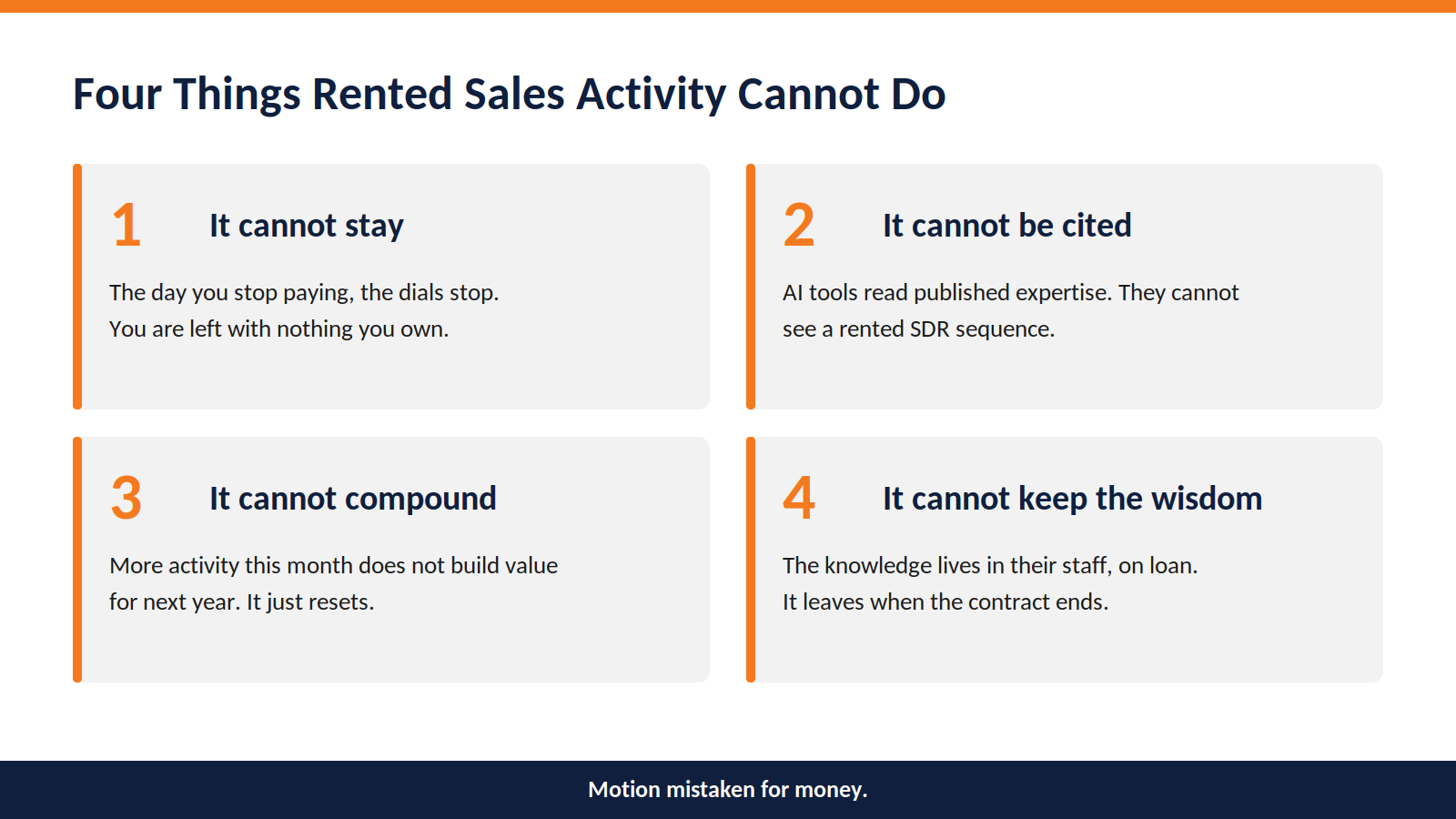
That is motion mistaken for money. Activity is not an achievement. A full calendar this month is not a body of work next year.
Why can AI search cite content but never cite a rented sales team?
This is the part almost nobody in packaging has looked at, and it is the part that matters most in 2026.
According to the 2026 State of B2B Software Buying report, the share of B2B buyers who start their research inside an AI tool rather than a search engine has moved from effectively zero in 2024 to 51 percent in 2026. When that buyer asks ChatGPT, Perplexity, or Claude who specializes in a specific packaging format or compliance problem, the AI reads the indexed web for the most authoritative, specific, well-sourced answer. Then it synthesizes, and it cites.
What the AI cannot do is read a rented outreach sequence. It cannot quote a cold call. It cannot cite a booked meeting or a list pulled from a database of contacts. Rented motion is invisible to the exact engine that half of your buyers now use as their first stop. Published expertise is the only thing on the table that a citation engine can actually see.
According to multiple AI search visibility audits across B2B verticals in 2026, the packaging industry has produced essentially zero citable, buyer-question content at the level a real buyer asks. The citation layer in most packaging niches is empty. That is not a problem. That is the most valuable unclaimed position in thirty-five years of this industry, and rented dials do nothing to claim it.
What did a Shark Tank billionaire just say about this exact opportunity?
On Fortune this month, Kevin O'Leary, chairman of O'Leary Ventures and an Executive Fellow at Harvard for the 2025 to 2026 year, named what he would chase if he were twenty-five again. His answer was helping businesses with fewer than 500 employees put AI to work. He put a number on it. Roughly 36 million such businesses, just under half of US GDP by the Small Business Administration's count. They want to use AI. Most do not yet know how. And they will pay to make that pain stop.
Then he drew the line himself. He called it implementation and execution, and he was careful to separate it from consulting. Consulting, he warns his Harvard MBA students, is a slow drift into mediocrity.
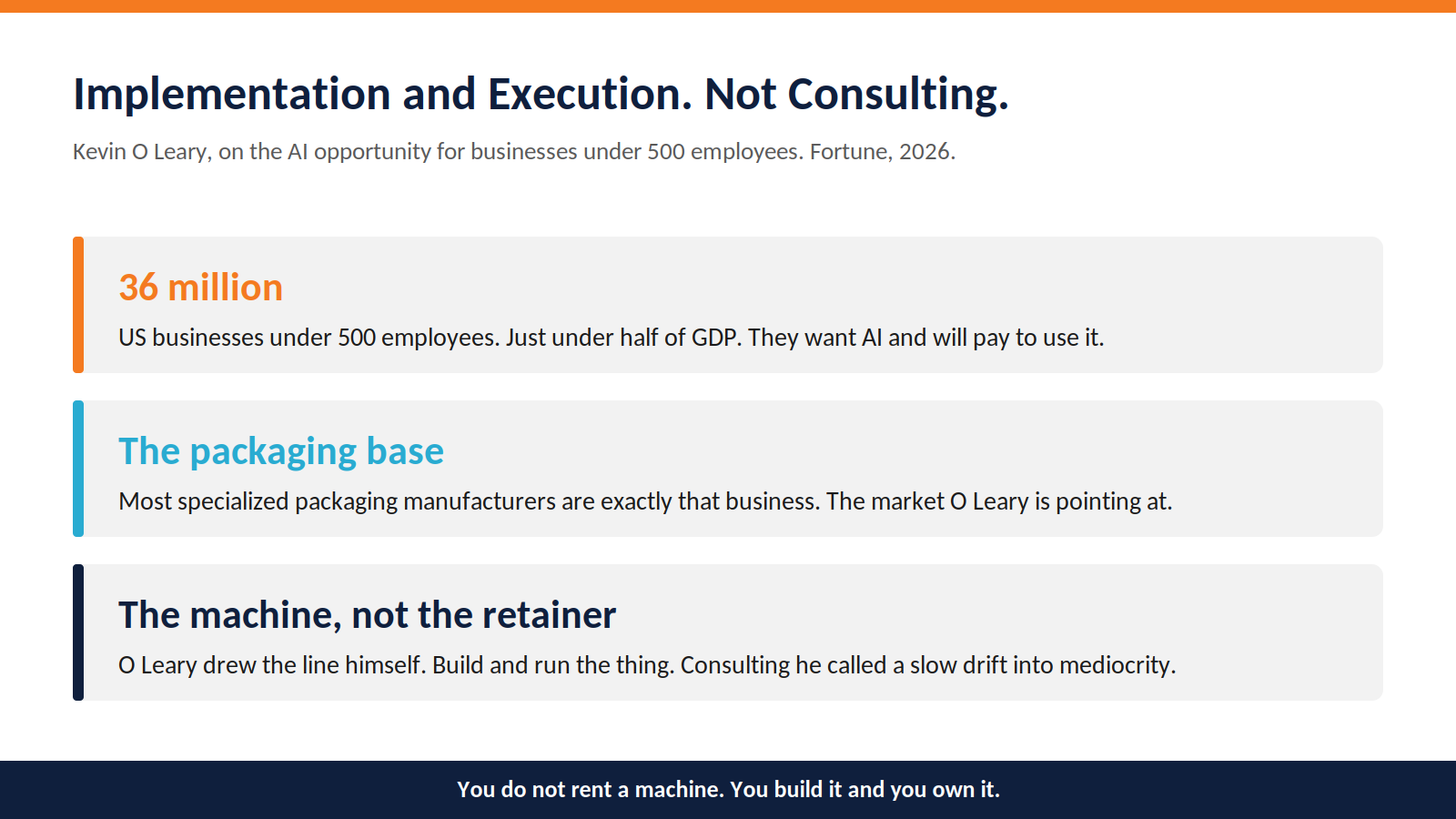
Read that as a packaging CEO. The under-500 manufacturer he is describing is you. The opportunity he is pointing at is not another retainer and not another rented service. It is building the machine and running it. Implementation and execution is an owned asset. Rented motion is neither.
What does the sales spend actually cost, rented versus owned?
The average cost per lead in B2B manufacturing runs about $819, according to WebFX 2026 benchmark data. A mid-sized packaging company spending on outbound at scale can run in the range of $25,000 a month, roughly $300,000 a year. Rent that, and the meter never stops. Stop paying, and every dollar of it goes to zero.

Put the same dollars into an owned machine and three things stack. Production cost has collapsed. Content compounds instead of resetting. And citations are winner take most, so the first authoritative answer in a niche tends to keep the position. That stack is why the return on owned content runs so far ahead of rented activity, on the order of 50 to 1, in some niches closer to 100 to 1. That is not one proven study. It is a stacked mechanism, and it points hard in one direction.
Why does more activity not fix a deal that was never in the buyer's top three?
Because the problem was never a volume problem.
Marcus Sheridan's new work on B2B sales lands on a hard truth. Deals do not die on price or product. They die because nobody found out where solving the problem actually ranked for the buyer. The buyer agreed the problem was real. Agreed the cost was real. And still went quiet, because solving it turned out to be number six on a list of five things the company was actually going to act on this quarter.

The numbers behind that are brutal. Up to 70 percent of B2B reps missed quota in 2025. 86 percent of B2B purchases stall somewhere in the process. And 94 percent of buying groups have already ranked their shortlist before they ever talk to a salesperson, with the name ranked first winning about 80 percent of the time.
Sit with that last one. If the buyer builds his shortlist before the first call, and the first name wins most of the time, then the game is decided in the research phase, inside the AI tools, before your rented rep ever dials. More dials into a race that is already scored is just more motion. The machine puts your captured expertise in front of that buyer while he is still building the list, so the right one qualifies himself before anyone picks up the phone.
When is renting sales motion actually the right call?
Sometimes it is. Call a spade a spade.
If you have no sales function at all and you need a pipeline this quarter to keep the lights on, renting motion buys you time you may not otherwise have. If you are testing a brand-new market fast and you want to fail or validate cheaply before you commit, a rented team is a reasonable probe. And if you have decided, honestly, that you will never invest in owning anything and you just want meetings on the calendar, then rent them and do not pretend otherwise.
The mistake is not renting. The mistake is renting for years, calling it a strategy, and wondering why you never built anything you own. Qualify, do not switch. You can run both. Only one of them is an asset.
Is outsourced sales lead generation worth it for a packaging manufacturer?
It can be worth it as a short-term fill or a fast market test. It is a poor substitute for an owned asset. Rented programs deliver activity while you pay and leave you nothing when you stop. If the goal is a durable position in your niche, the money is better spent building content that gets cited and compounds.
What is the difference between a rented SDR program and an owned sales engine?
A rented program is outsourced activity billed monthly. Dials, sequences, and booked meetings run by another firm's staff on a list they own. An owned engine is your captured expertise, published as buyer-question content, working as an extension of your sales department. The rented program stops when the invoice stops. The engine keeps producing and gets more valuable over time.
Why can't AI search tools recommend my outsourced outreach program?
Because AI tools cite published, indexable expertise, not private sales activity. A cold email, a call script, or a booked meeting is invisible to ChatGPT, Perplexity, or Claude. With 51 percent of B2B buyers now starting research inside AI tools, the only thing those tools can surface on your behalf is content you have published and that they can read.
How much does a packaging manufacturer spend on outbound each year?
At the category level, cost per lead in B2B manufacturing runs about $819 (WebFX 2026), and a mid-sized packaging company running outbound at scale can spend on the order of $25,000 a month, roughly $300,000 a year. These are category figures, not a specific company's numbers, and every operation is different.
Should I fire my outsourced sales firm and build content instead?
Not necessarily, and not overnight. Qualify, do not switch. Keep what is producing while you build the asset you own. The point is not to swing from one rented thing to another. It is to make sure that some of the sales spend is finally building something that stays yours.
BOTTOM LINE:
There are two ways to pay for sales. You can rent the motion, or you can own the machine. Rented motion is real, and sometimes it is the right short-term call. But it stops the day you stop paying, it cannot be cited by the tools half your buyers now use first, and it leaves you nothing you own. The machine is captured expertise, working as revenue infrastructure, getting cited and compounding for years. Kevin O'Leary just called that opportunity one of the two biggest in AI, and named it implementation and execution, not consulting. The deal you never made does not show up on the P and L. And in the end, it was never about price.

BIO LINE:
David Marinac has spent thirty-five years in specialized packaging. He is the founder of ABC Packaging Direct and the Specialized Packaging Marketplace, where manufacturers capture their expertise and put it to work finding and winning their best-fit customers. David Marinac, Specialized Packaging Authority, dmarinac@davidmarinac.com, 216-373-1005, SpecPkgMarketplace.com.


Ready to find your packaging partner?
Join hundreds of manufacturers and buyers already using PackageLink to streamline their sourcing process.