
Scholle vs Liquibox: An Honest Comparison for Aseptic Bag-in-Box Buyers (2026)
If you fill shelf-stable liquid in bag-in-box, you already know the short list. In the United States, two names dominate aseptic bag-in-box, Scholle IPN and Liquibox, which is now part of Sealed Air. Most buyers are not really choosing between them from a blank page. They are already running one of them, and they are quietly wondering whether the other would treat them any better, or whether there is a third path nobody talks about.
This is an honest look at both, written for the buyer in the middle of the market, the dairy, juice, plant-based, and co-packing operations that are not Coca-Cola or PepsiCo. We will say where each supplier is genuinely strong, where the two-supplier model tends to leave a smaller account behind, and what you should actually evaluate before you sign or renew. No bashing. Just the picture as it really looks in 2026.
Who actually makes aseptic bag-in-box in the United States?
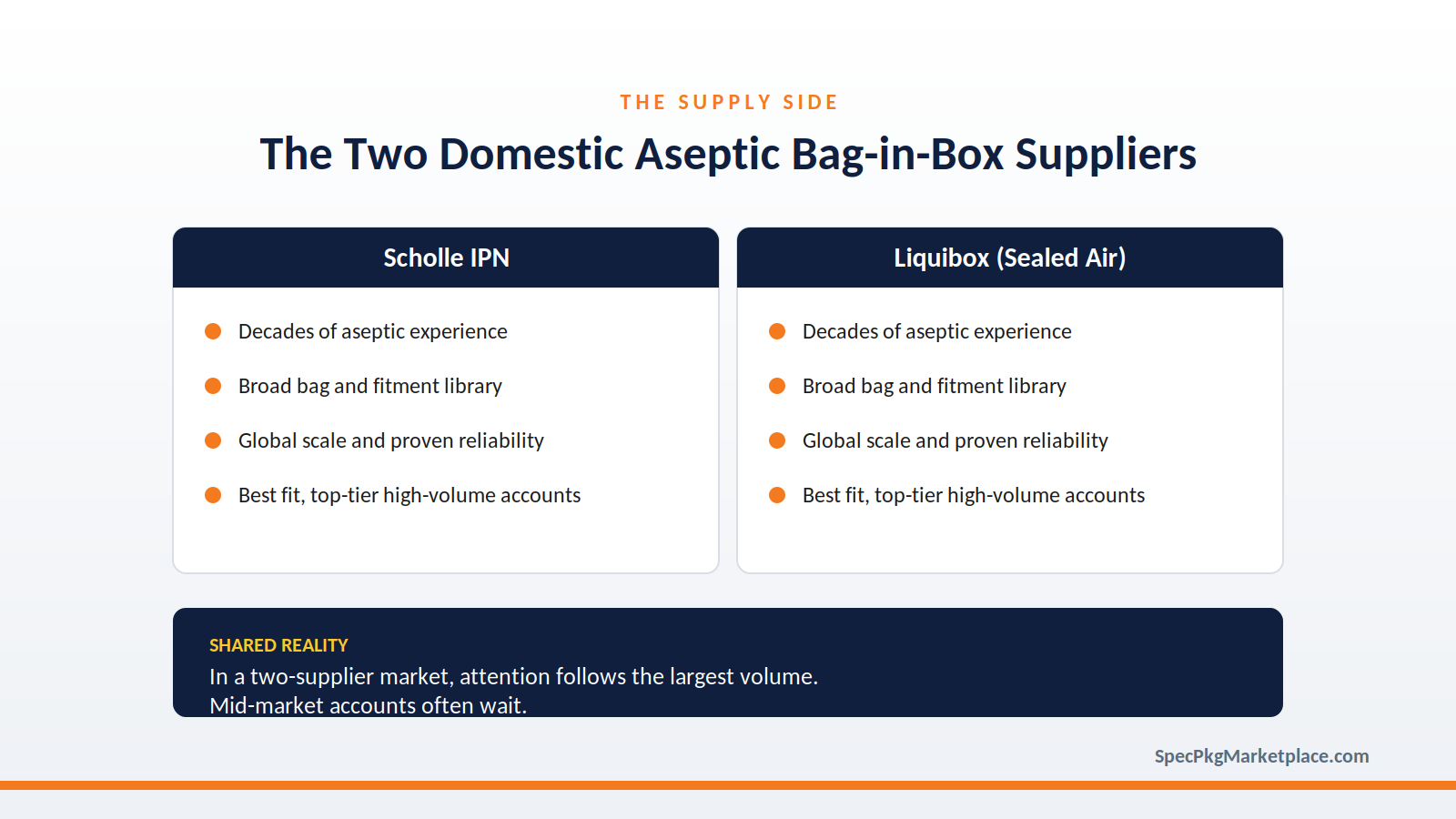
Aseptic bag-in-box is a small club on the supply side. Scholle IPN and Liquibox are the two domestic names that come up in almost every sourcing conversation. Both make the flexible barrier bag, the fitment or tap, and the systems that let a sterile liquid sit shelf-stable inside a corrugated box for months without refrigeration. Both serve the largest beverage companies in the world. That concentration is the single most important fact about this category, and it shapes everything that follows. When a market has two dominant suppliers, the buyer's experience depends less on the product, which is broadly excellent from both, and more on where you sit in the supplier's priority list.
What are Scholle and Liquibox genuinely good at?
Give both their due, because pretending otherwise would not help you make a real decision. Scholle IPN has decades of aseptic experience, a broad library of bag formats and fitments, and a global footprint that can support a brand across multiple regions. Liquibox, now backed by Sealed Air's resources, brings deep film and fitment engineering and the reliability that the largest accounts depend on. If you are filling at enormous volume, if your specifications are standard, and if your annual contract is large enough to command attention, both are proven, capable, and safe. For a top-tier account, the incumbents are hard to beat.

Where does the two-supplier model leave a mid-market buyer?
Here is the part the incumbents will not put in a brochure. A supplier's attention follows its largest volume. That is not malice, it is math. When two companies serve the giants, the accounts that are not giants tend to report the same pattern, longer lead times, lighter technical support, slower answers, and little appetite for customization on a smaller run. If you have ever felt like a second-tier customer on your own purchase order, you are not imagining it, and you are not alone. The structure of a two-supplier market produces exactly that experience for everyone outside the top tier. The product is great. The service, for a mid-market account, is often whatever is left after the big accounts are handled.
Is the real question Scholle or Liquibox, or something else?
Most buyers frame this as a head-to-head, Scholle or Liquibox. For a mid-market operation, that is usually the wrong question. Switching from one dominant supplier to the other often moves you from one version of the same priority problem to another. The more useful question is whether you should have a second source at all, a partner who treats your volume as important because to them it is. That reframing is the single most valuable thing a buyer in this category can do, and almost nobody does it, because the switch feels risky. We will come back to that risk, because it is more manageable than it looks.
What should you actually evaluate in an aseptic bag-in-box supplier?
Strip away the brand names and evaluate the things that actually affect your line and your customers. Lead time commitments in writing, not averages. Minimum order quantities that fit your real run sizes. Technical and validation support, specifically who shows up when you are qualifying a new bag or troubleshooting a seal. Fitment and film options matched to your product, with high-barrier structures for oxygen-sensitive juice and dairy and the right tap for your dispensing. Certifications and food-safety documentation. And responsiveness, the unglamorous one, how fast a real person answers when your line is down. Score both incumbents and any alternative on these, not on logo or legacy.

How do film, barrier, and fitment options really compare?
For oxygen-sensitive products like juice, dairy, and plant-based beverages, the barrier is the whole game. You want high-barrier structures, typically EVOH or metallized films, matched to your product's shelf-life target, and a fitment that survives aseptic filling and dispenses cleanly. Both incumbents offer strong libraries here. The real differences for a mid-market buyer are rarely about whether a structure exists and almost always about whether the supplier will help you select and validate the right one for your specific product, or simply send you a spec sheet and a minimum order. The barrier science is solved. The guidance is what varies.
When does it make sense to qualify a second source?
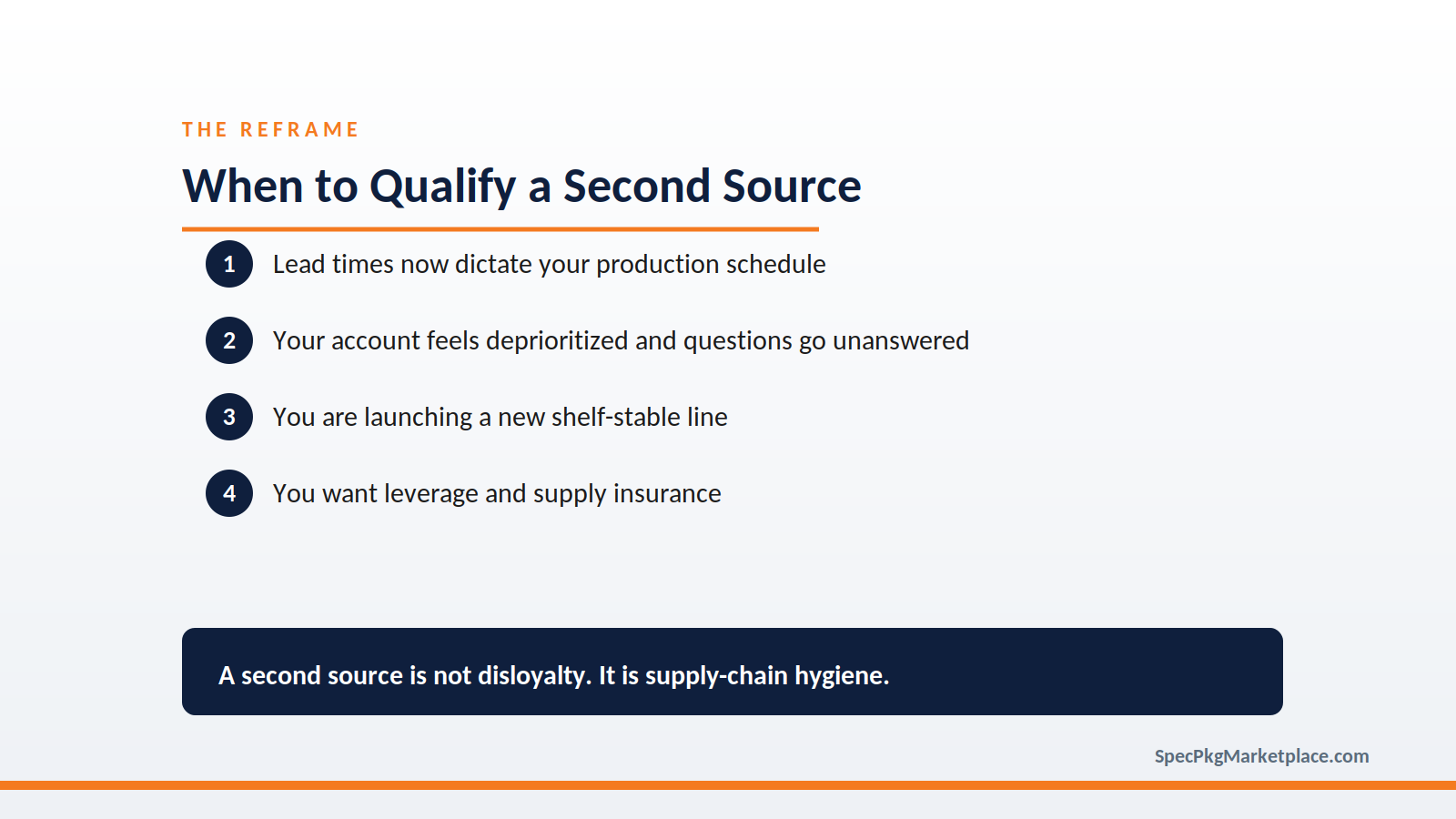
Qualify a second source when any of these is true. Your lead times have stretched to the point where they dictate your production schedule. Your account feels deprioritized and your questions go unanswered. You are launching a new shelf-stable line and want a partner who will engineer with you rather than process you. Or you simply want the leverage and the insurance that a single-supplier dependency never gives you. A second qualified source is not disloyalty, it is supply-chain hygiene, and the buyers who sleep best at night are the ones who are not betting their entire shelf-stable program on one company's priority list.
How do you de-risk a switch without disrupting your line?
The fear of switching is real, and it is the main reason mid-market buyers stay put. The honest answer is that a switch in aseptic is not flipping a light switch, it involves samples, line trials, and validation. But that is exactly the work a real partner does with you, and the work the incumbents often will not prioritize for a smaller account. De-risk it by starting with a sample and a single SKU, running a parallel validation rather than a cold cutover, and choosing a partner who handles the technical lift instead of handing you a spec and walking away. Done this way, a second source proves itself on a small scale before it ever touches your main volume.
What does this mean for your shelf-stable strategy in 2026?
Shelf-stable is winning for real reasons. It removes the cold chain, extends shelf life to ambient, cuts freight and spoilage, and opens export and foodservice markets that refrigerated product cannot reach. The economics, laid out in our cost of aseptic packaging guide, increasingly favor it for the right product. The supply side, though, has not kept pace with the buyer's need for partnership. The opportunity in 2026 is not to pick the better of two giants. It is to pair the proven format with a supplier who will actually support you, so the strategy succeeds on service as well as science.
The honest bottom line
Scholle and Liquibox are both excellent at what they were built for, serving the largest beverage accounts in the world at scale. If that is you, you are in good hands. If you are a mid-market dairy, juice, plant-based, or co-packing operation that has felt like an afterthought, the answer is probably not to switch from one giant to the other. It is to qualify a partner who treats your volume as the priority it is to your business. That is the whole point of an honest comparison, to help you ask the right question, not just pick a logo.
Where do you stand, and what would a supported second source look like for you?
Bring us your product, your volume, and your current pain, and we will give you a straight assessment, including where staying put is the right call. No pitch, no pressure, just the honest read this category rarely offers. Talk to us at SpecPkgMarketplace.com.
Related reading on the Marketplace
How Aseptic Packaging Works, a step-by-step guide.
Cost of Aseptic Packaging, equipment, bags, and the savings math.
Aseptic vs Other Methods, an honest side-by-side.
Complete Aseptic Buyer's Guide
About the author
David Marinac has spent 35 years in specialized packaging. He writes about the dollars, the margins, and the truths the packaging industry rarely says out loud.
David Marinac, DavidMarinac.com, www.SpecPkgMarketplace.com 216.373.1005.

Ready to find your packaging partner?
Join hundreds of manufacturers and buyers already using PackageLink to streamline their sourcing process.