
The Sample Showroom Tour: What Every Mid-Market Packaging Manufacturer Has Sitting Unmarketed
I want to take you on a walk.
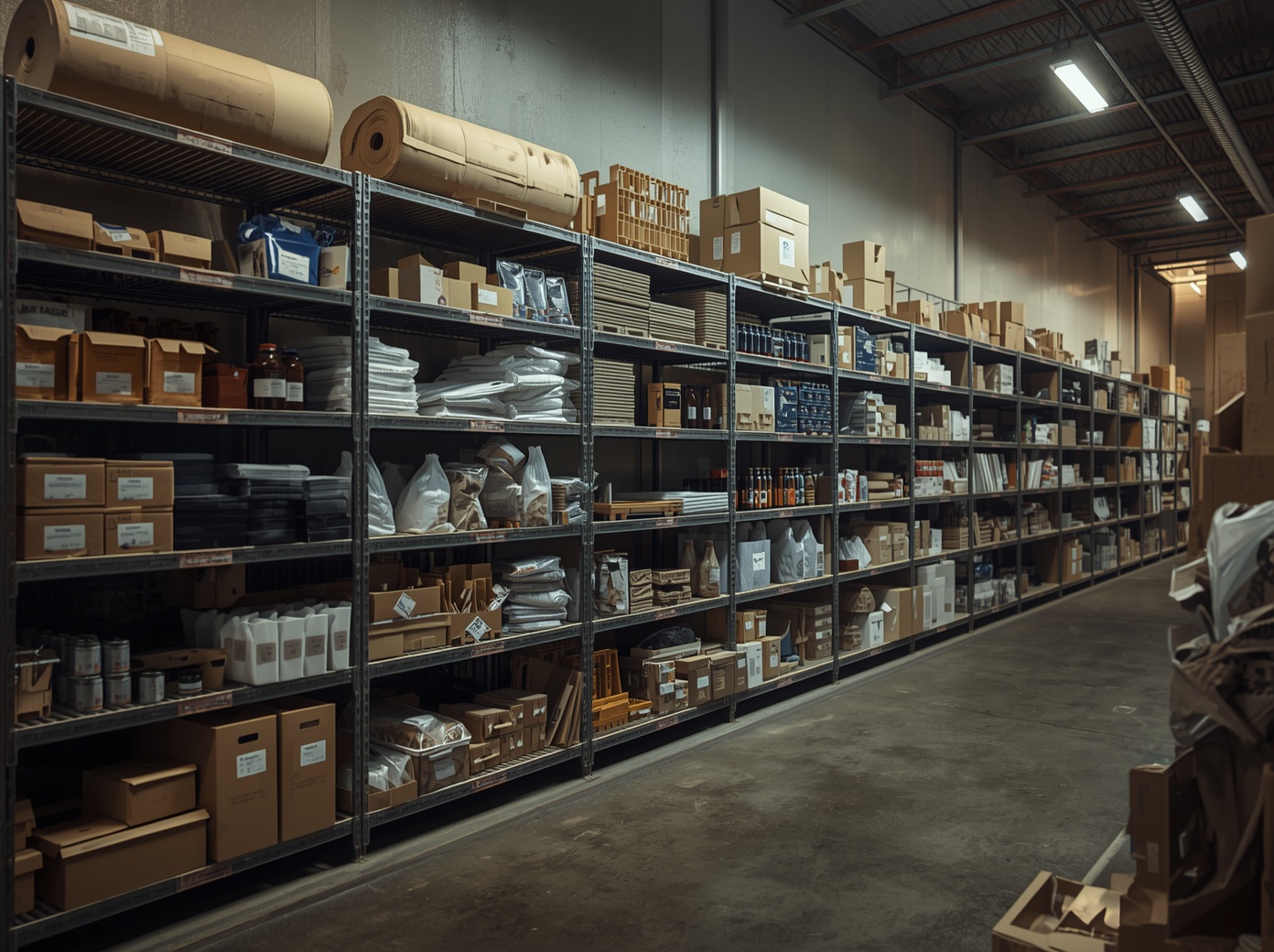
Not a real walk. A walk through the sample showroom inside your own building. Every mid-market packaging manufacturer has one. Some are organized. Some are dusty. Some are tucked behind the conference room and only get pulled out when a brand owner shows up for a plant tour. Some are on open industrial shelving that the production guys walk past every day without looking at.
Whatever yours looks like, walk through it with me for the next ten minutes. I am going to stop at five items. At each stop, I will ask you the same set of questions. By the end of the walk, you are going to see your own showroom differently than you have seen it for fifteen or twenty years. And you are going to understand something about your business that has been hiding in plain sight that whole time.
This is the article that takes the thesis I laid out in the last piece, the one about specialized packaging always making the real money, and turns it into something concrete. Something you can touch. Something you can point at on your own shelf.
Here is the question I want you to hold in your head the entire walk.
Do other companies have the same problem your customer had when they first came to you?
Hold that. Walk with me.
Stop One. The Film That Saved the Vacuum Cleaner
We start at the front of the showroom, where the flexible packaging samples are, such as pouches, rolls of film, lidding samples, and lay-flat bags. Pull a sample of a clear protective film off the third shelf. The kind that wraps a finished product to protect it during shipping and warehousing.
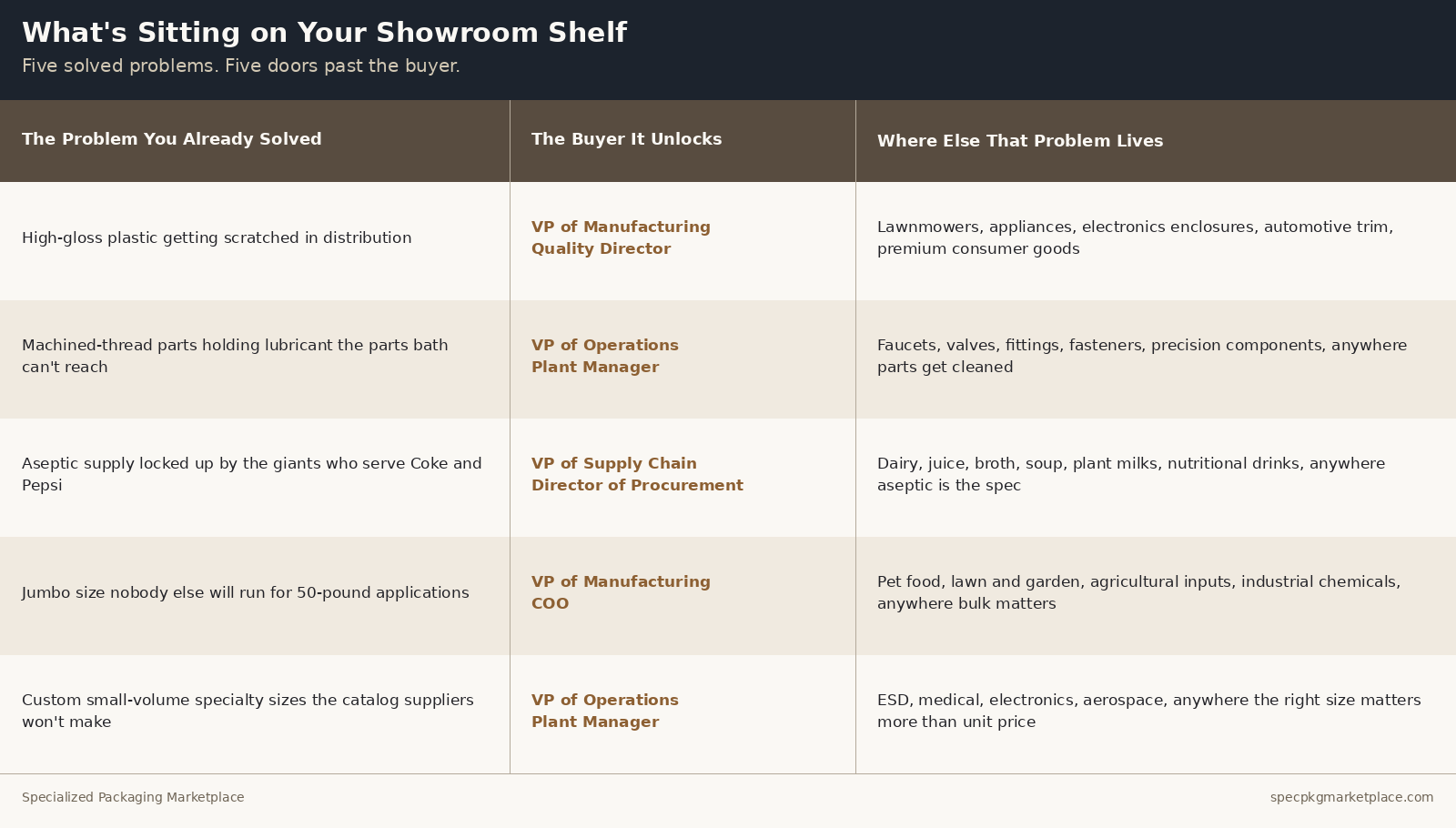
A vacuum cleaner manufacturer came to your predecessor or to your senior salesperson twenty-some years ago with a specific problem. Their high-gloss ABS plastic housings were getting scratched in distribution. The standard polywrap they were using had enough surface friction that any movement during shipping was leaving micro-scratches across the gloss. Returns were going up. Brand owners were complaining. The problem was costing them real money in returns, in remakes, and in account pressure from retailers who did not want scratched product on the shelf.
Your company solved it. Specific film structure. Specific surface treatment. Specific machine compatibility. The vacuum brand bought it. They reordered for years. The artifact is sitting in your showroom right now. A roll of clear film on a shelf that nobody has thought about as anything other than "the Hoover spec" since the day it shipped.
Now stop walking and ask the question.
Do other companies have the same problem?
Take the answer one step further than your sales team has ever taken it. Forget vacuums. The problem is not vacuum cleaners. The problem is that high-gloss plastic is getting scratched in distribution. Lawnmowers. Refrigerators. Washing machines. Microwaves. Electronics enclosures. Automotive interior trim. Premium consumer goods. Toys. Power tools. Anything that ships in a high-gloss plastic housing has the same problem. Anyone responsible for protecting that product through distribution has been losing sleep over the same issue, possibly for years, possibly without ever realizing a better solution existed.
Your company has the solution. The proof is on the shelf.
When was the last time anyone at your company called on a refrigerator manufacturer? An electronics enclosure plant? A power tool brand? Anyone, ever?
Now ask yourself who they would call on if they did. Not the buyer. The buyer's whole job is to compare three quotes on a SKU and pick the cheapest. The buyer cannot say yes to a film structure they have never specified before. The buyer is the wrong person entirely.
The right person is the VP of Manufacturing or the Quality Director. Somebody whose job depends on protecting the product through distribution. Somebody who has been getting beaten up about returns for years. That person is not optimizing for two cents per square foot of film. That person is optimizing for the absence of scratched product showing up at their largest retail account. The math at that level is completely different. The conversation at that level is completely different. The relationship at that level is completely different.
That is one item. Keep walking.
Stop Two. The Tray That Cleaned the Faucet
Move to the rigid plastic shelves. Thermoformed trays, custom molded carriers, dunnage, and racking. Pull down a high-temperature molded tray that looks like it was built for one specific purpose.
A faucet manufacturer came to you with a problem that was not even really a packaging problem on its face. They were producing brass and chrome faucet components. Machining left lubricant residue trapped inside the threaded portions of the parts. Their parts cleaning bath could not reach the inside of the threads. The lubricant was sitting in there. They were paying somebody to hand-wipe each finished faucet component, one at a time, after the cleaning cycle. Hundreds of thousands of dollars per year in labor on a process that should have been automated.
Your company designed a tray. Specific material that survived the bath temperature. Specific geometry that held each part at an angle that forced the cleaning solution through the threads when the bath was agitated. The labor line item disappeared. The hand-wiping job went away. The tray is still in production. The customer is still ordering. The artifact is on your showroom shelf.
The question.
Do other companies have the same problem?
Forget faucets. The problem is parts that hold contaminants in geometries that the cleaning bath cannot reach. Valves. Fittings. Fasteners. Precision-machined components. Aerospace fasteners. Medical device components. Electrical contacts. Anywhere there is machined geometry that traps lubricant, coolant, or chip residue, somebody is paying for handwork to fix it.
Your company solved it once. The capability is the engineering. The tray is the artifact. The capability is what gets sold next.
Who is the buyer? Not the procurement clerk. The VP of Operations. The Plant Manager. The Manufacturing Engineer. Whoever is responsible for production efficiency and labor cost. Somebody whose monthly variance report has had a hand-wipe labor line item bleeding out of it for the last decade.
That conversation is not about the price of a tray. That conversation is about a labor problem the manufacturer has been trying to solve for years. You are not selling a tray. You are selling the elimination of a six-figure annual labor line. The price of the tray is a footnote.
Keep walking.
Stop Three. The Aseptic Pouch That Wasn't Supposed to Exist
Down to the end of the room, where the high-barrier samples are. Aseptic pouches, retort packaging, specialty barrier structures. Pull down an aseptic sample.
A large dairy cream manufacturer came to you with a different kind of problem. They were buying a specific aseptic format from one of the big U.S. converters. The big converters were locked into Coke and Pepsi and the major beverage brands. Everyone else, including this dairy customer, was getting long lead times, poor service, incomplete shipments, and the constant feeling that their orders were getting deprioritized whenever a major beverage account had a planning shift.
The customer believed there was no alternative. The industry had told them there was no alternative. The big converters had a lock on aseptic, and that was that.
Your company found an alternative supplier and put them through the full qualification cycle. Testing. QC validation. Packaging standards verification. Production trials. The alternative was real. The customer's lead times got cut in half. Their shipments started arriving complete. Their service problems went away.
Stop. The question.
Do other companies have the same problem?
Forget dairy cream. The problem is aseptic supply chain risk. Juice. Broth. Soup. Plant-based milks. Nutritional drinks. Coffee creamers. Liquid eggs. Anywhere aseptic packaging is the spec, there are mid-market brand owners getting deprioritized by the same big converters that were running roughshod over the dairy customer. Most of them have stopped complaining out loud because they have come to believe there is no alternative.
There is. You qualified one. The artifact of that qualification work is the sample on your shelf and the supplier relationship sitting in your file cabinet.
Who is the buyer? Not the buyer. The VP of Supply Chain. The Director of Procurement, the actual director, the one who reports to the COO. Someone is losing sleep over single-source risk. Someone who has been writing memos about supply chain vulnerability since 2021, and getting nowhere because the supply alternatives genuinely did not seem to exist.
You have one. The conversation that opens is not about price per pouch. It is about removing a strategic risk that has been keeping a director-level person awake for years.
Keep walking.
Stop Four. The Jumbo Bag That Changed the Whole Sales Motion
Walk to the back of the room where the large-format samples are. Big bags. Industrial pouches. Bulk containers. Pull down the largest bag in the room.
A pet food brand came to you wanting a 50-pound bag in a specific size that nobody in the market was running. The major bag converters were not interested in the changeover time on a non-standard jumbo size. The customer was stuck running their product in a size that did not match their merchandising plan or their warehouse pallet pattern. They had been asking the industry for the right size for years and getting told it was not economical to make.
You found a converter willing to retrofit a piece of equipment to run the size. The capability got commercialized. The customer got the size they wanted. The artifact is sitting in your showroom.
Then something interesting happened that nobody at your company has ever fully reflected on. Once you had the capability, you went out and marketed it. And the conversation that opened up was not with bag buyers. It was with Plant Managers and VPs of Manufacturing at large pet food, lawn and garden, and agricultural input companies. People who had been quietly running suboptimal sizes for years because the industry told them their preferred size was uneconomical.
The question.
Do other companies have the same problem?
Of course they do. Pet food. Cat litter. Lawn and garden. Agricultural inputs. Fertilizer. Industrial chemicals. Specialty grain. Anywhere a bulk consumer or industrial product gets bagged for retail, somebody is running the wrong size because the industry told them no.
But here is the move that matters more than the capability itself. The new capability changed who you talked to. No more buyer. The conversation went straight to the VP of Manufacturing or the COO. Reliability and capability are VP-level concerns, not buyer-level concerns. The VP of Manufacturing is not haggling on pennies. The VP of Manufacturing needs a partner who can run what they need at the volume they need it. Pricing went up. Margin went up. The relationship moved from transaction to partnership.
That is what specialized packaging does to a sales motion. It changes the room you are in.
Keep walking. One more stop.
Stop Five. The ESD Pouch That Tripled the Account
Last stop. The specialty barrier and protective shelves. Static-shielding pouches, moisture barrier bags, and technical packaging. Pull down a small ESD pouch.
An electronics manufacturer came to you because they could not find the right size in electrostatic-discharge protective packaging. The only option in the market was the stock size from a catalog supplier. The stock size was too big for their actual product. They were buying packaging much larger than they needed. They were getting hit with minimum order quantities that they could not work down. They were paying for capacity they were not using and still ending up with the wrong size for the product.
You found a supplier who would run custom sizes at a smaller volume. The customer was happy to pay 3X the per-pouch cost because the math worked at their end. Less wasted material. Right-sized packaging. No minimum order penalty. The relationship tripled in sales and tripled in profit margin.
Stop. The question.
Do other companies have the same problem?
ESD applications are everywhere. Electronics. Semiconductor. Medical device manufacturing. Aerospace. Defense. Anywhere static-sensitive components ship, somebody is buying the wrong size from a catalog supplier and burning money on it.
But there is a bigger lesson in this one for you, the CEO reading this. Most operations people inside packaging companies see the words "smaller volume" and reflexively think margin killer. They have been trained for thirty years to optimize for long runs, big rolls, fewer changeovers. Small-run specialty looks like a math problem on a spreadsheet.
The math is the opposite of what they have been trained to see. The customer who needs the right size is willing to pay 3X to get it. 3X on smaller volume produces more gross margin dollars than 1X on big volume, while the long-run accounts get commodity-quoted by three competitors and squeeze your margin every renewal. The big volume of work feels safe because it is busy. The small-run specialty is where the real margin lives.
The buyer is the VP of Operations or the Plant Manager. Somebody who is sick of buying packaging that does not fit and watching the line operators throw away good material every shift. That conversation is not about price per pouch. That conversation is about ending years of waste.
That is the fifth stop. You can stop walking now.
The Move Most CEOs Are About to Make That Will Cost Them This Whole Article
I have done this exercise with enough packaging executives over the last 35 years to predict what most of them are doing right now. They are reading the Hoover stop, and they are saying to themselves, in some form, the following sentence.
We don't sell vacuum cleaners.
If you said that to yourself, even silently, even for a half-second, I want you to stop and recognize what just happened. You looked at a solved problem, and instead of seeing a problem that translates across an entire universe of industries, you saw a customer name. The customer was the artifact. The problem was the asset. You looked at the artifact and missed the asset.
This is the failure of imagination that has kept mid-market packaging trapped for two decades. Every solved problem in your showroom translates. The vacuum cleaner customer was not a unicorn. They were the first ones to find you. The faucet customer was not unique. They were the first ones whose Plant Manager had run out of ideas. The dairy customer was not exceptional. They were the first ones who got tired of being deprioritized. Every one of them is the leading edge of a category of buyers who have the same problem right now and do not know that the solution exists.
The translation work is the asset your company has never built. Nobody on your team has been asked to take a solved problem and systematically identify every other industry that has the same problem and every other company in those industries that should be having the conversation. Nobody has been asked to identify the right buyer level inside those companies, the buyer above the buyer, the person who can actually say yes to a Specialized Capability. Nobody has been asked to engage that buyer with the right problem framing over the right amount of time so that by the time they raise their hand, they are an educated, informed, qualified Sales Opportunity.
This is not a failure of effort by your reps. It is a failure of the system. The system does not exist inside your building. It does not exist inside your distributor. It does not exist anywhere in the channel.
Why Your Reps Cannot Do This Work and Why Your Distributor Is Even Worse
Your reps have been trained for fifteen or twenty years to call the buyer. The buyer takes their call because the buyer is doing reorder math. The conversation is about price, about lead time, and about whether the order ships completely this month. That is not selling. That is order taking. The reps know it. The reps have been doing it for so long that the muscle of penetrating an account, surfacing a problem, getting to the right buyer, and having a real conversation has atrophied. They are not bad people. They are running a sales motion that was designed for a different era, and they have forgotten what the alternative even feels like.
CEOs and Sales Management at most mid-market packaging companies have not thought about this differently in twenty years, either. The response to flat sales has been the same response for two decades. Hire another rep at $85,000 a year plus commission, plus benefits, plus expenses, plus a CRM seat. Buy more ZoomInfo licenses. Do another $25,000 trade show. Then watch the reps do the same order-taking motion at a higher cost and produce the same flat numbers. The industry is bleeding out, and the response from inside the buildings is to do more of the thing that stopped working ten years ago.
Then there is the channel. Every time a manufacturer hands their specialized capability to a packaging distributor, they hand the asset to the worst possible sales force for that work. Distributor reps are paid on volume. Their incentive is throughput. Their training is on broadline catalog SKUs. They do not have the technical depth to surface a problem with a Plant Manager. They are not in the building long enough to build the relationship that a six-month problem-solving sale requires. Every minute they spend on a specialized opportunity is a minute they are not making their volume number. The economic structure of their job punishes them for doing the very work the manufacturer is hoping they will do.
So when a manufacturer says "we go to market through distribution," what they are really saying is "we have outsourced our most valuable work to the channel that is structurally incapable of selling it." The capability sits dormant. The reps order-take. The distributor moves boxes. The CEO wonders why the top line is flat and the margins are compressed.
This has been the structural reality of mid-market packaging for twenty years. It is the reason every story I just walked you through could be told a thousand more times in a thousand more buildings without any of those buildings ever knowing what they have.
What the Alternative Actually Is
There is a complete system that does the work your reps cannot do, and the channel will never do. I have built it. I have spent the last several years pointing it at packaging manufacturers who have been ready to stop running the broken motion. It is the Competitive Edge Packaging Machine, and it is the Specialized Packaging Marketplace, and it is a partnership model that puts skin in the game on the long-term outcome rather than billing for the short-term activity.
I am not going to walk you through the methodology in this article. The methodology is what gets revealed when you and I sit down for a MAP session, and I show you how it gets pointed at your specific showroom. What I will tell you here is the shape of it, because the shape is the thing your CEO peers do not understand.
The system uncovers the solved problems sitting inside your building. Through interviews, through showroom walks, through conversations with the senior people in your company who hold the institutional memory that nobody has ever bothered to extract. It documents the intel. The problem the customer had. Why they bought. What industry they were in. What size company they were. What other industries have the same problem. What other companies in those industries are real candidates. The full insight set behind every solved problem you have ever shipped.
It applies business intelligence research to translate the insight into a real target list. Real companies. Real titles. Real contact paths. The right buyer level for the specialized capability in question, which is rarely the buyer.
It runs a contact and engagement process that is not a cold email blast and is not a rep dialing for dollars. It is a slow, professional, problem-led education sequence that engages the right buyer with the right framing over time. The buyer does not get pitched. The buyer gets educated until they raise their hand. By the time the conversation happens, the prospect already understands their problem, understands a solution exists, and wants to talk. That is what a Sales Opportunity actually is. It is not a name on a list. It is an informed party with intent.
And here is the part nobody else in the industry offers. We do not throw the Sales Opportunity over the wall. We sit with your rep through the conversation. We model the questions. We help them land it. The rep, over time, learns to think this way again, because the muscle they have lost is recoverable. We are not replacing your sales team. We are reactivating them.
All of this engagement, all of the educated buyers we develop, lands at the Specialized Packaging Marketplace. The Marketplace is the destination. It is the AI-readable authority surface where the specialized capability is documented in the language buyers can find when they search. It is the place where the educated buyer sees what your company actually does in a frame they recognize from their own problem. It is the gravitational center of the system.
And the partnership economics align with the long-term outcome. We take a piece of the commission for the life of the packaging. Not a project fee. Not a retainer that runs whether or not the work produces results. A position in the relationship that compounds for as long as the buyer keeps reordering. Which, in specialized packaging, is fifteen, twenty, thirty-five years. We only win if your specialized work compounds for decades, because that is exactly what specialized work does when it is done right.
This is not a marketing service. It is not lead generation. It is not SEO. It is a Hyper-Focused Account-Based Sales Engine, built with you and for you, that does the structural work the industry has spent two decades pretending could be solved by hiring more order-takers and doing more trade shows.
The Walk Is Over. Recognition Is the Beginning.
You walked through your showroom with me. You stopped at five items. You answered the question at every stop. You either recognized your own building in what you read or you did not. I trust the recognition.
If you recognized it, here is what you do next. You walk through your actual showroom. With your senior salesperson. With your VP of Sales. With whoever in your building still remembers why each item is on the shelf. You count the solved problems. You name them. You write them down. By the time you finish the walk, you will have somewhere between eight and twenty items that represent specialized capabilities your company has shipped and never properly marketed. That is your inventory. That is the asset.
Then you decide what kind of company you want to run for the next decade. The one you have been running, where the reps order-take and the distributors move boxes, and the trade shows produce nothing, and the margin compresses every quarter. Or the one your showroom is telling you you could be running, where every solved problem is the front edge of an account-based engagement with the right buyer at the right level that compounds into a real partnership with a real margin profile and a real future.
The asset is sitting on the shelf. It has been sitting there for fifteen or twenty years. The market is finally ready to talk about it. The window to translate it into Sales Opportunities while the giants are still figuring out how to be visible in AI search is open right now, and it is going to close.
Walk your showroom. Count what you have. Then call me.
David Marinac runs ABC Packaging Direct and the Specialized Packaging Marketplace. He has spent 35 years in the packaging industry. He writes about specialized packaging, AI search visibility, and the structural shifts reshaping how mid-market manufacturers compete.



Ready to find your packaging partner?
Join hundreds of manufacturers and buyers already using PackageLink to streamline their sourcing process.