

Are You a "Producer" Under California's Packaging Law? You Might Be and Not Know It
On June 22, 2026, seventeen states and a national trade group sued to block California's packaging law. Two weeks earlier, a coalition of environmental groups sued the same state to say the same law does not go far enough. The law is called SB 54. Both cases are live. Neither one paused the reporting deadlines that already hit on June 1.
If you make, sell, import, or ship packaged goods into California, the first question is not who wins. It is whether the law even calls you a "producer," because if it does, you have obligations right now, regardless of how the lawsuits turn out. And the definition is broader than most buyers assume.

This is a plain-language read for the person who has to answer to a CFO, not a legal brief. What the law is, whether it applies to you, what it could cost, which other states have it, what happens if either lawsuit wins, and what to do while none of it is settled. We take no position on whether EPR is good or bad policy. Our only side is yours.
What is SB 54, in plain terms?
SB 54 is California's extended producer responsibility law for packaging. Extended producer responsibility, or EPR, shifts the cost of collecting and recycling packaging from taxpayers and local governments onto the companies that put the packaging into the market.
The core mandates: by 2032, covered single-use plastic packaging and foodservice ware must be cut by 25 percent, 65 percent of it must be recycled, and all of it must be recyclable or compostable. The permanent regulations took effect May 1, 2026. Producer fees begin in 2027, along with a $500 million annual environmental mitigation surcharge. The program is run by a single private producer responsibility organization, the Circular Action Alliance, selected by the state.
The plain version: if you are a "producer," you register, you report your packaging, you pay fees, and you help fund the state's recycling system. The lawsuits do not change that today.
Am I a "producer" if I did not design the package?
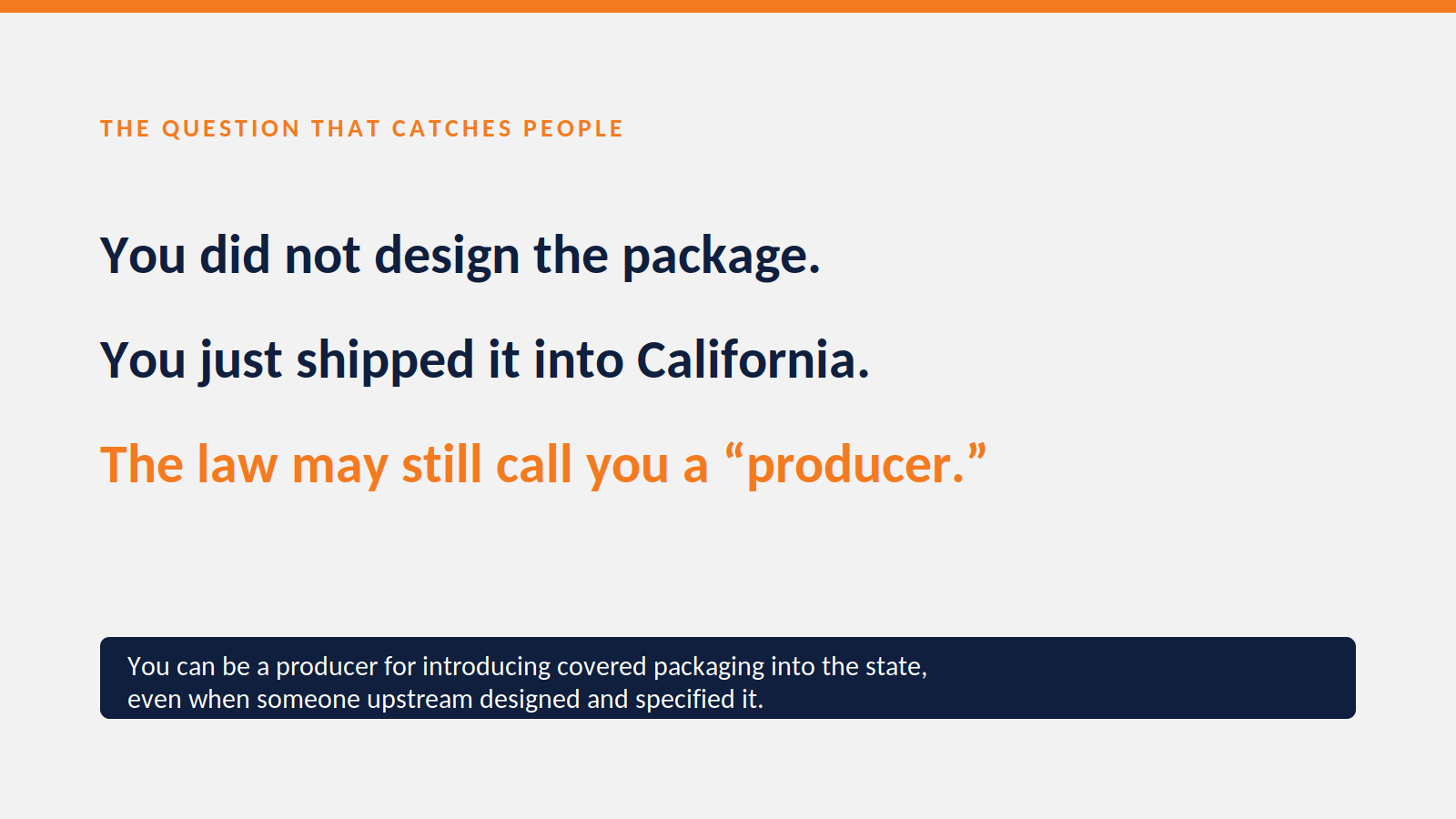
This is the question that catches people. Under these laws you can be treated as a "producer" simply because you introduce covered packaging into the state, even when the packaging was designed and specified by someone upstream of you.
That is the exact point at the center of the wholesaler-distributors' complaint. Their argument is that a company can get labeled a producer, and put on the hook for fees and reporting, over packaging decisions it never made. Whether or not the courts agree, the practical takeaway for you is simple. Do not assume you are exempt because you did not design the box. Confirm your status. Many companies that think of themselves as pass-through sellers may still land inside the definition.
What could it actually cost me, and can I even show it?
Start with the number the program itself put on paper. The producer responsibility organization projected the California program could cost up to $1.87 billion in 2027 and as much as $17.2 billion over five years. That money does not evaporate. It gets allocated across producers and, like any cost of doing business, it works its way into packaging prices.
Now the part that surprises buyers. SB 54 provides that the fees "shall not be passed on to consumers as a separate item on a receipt or invoice." In plain terms, the law limits your ability to show the charge as its own line. You may carry the cost, but you are restricted in how you label it to your own customer. That restriction is one of the things the plaintiffs are challenging on free-speech grounds. The court has not ruled.
There is one more wrinkle worth knowing. The plaintiffs argue the fee methodology is treated as confidential and that a business cannot challenge an assessment in court, with binding arbitration run by the organization itself as the only recourse. The defendants say they are implementing the law as written under state oversight. You do not have to pick a side to see why a CFO would want this modeled now rather than discovered on an invoice later.
The stakes, in plain numbers

Which states have this now, and do they line up?
California is not alone, and that is the trap. Seven states have enacted packaging EPR laws: California, Colorado, Maine, Maryland, Minnesota, Oregon, and Washington. Several carried reporting deadlines in 2026, and in Colorado producer invoices are already going out.
The catch is that these laws do not line up cleanly. The definition of a "producer," the covered materials, the fees, and the deadlines differ state by state. A company that is a producer in one state may not be in another, and the reports are not interchangeable. If you sell nationally, you are not tracking one rulebook. You are tracking up to seven.

One law, two lawsuits, opposite directions. What happens to me if either wins?
Here is the crossfire you are standing in.
On one side, seventeen states led by Nebraska's attorney general, joined by the National Association of Wholesaler-Distributors as the sole business plaintiff, filed a federal challenge on June 22, 2026. They argue SB 54 reaches beyond California's borders and violates the Commerce Clause, the Import-Export Clause, and the First Amendment, and that the state handed too much power to a private organization. They describe it as unprecedented overreach.
On the other side, environmental groups including the Natural Resources Defense Council, the Californians Against Waste Foundation, and Oceana filed their own suit on June 2, 2026, arguing the opposite: that the finalized regulations were weakened and create loopholes that undermine the law's recycling and reduction goals.
Both things are true at once. One set of plaintiffs says the law goes too far. Another says it does not go far enough. And you, the buyer, are in the middle with real deadlines that neither lawsuit paused.
The nearest bellwether is Oregon. The wholesaler-distributors already won a preliminary injunction there, the first time a court blocked a state packaging EPR law, though it was limited to that group's members. The merits trial runs July 13 to 17, 2026, in Portland. Watch it. It will not decide California, but it is the first real read on how these constitutional arguments land.
The honest answer to "what happens if either side wins" is that no one knows yet. Which is exactly why betting your compliance on a court outcome is the riskiest move on the board.

What do I do while it is all unresolved?
Do not wait for a verdict to act. The deadlines are running now, and the smart buyer plans for the law standing rather than gambling on an injunction.
First, confirm your producer status in every state you sell into, in writing. This is the single question that determines whether any of the rest applies to you.
Second, map your covered materials. You cannot report or budget for what you have not inventoried. Know what packaging you put into each state and in what volume.
Third, meet the live deadlines rather than betting on the courts. An injunction that helps one trade group's members is not a shield for you. Register and report where required.
Fourth, model the cost into your pricing now, before it shows up on an invoice you cannot cleanly label. Give your CFO the number while it is still a plan and not a surprise.
Fifth, find the specialist who can help you comply and stay competitive at the same time. Compliance is not the goal. Compliance while protecting your margin is the goal, and those are different problems.

Why is nobody explaining this to buyers in plain language?
Look at who is writing about SB 54. Law firms writing for other lawyers. Advocacy groups writing for their cause. Both are doing their jobs. Neither is writing the one thing a packaging buyer actually needs, which is: here is what this means for your invoice, your reporting, and your ability to compete, in words your CFO would use.
That gap is not a small thing. When a buyer asks an AI tool whether they are a producer under SB 54, or what EPR will cost them, the answer gets assembled from whoever bothered to write it down in plain, buyer-facing language on a source the engines trust. Right now, on one of the most consequential compliance questions in packaging, almost no one has. The independent voice that answers "how do I comply and still compete" does not just win a search result. It becomes the answer the buyer trusts.
That is what the Specialized Packaging Marketplace is built to do. Not to argue the politics. To stand on the buyer's side of a confusing law and make it navigable.
Get the checklist and know where you stand
If any of this made you unsure whether you are a "producer," or which states you are exposed in, download the EPR Producer-Status and State-Exposure Checklist and work through it in a few minutes. And if you are a packaging company that would rather be the source buyers come to for the "comply and compete" answer than the one that stayed silent, that is exactly what we help you build. Grab the checklist below, or message me.
David Marinac | ABC Packaging Direct and SpecPkgMarketplace.com | DavidMarinac.com | 216.373.1005
Note: This is general information for packaging buyers, not legal advice. Confirm your obligations under each state's program with qualified counsel.

Ready to find your packaging partner?
Join hundreds of manufacturers and buyers already using PackageLink to streamline their sourcing process.