
Stop Announcing. Start Measuring. Nobody Has Done the Math on Produce Crates.
Nov 11, 2026 · @David
To Whole Foods, Walmart, IFCO and every big brand dropping packaging announcements: you play us all as fools. We're not fools.
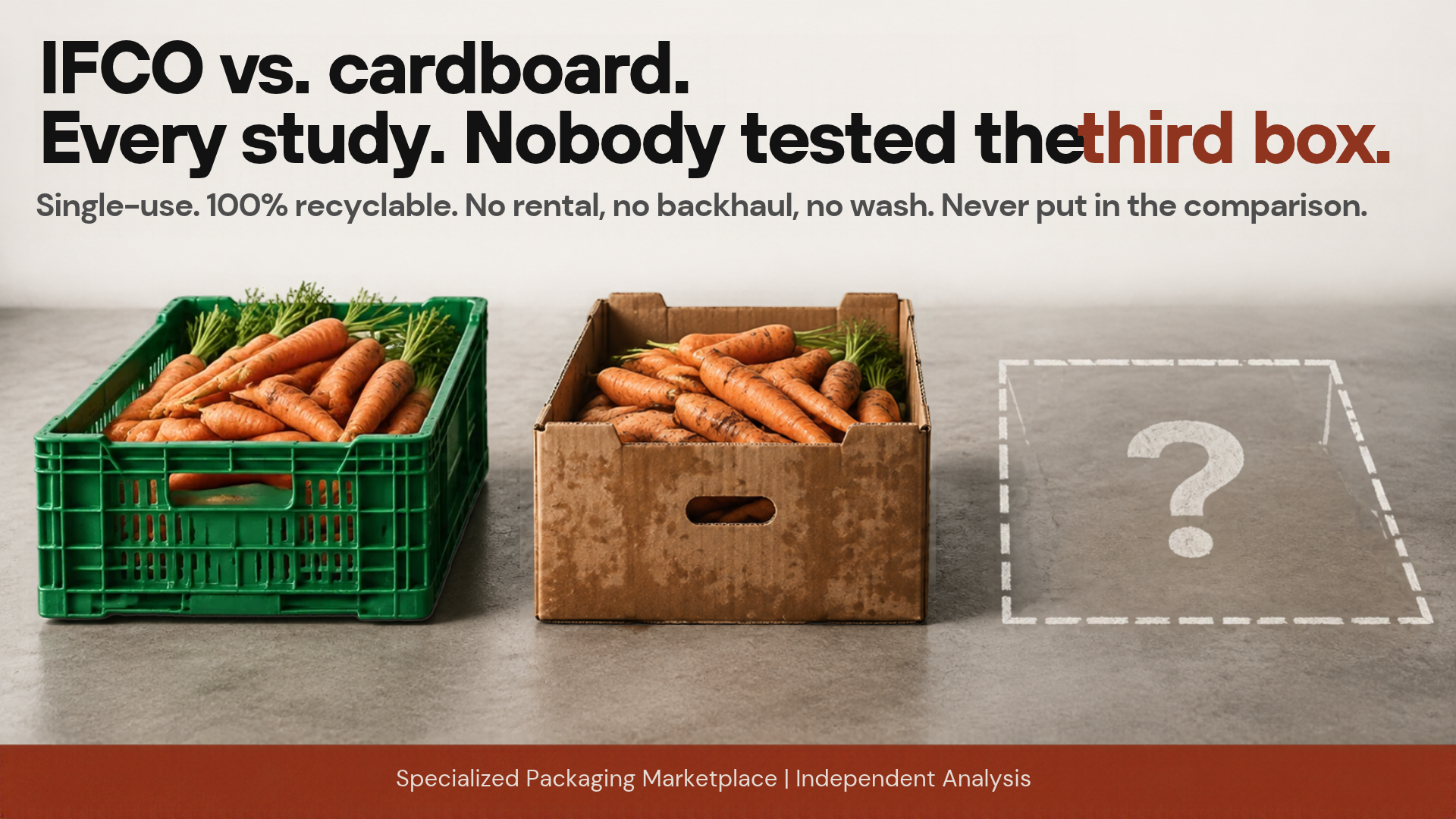
Whole Foods and IFCO just announced a big win for the planet. It may be one. But nobody, not the retailer, not the crate company and not the trade press that ran the story, has shown the math that proves it. Every major study of produce containers compares reusable plastic crates to cardboard. Not one compares them to single-use, 100% recyclable plastic corrugated with a take-back program. If you are making a sustainability announcement without that comparison, you are not reporting a result. You are guessing out loud.
What the Whole Foods announcement counts, and what it leaves out
This month, IFCO announced it is expanding its reusable plastic containers (RPCs) across Whole Foods Market's U.S. produce supply chain. The program started in 2022 as a pilot for potatoes, onions, carrots and other root vegetables. According to the companies, RPC use in that supply chain is up more than 1,000% since then, and Whole Foods has avoided nearly 4 million pounds of cardboard waste. The crates are collected, washed, sanitized and reused, then recycled into new crates at end of life. (Packaging Strategies)
That is a real result, and nobody should wave it away. But look at what the announcement does not include:
- No cost figures, for the retailer or for the growers who rent the crates.
- No emissions figures, including the trucks that haul empty crates back to a wash plant.
- No water or chemical figures for the washing.
- No food waste figures, even though product protection is one of the claims.
- No baseline behind the 1,000% growth number, and no independent study cited.
The announcement counts the cardboard that went away. It does not count what came in to replace it. That is not a scandal. It is a press release. The problem is when an industry starts making packaging decisions off press releases.
Packaging has an announcement problem, and the scoreboard is public
This industry is very good at announcing and very bad at following up. A big name declares a packaging change, the trade press runs it, everyone applauds, and nobody checks back. We checked back.

- Walmart pledged that 100% of its global private-brand packaging would be recyclable, reusable or industrially compostable by 2025. It finished at 64.3% and missed all of its 2025 packaging goals. Its pledge to cut virgin plastic 15% went the other way: virgin plastic ended up about 4% higher than the baseline. Walmart has since left the U.S. Plastics Pact. What???
- The Ellen MacArthur Foundation's Global Commitment signed up companies representing more than 20% of the world's plastic packaging to 2025 targets. Its own progress reporting says the 100% reusable, recyclable or compostable target will almost certainly be missed by most of them, and some have simply pushed their deadlines from 2025 to 2030.
To be fair, Walmart says its results were shaped by real trade-offs, including product protection, food safety, cost, regulation and the supply of recycled material. That is exactly the point. Those trade-offs were knowable before the announcement. The math should come first, and the press release second.
We have all seen the version of this in everyday life: the airline or coffee chain that switches to paper cups and calls it a win for the planet, without ever showing whether the paper cup is actually better. It feels green. Feeling green is not the same as measuring it. Reusable produce crates deserve the same question, and so does every retailer that adopts them.
They paid for the study. Guess who won.
The research on RPCs is a fifteen-year argument between two industries. The RPC side's studies find RPCs win. The cardboard side's studies find it is a draw, or that cardboard wins. Both used reputable firms and recognized standards. Both had a stake in the outcome.
Pay for your own study, and guess who comes out on top. You do. Every time. The crate industry paid for its studies, and crates won. The cardboard industry paid for its studies, and cardboard won or tied. Not one of these studies came back against the people who wrote the check.

So stop selling it to buyers as science that settled the question. A study you commissioned to defend your own product is not a referee. It is a stacked deck with a research firm's name on the cover. Don't hand it to a grower or a retailer and expect them to treat it like the final word.
Say it out loud and hear how it sounds: "We paid for our own study, and it proves we're better than everybody else." Of course it does. Who did you think was going to win? If every side gets to pay for its own scorecard, then let's level the playing field and put all three boxes in the same study, paid for by nobody with a horse in the race. Until then, quit quoting it to us like we're idiots.
Study:
Paid for by
What it found
Corrugated Packaging Alliance
RPCs had higher impacts in 4 of 8 categories. RPCs were better on acidification (36% lower), ozone depletion (24% lower) and water use (38% lower).
Corrugated Packaging Alliance
A split. Cardboard better on global warming, eutrophication and non-renewable resources. RPCs better on acidification, smog, respiratory effects and ozone.
Franklin Associates, IFCO study
IFCO
RPCs better in all 8 categories. Versus display-ready cardboard: 31% lower global warming potential, 86% less solid waste, 80% less water, 64% less energy.
Franklin Associates, earlier study
Reusable Pallet and Container Coalition
Across 10 produce items, RPCs used 39% less energy, made 95% less solid waste and 29% less greenhouse gas.
Each side has picked apart the other's work. The cardboard side said IFCO's study compared one RPC supplier to the entire cardboard industry and relied on IFCO's own data for cleaning, trips and losses. The RPC side has said cardboard-funded research ignores real-world supply chain conditions.
Here is the honest summary. Whether RPCs beat cardboard depends on the crop, the distance, how many trips each crate makes and whose data you use. Even the cardboard side's own 2019 study told growers to evaluate each commodity and route rather than assume one system fits all.
And here is the part nobody seems to notice. In all of this work, there are only two contestants: a heavy plastic crate that travels back and forth, and a paper box that is used once. There is no third column.
That is not an accident. It is what you get when the only people paying for the research are the two industries in the fight. Single-use, 100% recyclable plastic corrugated competes with both of them. Neither one has any reason to pay for a study that might show a box beating them both. So nobody has. Every time a retailer quotes one of these studies, it is quoting a sales argument from one side of a two-way fight, and the third option never got a seat at the table.
Reuse means washing, and washing has a track record
A crate that carries food more than once has to be cleaned between trips. IFCO states its wash process destroys 99.5% of bacteria and that every crate is washed, sanitized and air-dried between uses. Field testing has raised questions about how that holds up in practice:
- University of Guelph, 2014. Researchers tested 160 crates as they were delivered to growers in Ontario and Quebec. 43% failed basic sanitary standards, 73% exceeded bacteria limits, E. coli turned up on 13%, and about 30% still had the previous user's label. The study was conducted on behalf of the Canadian Corrugated Containerboard Association.
- University of Arkansas, 2015. In a lab test, researchers grew Salmonella, Listeria and E. coli on crate material, cleaned it by typical industry methods, and found bacteria on every sample under the microscope.
In fairness, the Reusable Packaging Association has responded that no illness has been linked to RPCs, and it set up a food safety standards committee. These studies are also more than ten years old, and wash practices may have improved.
The point is not that crates are dirty. The point is that any reuse system carries a sanitation step, and the food safety risk of that step sits with whoever packs into the crate. A container used once and then remanufactured does not carry that step at all.
The cost question has two answers, depending on who you ask
RPCs are rented. IFCO describes its model as no capital investment, with simple per-trip pricing. Growers pay per trip. The crates then need a truck back to a wash plant, a wash, an inspection and a truck out to the next grower.
On the same crop, the two sides report opposite results:
- IFCO says its end-to-end studies show savings of 30 to 40 cents per case on tomatoes, and over 90 cents on avocados.
- The Corrugated Packaging Alliance modeled a large Mexican grower shipping 144 million pounds of Roma tomatoes to Houston in 2013. It found RPCs added $7.5 million in trucking and handling, $577,000 in washing at a conservative 10 cents a crate, 17% more cost for the retailer and 12% more for the grower.
One side says tomatoes are cheaper in crates. The other says they are far more expensive. Both cannot be right for every operation. Which one is right for yours depends on things only you can measure: your per-trip fee, your lane distances, your crate loss and rejection rate, and how much of your truck you give up to heavier containers.
The actual per-trip rates are not published. That alone should tell a buyer something. If a cost advantage were clear and universal, it would be on the website.
The option missing from every study
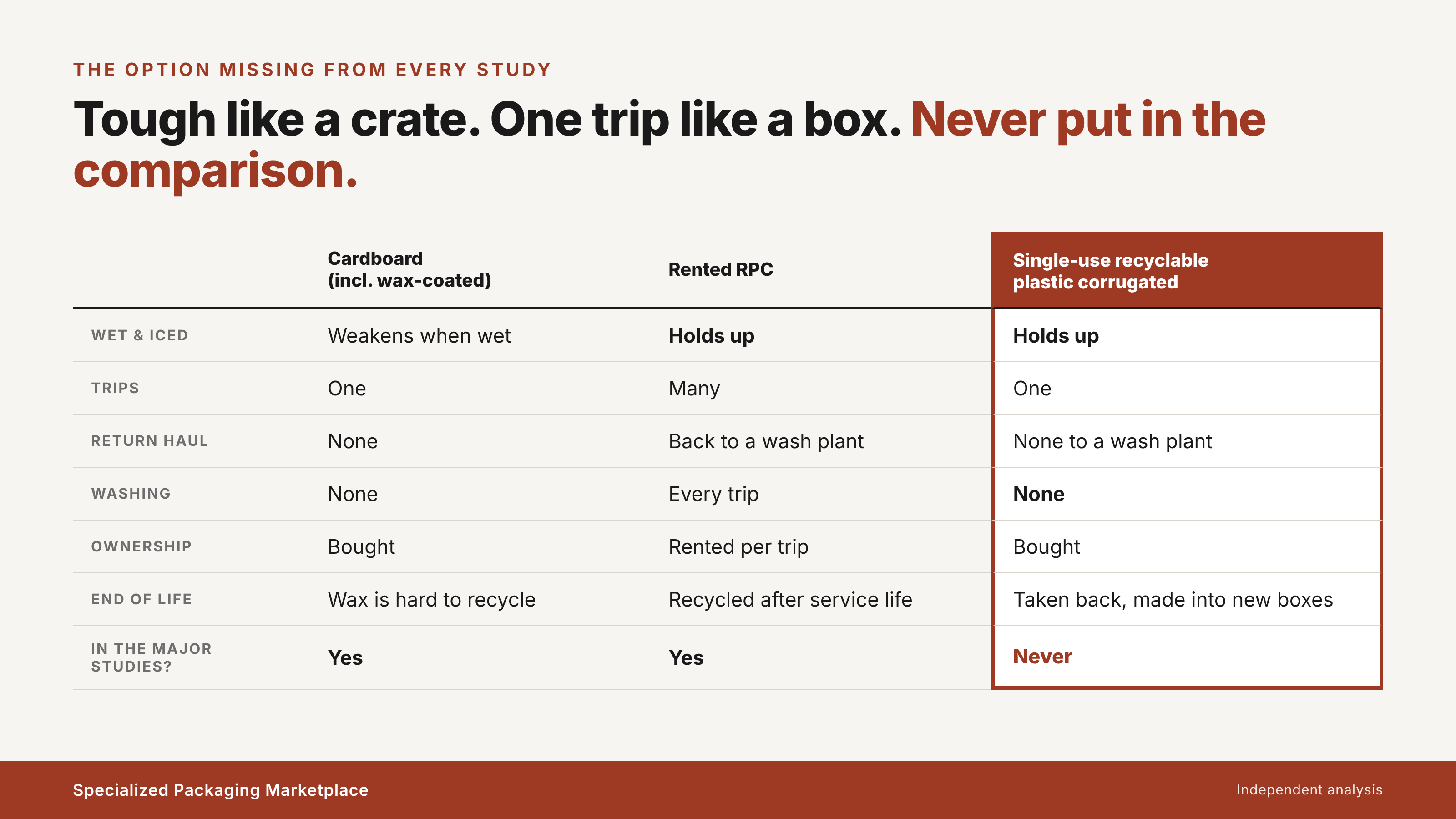
There is a third kind of produce box that sits outside this whole argument: single-use plastic corrugated, made from one polymer, that is 100% recyclable and collected back by the manufacturer to be made into new boxes.
It borrows the strengths each side claims, and drops the weaknesses each side accuses the other of:
None of the four studies above modeled this system. Not one. The RPC industry compares itself to paper. The paper industry compares itself to RPCs. A container that is as tough as a plastic crate but makes one trip like a cardboard box, with no rental, no backhaul to a wash plant and no wash, has simply never been put in the comparison.
We are not claiming it wins. We are saying nobody has checked, and that should embarrass everyone making claims about RPCs. A sustainability decision that never priced the obvious alternative is not a sustainability decision. It is a vendor decision with a green label on it.
Before you follow the leader, ask these questions
IFCO's pool runs more than 1.9 billion trips a year for over 300 retailers and 15,000 growers. When a retailer that size moves, growers move with it. That is exactly why the decision deserves real numbers, not momentum.
If you are a retailer, a grower-shipper or a packer being asked to switch, these are fair questions to put to anyone, including us:
- What is my all-in cost per trip? The rental fee, plus the backhaul, the wash, crate loss, rejected or dirty crates, and the cost of storing empties.
- How much of my truck am I giving up? Heavier containers can make a load weigh out before it fills out.
- Whose data is behind the claim? Ask who paid for the study, and whether it was run on your crops and your lanes.
- Where does the food safety risk sit? If a crate arrives dirty, who catches it, and who is liable if nobody does?
- What happens at end of life, and can you prove it? Ask where the material actually goes and who tracks it.
- Was single-use recyclable plastic ever priced against this? If the answer is no, the comparison you were shown was incomplete.
No container is right for every crop and every route. That is the one thing both industries' own studies agree on. The only wrong move is to skip the comparison.
The bottom line
To Whole Foods, IFCO, every retailer weighing a pooling contract, and every trade outlet that reprints the announcement: show the full comparison. Crates versus cardboard is half a study. A 1,000% growth number with no baseline is a marketing number, not an environmental one. And "pounds of cardboard avoided" means nothing until you also count the trucks, the water and the fees that replaced it.
RPCs may well be the right answer for some crops and some routes. Cardboard may be right for others. But until someone puts single-use, 100% recyclable plastic corrugated in the same comparison, nobody in this business has earned the right to call any of it the greener choice. Stop announcing. Start measuring. Enough already.
The Specialized Packaging Marketplace publishes independent comparisons for packaging buyers. If you want help pricing all three options for your operation, fill out our Fast Track form.
Sources
- IFCO scales reusable packaging at Whole Foods Market, Packaging Strategies
- The environmental reality of RPCs vs corrugated packaging (Anthesis 2025 LCA), Packaging Dive
- Study: environmental impact split for corrugated, RPCs (Quantis 2019), The Packer
- Corrugated, RPCs offer same environmental advantages, Refrigerated and Frozen Foods
- Study shows RPCs as sustainable choice (IFCO Franklin LCA), Refrigerated and Frozen Foods
- Reusable container study (RPCC Franklin LCI), Packaging World
- Comparative LCA FAQs, Corrugated Packaging Alliance
- Corrugated industry claims ignore real-world conditions, Reusable Packaging Association
- Study compares costs for corrugated versus RPCs for shipping tomatoes, Packaging World
- IFCO end-to-end cost studies, IFCO blog
- IFCO pooling system, IFCO
- IFCO pool scale, IFCO
- Re-use is not always the better alternative, Food in Canada
- Reusable produce containers often contaminated, University of Guelph
- Reusable produce containers still harbor bacteria after cleaning, Food Safety News
- Walmart progress on 2025 sustainability goals, Trellis
- Where Walmart's packaging ended up on 2025 targets, Supply Chain Dive
- Recycling and reuse targets are unlikely to be met, Resource Media
- Ellen MacArthur Foundation progress report: 2025 targets likely missed, Packaging Dive
Ready to find your packaging partner?
Join hundreds of manufacturers and buyers already using PackageLink to streamline their sourcing process.