
The Arrogance of Doing Nothing--Packaging Ownership-Leadership
Packaging ownership and packaging leadership. The trouble you are in is on you. Pack Expo closed two weeks ago and nothing in your building is different.
This is on you.
Not your sales manager. Not your marketing person. Not the four reps who did not work out. Not tariffs, not China, not the economy, not what Amazon did to your customers.
You.
You are going to get three paragraphs into this and wonder who the hell this guy thinks he is. Fair question. I have been in packaging since 1986, and I am going to tell you the truth, which is a thing almost nobody in your orbit is paid to do.
Your controller is not going to say it. Your sales manager is definitely not going to say it. Your banker says it with a number instead of a sentence, and by the time he does it is late.
So I will.
The show closed on October 21st.
By now the freight is back, the carpet invoice has cleared, and somebody has put the lead list in a folder.
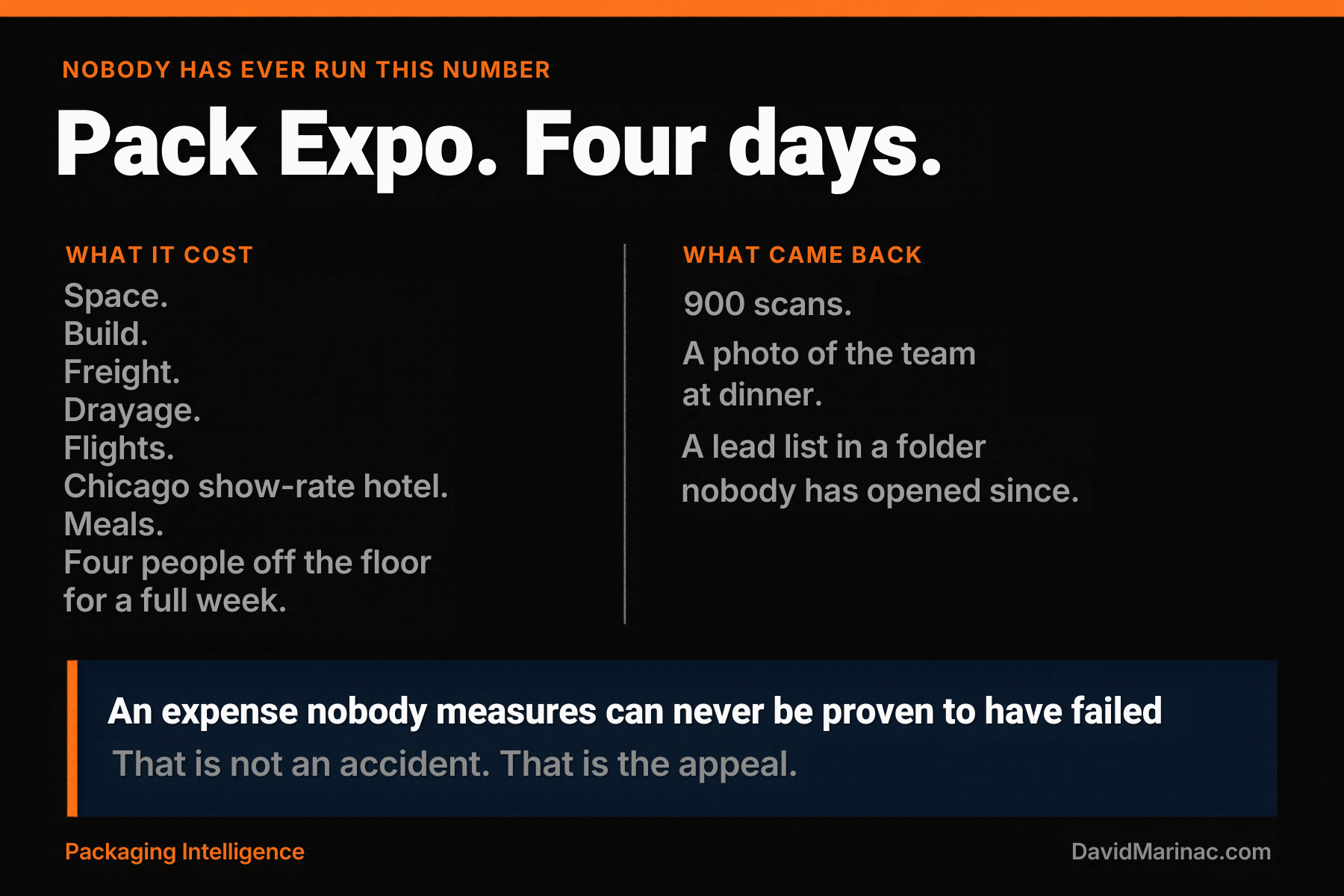
And the posts are up. Another great Pack Expo. Nine hundred scans. A photo of the team at dinner in Chicago the night before the floor opened.
Nine hundred scans is not nine hundred opportunities. It is nine hundred people who walked past a bowl of mints.
The dinner photo is not sales. It is PR, and it is PR aimed at your own employees.
So let me ask the question nobody at that booth asked out loud. What did it cost, and what came back?
Before you keep reading, I am talking to you specifically
Not your marketing coordinator. Not the HR person who posts the jobs. Not your rep.
I am talking to the owner. The president. The CEO. The second generation running what the first generation built, and the third generation running what the second one protected.
The person who signs the Pack Expo check and the person who decides whether anything changes afterward are the same person. That is you.
And before we go further, the exits are closed.
Do not blame the sales numbers on the sales manager. You hired him, you kept him, and you decided every year not to have the conversation.
Do not blame the lack of opportunities on marketing. Marketing has been asking you for something to say for three years and you have not given them one.
Do not blame the reps. You sent them out with a price list and a prayer.
Do not blame the market. Somebody in your category grew this year. It was not a different market.
Everything in this piece is on you, and I am going to spend the next three thousand words explaining exactly why.
First, the thing you will say back to me
You are busy. I know. You will tell me the plant is running, the schedule is full into February, and reorders are strong.
Let me take that seriously for a second, because it is true and it is also not the point.
Reorders are maintenance. They are last year's decisions still paying out. They are the fruit of a sale somebody made, sometimes a sale your father made, and your job on a reorder is to not screw it up.
That is a real job. It is not growth.
Growth is a customer who did not know your name in January and has a PO in by September. New work, in a new place, at a margin you set rather than one you defended.
Count how many of those you booked this year. Not quotes. Not conversations. Booked.
If that number is small, then busy is not the word for what is happening in your building. Occupied is the word. There is a difference, and the difference shows up about four years from now.
Doing nothing is a decision. It is just the only one nobody makes you defend.
Here is the mechanism, and once you see it you will see it everywhere.
Psychologists call it omission bias. People judge a bad outcome that came from an action far more harshly than the identical outcome that came from inaction.
Hire four salespeople. Lose three. You have now made four visible decisions that failed in front of your entire company. Your controller knows. Your plant manager knows. The one rep still standing knows.
Now do nothing for the same year and lose the same revenue. That was not a decision. That was tariffs. That was China. That was the economy. That was a soft market.
Same hole in the floor. One of them has your name carved next to it.
So the safest thing an owner can do, measured in reputation rather than in dollars, is nothing at all. And your whole industry has quietly agreed to measure it that way.
Keynes wrote the line in 1936 and it has never stopped being true. It is better for reputation to fail conventionally than to succeed unconventionally.
Look around your market. If every shop you know is flat, then flat stops feeling like a choice and starts feeling like weather.
It is not weather.
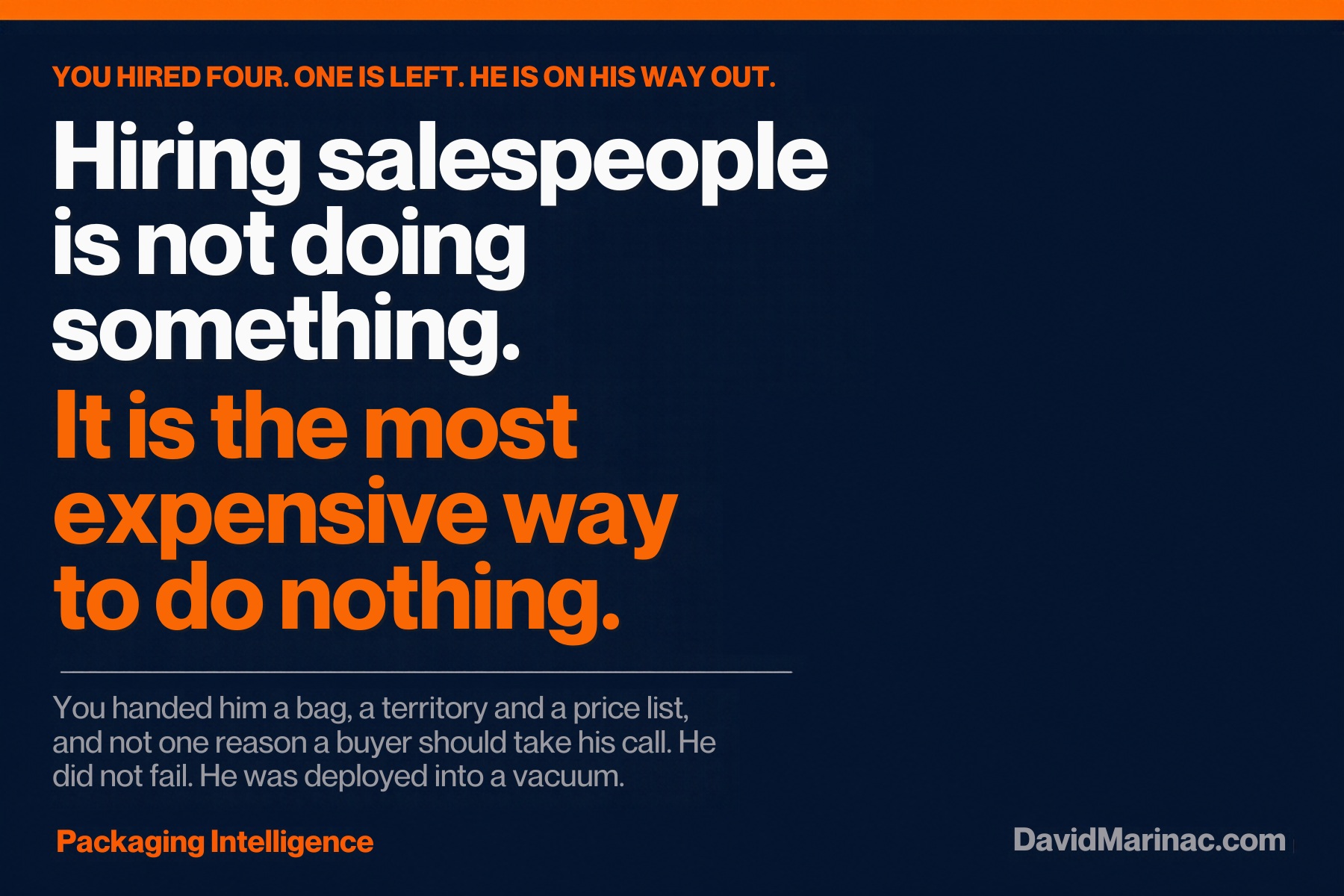
Hiring salespeople is not doing something. It is the most expensive way to do nothing.
This is the part that is going to annoy people, so let me be precise about it.
You hired four this year. One is left. He is on his way out and both of you know it.
You will tell me you have a hiring problem. You do not have a hiring problem.
Hiring is the one move in this business that is socially legible as action. It goes in the budget. It gets announced. It generates a job posting that everybody can see. It feels like momentum.
And it changes nothing underneath.
You handed a man a bag, a territory, a price list and a laptop, and you did not hand him one reason a buyer who has never heard of your company should take his call. Then you fired him in month nine for not making a number.
He did not fail. He was deployed into a vacuum.
Go look at your own job board right now. The packaging sales position that has been open forty days. The business development job posted three separate times this year. Your HR person pushes the same copy out again every few weeks, and a recruiter forwards resumes nobody reads with any seriousness.
You are not hiring a person. You are buying the feeling of having acted.
The email you did not open
This one I can prove, because I watch it happen several hundred times a month.
I send an owner a sequence. Evidence, guides, specific information about his market, his competitors, and brands actively looking for exactly what he makes.
He does not open it.
So I go to the second in command. He does not open it either.
Out of forty five or fifty companies, one writes back. And that one says, almost word for word, every time: I have never seen anything like this. How do we proceed.
For a long time I thought the other forty nine were too busy. They are not too busy. It takes four seconds to open an email.
What is actually happening has a name. Researchers call it information avoidance, and it is well documented. People will decline free information, at no cost, when having it would create an obligation.
Read my email and one of two things happens. Either it is nothing, and you wasted four seconds. Or it is something, and now you have to either act on it or consciously decide not to.
That second branch is the whole problem. Deciding not to act is uncomfortable in a way that never having known is not.
So the email stays closed. Not out of laziness. Out of self-protection.
You are not ignoring me. You are protecting yourself from having to decide.
And when somebody hands you the meeting, you say no
I want to put one more thing on the record, because this is the one I cannot get past.
We have handed packaging companies direct contact with an actual decision maker. Not a buyer. Not a clerk in procurement. The person who signs.
And the answer comes back: no, we are good. We will keep knocking on his door.
The door he has not answered in two years.
That is not discipline. That is a man whose identity is wrapped around a method, choosing the method over the outcome. Accepting the introduction would mean admitting the door approach did not work, and the cost of that admission is apparently higher than the value of the meeting.
That is the clearest picture of this entire problem I can give you. Somebody opened a door, and you declined it, because you had already decided doors only open one way.
And then there is the version of this I find hardest to be polite about.
Somebody we both know makes an introduction. A real one, with both names on it, from a person who vouched for you.
You dodge it.
No reply. No call back. Not even the courtesy of a no.
You did that like a man running a company that does not need anything. I have looked at your numbers, or at the public shape of them, and that is not the company you are running.
There is a word for carrying yourself like a big shot while the thing underneath you is going soft, and it is not confidence.
Nobody has ever run the Pack Expo number
Back to the show, because it is the purest example of the whole pattern.
Twenty thousand dollars. Fifty thousand. More, for some of you, once you count space, build, freight, drayage, flights, hotel at Chicago show rates, meals, and four people off the floor for a week.
Now tell me what came back. Not scans. Revenue. Named accounts that exist today because of that week.
You cannot, and here is the uncomfortable reason why that is fine with everybody involved.
Pack Expo survives in your budget precisely because nobody measures it. An expense that is never measured can never be proven to have failed. It produces photos, it produces a feeling, it produces a line item everybody already agreed to last year, and it produces zero accountability.
That is not an accident. That is the appeal.
Now compare it to what I do. Packaging Intelligence produces a number. It tells you which of your capabilities actually carries margin, which accounts are structural and which are borrowed, which of last year's growth was worth having.
And a number can indict you.
You are not avoiding this because it is expensive. You are avoiding it because it takes away the excuse.
The sales manager you will not have the conversation with
You know the one.
Five years past the point where it was working. Does not use email in any meaningful way. Treats the internet like a fad that has gone on a bit long. Tells you buyers in this industry still do it the old way, over lunch, the way he has always done it.
And he is visibly uncomfortable every time somebody proposes a different approach. Not a replacement for him. Not a threat to his seat. Just a different way of finding work.
You see it happen. You have seen it for years.
And you let it stand, because having that conversation is unpleasant and the quarter is already hard.
Here is what that costs. Every rep underneath him learns, in about a month, that the way to survive in your company is to do it his way. You did not just keep one manager. You trained a department.
That is on you. Not on him. He is doing what the system you built rewards.
You did not inherit a company. You inherited a mandate.
For the second and third generation reading this, and a lot of you are.
Your father or your grandfather started something under real risk. He could have lost everything and he knew it, and that is exactly why he made decisions the way he did.
You did not inherit his business. You inherited an instruction, and the instruction was do not lose this.
Every incentive you have ever had has been custodial. Nobody has ever rewarded you for a bold call. Plenty of people would notice a bad one.
So you moved things around. You took the distribution from another line. You said any day now, it is going to turn. You spent the money that was already there and told yourself the market would come back.
Nobody ever told you that preservation is also a decision, and that it has a price, and that the price compounds quarterly.
Your grandfather was not a careful man. That is why there is a company for you to be careful with.
The most expensive sentence in this industry
It is not what you think. It is not we cannot afford it.
It is I already know how this works.
Forty years in, you have a complete model of how business arrives at a packaging company. Referral. Relationship. Trade show. Cold call. Somebody's brother in law at a brand.
That model worked for a very long time and it built real companies, including probably yours.
The arrogance is not that you think you are better than everyone. The arrogance is treating a complete model as a closed one.
You did not evaluate what I sent you and reject it. Your model has no slot for it, so it never registered as information at all. It registered as noise from outside the system.
Meanwhile the packaging engineer at the brand you want spent her Tuesday afternoon typing a question into an answer engine, got back three names, and started a program with one of them. No cold call. No show floor. No lunch.
That search happened whether or not your model has a slot for it.
You are already a target, and the arrogance is what painted it on you
Here is the part I want you to sit with longer than the rest.
You think doing nothing is the safe position. It is the opposite. Doing nothing is what makes you takeable.
Start with the obvious one. Somebody is going to come for your best account. Not a bigger company with a better plant. A shop your size, run by somebody less afraid, who wrote down what he is good at and put it where buyers are looking. Your customer will find him on a Tuesday afternoon without ever telling you he was looking.
You will not see that coming, because the entire event happens somewhere you have decided not to look.
Now the one nobody says to your face.
You are sitting on cash. Maybe your grandfather's, maybe thirty years of retained earnings, maybe a building that is paid for. You believe that cash is protection.
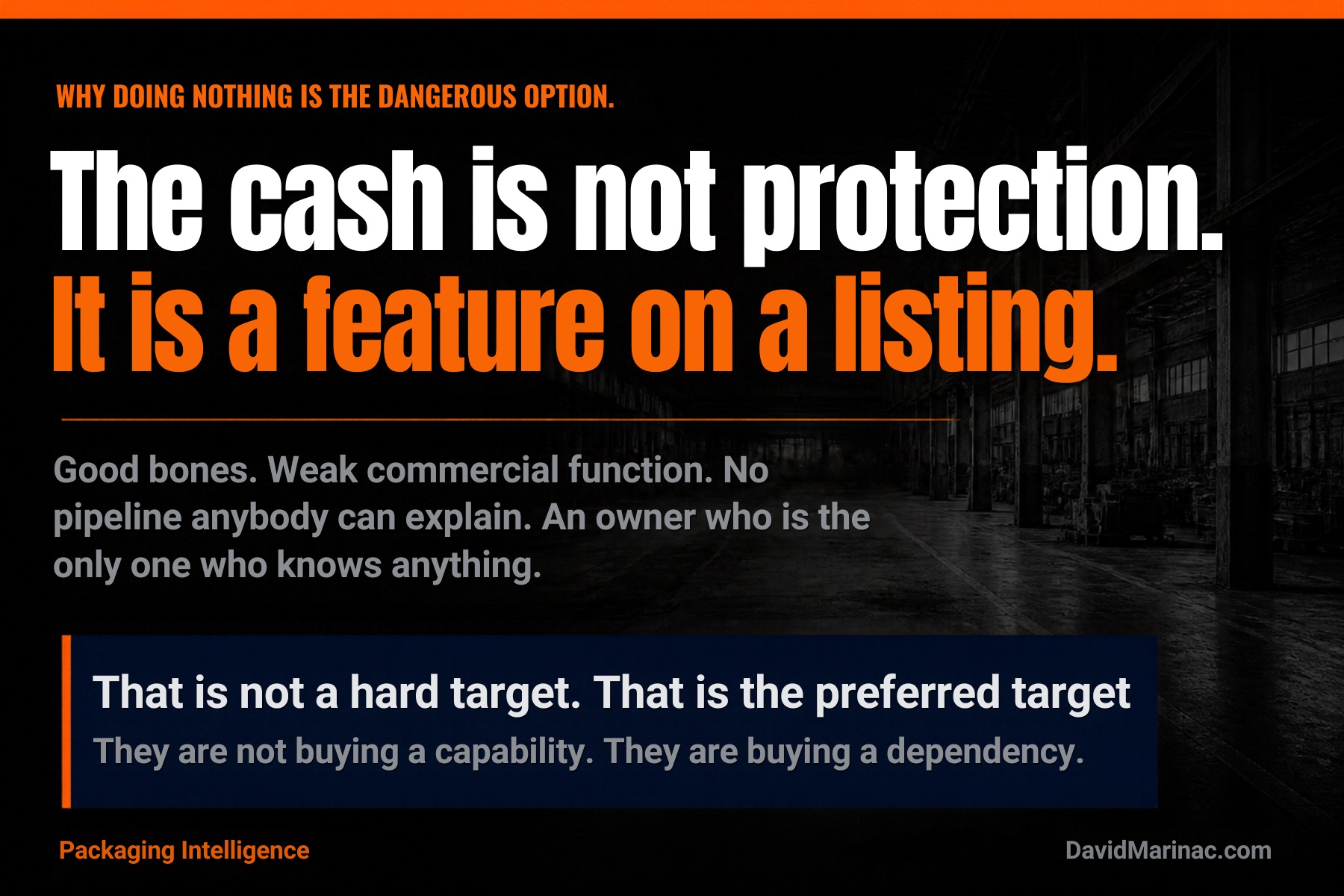
It is not protection. It is a feature on a listing.
Private equity is active in packaging right now and paying real multiples, and the people running those models are extremely good at exactly one thing. Finding a company with good bones, weak commercial function, no pipeline it can explain, and an owner who is the only one who knows anything.
That is not a hard target. That is the preferred target. Strong assets and a weak front end is the entire thesis, because the front end is the cheap part to fix after they own it.
And when they value you, everything in this article shows up in the number. No documented niche. No published expertise. Nothing a buyer can find when he searches. Revenue that comes from relationships living in one man's head and a reorder book nobody has stress tested.
They are not buying a capability. They are buying a dependency, and they discount dependencies hard.
So the cash does not save you. The cash is what makes you worth the phone call.
You can be weak and invisible and still feel fine, right up until the week somebody actually looks at you. Then weak and invisible is the whole conversation, and you are negotiating from the worst position a man can be in, which is the one where the other side has done more homework on your company than you have.
The arrogance did not just cost you growth. It put a price tag on you and let somebody else write the number.
So what actually works
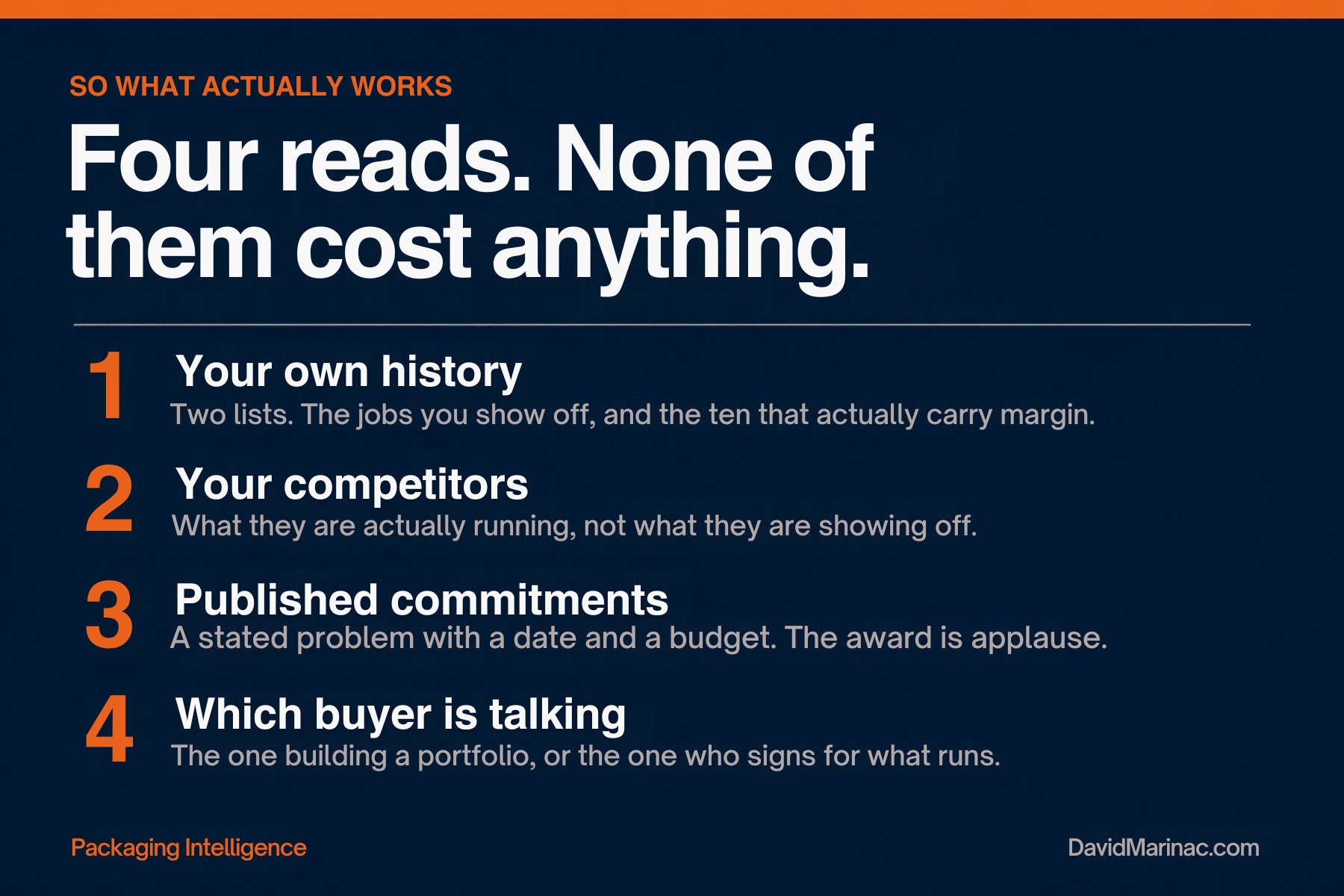
I am not going to spend two thousand words telling you what is broken and then leave you standing there. Here is the alternative, and it costs you nothing to start.
Packaging Intelligence is the practice of capturing what your company already knows and organizing it so you can find and win more of your best fit customers.
Not software. Not a department. Not a campaign. Four reads, and you can run the first one this week.
One. Read your own history.
Pull five years. Two lists. The jobs you put on the website and entered in awards. And your ten most profitable jobs by gross margin dollars per machine hour, not by revenue. Put them side by side. If they do not overlap, you have just found the most expensive gap in your company, and you found it in an afternoon for free.
Two. Read your competitors.
What are the shops in your category actually running, versus what they are showing off. If everybody is chasing the same showcase work, that is a red ocean with a trophy floating in it. The work nobody brags about is where the margin lives.
Three. Read published commitments, not applause.
Consumer brands post recyclability targets, recycled content targets and sustainability deadlines on their own websites, approved by their own boards. That is a stated problem with a date and a budget attached to it. It is a buying signal sitting in the open, and almost nobody in this industry reads it.
Four. Read which buyer is actually talking.
The brand manager who wanted the showpiece is building a portfolio and will be at another company in three years. The operations seat that signs for the job paying your mortgage cares whether it runs and whether the seal holds at line speed. Two different buyers. You cannot build a company for both.
That is it. That is the whole thing. No budget. No software. No consultant required to get started.
What it requires is somebody willing to look at the answer.
Why this beats the big guys, which is the part you should actually care about
The large consolidators cannot do this. Not because they are stupid, but because their structure prevents it.
They are too broad to have a real niche. Their knowledge is spread across forty plants and twelve acquisitions and nobody owns it. Their marketing is approved three levels up and comes out generic by the time it ships.
You have one building, one set of capabilities, and thirty or forty years of pattern recognition sitting in two or three heads.
That is the only advantage in this industry that cannot be bought with a bigger balance sheet. And right now it is unwritten, unpublished, invisible to search, and useless to everybody except you.
You can out-position a billion dollar competitor in your specific niche inside ninety days, for the cost of somebody's time.
That is not a pitch. That is arithmetic.
Look in the mirror
So here is where I land, and I am going to say it the way I would say it across a table.
You are not stuck because the market is hard. The market has always been hard.
You are not stuck because you cannot find good salespeople. You have never given a good salesperson anything to say.
You are not stuck because of tariffs or China or the economy or what Amazon did to your customers.
You are stuck because doing nothing has never once required you to stand up and defend it, and every alternative does.
And while it has never required you to defend it, it has been quietly making you easier to take. Weaker every quarter, more dependent on one head, more invisible to the only search your next customer is going to run.
That is the arrogance. Not that you think you are the best. That you have decided you already know, and arranged your week so that nothing can reach you to prove otherwise.
Do you want to beat your competition or not. Do you want to be in business in five years or not. What exactly are you waiting for.
The buck stops with you. Not with the sales manager. Not with the four reps who did not make it. Not with the show. With you.
Open the next email. That is the entire ask. Four seconds.
Then go pull your two lists. It takes an afternoon, nobody has to lose an argument, and by dinner you will know something about your own company that you have never known.
If what you find makes you want to talk it through, I do a thirty minute Packaging Intelligence Briefing.
https://calendly.com/dmarinac/30min
I have been in this industry since 1986. I am not writing this because I think you are stupid. I am writing it because I have watched good companies with real capability get quietly passed by companies that were worse at making packaging and better at saying so.
That is a terrible way to lose. And it is completely avoidable.


Ready to find your packaging partner?
Join hundreds of manufacturers and buyers already using PackageLink to streamline their sourcing process.