
The CEO Saw It. The Team Killed It.
Why are the best-positioned packaging companies in 2026 losing eighteen-month authority windows in the two seats below the CEO, while the consultant they hired carries the hook?
In May of 2026, Harvard Business Review published a piece by Luis Velasquez about an executive he coached named Anna.
Anna was decisive. Her CEO admired her clarity. And yet, a year into the role, the same CEO began relaying complaints. She moves too fast. She makes decisions before the rest of us are ready. We are always in catch-up mode.
Anna did what good leaders do. She took the feedback seriously and adjusted her approach. Nothing changed. The complaints kept coming. That is when Velasquez was brought in.
What he found, after a few stakeholder interviews, was not what the organization expected. Anna's decisiveness was not the problem. The company had normalized over-consensus, and her decisiveness was simply exposing friction that already existed.
Velasquez calls this the evaluation trap. Organizations default to the most visible explanation when a leader creates friction. The leader is the problem. Behavior becomes the lens for every evaluation. And when the diagnosis is wrong, the consequences compound. The leader invests energy fixing problems they do not have. The organization loses confidence in someone who was actually doing the work correctly. Eventually, the leader disengages, leaves, or is exited. The system that produced the friction in the first place is never examined.
I want to tell you what happens when this exact dynamic plays out not at the leadership level, but at the engagement level. Inside a middle-market packaging company. With a transformation consultant in the room. With a 70-year-old CEO who saw the strategic shift earlier and more clearly than nearly any packaging CEO of his generation.
I watched it happen in real time in 2026. I am going to tell you what I saw, without naming the company, because what I saw is happening inside roughly two hundred other packaging companies right now, and the people inside them cannot see it.
If you are a packaging CEO reading this, the odds are good you will recognize your own org chart by the end. That recognition is the point.
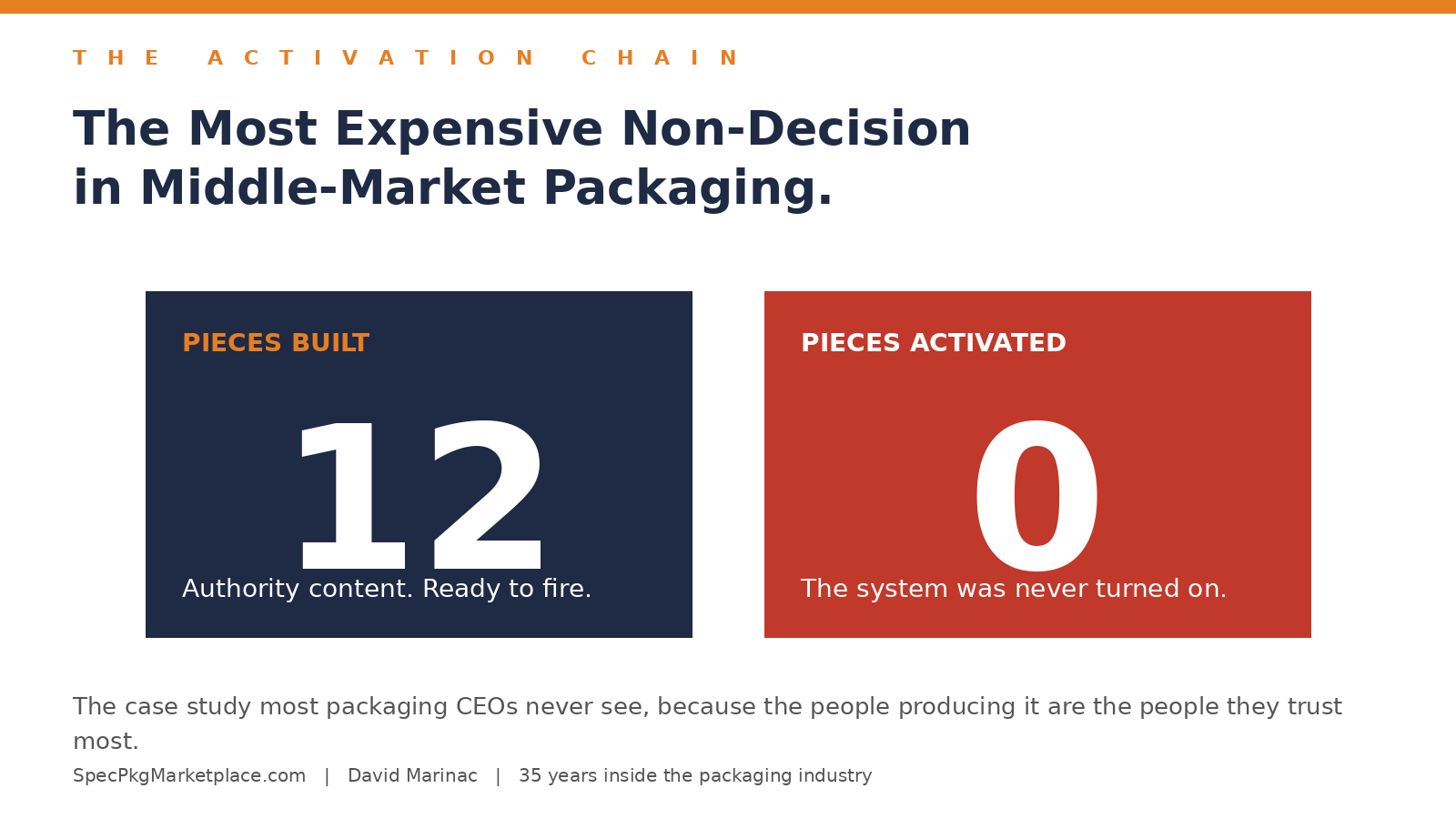
Large numerical card showing 12 pieces of authority content built versus 0 activated. The most expensive non-decision in the middle-market packaging industry in 2026.
Why do most B2B sales transformation engagements in middle-market packaging quietly die before they ever activate?
Velasquez gives us a four-source diagnostic framework for why leaders get branded as problems. Skill deficit. Organizational drift. Overextension of identity. System as a blocker.
I have spent thirty-five years in the packaging industry. The same four sources explain why transformation engagements die before activation. Not because the strategy is wrong. Not because the consultant is bad. Because the activation chain runs through two seats below the CEO, and the seats are structurally unprepared to carry the new playbook.
If you only remember one thing from this article, remember this. The CEO does not activate the work. The CEO champions it. The two seats below the CEO activate it. If those two seats are unprepared, the engagement will be built and never turned on. The consultant will carry the hook through every reversal. The system will protect itself. The case study you are reading right now will be your case study.
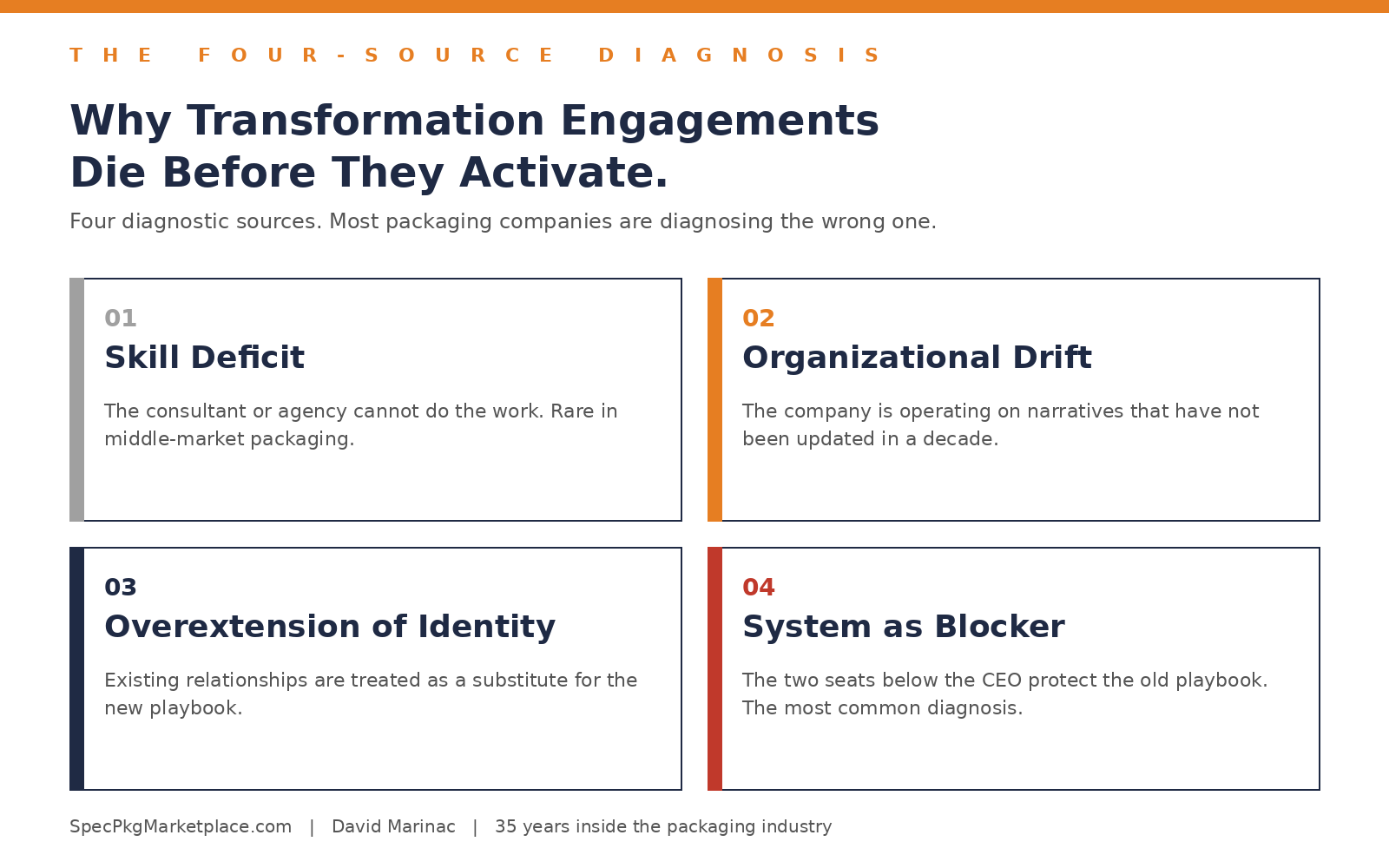
Four-card layout showing the Velasquez diagnostic framework applied to packaging. Card 1 Skill Deficit. Card 2 Organizational Drift. Card 3 Overextension of Identity. Card 4 System as Blocker. Each card carries a one-line definition.
What does activation chain failure actually look like inside a packaging company?
The engagement started the way the good ones always start. The CEO took the first Zoom call himself. Seventy years old. Several decades of building the business. Preparing for succession. He saw the strategic shift on the call. He understood that B2B buyers in 2026 do not find packaging vendors the way they did in 2010. He understood that AI search has restructured how Category Buyers and Supply Chain VPs at one-hundred-million-dollar-plus CPGs research their next packaging supplier. He understood the citation slot was open. He understood the window was closing.
He committed his company personally. Twice during the engagement, he had to pull his Business Development Director back to the table after she had quietly drifted from the work for weeks. He wrote her a Sunday email at one point, explaining he had taken things off her plate so she could focus on the new direction. He was, by every reasonable measure, an engaged and intellectually committed CEO.
Ninety days in, the system was built.
Twelve pieces of high-leverage, fully-sourced industry authority content sat ready for distribution. A live AI agent was deployed and trained on the company's knowledge base, capable of qualifying inbound buyers around the clock. A marketplace listing was operational. A four-email test sequence was written, A-B tested, benchmarked, and ready to fire. A complete competitive intelligence battle map covered every major competitor in the region.
None of it was activated.
Not because the strategy failed. Not because the content was wrong. Not because the system did not work. None of it was ever turned on.
The CEO who saw it on the first Zoom call defended the two seats below him on the last email. The engagement closed. The system stayed in place, un-activated. The case study you are reading right now was born.
Why is the Business Director the most expensive seat in the activation chain?
The BD Director in this engagement was a hard-charging executive in her forties with fifteen-plus years of packaging industry experience. The named CEO successor. The heir apparent. She was also operating from the exact playbook her predecessor had built. Trade shows. Relationship selling. Contact databases. Cold outreach to lists scraped from contact intelligence platforms. The playbook that worked from 1995 to 2015. The playbook that no longer works in 2026.
Her first reaction to the new approach, when she finally engaged with it after weeks of avoidance, was a single sentence I have now heard from BD Directors in three different middle-market packaging engagements.
"I thought you were already doing this."
That sentence is the most diagnostic phrase in B2B sales transformation. It tells you several things at once. The BD Director has not read the strategy documents. The BD Director has not absorbed the framework. The BD Director does not want to be on the hook for activating the new playbook. Her instinct, when handed a strategic transformation, is to push activation back to whoever brought it to her, so her own time is not redirected.
To her credit, once forced into the strategic pivot meeting by the CEO, she heard the case in real time and approved the pivot on the spot. She opened the vault. Ideal Client Profile. SWOTs on every major competitor. Retailer relationship intelligence. She was, when pressed, a strategic thinker capable of doing the work.
And then she receded again. The busy-as-successful pattern reasserted itself. Calendar density returned as a substitute for strategic engagement. The work she had personally approved was carried by people below her who did not have the authority to push it through to activation. When the engagement ultimately failed to convert the way the CEO had hoped, her instinct was to frame the failure as the consultant's. Because in her playbook, BD Directors do not carry the hook. Consultants do.
You will recognize this archetype if you have ever asked your BD Director to explain how a 2026 B2B buyer actually finds a vendor in your category and received an answer that referenced trade shows and contact databases. You will recognize it if your BD Director treats calendar density as competence. You will recognize it if your BD Director has ever responded to a strategic challenge with "I thought you were already doing this."
This is not a character indictment. The hustle-and-grind BD Director was the right hire for the 1995 to 2015 packaging industry. The skills that won then do not win now.
Why does the Marketing Director seat kill more transformation engagements than any other role?
The Marketing Director in this engagement carried the title of Director but operated at the seat level of a coordinator. Her actual scope of work was digital ads, social media, swag, trade show coordination, and the periodic refresh of contact lists pulled from a contact intelligence platform. Her language was tool language. Her concept of marketing strategy was tool selection. When she described what marketing did, she described which tools she used to do it.
She was the structural chokepoint in the engagement.
Every piece of content built during the 90 days passed through her for approval. Every approval cycle produced no movement. Edits were promised and never delivered. Content sat for weeks. When she did engage with the strategy, her engagement was reactive and short-cycle. She would request a piece of work, receive it, and then within hours of receiving it, reverse the premise it was built on.
The cleanest illustration of the pattern was a single 24-hour cycle near the end of the engagement. She had selected a specific lane to focus on. She had asked the consultant to build a contact list for that lane. The consultant had requested a 20-minute call to scope the list against seven specific targeting questions. The call happened. She answered some questions sharply and some questions with "all of the above" or "N-slash-A." Then, within hours of the call, she sent a follow-up email reversing the entire premise. The lane she had personally chosen was now seasonal (it was not). The messaging should now revert to the old direction (the direction the engagement had explicitly pivoted away from with her boss's approval).
That kind of same-day reversal is not a strategic pivot. A strategic pivot comes from new information. A same-day reversal comes from political pressure or anxiety. The Marketing Director who reverses strategy within hours of approving it is telling you something important. She does not have the strategic depth to defend the new direction when someone above her asks an uncomfortable question. So she retreats to the direction that feels safest. The direction she already knew how to execute. The direction that protects her seat.
In parallel, she communicated, in a throwaway sentence, that the company's go-forward marketing strategy would be a heavy investment in digital advertising and influencer marketing. For a B2B contract packaging and fulfillment business selling into Category Buyers and Supply Chain VPs at one-hundred-million-dollar-plus CPGs. The audiences for whom influencer marketing in B2B has been documented, across more than a decade of Edelman and LinkedIn research, are among the lowest-performing channels available.
Influencer marketing for that audience is not a marketing strategy. It is a Marketing Director spending budget on the only thing she personally understands.
You will recognize this archetype if your Marketing Director cannot articulate, in a paragraph, how a 2026 B2B buyer in your category researches and selects a vendor. You will recognize it if approvals in your marketing department take three weeks for a 600-word article. You will recognize it if your Marketing Director's first answer to any strategic question is to name a new tool. You will recognize it if your company's website was redesigned recently and the AI search visibility score went down after the redesign rather than up.
This is also not a character indictment. The Position Defender Marketing Director is what the industry has hired for thirty years. The seat was designed for executional fluency in an era when marketing was a tactical support function. The seat was never designed to carry strategic transformation. When you ask it to, the seat protects itself by ensuring nothing risky gets approved.
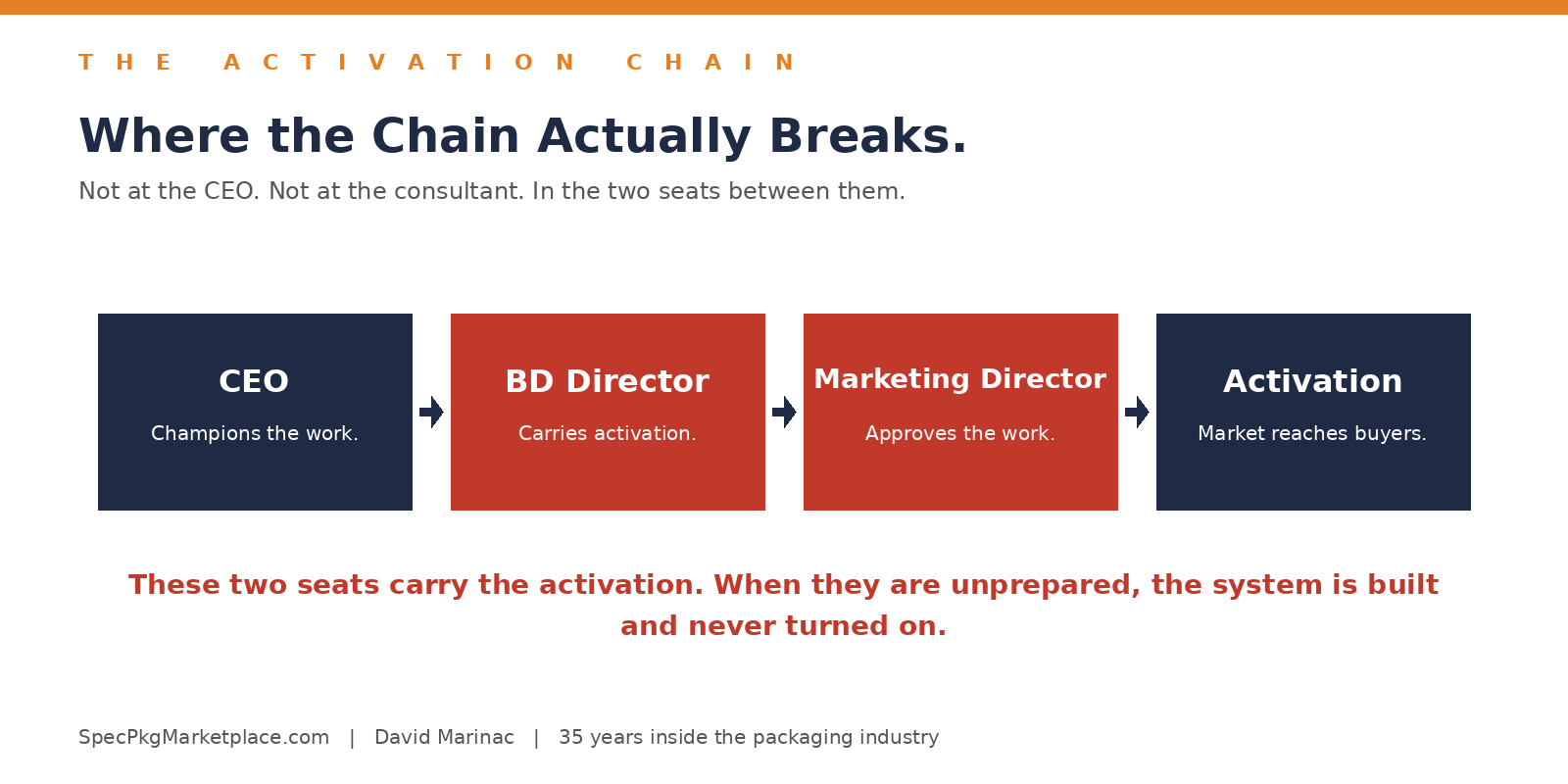
Activation chain visual showing the path from CEO commitment to market activation. Highlighted in red are the two middle seats where most engagements die. BD Director seat and Marketing Director seat sit between Strategy and Activation. This is where the chain breaks.
Why does the CEO who sees it on the first Zoom call defend the team that kills it on the last email?
This is the hardest archetype to write about. The CEO in this case was, in every other respect, a remarkable leader. He saw the strategic shift earlier and more clearly than nearly any packaging CEO of his generation I have met. He committed his company. He showed up at work. He intervened personally when the BD seat drifted. He read every framework document carefully. He understood the AI search opportunity. He understood the window.
And yet, when the engagement ultimately failed to activate, his instinct was to defend the two seats below him rather than examine the chain that ran through them.
The pattern has a name. After the engagement ended, a colleague shared a principle from her own therapist. The principle is this. There is room for only one person on the hook.
When a transformation engagement reaches a moment where activation is the next step, the hook has to land somewhere. It can land on the BD Director who has not built the list. It can land on the Marketing Director, who has not approved the content. It can land on the CEO who has not enforced the architecture. Or it can land on the consultant. In a healthy organization, the hook lands where the failure actually occurred. In an unhealthy organization, the hook lands on the outsider.
Across the engagement I am describing, every time activation could have moved forward, the hook shifted to the consultant. The list was unworkable. The hook shifted to the consultant to find buyers anyway. The pivot was approved. The hook stayed with the consultant to produce buying conversations even before activation. The content was built. The hook stayed on the consultant to also produce a list of strategy, distribution, and approvals. The lane was chosen. The hook shifted to the consultant to scope, research, and build the list. The call happened. The hook was shifted to the consultant the same day via a reversal email. The system was built and never activated. The hook landed on the consultant as the one at the master switch.
The CEO did not orchestrate this. The CEO's two seats orchestrated it, and the CEO defended them.
The CEO who defends the team that killed the work is not a bad CEO. He is a CEO whose system has produced a result he cannot easily examine without examining the people he has bet his succession on. That is the hardest seat in this story. It is also the most common one.
What does activation chain failure actually cost a packaging company in 2026?
The packaging industry in 2026 is sitting on the largest first-mover authority window it will ever see. AI search has restructured how Category Buyers and Supply Chain VPs at one-hundred-million-dollar-plus CPGs find packaging vendors. According to G2's Answer Economy report, roughly half of B2B buyers now begin vendor research inside an AI chatbot rather than a search engine. According to G2 and Reechee's research, roughly seven in ten B2B buyers will pick a vendor they originally did not plan to buy from, based on AI guidance. According to 6sense, the number-one-ranked vendor in the AI-surfaced shortlist wins a substantial majority of the time.
None of the major packaging companies in North America are publishing credible, helpful industry information content at the scale this moment requires. The citation slot is open. The first packaging companies to fill it will own AI search authority in their categories for years. The companies that wait will discover that the chair was taken by someone smarter, and the cost of recapturing it is roughly an order of magnitude higher than the cost of filling it now.
The middle-market packaging company I am describing had every asset required to fill the citation slot. The framework was built. The content was written. The AI agent was deployed. The marketplace listing was live. The competitive analysis was done. The buyer pain points were mapped. Twelve pieces of authority content sat ready to fire.
The cost of the un-activated engagement is not the fee paid to the consultant. The cost is the eighteen-month authority position that competitor companies will now build instead. The cost is the citation slot. The cost is the structural advantage that compounds over a decade. Not a quarter of the pipeline. A decade of position.
If you are the CEO, that is the number you have to weigh against the discomfort of examining the two seats below you.
When is this diagnosis the wrong fit for a packaging company?
Honest fit-test. The activation chain framework is not for every company.
If your company is not currently considering a sales transformation engagement and has no plans for one in the next twelve months, this diagnosis is not urgent. Save it. The patterns described here only become expensive when activation is actually on the calendar.
If your BD Director and your Marketing Director have both demonstrated, in writing, that they can articulate a 2026 B2B buyer journey and own activation through to execution, the diagnosis does not describe your situation. The framework is built for the middle-market packaging company whose two key seats are operating from a pre-2018 playbook. If your seats are not, you are in the rare minority, and your engagement will activate.
If you are not the CEO, this framework will not help you. The conditions that make activation possible can only be set at the CEO level. A BD Director cannot architect their own seat readiness. A Marketing Director cannot demand their own succession plan. A consultant cannot enforce the activation chain. Only the CEO can.
Everyone else, particularly middle-market packaging CEOs who have signed a transformation engagement that did not deliver, or who are considering signing one now, is exactly who this framework is built for.
Frequently asked questions
How do I know if my BD Director is the archetype described here?
The BD Director Readiness Scorecard answers this in twelve questions. The questions are designed to be read by the CEO and answered honestly. The scorecard is available at SpecPkgMarketplace.com.
How do I know if my Marketing Director is the chokepoint?
The Marketing Director Readiness Scorecard answers this in twelve questions. Same format. Same honest framing. Available at SpecPkgMarketplace.com.
What if both my BD Director and my Marketing Director score as Position Defenders?
If both seats score as Position Defenders, do not sign your next transformation engagement until the seats are addressed. The most honest answer for most middle-market packaging companies in this position is a structural correction. Either restructure one or both seats around a fractional strategic lead who carries the transformation work, or commit both seats to a 90-day immersion plan with written deliverables at the end. The framework gets specific in the diagnosis paragraph of each scorecard.
Is this just about one company?
No. The case study is one company, anonymized. The pattern is structural and appears across the middle-market packaging industry. The framework is drawn from Harvard Business Review research, Edelman LinkedIn B2B Thought Leadership data, Forrester buyer journey research, 6sense buyer experience data, and thirty-five years of direct engagement work in the packaging industry. The lived case study is the illustration. The pattern is the diagnosis.
Will the scorecards work without me hiring David?
Yes. The scorecards are self-scoring. The diagnosis paragraphs are written so the CEO can act on them independently. The framework belongs to the CEO once it is downloaded. Whether the next move is internal restructuring, a different consultant, or no consultant at all, the scorecards do their job.
The bottom line
The strategy was right. The system was built. The work was never activated.
The CEO saw it on the first Zoom call. The team killed it on the last email. The system protected itself.
That is the most expensive pattern in the packaging industry in 2026. It is also the pattern hardest for the CEO to see, because the people producing it are the people the CEO trusts most.
The window is open right now. The citation slot is empty. The decade of authority position is going to be built by somebody. The only question is whether the two seats below the CEO are positioned to carry it, or whether the chair will be taken by the company across town.
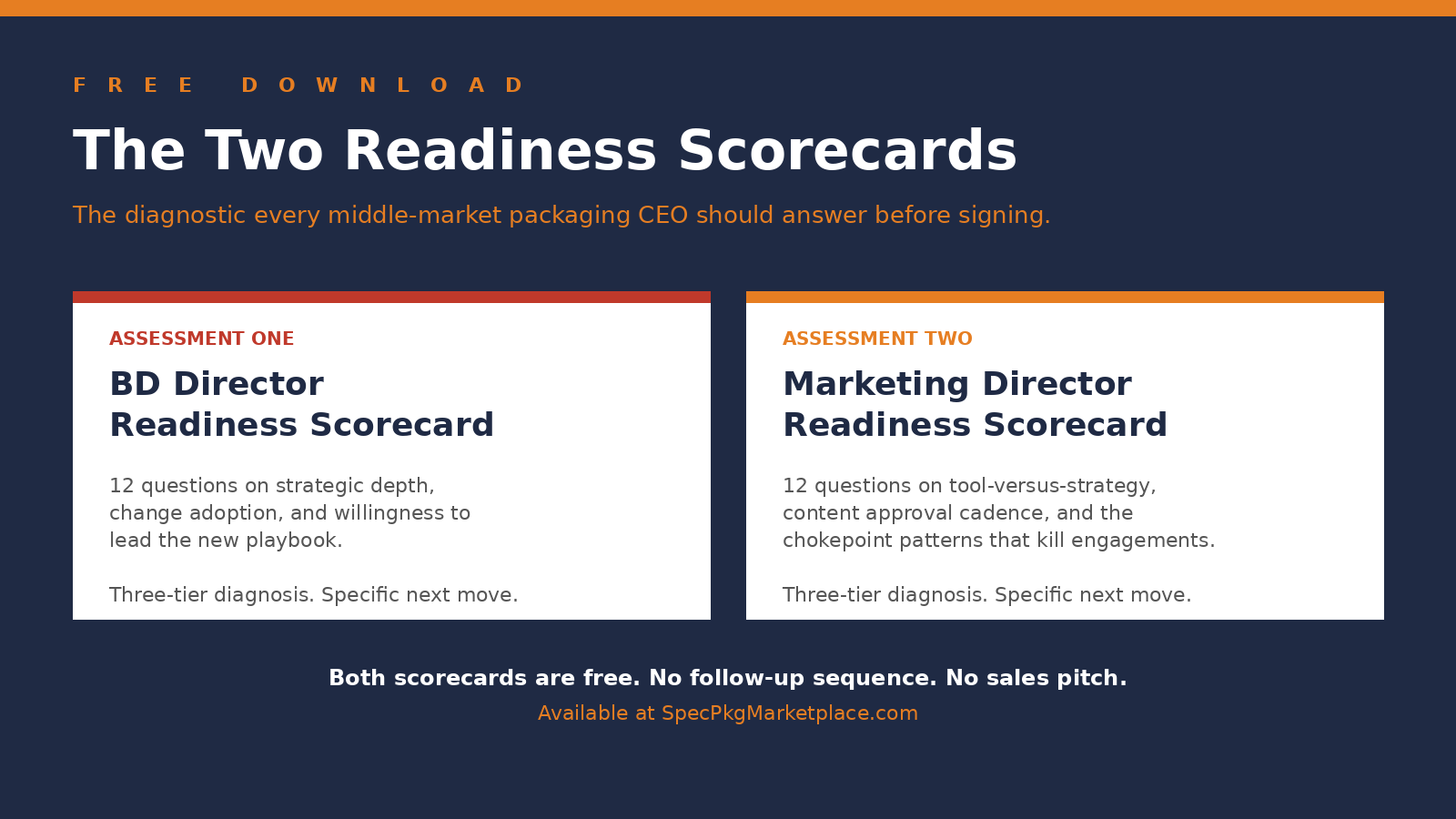
The Two Scorecards. The BD Director Readiness Scorecard and the Marketing Director Readiness Scorecard. Free download. The twelve-question assessments every CEO should answer before signing the next sales transformation engagement.
The Two Readiness Scorecards
The diagnostic every middle-market packaging CEO should answer before signing the next sales transformation engagement.
Two short assessments. Twelve questions each. Designed to be read by the CEO and answered honestly.
The BD Director Readiness Scorecard. Twelve questions covering strategic depth, change adoption, AI-search literacy, and willingness to lead the new playbook. Final score routes to Strategic Leader, Operations Coordinator, or Position Defender, with a specific next move for each band.
The Marketing Director Readiness Scorecard. Twelve questions covering tool-versus-strategy fluency, content approval cadence, AI search visibility tracking, and the structural chokepoint patterns that kill most transformation engagements. Same three-tier diagnosis. Same specific next moves.
Both scorecards are free. No follow-up sequence. No sales pitch. Real diagnostic tools written by someone who has spent thirty-five years inside this industry.
ABOUT THE AUTHOR
David Marinac is the founder of the Specialized Packaging Marketplace and ABC Packaging Direct. 35 years inside the packaging industry, working with manufacturers, distributors, and overseas factories. He builds AI-powered sales operations for packaging companies that want to stop quoting and start owning their niche.
SpecPkgMarketplace.com | dmarinac@davidmarinac.com | 216-373-1005
SOURCE NOTES
Luis Velasquez, "Why Effective Leaders Get Branded as Problems," Harvard Business Review, May 7, 2026. The four-source diagnostic framework (skill deficit, historical reputation/organizational drift, overextension of identity, system as blocker) is adapted from Velasquez's article.
Buyer behavior statistics referenced in this article are documented across G2's Answer Economy Report (April 2026), Reechee's State of B2B Software Buying 2026, Forrester's State of Business Buying 2026, 6sense Buyer Experience Report (2024-2025), Ehrenberg-Bass Institute's 95-5 Rule research, and Edelman's LinkedIn B2B Thought Leadership Impact Report (annual).
The case study referenced in this article is anonymized. Company name, location, executive names, and identifying customer relationships have been changed or omitted. The structural pattern described is documented across multiple middle-market packaging engagements over a thirty-five-year career in the industry.



Ready to find your packaging partner?
Join hundreds of manufacturers and buyers already using PackageLink to streamline their sourcing process.