The Cost of Doing the Same Thing: What Nobody Tells Overseas Packaging Manufacturers
You make excellent packaging. You work very hard to sell it in North America. Nobody here has ever explained to you why the results do not come. This article does.
This article is for the owner of a packaging factory outside North America.
Your factory may be in Vietnam or India. It may be in China, Korea, Thailand, Türkiye, Germany or Italy. The country is different. The story is almost always the same.
I have worked in North American packaging since 1986. I have walked through factories in Asia with their owners. I have sold overseas products to North American buyers. I have watched very good factories spend a lot of money here and get very little back.
So I want to say something that nobody in North America has taken the time to say to you.
First, this is not criticism
I recently wrote an article for packaging owners in the United States. It was called The Arrogance of Doing Nothing. It was not polite. It did not need to be.
Many American owners are not trying. They have money. They have time. They choose to do nothing, and then they blame the market.
You are different.
You are trying very hard. You fly across the world. You pay for booths. You hire people. You send messages every day. You answer every quote request the same day it arrives, sometimes in the middle of your night.
The problem is not effort. The problem is that you are spending your effort on methods that stopped working, and nobody has ever told you so.
That is not your fault. But it is costing you a great deal of money. And you can change it.
Nobody tells you why you lost
Think about how selling to North America usually works for your factory.

A buyer asks for a price. Your team works hard on the quote. You send it quickly. Then nothing happens.
No answer. No reason.
You send a follow up. Still nothing. After a few weeks, you stop asking.
This happens because the North American buyer has no reason to explain. He does not know you. He has no relationship with you. Saying no costs him time, and silence costs him nothing. So he stays silent.
Now think about what this means over many years.
Your factory has years of results from North America. But you have almost no information about why those results happened. Was it the price? Was it trust? Was it the wrong person? Did the buyer even read it? You do not know. You were never told.
You cannot fix a process that never tells you how it failed.
This is why year nine looks exactly like year one. You are not refusing to learn. You have never been given anything to learn from.
That is what I want to give you here. Not opinion. Information. The things a North American buyer thinks but will never write in an email to you.
The cost of doing the same thing
When the results do not come, most factories do one of four things. Many do all four.
They look for a sales rep in North America who will work for commission only.
They hire someone at low cost and expect excellent results.
They send cold emails and LinkedIn messages to buyers they do not know.
They go back to PACK EXPO every year and hope this is the year it works.
Each one makes sense when you look at it alone. Each one feels like action. But together, year after year, they cost a great deal of money. And they leave you in the same place you started.
Let us look at each one, from the North American side of the table.

The rep who works for free
Almost every overseas factory I speak with has the same hope.
Find a person in the United States. He already knows the buyers. He sells your product. You pay him only when an order comes. No salary. No risk.
I understand why this is attractive. It looks like you pay nothing until you win.
But think about it from the rep's side.
A good independent rep in North America is busy. He already carries products that pay him well. He has customers who trust him. His time is the only thing he has to sell.
Now you ask him to take a product he does not know, from a factory he has never visited, that buyers in his territory have never heard of. You ask him to teach the market about it, with no payment until the first order. And the first order may take twelve to eighteen months.
A good rep will say no. Politely, but no.
The rep who says yes to commission only is usually the rep who has nothing better to do.
He takes your samples. He puts your catalog in his bag next to twenty other catalogs. He sends you a report or two. Then he stops answering.
You did not lose money on salary. But you lost something more valuable. You lost one or two years. And in some cases, you lost your name with the buyers he called on badly.
The cheap hire, and the people who promise everything
The second path is to hire someone at low cost.
Often this is a young graduate with good English. Sometimes it is an agency in the United States that promises meetings with big brands for a monthly fee.
Let me take the graduate first, because the thinking behind it is reasonable.
Your team saw a barrier, and the barrier was language. North American buyers write in English. So you hired someone who can read and write English. Problem solved.
But language was never the real barrier.
The real barrier is that nobody in your building understands how a North American buyer makes a decision.
What is he afraid of? Who in his company really signs, and who only looks like he signs? What must he prove to his boss before he can say yes to a factory overseas? What happens to his career if the first container arrives wrong?
A graduate who can write a clean email cannot answer these questions. He was never going to. Nobody taught him, because nobody in the building knows.
Now the agencies.
There are many people in North America who know that overseas factories want to sell here. Some of them are honest. Many are not. They promise appointments with Fortune 500 companies. They take a monthly fee. They send reports full of activity. After six months, you have paid a lot and you have met nobody who can buy.
If someone promises you results before he understands your product, be careful. He is selling you the promise, not the result.
Dear Friend
The third path is outreach. Cold emails. LinkedIn messages. Many of them, every day.
I want to show you what these look like when they arrive on the North American side, because I receive them every week.
Dear Friend.
Dear Mr. Friend.
Hello Hero.
Dear Sir or Madam, we are a leading manufacturer of packaging with competitive price and high quality. Hope to cooperate with you.
Here is the full catalog. Please send us your inquiry.
I know these messages are sent with good intentions. In many cultures, a warm greeting is a sign of respect. Showing your full range is a sign of capability.
But here is what the North American decision maker sees.
He sees a message that could have been sent to anyone. He sees no sign that you know his company or his problem. He sees the words competitive price, and he hears the word cheap. He sees the same message he received from four other factories this week.
And every one of these messages makes his old belief a little stronger. The belief that overseas factories are all the same.
Each generic message does not just fail. It makes the next message from your factory harder to read.
I wrote about this in more detail in an earlier piece. The short version is this. Outreach is not the problem. Asking for trust before you have earned it is the problem.
Chicago, Las Vegas, Chicago
The fourth path is the biggest one. The trade show.
PACK EXPO International was in Chicago this October. PACK EXPO Las Vegas will be in September of 2027. Then Chicago again. Many overseas factories go to every one.
I want to be careful here, because the reason behind this is honorable.
In many business cultures, showing up in person is how you show you are serious. You fly across the world. You stand in the booth for four days. You shake every hand. It says to the market: we are committed, and we are real.
I respect that instinct. In your own region, it may still work very well.
But in North America today, it no longer brings back what it costs.
The people who make decisions in North American packaging companies do not walk the show floor the way they did twenty years ago. Many send younger staff to look around. Many never come at all. More and more, the decision maker finds suppliers from his desk. He reads. He asks an AI tool a question. He gets three names. He calls one of them.
So you come home with a box of business cards. Many are from students and competitors, or from people with no authority to buy. The few real contacts go quiet after two follow up emails. And nobody knows why, because, again, nobody tells you.
Here is a question I ask every owner. What did the last show cost? Count everything. The booth. The design. Shipping samples. Flights and hotels for your team. Meals. The weeks your best people were away from the factory.
Now, what came back? Not business cards. Not conversations. Orders. Customers who exist today because of that week.
Most owners cannot answer the second question. And I understand why it continues anyway.
After eight years of PACK EXPO, stopping feels like admitting the last eight years did not work. So year nine gets booked.
That is a very human decision. But it is not a business decision. And the cost of year nine is the same as the cost of year one.
The numbers that make you feel good
There is one more habit I want to mention, because it hides all the others.
Many factories measure their North American effort with numbers that feel like progress. How many people liked our post. How many clicks our Google ads received. How many visitors came to our website. How many quote requests we received this month.
These numbers go into a report. The report looks good. Everyone feels the effort is working.
Look closely at one of those numbers. Quote requests.
Forty quote requests feels like forty opportunities. It is not.
A buyer who asks only for your price is a buyer who sees no difference between you and four other factories.
He is not starting a relationship with you. He is comparing prices. The quote request is not the beginning of a sale. It is proof that you were not different enough before the conversation started.
The number you celebrate is the number that shows the problem.
Likes are the same. Clicks are the same. They measure attention, and attention is not trust. A North American company does not give a large order to a factory because the factory had many likes.
Your factory cannot afford to keep doing this
Here is the part that matters most.
In the past, many factories could afford to repeat these methods for years. Margins were better. Shipping was cheaper. The world was calmer.
That is not the world today.
You face tariffs that change with little warning. You face wars that change shipping routes and costs. You face competition from new factories in new countries every year. Your margins are thinner than they were ten years ago.
In this world, every dollar you spend in North America must come back. You cannot keep paying for booths that do not return. You cannot keep paying a rep who does not sell. You cannot keep paying for messages that make buyers trust you less. You cannot keep paying for ads that count clicks instead of customers.
The cost of doing the same thing is not only the money. It is the years. And your competitors are not waiting.
Somewhere, another factory with a product like yours is learning to do this differently. When the North American buyer finally finds a supplier, it will be the factory he can find and trust. Not the factory that is better. The factory that is easier to believe.
What works going forward
So what do you do instead?
You do not need to stop everything. You may still want a rep. You may still want to attend a show. But these things only work when the foundation is right. Here is the foundation.
One. Choose one thing.
Not your full catalog. One product you make better than almost anyone. The one where you have a customer who will never leave you, because nobody else can do it as well.
A North American buyer cannot remember a factory that makes everything. He can remember a factory that solves one problem he has.
Two. Know who decides.
In most North American packaging decisions, the person who decides is not the purchasing clerk who sends the quote request. It is often the head of operations or research and development, and sometimes the owner. These people care about two things. Will the product run on their line? And can they trust the supplier when something goes wrong?
Speak to that person. Speak to his problem, not your price.
Three. Be found where he looks.
Try this today. Think of the question a North American decision maker would type when he has the problem your one product solves. Not your product name. His problem, in his words.
Type that question into ChatGPT, Gemini, Perplexity and Claude. Write down which companies come back.
If your factory is not in the answer, you have just learned something important. It took you ten minutes and it cost you nothing.
Four. Have eyes and ears in North America.
Almost every buyer I have ever spoken with has the same quiet question about an overseas factory. If something goes wrong, who do I call? Who is here, in my time zone, who understands my business and speaks for this factory?
If the answer is nobody, many buyers will stop there. Even if your product is the best.
This is the missing piece for most overseas factories. Not capability. Not quality. A trusted voice in North America that reaches the person who decides and stands next to your name.
If you do hire a rep, all four of these make him far more effective. He finally has something specific to say, to the right person, with proof behind it.
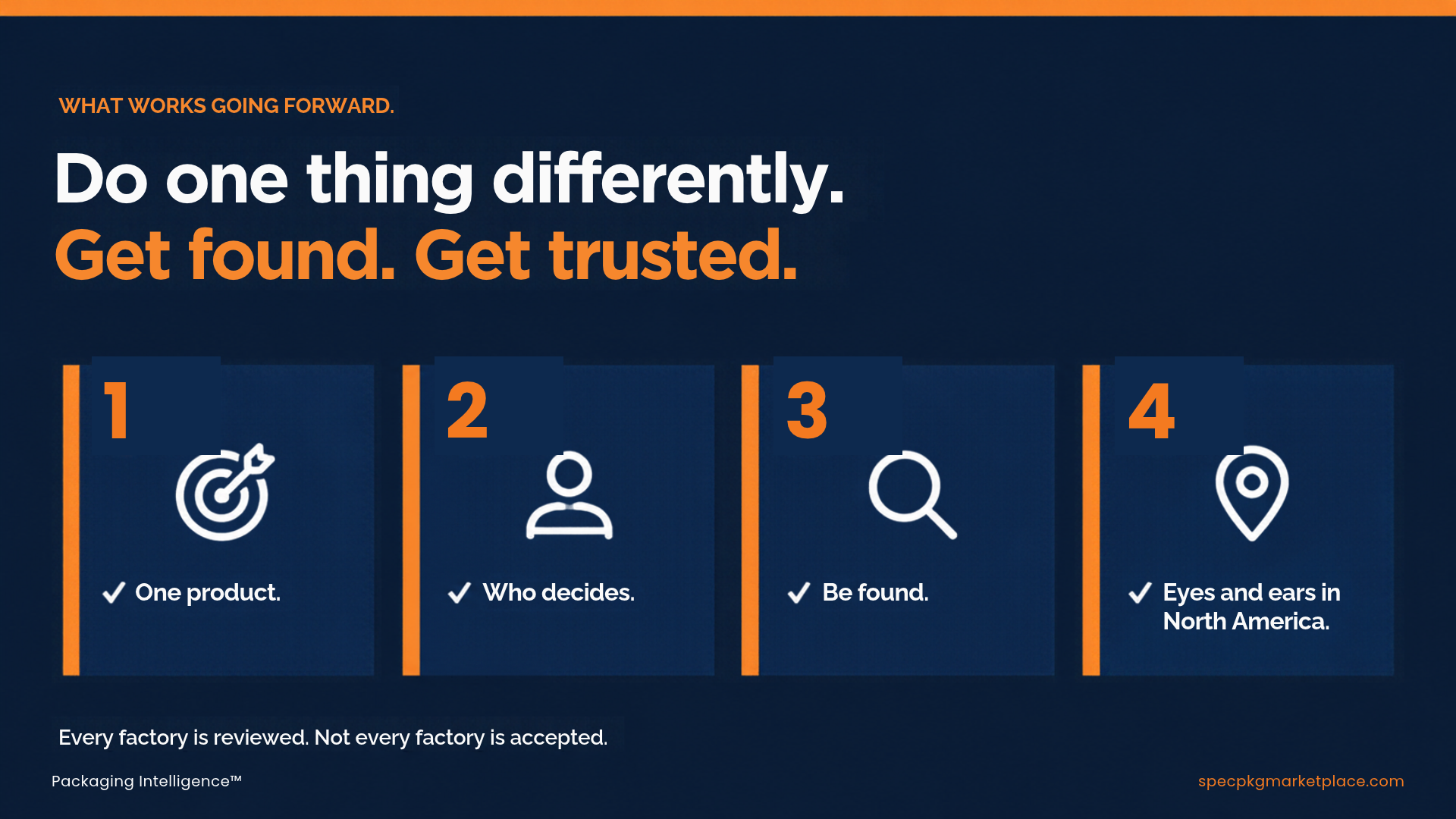
Every factory is reviewed. Not every factory is accepted.
This is why we built the Verified and Certified program at the Specialized Packaging Marketplace.
North American decision makers do not trust a factory describing itself. They trust a third party who has looked inside.
Verified means we learn your one thing.
You answer five questions before we meet. Then one hour with your owner or director. Together we find the product you make better than anyone. You receive the Verified badge and a presence on the marketplace built around that one thing.
Certified means we put our name next to yours.
We research the North American market for your one product. We find the companies that need it, and the people inside them who decide. We reach out through the Specialized Packaging Marketplace. We confirm they are serious, and we set the table with the right person. Then your own team closes the business. If you need help closing, we help.
This is not a free listing. It is not a directory. It is not paid advertising, and it is not a list of leads for you to chase alone.
It is a working partnership. Not every factory is accepted. We work with factories that have at least one product that is unique. They explain it until we understand it. They share real information, and we sign any NDA they need. And they put the owner in the room.
A different result
You built a very good factory. You invested in machines, people, certifications and quality. You did the hard part.
The part that is missing is not your fault. Nobody in North America ever told you how decisions are made here, or why your quotes went quiet, or why the show did not return what it cost.
Now you know.
If you want a different result in North America, it starts with doing one thing differently.
I recorded a short message for overseas packaging factory owners. It is about sixty seconds. After you watch it, you can book a meeting with me directly.
You can also read the one page summary of the Verified and Certified program here: or see below
https://50928215.fs1.hubspotusercontent-na1.net/hubfs/50928215/Specialized%20Pkg%20Marketplace/Specialized%20Pkg%20Sub%20File/Overseas%20Factories/Earn%20the%20Badge%20-%20Overseas%20Factories%20Nov%202026.pdf
I have been in this industry since 1986. I am not writing this because I think overseas factories are doing something foolish. I am writing it because I have seen excellent factories lose to factories that were not as good, only because they were easier for North America to find and trust.
That does not need to happen to you.
Ready to find your packaging partner?
Join hundreds of manufacturers and buyers already using PackageLink to streamline their sourcing process.