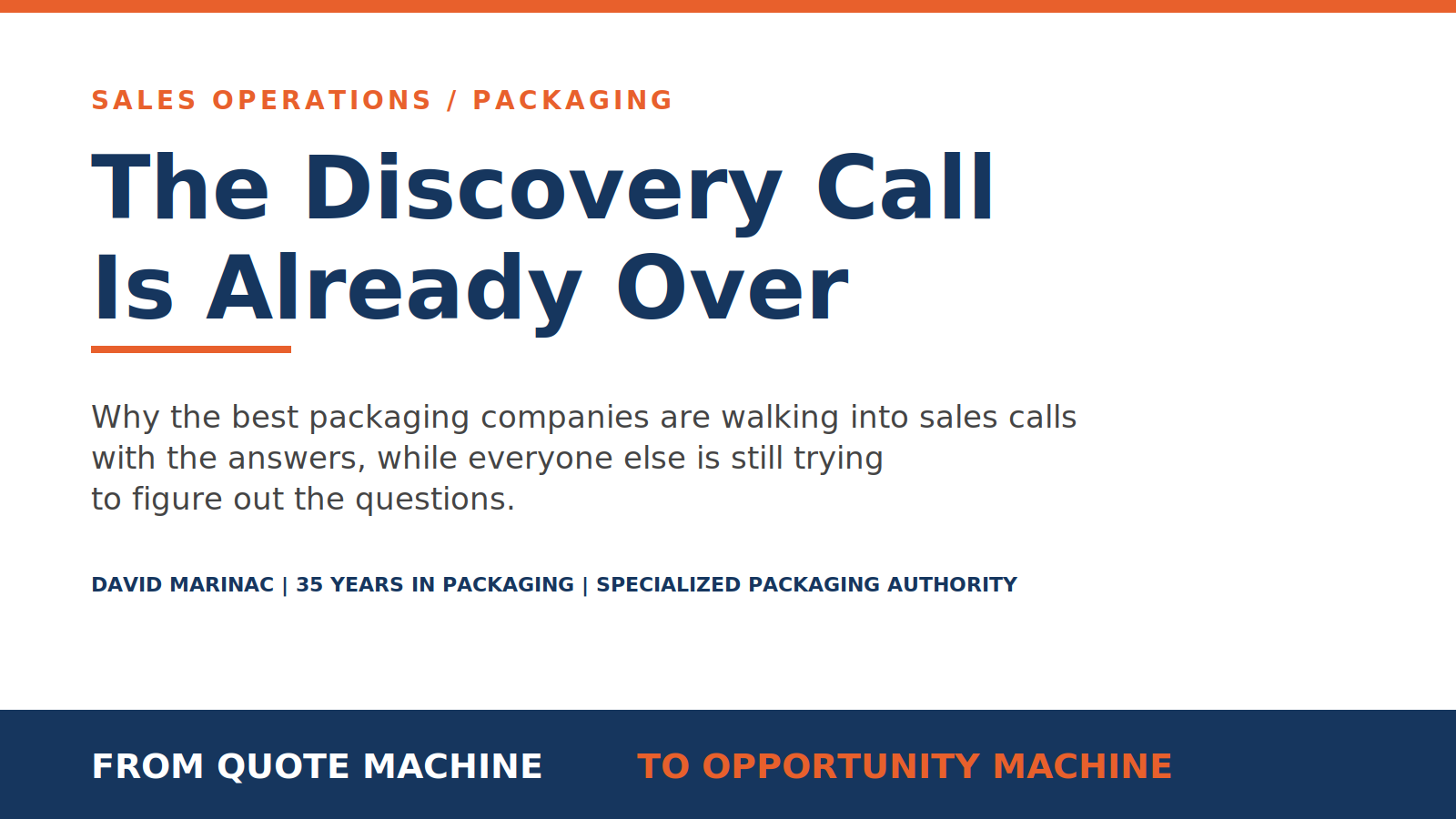
The Discovery Call Is Already Over
Why the best packaging companies are walking into sales calls with the answers, while everyone else is still trying to figure out the questions.
Marcus Sheridan and the team at Ask Elephant just analyzed 981 B2B sales calls. The findings should terrify every CEO running a packaging company in North America.
Three numbers in particular.
> 76 percent of reps talked more than the prospect on a so-called discovery call.
> Only 16 percent ever asked about the financial impact of the prospect's problem.
> Out of 981 calls, exactly 4 reps identified the three things every B2B discovery call must uncover: Issue, Impact, and Importance.
Four out of nine hundred and eighty-one. That is 0.4 percent.
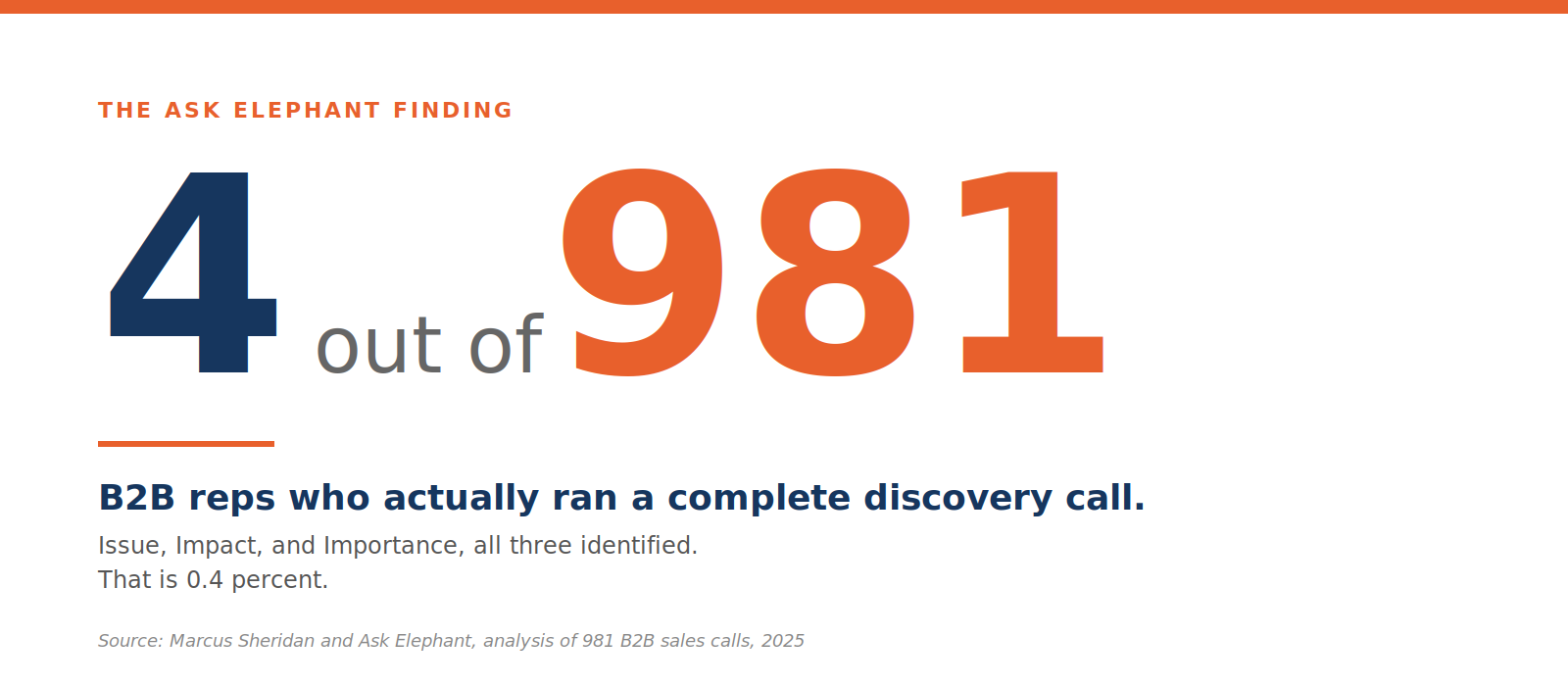
Large numerical card showing 4 out of 981 with the caption B2B reps who actually ran a complete discovery call.
Now picture your top sales engineer on a Zoom call with a real prospect. A brand worth a million dollars in annual recurring packout business. Your rep walks in armed with the capabilities deck, the certifications, the case studies, and the lead time chart. They do what every untrained rep does. They default to what is comfortable. They talk about themselves and their product.
The prospect nods. The prospect says it sounds great. The prospect says they will be in touch. And then the deal goes silent, and nobody on your team knows why.
Sheridan calls this a training problem. He is right. But in packaging, it is worse than that. It is a structural problem.
Why is the I3 problem worse in packaging than anywhere else?
Sheridan named the framework I3. Issue, Impact, Importance. His mentor Ian Altman taught it to him years ago. The system is simple, and that is the point.
Issue. What is actually broken for this prospect?
Impact. What is that issue costing them in dollars, time, customers, or risk?
Importance. Where does fixing this problem rank against the fourteen other fires they are putting out today?
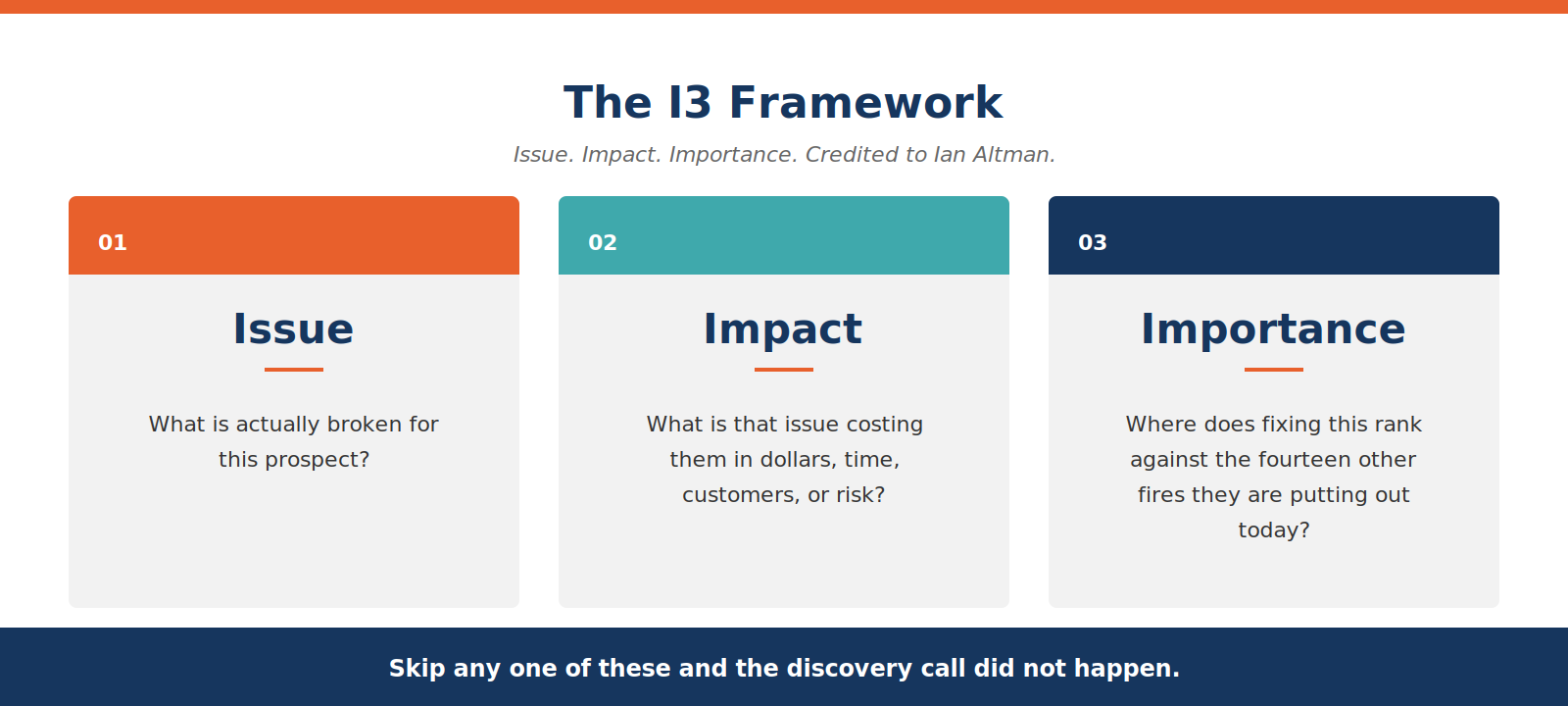
Three-card layout showing the I3 framework. Issue, Impact, Importance, each card with a one-line definition.
Sheridan says most B2B reps skip Importance. They walk off the call thinking there is a fit and a need, but no urgency. The deal dies a quiet death and the rep blames the market.
In packaging, it is even uglier. Here is why.
The industry trained buyers to act like clerks
Most packaging buyers are not strategic decision makers. They are clerks executing a spec sheet. They ask three questions. What does it cost? When can I have it? Are you certified? They do not volunteer impact or importance because they have been conditioned for thirty years to commodify quote-out and pick the lowest number.
Your rep is staring at someone who will not tell them what hurts. So your rep does what feels natural. They quote the spec. They lose to the cheapest bid. They blame procurement.
Your reps cover too many industries to know what to ask
A generalist rep covering CPG, beauty, food, supplements, pet, and beverage cannot ask intelligent Impact questions in any of them. They do not know what an OTIF chargeback costs a Walmart vendor. They do not know what an ISTA 6 failure costs an Amazon brand. They do not know what a missed Costco rollout window costs the brand manager personally.
So they ask none of it. They ask about quantity, dimensions, and timeline. The prospect answers in clerk language. The deal becomes a quote. The quote becomes a loss.
Nobody trained anyone to do it differently
Sheridan asked twenty-five business owners how many of them identify Issue, Impact, and Importance on every discovery call. One raised their hand. One out of twenty-five.
In packaging, the number is closer to zero. Reps were not trained on a methodology. They were trained on the product line. Onboarding is forty pages of board grades, flute profiles, and color systems. There is no module called How to Ask A Buyer What This Problem Is Costing Them.
So the rep wings it. And as Sheridan put it, we all overestimate our ability to read a prospect by feeling them out. Driving without a GPS to a destination you have never been to.
> If your rep cannot answer Issue, Impact, and Importance after a discovery call, the call was not a discovery. It was a conversation, and likely an ineffective one.
What is this actually costing your packaging company right now?
Run the math on your own sales operation. Take the number of opportunities your reps worked in the last twelve months that did not close. Now ask three questions about each one.
Did the rep clearly identify the prospect's actual issue, in writing, in the CRM?
Did the rep quantify the financial impact of that issue on the prospect?
Did the rep establish where solving this ranked against everything else on the prospect's plate?
If your reps are anywhere near the Ask Elephant average, the answer is no on most of them. Which means you did not lose those deals to a competitor. You lost them to a discovery call that never happened.

Visual showing the Pre-Sale Investment Tax concept. Stacked cost categories including quotes, samples, site visits, and Zoom calls flowing into a labeled box reading Lost Without I3.
That is your Pre-Sale Investment Tax. Every quote your team produced for a prospect whose Importance was actually a four out of ten. Every sample you shipped to a buyer whose Impact you never quantified. Every site visit, every spec call, every Zoom that ended with we will be in touch.
The packaging industry has been paying this tax for thirty years. It is the silent killer of margin. And no new CRM, no new sales kickoff, no new comp plan is going to fix it. Sheridan said so. The data says so.
If sales training is not the fix, what is?
Here is what changed in the last eighteen months that almost nobody in packaging has caught up to.
Buyers are now using AI search and AI agents to research suppliers before they ever take a sales call. They are doing their own discovery on you, before you do any discovery on them. They are reading content. They are comparing. They are pre-qualifying you against three or four alternatives. By the time they fill out a contact form, they are not at the top of the funnel. They are at the bottom.
Which means the discovery call your rep is preparing for has, in many cases, already happened. The buyer just had it without you in the room.
That is the bad news. Here is the opening.
If buyers are doing pre-call discovery on you, the highest leverage move you can make is to do pre-call discovery on them. Before the meeting. Before the rep dials. Before a single hour of pre-sale investment is spent on a prospect whose Importance is a four.
That is what the Hyper-Focused Account-Based Sales Engine is built to do.
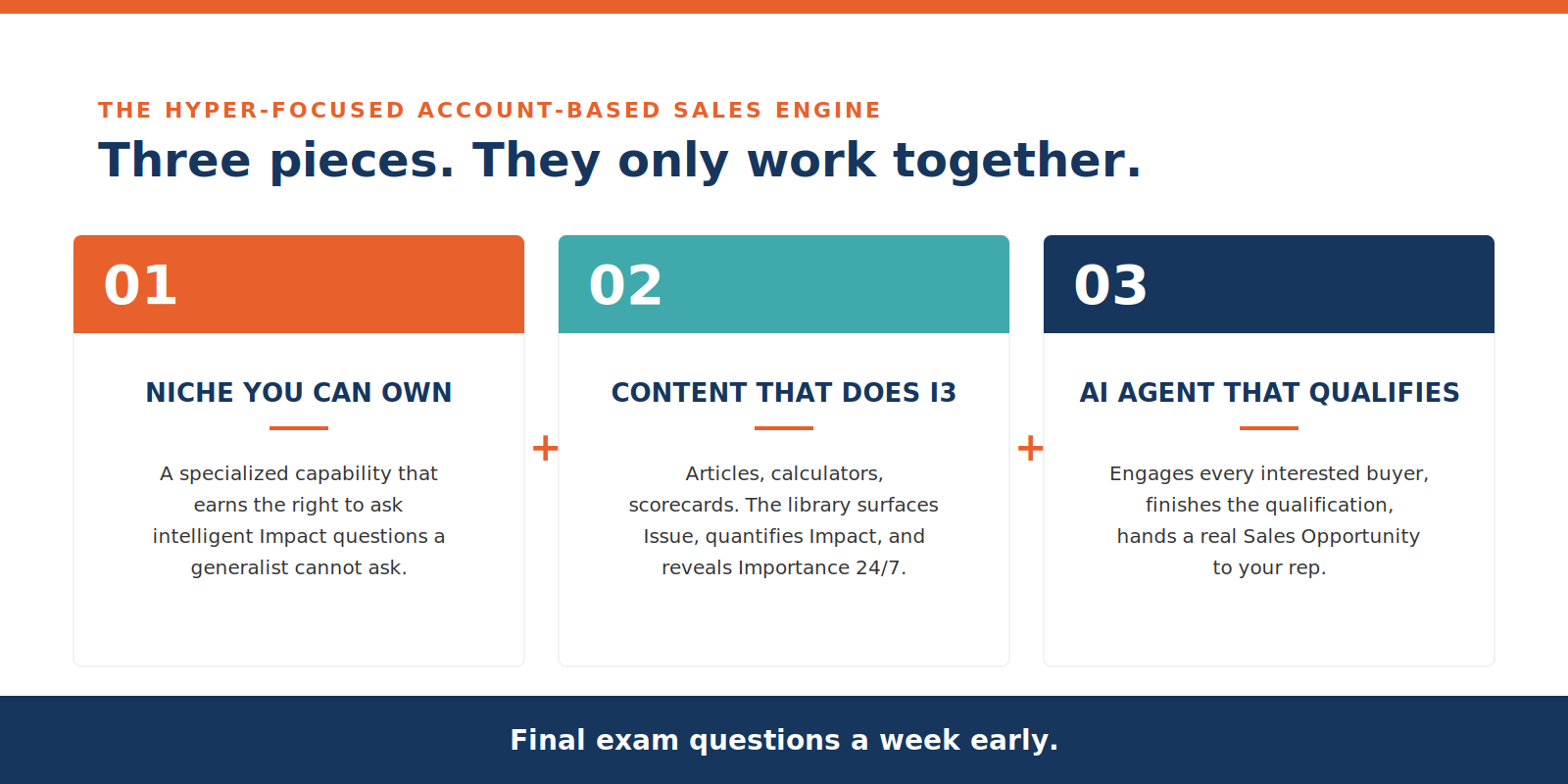
Three numbered cards showing the three pieces of the Hyper-Focused Account-Based Sales Engine. Card 1 Niche You Can Own. Card 2 Content That Does I3 For You. Card 3 AI Agent That Finishes Qualification.
Piece one. A niche the buyer can actually find.
This is the Niche You Can Own Program. Packaging companies that try to be everything to everyone are invisible to AI search and indistinguishable to buyers. Companies that pick one or two specialized capabilities and build a deep, specific content library around them get found, get cited, and get recommended.
More importantly, they earn the right to ask intelligent Impact questions. A specialist in club store packout knows what an OTIF chargeback costs a Costco vendor. A specialist in multi-vendor pallets knows what a Walmart compliance failure costs a brand. A specialist in regulated packaging knows what an FDA recall costs a CPG. When the rep finally gets in the room, they ask questions a generalist cannot ask, because they understand the world the buyer lives in.
Piece two. Content that does Issue and Impact for you.
Once the niche is locked in, the content library does the heavy lifting. Articles, checklists, calculators, scorecards, comparison tools. Each one is a buyer education asset that surfaces the Issue, quantifies the Impact, and makes the Importance impossible to ignore.
A buyer who downloads a chargeback exposure calculator is telling you they have a chargeback issue. A buyer who reads an article on multi-vendor pallet liability is telling you they have a liability issue. The content is doing the discovery for you, twenty-four hours a day, while your reps sleep.
Piece three. An AI agent that finishes qualification before the rep ever picks up the phone.
This is the part most packaging companies do not understand yet. A trained AI agent, working off your specific content and your specific niche, can engage every contact who shows interest, ask the right follow-up questions, and qualify out anyone whose Importance is a four out of ten. It never gets busy. It never forgets. It runs at 2 am on a Sunday if that is when the buyer is researching.
By the time a real Sales Opportunity reaches your sales team, three things are true.
The Issue is documented.
The Impact is quantified.
The Importance has been established and ranked.
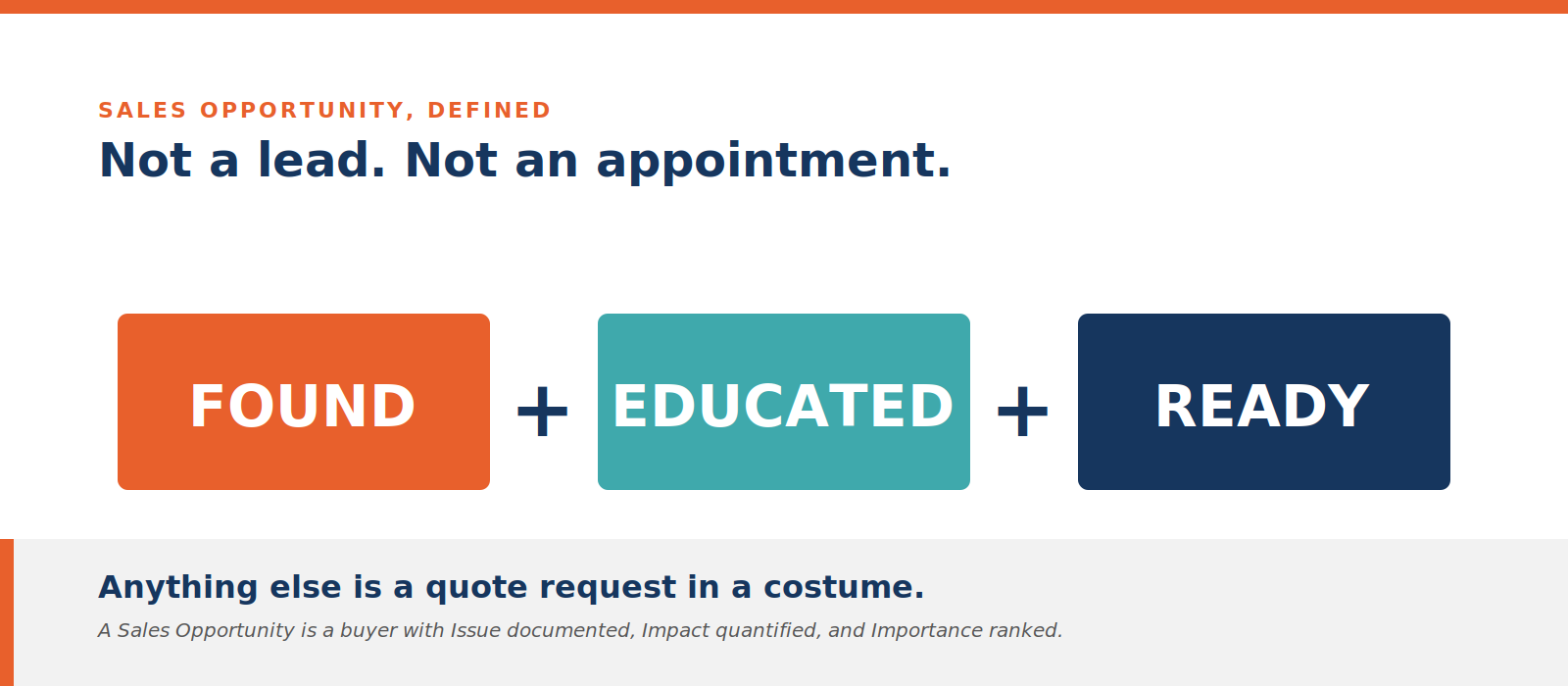
Visual definition card. Sales Opportunity equals Found plus Educated plus Ready. Caption reads Anything else is a quote request in a costume.
Your rep walks into the call with the final exam questions a week early. Not because they are a better rep. Because the system did the work that 99.6 percent of B2B reps never do.
> That is the difference between a lead, an appointment, and a Sales Opportunity. A Sales Opportunity is a buyer who has already been Found, Educated, and Ready. Anything else is a quote request in a costume.
Why is this window closing faster than packaging CEOs think?
There is a temptation, watching all of this, to say it is too early. The buyers are not really using AI yet. The reps will figure it out. We have always done it this way and we are still in business.
Here is what the numbers actually say.
Sheridan has been polling audiences for over a year on this exact question. How many of you use AI as your preferred way to search online? A year ago, the average was 35 percent. Today it is 65 to 70 percent. In another six months, he expects 85 percent.
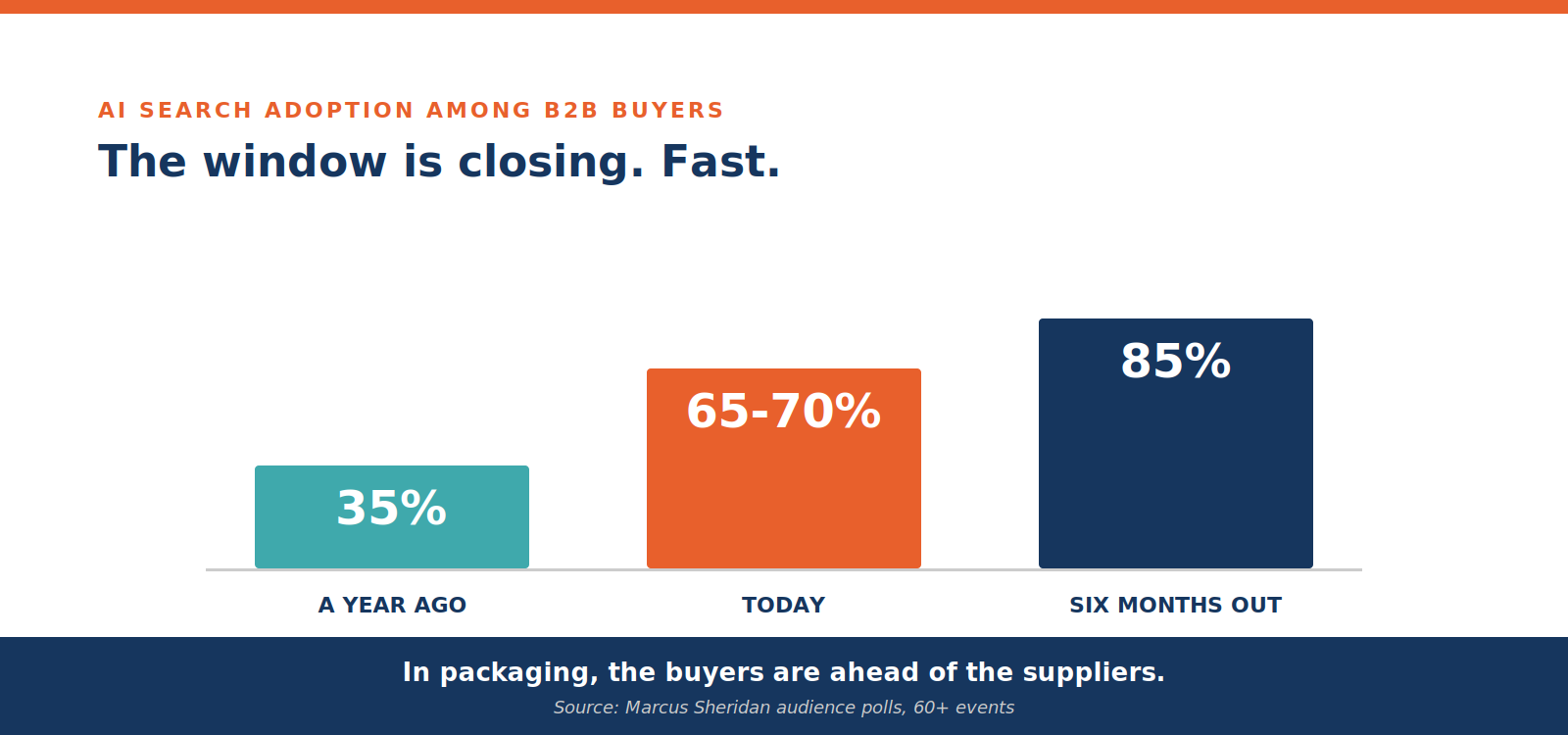
Chart showing AI search adoption among B2B buyers. 35 percent a year ago. 65 to 70 percent today. Projected 85 percent in six months.
In packaging, the buyers are ahead of the suppliers. CPG brand managers, fulfillment directors, and procurement leaders are using ChatGPT, Perplexity, and Google AI to shortlist suppliers right now, today, while your competitors are still arguing about whether AI search is real.
The first packaging company in any niche that builds a real I3 engine in front of their reps, deployed where buyers are actually researching, owns that recommendation for the next decade. The second one in is fighting for scraps. The third one does not get found at all.
This is not a marketing problem. It is not a content problem. It is a sales operations problem with a closing window.
When is this approach the wrong fit for a packaging company?
Honest fit-test. The Hyper-Focused Account-Based Sales Engine is not for everyone.
If your company is a true commodity supplier competing only on price and lead time, this system will not save you. The math does not work for a vendor whose entire value proposition is being three cents cheaper than the next bid.
If you have no specialized capability, no niche worth owning, and no story your best people could tell that a competitor could not, the Niche You Can Own Program has nothing to extract. Build the capability first. The system amplifies expertise. It does not invent it.
If you are unwilling to let your sales team become closers instead of prospectors, this system will create friction. The whole point is that reps stop chasing and start working educated buyers. If your sales culture is built around activity metrics and quote volume, the transition is uncomfortable.
Everyone else, particularly specialized manufacturers, regulated packaging suppliers, integrated packout operations, and overseas factories trying to sell into North America, is exactly who this is built for.
Frequently asked questions
Is this just a content marketing program?
No. Content is one piece of three. The system only works when a Niche You Can Own, an AI-search-optimized content library, and a trained AI agent are running together. A content program by itself produces traffic. This produces Sales Opportunities.
How is this different from lead generation services?
Lead generation services hand off contacts. This system hands off Sales Opportunities. A contact is a name. A Sales Opportunity is a buyer who has been Found, Educated, and Ready, with Issue, Impact, and Importance documented before the rep ever takes the call. The two should not be confused.
Will this replace our sales team?
No. It changes what the sales team does. Reps stop spending 60 to 70 percent of their time on prospecting and quoting. They spend that time closing educated buyers. The system does the discovery work that 99.6 percent of reps never do. The reps do the work only humans can do, which is to build trust and close.
How long until we see qualified opportunities?
The first piece, the Niche You Can Own Program, takes about thirty days. The content library starts producing AI-visible signals shortly after. Most clients see qualified Sales Opportunities reaching their sales team within ninety days. The system compounds from there.
We have an inside sales team and a CRM. Why do we need this?
Because none of those tools do I3 before the call. A CRM tracks activity. An inside sales team makes calls. Neither one engages a buyer at 2 am, qualifies their Importance against fourteen other priorities, and routes a fully briefed Sales Opportunity to the right rep with the homework done. That is what the engine adds.
The bottom line
Sheridan's data is the receipts that the packaging industry has been pretending it did not need. 0.4 percent of B2B reps run a real discovery call. The rest are losing deals they were never positioned to win.
You can keep paying the Pre-Sale Investment Tax. Or you can put a system in front of your sales team that does Issue, Impact, and Importance before a rep ever picks up the phone.
The window for being first in your niche is open right now. It will not stay open.
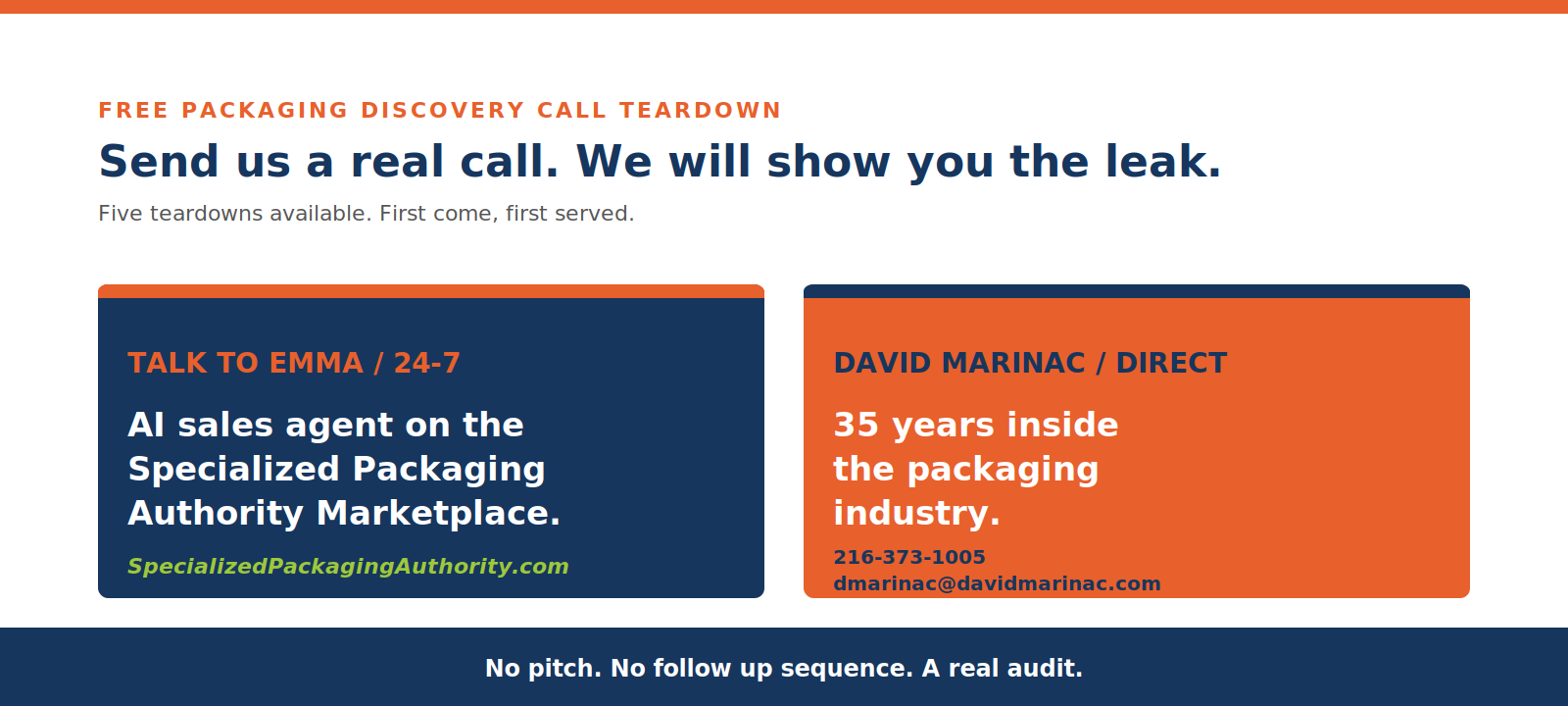
Free Packaging Discovery Call Teardown
Send a recent recorded sales call. A real prospect, not a friendly customer. Forty-five minutes or less. We will run a Packaging Discovery Call Teardown and send back a written report covering four things.
Did your rep identify the actual Issue the buyer was trying to solve, in plain language?
Did your rep quantify the Impact in dollars, risk, or customer exposure?
Did your rep establish where this ranked against everything else the buyer is dealing with?
What would have been already answered if this Sales Opportunity had reached your team through a Hyper-Focused Account-Based Sales Engine instead of a cold form fill?
No pitch. No follow-up sequence. A real audit, written by someone who has spent thirty-five years inside this industry, applied to a real call from your team. You will see exactly where the leak is. You will see exactly what a Sales Opportunity could have looked like instead.
Five teardowns available. First-come, first-served.
ABOUT THE AUTHOR
David Marinac is the founder of the Specialized Packaging Marketplace and ABC Packaging Direct. 35 years inside the packaging industry, working with manufacturers, distributors, and overseas factories. He builds AI-powered sales operations for packaging companies that want to stop quoting and start owning their niche.
SpecPkgMarketplace.com | dmarinac@davidmarinac.com | 216-373-1005
SOURCE NOTES
Marcus Sheridan and Ask Elephant, analysis of 981 B2B sales calls, 2025. The I3 framework (Issue, Impact, Importance) is credited to Ian Altman.

Ready to find your packaging partner?
Join hundreds of manufacturers and buyers already using PackageLink to streamline their sourcing process.