
When Your Best-Selling ProductBecomes Expensive Garbage
Published bythe Specialized Packaging Marketplace
It’s the firstMonday of the month. Time to build this month’s candy subscription boxes. Theteam pulls the pick list. Everything looks good.
Then someonechecks the gummy bears.
Best by date:three weeks ago.
There are 2,400bags. They were supposed to go in 2,400 boxes. They’re now trash.
Someone receivesa frantic call from the operations manager: “We need 2,400 bags of gummy bearsby Thursday. Any supplier. Any price. We have boxes shipping Friday.”
This is theexpiration date nightmare. And for candy subscription brands managing 50, 60,or 100+ rotating SKUs, it’s not a question of if it happens it’s a questionof how often.
Why Candy Subscriptions Have ItWorst
Every food businessdeals with expiration dates. But candy subscription boxes have a uniquecombination of factors that make freshness management exponentially harder.
The Variety Multiplier
A typical grocery store managesexpiration dates across thousands of SKUs, but they have sophisticatedinventory systems, dedicated category managers, and decades of establishedprocesses.
A candy subscription startupmanages 50-100 SKUs with a small team, rotating inventory, multiple suppliers,and systems that were probably built in a spreadsheet.
More SKUs = more dates to track =more opportunities to miss something.
The Rotation Problem
Candy subscriptions promisediscovery. Customers expect new items each month. That means:
• New products coming in constantly
• Old products cycling out
• Seasonal items appearing and disappearing
• Limited editions with short windows
• Supplier-driven changes you don’t control
Every rotation is an inventory management event. New SKUs need to be received, dated, stored, and tracked. Old SKUs need to be depleted or removed. The churn is relentless.
The Supplier Inconsistency
Different candy suppliers havewildly different approaches to shelf life:
Supplier A: Shipsproduct with 9 months of remaining shelf life. Reliable. Predictable.
Supplier B: Shipsproduct with 4 months remaining. Sometimes 3. Once shipped with 6 weeks.
Supplier C: Doesn’t putexpiration dates on cases, only on individual units. You don’t know until youopen it.
International Supplier D:Uses date format DD/MM/YY. You thought those gummies expired in June. Theyexpired in January.
When your freshness depends onthe practices of 20+ suppliers, consistency is impossible without aggressivereceiving inspection.
The Long Tail Problem
Candy subscriptions often have a fewhigh-volume items and many low-volume specialty items.
High-volume items: Turn fast.Fresh product constantly flowing. Expiration rarely an issue.
Low-volume items: Sit longer.Ordered in minimum quantities. Might take 3-6 months to sell through. These arethe ones that expire.
The irony: the specialty items thatmake your box special are the ones most likely to go bad.
The Math of Expiration
Let’s quantify how expiration datescompound into a serious operational and financial problem.
TheProbability Problem
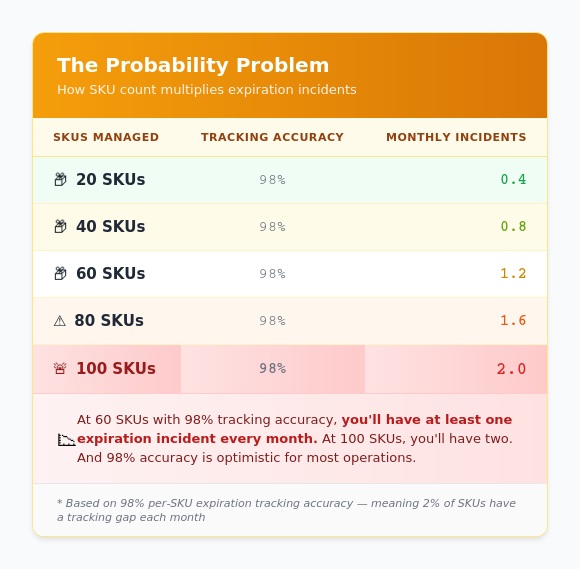
Assumeyou manage 60 SKUs and your expiration tracking is 98% accurate, meaning 2% ofthe time, an expiration issue slips through.
The Financial Impact
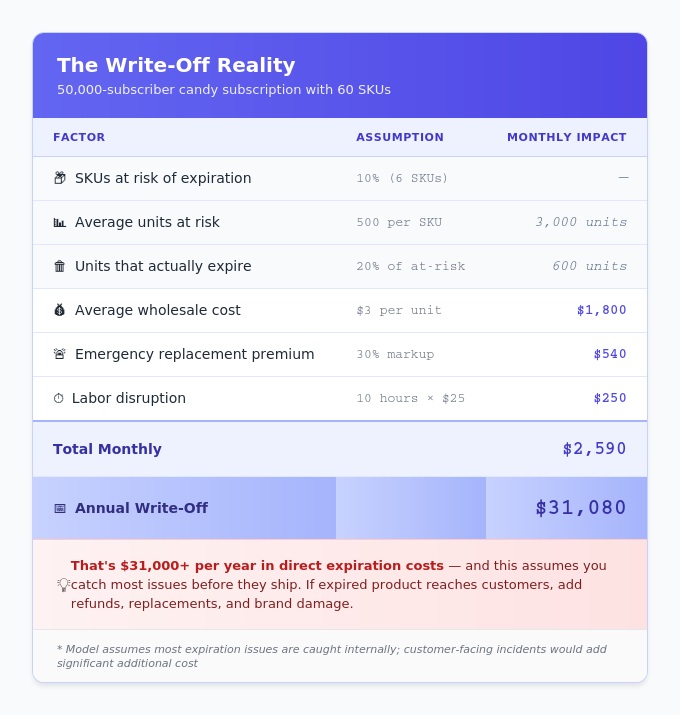
Whencandy expires, the costs cascade:
Productwrite-off: The expired candy has to be disposed of. At wholesale cost, thismight be $2-10 per unit depending on the item.
Emergencyreplacement: You need that item for this month’s boxes. Rush orders costpremium prices. Expedited shipping adds more.
Labordisruption: Someone has to identify the problem, find alternatives, receiveemergency shipments, and adjust pick lists. This isn’t planned work it displaces other priorities.
Potentialshipping delays: If you can’t source replacement quickly enough, boxes shiplate. Customer satisfaction takes a hit.
Customercomplaints: If expired product slips through to customers (it happens),you’re dealing with refunds, replacements, and reputation damage.
Where Expiration Failures Happen
Expiration issues don’tappear randomly. They cluster at specific failure points in the operation.
Failure Point #1: Receiving
This is where most expiration problems originate andwhere they’re easiest to prevent.
What goes wrong:
• Shipment arrives but expiration dates aren’tchecked on receipt
• Dates are checked on outer cases but not oninner units (they differ)
• International date formats are misread (DD/MM vs. MM/DD)
• Receiving team is rushed and skips dateverification
• Short-dated shipment is accepted “because weneed the inventory”
• No formal threshold for acceptable remainingshelf life
The critical mistake: Accepting product withinadequate remaining shelf life because “we’ll use it fast” then not using itfast.
Failure Point #2: InventoryManagement
Once product is in the warehouse,tracking has to work perfectly.
What goes wrong:
• Expiration dates not entered into inventorysystem at receiving
• Dates entered incorrectly (typos, format errors)
• System doesn’t support lot-level tracking (onlytotal quantity)
• Multiple lots of same SKU mixed together instorage
• FEFO (First Expired, First Out) not enforced inpicking
• Inventory system doesn’t alert when itemsapproach expiration
The data problem: Your inventorysystem says you have 500 bags of sour worms. It doesn’t know that 200 expirenext week and 300 expire in four months.
Failure Point #3: Demand Forecasting
Expiration is ultimately a mismatch betweenhow much you have and how fast you use it.
What goes wrong:
• Ordered too much of a slow-moving SKU
• Demand forecast missed (new item didn’t sell asexpected)
• Seasonal item ordered too early
• Minimum order quantities exceed actual need
• Supplier promotions create bulk buying of itemsyou can’t sell through
The over-order trap: Supplier offersa volume discount. You buy 10,000 units. You sell 6,000 before they expire. Thediscount cost you more than it saved.
Failure Point #4: Rotation Timing
Candy subscriptions constantly rotateproducts. The timing of rotation determines whether inventory becomes waste.
What goes wrong:
• Product rotated out of monthly box whileinventory remains
• New products added before old products depleted
• “Last chance” items not featured prominentlyenough to move
• End-of-season items not cleared before seasonends
• Limited editions ordered optimistically, thendiscontinued
The rotation trap: You commit to June’sbox lineup in May. You have inventory planned through June. In May, you decideto switch one item. Now you have inventory for an item not in any upcoming box.
Failure Point #5: Picking andShipping
Even with perfect tracking, execution canfail.
What goes wrong:
• FEFO not followed (worker grabs from mostaccessible location)
• Oldest inventory stored in back, newest in front(wrong)
• Pick system doesn’t direct to specific lot
• Short-dated product goes into boxes shipping tocustomers who pause frequently
• Quality check at pack doesn’t include dateverification
The LIFO problem: New shipmentsget binned in front. Workers pick what’s easy to reach. Old inventory ages inthe back. Classic LIFO (Last In, First Out) when you need FEFO.
The Customer Experience Failure
When expiration managementfails completely, customers receive products that are expired or nearlyexpired. This is the worst outcome.
The “Best By” Confusion
Customers check dates. They open the box, excited to trynew candies, and notice the gummy bears are “Best By” two weeks ago.
Customer thoughts: - “Is this safe to eat?” -“How long has this been sitting around?” - “Am I paying premium prices for oldcandy?” - “Do they even check what they send?”
It doesn’t matter that “Best By” dates are aboutquality, not safety. Customers see an expired date and feel cheated.
The “Almost Expired” Problem
Even products within date can feel stale if thedate is too close.
Customer receives a chocolate bar with a “Best By”date three weeks out. They think: “I’m supposed to enjoy this over the month.By the time I get to it, it’ll be expired.”
The freshness expectation: Customers paying$30-50 for a premium candy box expect premium freshness. “Technically notexpired” isn’t the standard they’re measuring against.
The Repeat Offender Damage
One expired item might be forgiven. But if ithappens twice? Three times?
First incident: “Mistakes happen. I’ll letthem know.”
Second incident: “This is becoming apattern. Do they have a quality problem?”
Third incident: “I’m done. Canceling.”
Expiration issues that become visible to customersare churn accelerators.
What Good Expiration ManagementLooks Like
Operations thatmaintain freshness across high-SKU counts have built systems specificallydesigned for the challenge.
Receiving Discipline
Inspection protocol: Everyinbound shipment is checked for expiration dates before it’s accepted intoinventory. Not sampled every case.
Minimum shelf life thresholds:Clear policy: “We don’t accept product with less than 90 days remaining” (orwhatever threshold fits your turn rate). Suppliers know this in advance.
Date standardization: All dates converted to single format at receiving. No confusion between DD/MM and MM/DD. International products get verified.
Rejection authority: Receivingteam has authority to reject short-dated shipments, even if operations “needs” the inventory. The cost of accepting bad inventory exceeds the cost of atemporary stockout.
Lot-Level Tracking
Every lot, every date: Inventorysystem tracks not just “500 bags of sour worms” but “200 bags lot A exp. 06/15,300 bags lot B exp. 10/20.”
Location assignment: Each lotassigned to specific location. Lots don’t mix in storage. When you pick fromlocation A, you’re picking the specific lot in location A.
System alerts: Automated alertswhen lots approach expiration. 60 days out? Flag it. 30 days out? Escalate. 14days out? This is now a problem.
FEFO Enforcement
System-directed picking: Picksystem directs workers to specific location for specific lot. Not “pick gummybears from anywhere” but “pick gummy bears from location A-15, lot 2024-2847.”
Physical organization: Oldestinventory in most accessible position. New inventory goes in back. Storagelayout supports FEFO, not LIFO.
Pick verification: Worker confirmslot number at pick, not just item. System won’t accept pick from wrong lot.
Demand-Based Ordering
Right-sized orders: Orderquantities based on actual expected usage plus safety stock, not supplierminimums or volume discounts that create excess.
Shelf life modeling: Beforeordering, calculate: “If I order 5,000 units and use 800/month, will I use thembefore they expire?” If no, order less.
Supplier negotiation: Workwith suppliers on smaller, more frequent shipments rather than large bulkorders. Pay slightly more per unit to avoid write-offs.
Rotation Planning
Inventory-aware curation: Whenplanning monthly box lineup, check what’s in inventory and what’s approachingexpiration. Feature items that need to move.
“Last Chance” mechanism: Formalprocess for items being rotated out. If 500 units remain and only 200 will goin final month’s boxes, have a plan (flash sale, bonus items, donation).
Discontinuation protocol: When aproduct is leaving the lineup, calculate exactly how many boxes it can befeatured in and order only that amount.
Freshness Buffer
Customer-facing threshold: Even ifproduct is technically good until the date, internal policy ensures customersreceive items with meaningful remaining life. If your box takes 5 days toarrive and customers eat candy over 2 weeks, they need 3+ weeks of remainingshelf life at ship.
Buffer calculation: Work backwardfrom customer experience. If minimum acceptable remaining life at receipt is 30days, and transit is 5 days, ship nothing expiring in less than 35 days.
The Technology Requirements
Managing expiration at scalerequires system capabilities that many fulfillment partners lack.
Lot-Level Inventory Management
The warehouse management system must track:
• Individual lots for every SKU
• Expiration date per lot
• Quantity per lot
• Location per lot
• Receipt date per lot
Systems that only track total quantity per SKU cannot support proper expiration management.
FEFO-Directed Picking
The picking system must:
• Direct workers to specific lot, not just SKU
• Enforce oldest-first logic
• Prevent picks from wrong lots
• Handle partial lot depletion
• Update lot quantities in real-time
Paper-based or basic pick systems cannot reliablyenforce FEFO.
Alerting and Reporting
The system should:
• Generate automatic alerts when lots approachexpiration thresholds
• Report on inventory age across all SKUs
• Identify slow-moving items before they becomeproblems
• Track write-off rates and trends
• Support expiration-based reorder pointcalculations
Reactive systems that only show current state cannotprevent expiration issues.
Integration with Curation
For candy subscriptions specifically, inventorysystems should inform product curation:
• Visibility into what’s approaching expiration
• Automatic flagging of items needing to befeatured
• Constraint-based curation that factors ininventory position
Curation done in a separate system withoutinventory visibility creates rotation problems.
Questions to Ask FulfillmentPartners
If you’re evaluatingfulfillment partners for a candy subscription operation, these questions revealwhether they can actually manage freshness:
Receiving and Tracking
1. Do you verify expiration dates at receiving forevery inbound shipment?
2. What’s your minimum remaining shelf lifethreshold for accepting product?
3. Does your WMS track inventory at the lot levelwith expiration dates?
4. How do you handle international date formats?
Storage and Picking
5. How do you enforce FEFO in your picking process?
6. Is picking system-directed to specific lots, ordo workers choose?
7. How do you physically organize inventory tosupport oldest-first picking?
8. What happens if a worker picks from the wronglot?
Monitoring and Alerts
9. Does your system generate alerts when lotsapproach expiration?
10. What’s your escalation process when items are atrisk of expiring?
11. Can you show me reporting on inventory age andexpiration trends?
12. How do you track and report write-off rates?
Experience
13. What’sthe highest SKU count you’ve managed with expiration date tracking?
14. Canyou show me accuracy data for lot-level inventory?
15. Whatcandy or food subscription brands do you currently work with?
Red Flags:
• “We track inventory by SKU, not lot” (cannotsupport FEFO)
• “Workers know to pick the oldest first” (nosystem enforcement)
• “We check dates periodically, not everyreceiving” (problems will slip through)
• Can’t produce reporting on inventory age orwrite-offs
• No experience with high-SKU food products
The Bottom Line
The expiration date nightmare is a systemsproblem, not a discipline problem. You cannot train or motivate your way tofreshness management across 50, 60, or 100 SKUs. You need:
• Receiving processes that verify dates beforeaccepting inventory
• Inventory systems that track at the lot level
• Picking systems that enforce FEFO
• Alerting that surfaces problems before theybecome crises
• Curation that’s informed by inventory position
The brands winning in candysubscription aren’t winning because they have better candy or better marketing.They’re winning because their operations don’t turn best-selling products intoexpensive garbage.
For candy subscriptions, freshness isn’t aquality metric. It’s the entire customer promise.
Looking for a candy fulfillment partnerwho understands expiration date management?
The Specialized Packaging Marketplaceconnects candy and snack subscription brands with vetted fulfillment partnerswho have lot-level tracking, FEFO systems, and food-grade operations. Search bycapability, SKU count experience, and food safety certifications.
Bay Cities is a 100% employee-owned direct manufacturer of retail packaging, POP displays, and packout services. Preferred vendor at major retailers.



Ready to find your packaging partner?
Join hundreds of manufacturers and buyers already using PackageLink to streamline their sourcing process.