

Five Vendor Handoffs. Five Invoices. Five Chances forSomething to Go Wrong.
The Problem Nobody Puts in a Spreadsheet
Ask any supply chain leader how many vendors touch theirproduct between the factory and the customer, and you’ll usually get a pausebefore the answer.
Not because they don’t know. Because the number is higherthan they’d like to admit.
For most consumer brands especially those importing product, managing retail distribution, or running subscription programs the typical supply chain involves four to six separate partners: a warehouse, a co-packer, a packaging supplier, a labeling vendor, a 3PL, and sometimes a freightbroker trying to coordinate all of them.
Each one of those partners does their job. The problemisn’t any single vendor. The problem is the gaps between them.
And those gaps are where margin disappears.
The Five Hidden Costs of Fragmentation
When brands evaluate their supply chain costs, theytypically look at unit economics: cost per case, freight per shipment, laborper unit. Those numbers are real, and they matter.
But they’re not the whole picture. The real cost of afragmented supply chain lives in the spaces between the line items the overheadthat never gets its own row in the budget.
1. Coordination Overhead
Every vendor in your chain requires management. Thatmeans emails, calls, status updates, exception handling, and escalation whensomething goes sideways. Your operations team isn’t just managing product flowthey’re managing relationships.
For a mid-size brand running five vendors across theirpackaging and fulfillment chain, the coordination overhead alone can consume8–12% of total packaging spend. Not freight. Not materials. Just the cost ofkeeping everyone aligned.
That’s real salary dollars spent on project managementthat wouldn’t exist if the handoffs didn’t exist.
2. Lead Time Compounding
Here’s a scenario most ops leaders will recognize: eachvendor in your chain quotes a two-week turnaround. Reasonable. Professional. Onpaper, you’re looking at eight weeks through four vendors.
In practice? More like twelve. Because between each vendor, there’s a gap. Shipping from facility A to facility B. Intake inspection. Queue time. Material staging. Those gaps don’t appear on anyvendor’s quote, but they show up in your delivery timeline.
The industry calls it “lead time compounding.” Eachhandoff adds two to five days of invisible delay. Across four handoffs, you’relooking at one to three additional weeks that nobody budgeted for.
3. Error Amplification
Mistakes in a single-partner operation get caught andfixed fast. Mistakes in a multi-vendor chain get amplified.
A labeling error at your co-packer doesn’t get discovered until your 3PL tries to ship and the retailer rejects the pallet. Now you're paying for return freight, rework at a separate facility, expedited-shipping, and potentially a chargeback all because an error at step two wasn’t visible until step four.
The longer the chain, the later errors surface. And thelater they surface, the more expensive they are to fix.
4. Compliance Fragmentation
Retail compliance is where fragmented supply chains causethe most expensive damage.
Every major retailer has specific requirements: labelplacement, pallet configuration, ISTA testing certification, EDI formatting,and delivery windows. Miss any one of them and the chargeback is immediate.
Here’s the problem: when your packaging vendor handlesthe carton, your co-packer handles the assembly, and your 3PL handles theshipping, who owns compliance? In theory, everyone. In practice, nobody.
The brand gets the chargeback. Walmart doesn’t care whichof your five vendors put the label in the wrong spot. They care that the palletarrived non-compliant. And for some retailers, chargebacks have essentiallybecome a profit center they’re looking for reasons to deduct, not reasons toforgive.
5. Invisible Margin Erosion
This is the cost that never shows up on a P&L because it doesn’t have a line item. It’s the sum of all the above: the coordination hours, the extended timelines, the error rework, the compliance failures, the freight redundancy of moving product between multiple facilities.
Individually, each cost seems manageable. Collectively,they erode 15–25% of what most brands think their supply chain costs.
The brands that figure this out don’t just save money.They discover capacity they didn’t know they had because their ops team stopsmanaging handoffs and starts managing growth.
The Math: What Fragmentation Actually Costs
Let’s put rough numbers on it for a brand managing atypical import-to-retail supply chain across five vendors:
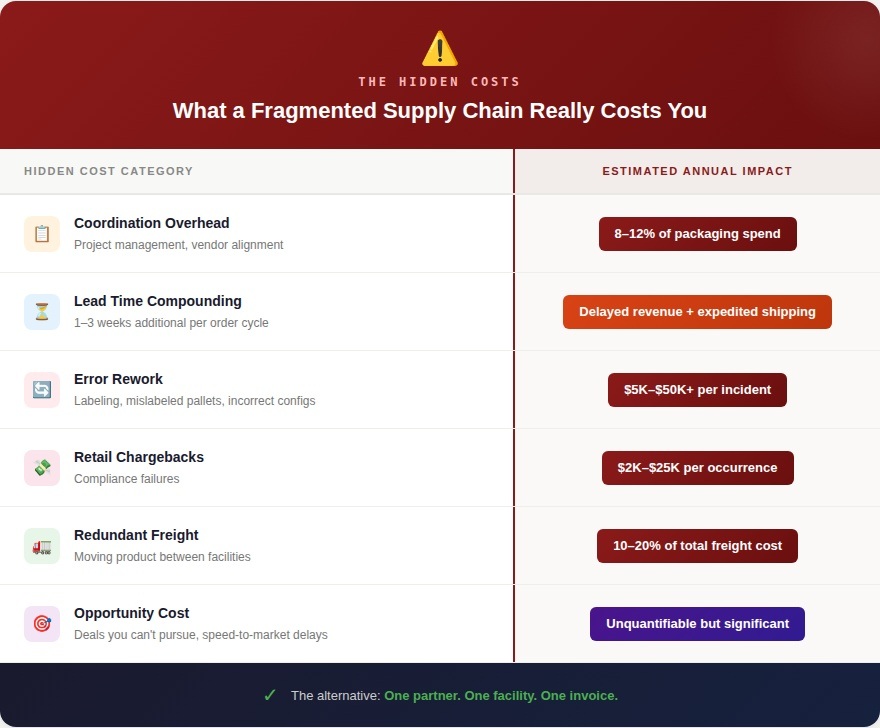
For a brand spending $500K–$2M annually on packaging andfulfillment, the fragmentation tax is typically $75K–$300K in costs that couldbe eliminated with a consolidated model.
That’s not a rounding error. That’s a head count. Aproduct launch. A margin improvement that changes how the brand competes.
The Consolidation Alternative
The solution isn’t necessarily doing everything in-house.It’s reducing handoffs.
The brands that have solved the fragmentation problemtypically share one characteristic: they found a partner who can handle more ofthe chain under one roof. Not a generalist who farms out half the work. Avertically integrated operation that eliminates the handoffs rather than justmanaging them.
The difference is structural. When packaging design,manufacturing, assembly, kitting, compliance, and distribution happen in asingle facility with a single team, the five hidden costs essentiallydisappear:
• Coordination overhead drops to a single point of contact.
• Lead time compounding collapses because there are no gaps between vendors.
• Errors get caught and fixed in real time by the same team thatcaused them.
• Compliance is owned by one partner who understands every retailer’srequirements.
• Freight redundancy is eliminated because product doesn’t move betweenfacilities.
One facility. One partner. One conversation whensomething needs to change.
How to Audit Your Own Supply Chain
Before making any changes, it’s worth doing an honestassessment. Here are the questions that reveal the real cost of fragmentation:
1. Count the handoffs. How many times does your product get physically movedbetween the factory and the end customer? Every move is a cost and a risk.
2. Count the invoices. How many separate vendors are you paying for what isessentially one continuous process? Each invoice represents a relationship, amarkup, and a coordination cost.
3. Map the timeline. What’s the total elapsed time from receipt of materialsto ship-ready? Now compare that to the sum of each vendor’s quoted turnaround.The gap is your lead time tax.
4. Track the errors. Over the last 12 months, how many issues required rework, re-shipping, or chargebacks? Where in the chain did each one originate? Wherewas it discovered?
5. Calculate the overhead. How many hours per week does your team spend coordinatingbetween vendors? Multiply that by your loaded labor cost. That’s yourfragmentation tax.
Most brands that run this audit are surprised by theanswer. Not because any single cost is shocking, but because the total is.
The Bottom Line
A fragmented supply chain isn’t broken. It works. Ordersship. Products reach shelves.
But “it works” is an expensive standard. The hidden costsof coordination, delays, errors, and compliance failures compound quietly,eroding margin in ways that never get their own line item in the budget.
The brands that gain a competitive advantage in packagingand fulfillment aren’t necessarily spending less. They’re spending smartereliminating the handoffs, consolidating the partners, and turning a five-vendorcoordination problem into a single-partner operation.
If your supply chain has more vendors than it needs andmore handoffs than you’d like, the cost is higher than you think. And thealternative is simpler than you’d expect.
Want to See What Consolidation Looks Like?
If you’re managing multiple vendors across your packagingand fulfillment chain and want to understand what a consolidated model wouldlook like for your specific operation, we’re happy to walk through thecomparison.
Have a quick question? Emma, our 24/7 Midwest Packout specialist, can help.
Bay Cities is a 100% employee-owned direct manufacturer of retail packaging, POP displays, and packout services. Preferred vendor at major retailers.



Ready to find your packaging partner?
Join hundreds of manufacturers and buyers already using PackageLink to streamline their sourcing process.