
One Missing Shallot Ruins Everything
Publishedby the Specialized Packaging Marketplace
It’sTuesday at 6:47 PM. The kids are hungry. The HelloFresh box arrived on time.Everything is going according to plan.
Mom pulls out the recipe card: Tuscan Chicken with Roasted Vegetables and Garlic Herb Butter. Sounds amazing. She starts unpacking ingredients.
Chicken breasts. Check. Zucchini. Check. Cherry tomatoes. Check. Italian seasoning. Check. Garlic herb butter. Check. Shallot.
Where’s the shallot?
She digs through the box. Checks the other meal bags. Looks under the ice packs. Nothing.
The shallot the $0.35 ingredient that takes the sauce from “fine” to “restaurant quality” isn’t there.
Now she’s improvising with half an old onion from the fridge. The meal is “okay.” Not what she paid for. Not what she planned her evening around. Not the experience that justifies the premium price.
One missing shallot. One frustrated customer. One step closer to cancellation.
This is the missing ingredient problem. And it’s why meal kit fulfillment has the most demanding accuracy requirements of any e-commerce category bar none.
The Math That Makes Meal Kits Impossible
Let’s start with why meal kit accuracy is structurally harder than any other fulfillment challenge.
The Pick Count Problem
A typical e-commerce order: 1-3 items. Pick them, pack them, ship them.
A typical meal kit box: - 3-4 recipes per box - 10-15 ingredients per recipe - 40-60 individual items per shipment
That’s not an order. That’s an inventory management exercise happening in every single box, thousands of times per day.
The Probability Nightmare
Here’s where the math gets brutal.
Let’s say your fulfillment operation achieves 99% per-item pick accuracy. That’s genuinely excellent most operations would celebrate that number.
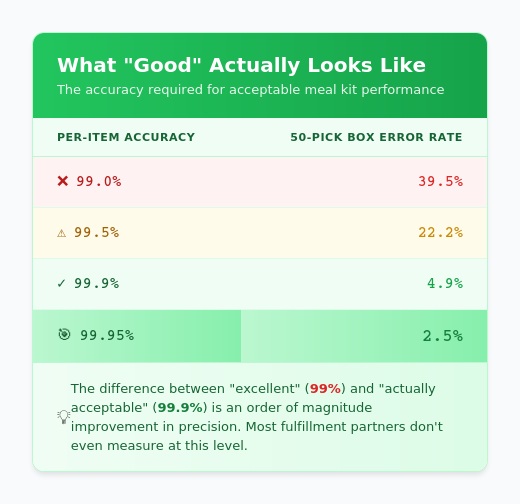
At 99% per-item accuracy with a 50-pick meal kit box, nearly 40% of your boxes have at least one error.
Ship 100,000 boxes per week? That’s 40,000 customers receiving incomplete meals. Every. Single. Week.
Now you understand why meal kit brands are obsessed with accuracy and why “99% accuracy” isn’t nearly good enough.
What “Good” Actually Looks Like
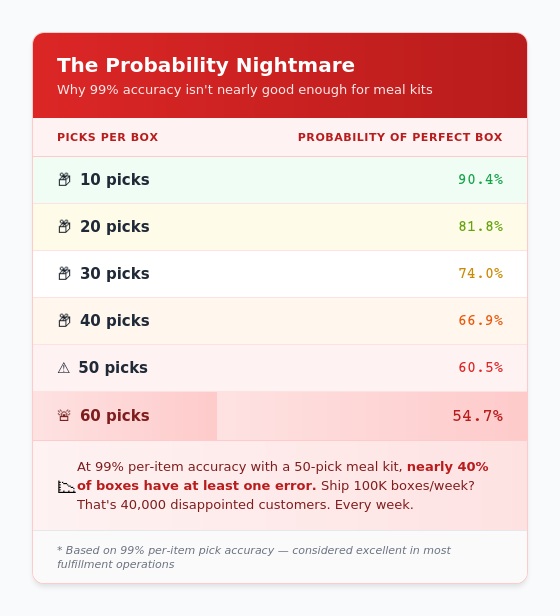
To achieve less than 5% box-level error rate on a 50-pick meal kit, you need 99.9% per-item accuracy.
The difference between “excellent” (99%) and “actually acceptable” (99.9%) is an order of magnitude improvement in operational precision.
Most fulfillment partners don’t even measure at this level of granularity. They report “order accuracy” which for meal kits is meaningless. One box with one missing item counts the same as one box with ten missing items.
Why Missing Ingredients Hit Different
A missing item in most e-commerce categories is an inconvenience. A missing ingredient in a meal kit is a failure cascade.
The Recipe Doesn’t Work
Unlike a missing accessory or a wrong color, a missing ingredient often means the recipe cannot be executed as designed.
Missing the shallot for the sauce? The sauce is different. Missing the pine nuts for the pesto? The pesto doesn’t exist. Missing the miso paste? That’s not miso-glazed salmon anymore.
The customer didn’t order ingredients. They ordered a meal. When the meal can’t be made as promised, the entire value proposition collapses.
The Timing Is Locked
When someone orders a phone case and it arrives wrong, they return it and wait for a replacement. Inconvenient, but manageable.
When someone plans Tuesday dinner around a specific recipe and an ingredient is missing, there’s no waiting for are placement. Dinner is in 45 minutes. The kids are hungry. The decision has already been made.
The customer is now: - Improvising with substitutes they may not have - Ordering pizza (and questioning why they pay for meal kits) - Eating something else (while the remaining ingredients spoil)
There’s no recovery. The moment is gone.
The Trust Multiplier
Missing ingredients compound in customer psychology.
First missing ingredient: “Mistakes happen. I’ll contact support.”
Second missing ingredient: “This is becoming a pattern. Am I getting what I paid for?”
Third missing ingredient: “I can’t rely on this service. Why am I paying a premium for uncertainty?”
Each incident doesn’t just damage satisfaction it damages trust. And in subscription businesses, trust is the entire retention model.
The Multi-Meal Multiplication
Here’s what makes meal kit errors particularly devastating: customers often don’t discover them until they’re cooking.
The box arrives. It goes in the fridge. Two days later, it’s time to cook Recipe #2.
Now the customer discovers Recipe #2 is missing the ginger. But they already made Recipe #1 successfully, so they didn’t contact support immediately. By the time they discover the error, their window for easy resolution has passed.
And if Recipes #3 and #4 also have issues? The customer didn’t have one bad experience they had a bad week. That’s not a support ticket. That’s a cancellation.
Where Missing Ingredient Errors Actually Happen
Missing ingredients aren’t random. They cluster around specific failure points.
Failure Point #1: Receiving and Inventory
Ingredients arrive at the fulfillment center from multiple suppliers, often daily.
What goes wrong: - Ingredients received but not properly checked into inventory -Quality issues not caught (bruised produce accepted, then later rejected) -Inventory placed in wrong location - System shows available but physical inventory isn’t there - Short shipments from suppliers not caught immediately
The error happens before picking even begins. The system says there are 5,000 shallots. There are actually 4,200. By Thursday, pickers are reaching into empty bins.
Failure Point #2: The Pick Process
This is the highest-risk moment when ingredients move from inventory to customer boxes.
What goes wrong: -Worker picks wrong ingredient (similar-looking items) - Worker picks wrong quantity (2 carrots instead of 3) - Worker skips line on pick list - Worker picks from wrong bin (yesterday’s garlic in today’s location) - Worker substitutes without authorization when bin is empty - Ingredient falls out of tote during transport
At 40-60 picks per box, each pick is an opportunity for error. The cumulative probability is relentless.
Failure Point #3: Recipe Kitting
Many meal kit operations pre-kit ingredients by recipe, then combine recipe kits into customer boxes.
What goes wrong: -Ingredient omitted from recipe kit - Wrong recipe kit version used (Recipe Av2.1 vs v2.2) - Recipe kits for different meals look similar and get swapped -Protein packs mismatched to recipe kits - Sauce packets or seasoning sachets missing or wrong
Kitting adds an assembly step which means another error opportunity before final pack.
Failure Point #4: The Pack Station
Final assembly is the last chance to catch errors or introduce new ones.
What goes wrong: -Recipe kits don’t all make it into box - Wrong combination of recipes for customer’s subscription type - Ice packs or insulation displace ingredients -Ingredients fall out during packing - QC check is cursory or skipped under time pressure
Without rigorous final verification, errors pass through to the customer.
Failure Point #5: Post-Pack Damage
Even perfectly packed boxes can fail after leaving the station.
What goes wrong: -Rough handling punctures packaging - Temperature fluctuations damage or spoil ingredients - Compression crushes delicate items - Liquids leak and contaminate other ingredients - Insects or pests infiltrate during storage or transit
The customer receives the box, opens it, and finds a mess even if every pick was correct.
The Error Categories Nobody Tracks
Most fulfillment operations measure “missing items.” But meal kit accuracy requires tracking multiple error types:
Missing Errors
Item should be there but isn’t. Example: No shallot in the Tuscan Chicken kit.
Wrong Item Errors
Different item substituted, intentionally or not. Example: Yellow onion instead of shallot.
Wrong Quantity Errors
Right item, wrong amount. Example: 2 tomatoes instead of 4.
Quality Errors
Right item, right quantity, unacceptable condition. Example: Bruised avocado that’s brown inside.
Wrong Recipe Errors
Ingredients for different recipe included. Example: Thai basil (for Recipe B) instead of Italian basil (for Recipe A).
Version Errors
Outdated recipe version components mixed with current version. Example: Old sauce packet formulation with new protein portion size.
Protein Errors
Wrong protein type or wrong weight. Example:8 oz chicken breasts instead of 12 oz, or chicken instead of salmon.
Each error type has different root causes, different detection methods, and different customer impact. Operations that only track “missing items” are blind to most of their accuracy problems.
What Missing Ingredients Actually Cost
Let’s quantify the damage.
Direct Costs
Customer service: Every missing ingredient generates a support contact. At fully-loaded costs of $20-25/hour and 10-15 minutes per contact, that’s $3-6 per incident.
Credits and refunds: Most meal kit brands credit the cost of the affected recipe. At $10-15 per recipe, that’s the most visible direct cost.
Replacement shipments: Some brands ship replacement ingredients. Expedited shipping for a single item often exceeds the ingredient’s value. $8-15 per replacement.
Product waste: If the customer already made the recipe with substitutes, the late-arriving replacement is trash.
Direct cost per missing ingredient incident: $15-35
Indirect Costs (The Business Killers)
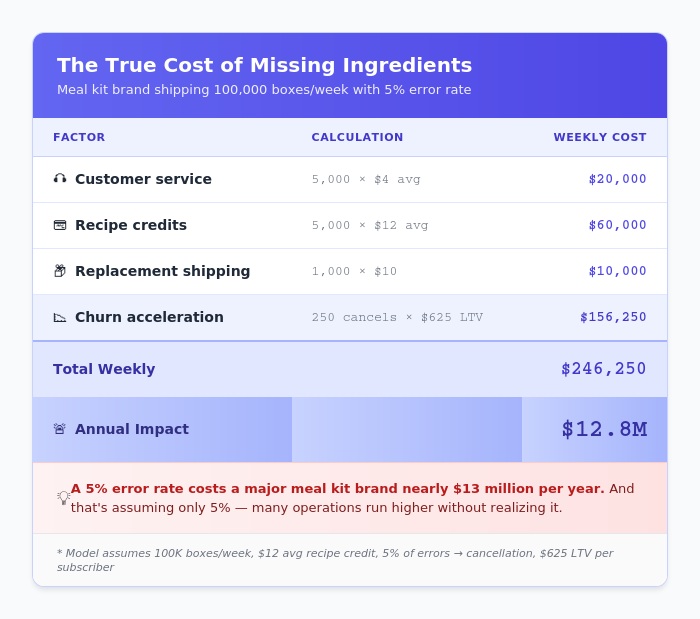
Accelerated churn: Customers who experience fulfillment errors churn at 3-4x the baseline rate. For a $12/week subscription with 12-month potential LTV of $625, even a 5%churn acceleration is devastating.
Reduced order frequency: Some meal kit services let customers skip weeks or reduce box size. Accuracy issues drive customers to order less frequently even before they formally cancel.
Brand damage: Reviews, social media, word of mouth. “Ingredients are always missing” appears in every negative review thread.
Competitive switching: The meal kit market is crowded. HelloFresh, Blue Apron, Sunbasket, Home Chef, EveryPlate customers can switch with a click. A missing ingredient in your box is an acquisition opportunity for your competitor.
The Total Impact Model
Why Standard 3PLs Fail at Meal Kit Accuracy
Most third-party logistics providers were built for different products discrete units with barcodes, 1-3 items per order, low consequences for errors.
Meal kits break every assumption.
The “Picks Per Hour” Delusion
Standard fulfillment optimizes for picks per hour. Workers are measured on speed. The faster they pick, the more efficient the operation, the lower the cost.
For meal kits, picks per hour is almost meaningless.
What matters is accurate picks per hour. A worker who picks 200 items per hour at 98% accuracy creates twice as many errors as a worker who picks 150 items per hour at 99% accuracy.
Speed-focused operations systematically under-invest in accuracy and meal kit accuracy can’t survive that trade-off.
The Single-Point Verification Problem
Standard fulfillment does quality control at pack station: scan the items, verify against the order, close the box.
For meal kits with50+ items, single-point verification is insufficient. Errors need to be caught at multiple stages: - Receiving verification - Bin location verification - Pick verification - Recipe kit verification - Final pack verification
A fulfillment partner with only final-stage QC will let errors compound through the entire process.
The “It’s Just Groceries ”Misunderstanding
General 3PLs often approach meal kits like grocery fulfillment: put the food items in a box, keep it cold, ship it.
But meal kits aren’t groceries. They’re recipe kits curated, specific, assembled with intent. The difference matters:
• Groceries: Customer will substitute if item is unavailable
• Meal kits: Specific ingredients for specific recipes, no substitution without communication
• Groceries: Approximate quantities are fine(roughly a pound of chicken)
• Meal kits: Precise portioning required (exactly12 oz for 2 servings)
• Groceries: Customer is shopping, making real-time decisions
• Meal kits: Customer committed to a menu days ago, planning depends on it
A fulfillment partner who treats meal kits like grocery fulfillment will systematically under-deliver on accuracy.
The Ingredient Complexity Problem
Most fulfillment operations handle products that are discrete, barcoded, and visually distinct.
Meal kit ingredients include: - Loose produce that looks similar (is that a shallot or a small onion?) - Herbs that are hard to distinguish (flat parsley vs. cilantro) -Portioned ingredients in identical bags (same bag, different spice) - Liquids in similar bottles (both are 2 oz sauces which one?) - Proteins that must be matched to specific recipes
Standard pick systems weren’t designed for this complexity. The technology and training requirements are different.
What High-Accuracy Meal Kit Fulfillment Looks Like
The operations achieving 99.9%+ pick accuracy aren’t doing it through heroics. They’ve built systems designed specifically for the meal kit challenge.
Upstream Quality Control
Accuracy starts at receiving, not at pack.
Supplier scorecards: Track accuracy and quality by supplier. Poor performers get feedback or replacement.
100% receiving verification: Every ingredient checked for quantity and quality on arrival. No exceptions.
Quality holds: Ingredients that don’t meet standards are rejected before entering pickable inventory.
Inventory integrity audits: Regular physical counts to catch system-vs-reality gaps before they cause pick failures.
Station-by-Station Verification
Multiple checkpoints catch errors before they reach customers.
Pick verification: Worker confirms item identity at pick (visual, scan, or weight verification).
Recipe kit verification: Completed recipe kit checked against kit contents list before proceeding.
Final pack verification: Full box contents verified against order requirements before closing.
Random audit sampling: Additional QC layer on random percentage of boxes.
Four or five verification points. Each catches different errors. Together, they achieve accuracy levels impossible with single-point QC.
Ingredient-Specific Handling
Recognition that ingredients aren’t all the same:
Look-alike protocols: Special handling for visually similar items. Different storage locations. Explicit identification requirements.
Protein verification: Weight verification for portioned proteins. Temperature logging. Visual quality check.
Produce grading: Clear standards for acceptable quality. Workers empowered to reject substandard items.
Sauce and sachet verification: Package type and labeling confirmed against recipe requirements.
Technology Built for Complexity
The warehouse management system matters.
Recipe-aware picking: System understands relationships between ingredients and recipes, not just individual items.
Version control: When recipes change, system enforces correct component versions.
Exception handling: When ingredients are unavailable, system guides proper substitution or order hold never silent omission.
Lot traceability: Every ingredient traceable to source, for quality issues and recall response.
Error Analysis and Response
High-accuracy operations treat every error as information.
Root cause analysis: Why did this error happen? Which failure point? Which ingredient? Which worker? Which shift?
Pattern detection: Are errors clustering by ingredient type? Time of day? Recipe complexity? Supplier?
Feedback loops: Insights fed back into training, process design, supplier management.
Continuous improvement: Accuracy targets that ratchet up over time, not static standards.
Questions to Ask Meal Kit Fulfillment Partners
If you’re evaluating fulfillment partners for a meal kit operation, these questions separate the capable from the pretenders:
Accuracy Measurement
1. How do you measure pick accuracy — per-item or per-box?
2. What is your current per-item accuracy rate on meal kit operations?
3. Do you track accuracy by error type (missing, wrong, quantity, quality)?
4. How often do you report accuracy metrics to clients?
Process and Verification
5. How many verification checkpoints exist between receiving and ship?
6. How do you handle look-alike ingredients?
7. What happens when an ingredient is out of stock mid-pick?
8. How do you verify portioned proteins for weight accuracy?
Systems and Technology
9. Does your WMS understand recipe-to-ingredient relationships?
10. How do you handle recipe version changes?
11. Can you trace every ingredient in a box back to its source lot?
12. How does your system handle substitution authorization?
Error Response
13. What is your process when a pick error is discovered?
14. How do you analyze error root causes?
15. Can you show me error trend data from current meal kit clients?
16. How do accuracy issues feed back into training?
Red Flags: - Reports only “order accuracy” without per-item breakdown - Single verification point at pack station only - “We handle groceries, meal kits are similar” - No recipe-aware WMS capabilities - Can’t provide accuracy data from existing meal kit operations
The Bottom Line
Meal kit fulfillment has the highest accuracy requirements in e-commerce because it has the lowest tolerance for error. One missing ingredient doesn’t just create a support ticket it ruins a dinner, erodes trust, and accelerates churn.
The math is unforgiving. At 50-60 picks per box, even “excellent” accuracy rates produce error rates that would be catastrophic for any subscription business. Achieving acceptable box-level accuracy requires per-item precision that most fulfillment operations aren’t designed to deliver.
The brands winning in meal kit aren’t winning because of better recipes or better marketing. They’re winning because their boxes arrive complete every ingredient, every meal, every time.
For meal kit brands, accuracy isn’t a fulfillment metric. It’s the entire customer promise.
Looking for a meal kit fulfillment partner who understands high-accuracy kitting?
The Specialized Packaging Marketplace connects meal kit and fresh food brands with vetted fulfillment partners who specialize in multi-ingredient accuracy. Search by accuracy metrics, cold chain capability, and food safety certifications.
Search Meal Kit Fulfillment Partners



Ready to find your packaging partner?
Join hundreds of manufacturers and buyers already using PackageLink to streamline their sourcing process.