

And What It’s Actually Costing Your Subscription Business
Published by the Specialized Packaging Marketplace
It’s4:30 PM on a Saturday. A seven-year-old tears open her Kiwi Co box, excited to build this month’s hydraulic claw machine. Mom clears the kitchen table. Theinstruction card is spread out. Components are sorted.
Andthen: “Mom, where’s the tubing?”
It’snot there. The one piece that makes the whole project work the clear plastictubing that connects the syringes to create the hydraulic mechanism is missing.
Thebox had 14 components. 13 of them made it. One didn’t.
Thatone missing piece just cost you a customer.
Notbecause the parent is unreasonable. Not because your product is bad. Butbecause in kids subscription, the experience IS the product and a missing component doesn’t just inconvenience the customer. It ruins an afternoon. It disappoints a child. It breaks a promise.
This article breaks down why kids activity boxes have the highest error rates in the subscription industry, what those errors actually cost, and what the brands getting it right do differently.
The Math That Makes Kids Boxes So Hard
Let’s start with the uncomfortable reality: kids activity subscription boxes are, from a fulfillment perspective, the most error-prone product category in the industry.
Here’s why.
Component Count Multiplies Error Probability
A typical beauty subscription box has 4-5 items. A pet box might have 5-7. A coffee subscription has 1-3.
A kids STEM or craft subscription box? 10-20 components. Sometimes more.
KiwiCo’s crates regularly contain 12-18 separate pieces. Lovevery boxes include multiple toys, books, and play guides. CrunchLabs builds require dozens of parts across multiple bags.
The math is brutal: If your pick accuracy is 99.5% per item (which is considered excellent in fulfillment), here’s what happens as component count increases:
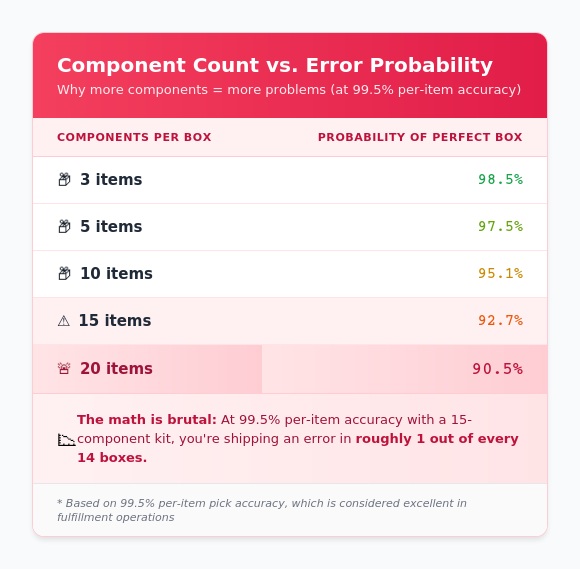
Scale that to50,000 monthly subscribers and you’ve got 3,500+ customers receiving incompletekits. Every. Single. Month.
Small Parts Amplify the Problem
It’s not just the count it’s what you’re counting.
Kids activity boxes don’t contain neatly barcoded retail units. They contain:
• Tiny hardware: screws, nuts, bolts, axles, washers
• Craft supplies: googly eyes, pom-poms, pipe cleaners, beads
• Specific quantities: “4 yellow gears and2 blue gears”
• Similar-looking items: components that differ only in size or color
• Bagged sub-kits: pre-sorted component bags that must match the project
A fulfillment worker picking a bag of 6 small wooden dowels vs. 8 small wooden dowels? That’s not a scan-and-confirm operation. That’s a counting operation. And humans make counting errors especially at speed, especially at volume, especially in Q4.
Substitution Isn’t an Option
When a beauty box is missing a lipstick, the brand can substitute a similar shade or offer a credit. Annoying, but workable.
When a STEM kit is missing the specific motor that makes the robot walk? There is no substitute. That exact part is required for that exact project. The box is worthless without it.
This is the fundamental challenge: kids activity boxes have zero tolerance for component errors in a product category that structurally produces more errors than any other.
The Real Cost of Missing Pieces
Most subscription operators track error rates. Few track what those errors actually cost.
Direct Costs
Replacement shipping: You’re sending another package often expedited because the customer already tried to do the project. That’s $5-$15 per incident just in carrier costs.
Replacement inventory: The missing component has to come from somewhere. Often it’s pulled from another kit, creating a cascade of inventory issues.
Customer service time: Every missing piece is a ticket, a call, an email chain. At fully-loaded CS costs of$15-25/hour, each incident burns $5-10 in labor before you’ve solved anything.
Rework labor: Someone has to pick, pack, and ship the replacement. That’s not free.
Direct cost per incident: $15-$40
Indirect Costs (The Ones That Actually Kill You)
Churn: A parent whose kid cried because the project didn’t work isn’t renewing. Research shows that subscription customers who experience a fulfillment failure are 3-4x more likely to cancel within 90 days.
Lifetime value destruction: A kids subscription customer who stays for 24 months is worth4x a customer who cancels after 3. Every missing piece incident puts that LTV at risk.
Word of mouth: Parents talk. Facebook groups, Reddit threads, playground conversations. “We tried KiwiCo but half the kits were missing pieces” spreads faster than any marketing can counter.
Social media damage: In the age of unboxing videos, a missing component isn’t just a customer service issue it’s public content. A disappointed kid on TikTok is a brand problem.
Review damage: “Great concept but quality control is terrible” shows up on every product page and stays there forever.
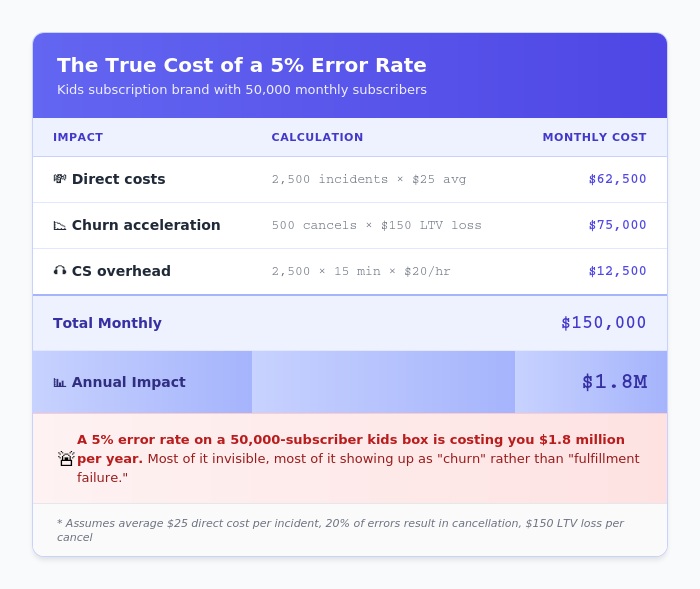
The True Cost Calculation
Why General Fulfillment Partners Fail at Kids Boxes
When kids subscription brands outgrow their garage operation and seek a fulfillment partner, they often choose based on price, location, or general reputation.
Then they discover that a 3PL optimized for shipping single-SKU e-commerce orders has no idea how to handle 15-component STEM kits.
The “Pick and Pack” Mindset Doesn’t Work
Standard e-commerce fulfillment is: scan barcode, pick item, put in box, ship.
Kids activity boxful fillment is: count 6 wooden dowels, verify 2 blue gears and 4 yellow gears, confirm motor variant matches instruction version, check that rubber bands are the correct size, ensure instruction card matches kit version 3.2 not 3.1, arrange components so child sees the “hero piece” first upon opening.
These are fundamentally different operations. A fulfillment partner who quotes you based on “picks per order” doesn’t understand what they’re signing up for.
Speed Incentives Create Errors
Most fulfillment operations incentivize speed. Workers are measured on units per hour. Faster = more efficient = lower cost.
For a kids activity box, speed kills quality.
Counting 8 small screws takes time. Verifying that component bag A matches project variant A takes time. Checking that the instruction card version aligns with the component set takes time.
A fulfillment partner whose entire operational model is built around speed will never achieve the accuracy kids boxes require.
No Understanding of “Experience Packing”
General 3PLs pack for protection. Products arrive undamaged. Job done.
Kids subscription brands need to pack for experience. The unboxing IS part of the product. Components should be arranged intentionally. The “hero piece” the coolest-looking part should be visible first. Tissue paper should create anticipation. The instruction card should be on top, not buried.
A fulfillment partner who views packing as “put stuff in box so it doesn’t break” will never execute the presentation standards that kids subscription brands require.
What High-Accuracy Kids Fulfillment Actually Looks Like
The brands achieving 99%+ kit accuracy (meaning less than 1% of boxes have any error) aren’t doing it through heroic effort. They’re doing it through systems.
Station-by-Station Quality Control
Instead of one final inspection before the box closes, high-accuracy operations build verification into every step:
Station 1: Component bags verified against pick list. Count confirmed. Bag sealed with lot number.
Station 2: Sub-assemblies checked. Correct variant confirmed. Passed to next station.
Station 3: Full kit assembled. Complete checklist verified. Visual inspection of all components.
Station 4: Presentation arranged. Instruction card version matched. Box closed.
Station 5: Finalaudit on random sample (5-10%). Any error triggers line stop.
This is slower than “throw everything in a box.” It’s also the only way to achieve the accuracy kids boxes require.
Lot Traceability at Component Level
When an error is discovered, you need to answer: Was this a one-time pick error, or is there a batch of wrong components in inventory?
High-accuracy operations track lot numbers at the component level not just the finished box level. When Customer X reports a missing gear, you can trace exactly which lot of gears was used, check if other boxes from that lot had issues, and determine if there’s a systemic problem.
Without this traceability, you’re flying blind. Every error is a one-off, and patterns never surface until they’ve affected thousands of customers.
Version Control Systems
Kids activity boxes constantly evolve. The project design gets tweaked. The instruction card is updated. A component is substituted due to supply chain issues.
Every change creates a version management challenge. The motor in the kit must match the wiring diagram in the instructions. The instruction card for “Hydraulic Claw v3.2” cannot ship with components from “Hydraulic Claw v3.1.”
High-accuracy operations have formal version control: new versions are quarantined until all matching components are available, old versions are depleted before new versions enter the line, and the pick system enforces version matching at the point of assembly.
This sounds like software engineering process. That’s because it is. Kids activity box fulfillment is manufacturing, not warehousing.
Dedicated Lines, Not Shared Resources
The worst-case scenario for a kids subscription brand: your complex 15-component kits are being assembled on the same line, by the same workers, as some other client’s simple 2-SKU orders.
When volume spikes or deadlines pressure the operation, which orders get rushed? Not yours yours are too complicated. Your kits get deprioritized, delayed, or assembled by workers who were just doing something completely different.
High-accuracy operations dedicate fulfillment lines to complex kitting programs. Workers specialize. They know your products. They recognize when something looks wrong because they see it every day. That specialization is worth paying for.
The Age-Variant Complexity Multiplier
As if component complexity wasn’t enough, kids subscription brands add another layer: age segmentation.
Lovevery ships different boxes to 0-12 month, 12-24 month, 2-3 year, 3-4 year, and 4-5 year olds. That’s 5 completely different product lines running simultaneously.
KiwiCo has multiple “crate” lines for different age ranges and interests. Little Passports offers age-appropriate versions of their geography curriculum.
What Age-Segmentation Does to Fulfillment
SKU multiplication: Instead of one box, you have 5-8 different boxes. Each with different components. Each with different instructions. Each with different safety requirements.
Pick accuracy challenge: Now the fulfillment worker isn’t just counting components they’re confirming that the 3-year-old version components go in the 3-year-oldbox, not the 5-year-old box.
Safety implications: A small part that’s appropriate for a 5-year-old is a choking hazard for a 2-year-old. An age-matching error isn’t just a customer serviceissue it’s a safety issue.
Inventory complexity: You’re carrying inventory for 5+ product lines. Forecasting is harder. Stockouts are more likely. Storage is more complex.
The Age Progression Problem
Here’s a challenge unique to kids subscription: your customer’s needs change every month.
A child who was 2 years and 11months old when they subscribed is 3 years old a month later. Do they now get the 3-4 year box? When does the transition happen? Who manages it?
Every age progression is an opportunity for error. The system says “age 3” but the last box shipped was the2-3 version. Does this month ship the 2-3 version (continuity) or the 3-4version (age-appropriate)?
High-accuracy operations have systematic age progression protocols and the fulfillment system enforces themautomatically, not through manual intervention that can be forgotten.
The Q4 Multiplier: When Everything Gets Worse
Kids subscription boxes are among the most seasonal products in the entire subscription economy.
The gift subscription surge: Grandparents, aunts, uncles everyone buys kids subscriptions as holiday gifts. Volume can spike 3-5x between November and January.
The timing pressure: These are gifts. They MUST arrive before Christmas. Late delivery doesn’t mean mild disappointment it means a wrapped box with nothing inside it on Christmas morning.
The quality collapse: Under volume pressure, error rates increase. The same operation that achieves 98% accuracy in March might drop to 93% accuracy in December. That’s 5% more errors during the period when you can least afford them.
How the Best Handle Q4
Capacity planning in Q2: By the time October arrives, it’s too late. High-accuracy operations plan holiday capacity 6+ months in advance.
Dedicated seasonal labor, trained early: Temporary workers brought in during November and thrown onto the line with minimal training make errors. Seasonal workers brought in during September and trained for 8 weeks before peak make far fewer.
Staged shipping: Instead of trying to ship everything in the two weeks before Christmas, spreading gift shipments across November and early December reduces volume pressure and improves accuracy.
Quality thresholds that don’t flex: Some operations accept lower quality during peak to maintain speed. The best don’t. They’d rather ship late than ship wrong because a late box is recoverable, a ruined Christmas morning is not.
What to Look for in a Kids Subscription Fulfillment Partner
If you’re evaluating fulfillment partners for a kids activity box program, here are the questions that separate the capable from the pretenders:
Kitting Experience
• How many components is the most complex kit you currently fulfill?
• What’s your error rate on kits with 10+components?
• Can you show me your quality control checkpoints?
• How do you handle version control when kit designs change?
Accuracy Systems
• Do you have station-by-station QC or just final inspection?
• How do you track lot numbers at the component level?
• What happens when an error is discovered how do you identify if it’s systemic?
• Can you show me your accuracy metrics for complex kitting programs?
Age-Segment Capability
• Have you handled age-segmented subscription programs before?
• How does your system prevent shipping the wrong age variant?
• How do you manage age progressions for existing subscribers?
• What’s your protocol for small parts / safety compliance by age?
Seasonal Capacity
• What’s your capacity increase during Q4?
• How do you maintain quality under volume pressure?
• When do you bring in seasonal labor and how do you train them?
• What’s your accuracy track record during peak vs. off-peak?
Presentation Standards
• Do you understand “experience packing ”vs. “protective packing”?
• Can you execute branded presentation standards consistently?
• How do you ensure the instruction card matches the kit version?
• Can I see examples of how you pack complex kits?
The Bottom Line
Kids activity subscription boxes are the hardest product category to fulfill accurately. The component count creates structural error risk. The small parts create counting challenges. The age segmentation adds complexity. The seasonality adds pressure. The zero-tolerance nature of the product where one missing piece ruins the entire experience means errors cost more than in any other category.
The brands winning in this space aren’t winning because they have better products or better marketing. They’re winning because they’ve solved the fulfillment problem.
The missing piece isn’t just a operational issue. It’s the difference between a child who can’t wait for next month’s box and a parent who quietly cancels.
For kids subscription brands, fulfillment accuracy isn’t a back-office metric. It’s the product.
Looking for a kids subscription fulfillment partner who understands complex kitting?
The Specialized Packaging Marketplace connects kids and education brands with vetted kitting, assembly, and fulfillment partners who specialize in multi-component subscription programs. Search by capability, accuracy metrics, and seasonal capacity.
Search Kids Subscription Fulfillment Partners


Ready to find your packaging partner?
Join hundreds of manufacturers and buyers already using PackageLink to streamline their sourcing process.