

The Silent Brand Killer Nobody’s Tracking
Published by the Specialized Packaging Marketplace
Your customer takes their probiotic every morning. They trust it’s working. They’re paying $50/month for those 50 billion CFUs on the label.
But here’s what they don’t know: if that bottle sat in a 95°F warehouse for three days or rode in a delivery truck through Arizona in July, or waited on a Phoenix doorstep for six hours those 50 billion CFUs might be 5 billion by the time they swallow it.
They’ll never know why it stopped working. They’ll just cancel.
This is the probiotic potency problem. And it’s killing subscription brands from the inside out invisibly, silently, in ways that never show up in your fulfillment metrics.
This article breaks down how temperature failures destroy probiotic efficacy, where the failures actually happen, what it’s costing your brand, and what the companies getting it right do differently.
The Science: Why Probiotics Die in Heat
Let’s start with the biology that makes this problem so insidious.
Probiotics are living organisms. Unlike a vitamin tablet that remains chemically stable for years, probiotics are bacteria that must survive to provide benefit. And bacteria have a temperature range where they thrive and temperatures where they die.
The Death Curve
Most commercial probiotic strains are stable at refrigerated temperatures (35-46°F) and reasonably stable at “room temperature” (68-77°F). But above 77°F, degradation accelerates exponentially.
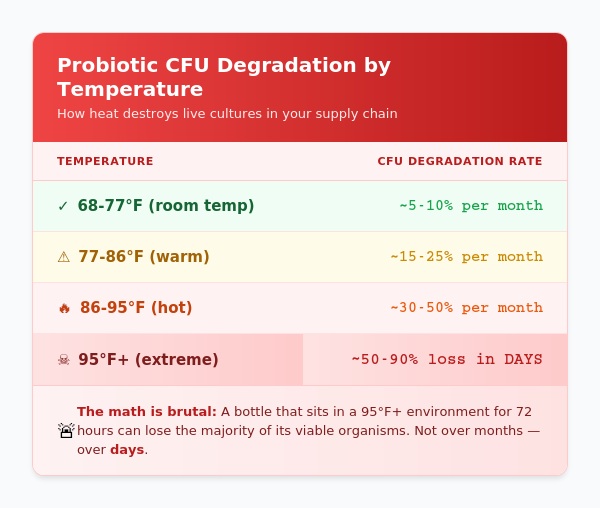
And here’s the worst part: the bottle looks exactly the same. The pills look exactly the same. There’s no visibleindicator that the product is now essentially useless.
What “Shelf-Stable” Actually Means
Many probiotic brandsmarket their products as “shelf-stable” meaning they don’t requirerefrigeration. This is technically true for controlled room temperature conditions.
But “shelf-stable” doesn’t mean “survives a UPS truck in August.” It doesn’t mean “survives threedays in a warehouse without climate control.” It doesn’t mean “survives six hours on a Phoenix doorstep at 110°F.”
Shelf-stable means: if you keep this product at 68-77°F, it will maintain potency through theexpiration date. That’s a big “if” in a supply chain you don’t fully control.
Where Temperature Failures Actually Happen
Most probiotic brands focus on their manufacturing facility’s temperature controls.That’s the easy part. The hard part is everything that happens after.
Failure Point #1: The Fulfillment Warehouse
This is wheremost temperature damage occurs and where most brands have the least visibility.
The problem: Many 3PLs and fulfillment centers don’t have true climate control. They have“ambient” warehouses that track with outdoor temperatures. In summer months,“ambient” can mean 85-95°F+ in parts of the facility.
The hot spots: Even facilities with HVAC often have temperature gradients. Product nearloading docks, in upper racking levels, or near exterior walls can be 10-20°F warmer than the thermostat reading.
The overnight gaps: Climate control costs money. Some facilities reduce or shut off HVAC during overnight and weekend hours to save on utilities. Your probiotics might be in a 72°F facility during business hours and a 90°F facility overnight.
The audit problem: Most brands never visit their fulfillment facility in July or August. They see the facility in March, it seems fine, and they assume it’s always that way.
Failure Point #2: Outbound Shipping
Once your product leaves the fulfillment center, temperature control essentially ends.
Ground shipping: A UPS or FedEx Ground truck in summer can reach 120-140°F internally. Your probiotics might spend 3-5 days in that environment crossing the country.
The sort facility: Packages sit in carrier sort facilities that are not climate-controlled. Inmajor hubs like Phoenix, Memphis, or Dallas, summer temperatures in these facilities can exceed 100°F.
Weekend delays: A package that ships Thursday might not move Friday-Sunday. That’s 72+ hours sitting in a hot facility or truck.
Failure Point #3: Last-Mile and Doorstep
The final stretch is often the most damaging and the least controllable.
Delivery trucks: Local delivery vehicles are not climate-controlled. Your package might ride around in a 130°F truck for 8 hours before delivery.
The doorstep: Amazon’s own research indicates that packages left on doorsteps can reach internal temperatures of 120-160°F in summer sun within hours. A probiotic bottle sitting on an Arizona doorstep from noon to 6 PM has experienced catastrophic CFU loss.
The mailbox: Customers who receive deliveries to mailboxes are even worse off metal mailboxes can exceed 150°F internally on hot days.
The Invisible Churn Problem
Here’s what makes the probiotic potency problem so dangerous: it doesn’t show up inyour fulfillment metrics. It shows up in your churn metrics months later, withno apparent cause.
The Customer Experience Timeline
Month 1: Customer starts subscription. Product works well (shipped in spring, no temperature issues).
Month 2-3:Customer continues subscription. Still working. Establishes habit.
Month 4: Summer shipment. Product sits in hot warehouse, hot truck, hot doorstep. CFUs are 10%of label claim by arrival.
Month 5-6: Customer notices product “isn’t working like it used to.” Bloating returns. Digestion issues resume. Assumes their body “adjusted” or product “stopped working.”
Month 7: Customer cancels. Lists reason as “product stopped being effective.”
The Attribution Problem
When you analyze that cancellation, what do you see?
• Fulfillment metrics: On-time delivery ✓, no damage reported ✓, no customer complaint ✓
• Product metrics: Same formulation, same supplier, no changes ✓
• Cancellation reason: “Product noteffective” sounds like a product problem, not a fulfillment problem
You might spend months reformulating, changing strains, adjusting dosages never realizing the productwas fine when it left manufacturing. It just died in your supply chain.
The Review Damage
The customers who cancel quietly are actually the best-case scenario. The worst case: they leave reviews.
“Worked great for the first few months, then just stopped. Don’t waste your money.”
“Way overpriced for something that doesn’t actually work.”
“Switched to [competitor] and immediately noticed a difference.”
These reviews live forever. They damage conversion for years. And they’re often attributable to fulfillment failures the brand never identified.
What Temperature Failure Actually Costs
Let’s put numbers to this problem.
Direct Costs
Product waste: Probiotics shipped through compromised supply chains aren’t returned they’re consumed by customers who don’t realize they’re ineffective. You don’t see this as a “loss.” But you’ve essentially shipped empty calories.
Refunds and replacements: When customers do complain that products “aren’t working,” many brands offer refunds or replacements. At $40-60 per unit, this adds up quickly.
Customer service: “My probiotics aren’t working” tickets require nuanced responses. These aren’t quick resolutions they’re 15-30 minute conversations that often end in refunds anyway.
Indirect Costs (The Real Damage)
Accelerated churn: Customers who experience efficacy loss churn at 3-4x the rate of satisfied customers. For a subscription business, this is catastrophic.
LTV destruction: A probiotic subscription customer who stays 24 months is worth 4x a customer wholeaves at 6 months. Every summer shipment failure is an LTV impairment event.
Brand reputation: Reviews, word of mouth, social media “this product doesn’t work” spreadsfaster than “this product is great.” The asymmetry is brutal.
Competitor switching: The probiotic market is crowded. A customer who decides your product “stopped working” doesn’t stop taking probiotics they switch to a competitor. You’ve funded their customer acquisition.
The Math
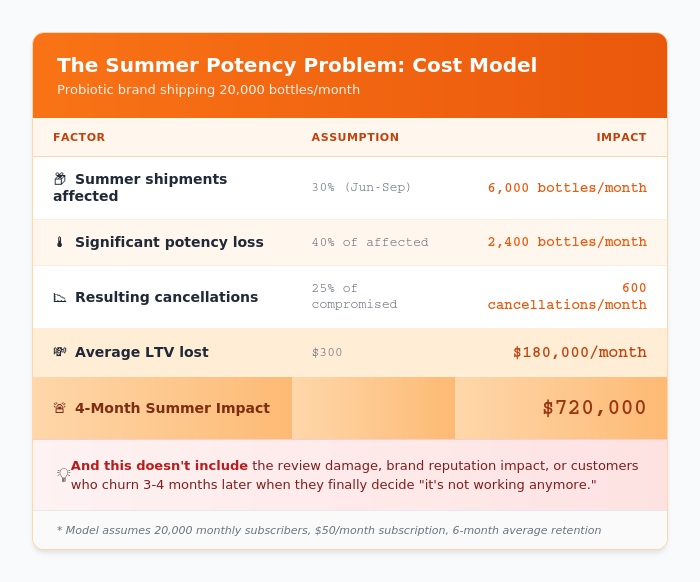
A temperature-compromised supply chain caneasily cost a mid-size probiotic brand $1M+ annually in invisible losses.
Why Your Current Fulfillment Partner Probably Isn’t Equipped
Whenmost probiotic brands select a fulfillment partner, they evaluate: - Cost perorder - Geographic location - Technology/integration - References
Whatthey often don’t evaluate: actual temperature control capability fortemperature-sensitive products.
“Climate Controlled” vs. Actually Climate Controlled
Many fulfillment facilities claim to be “climate controlled.” Here’s what that often actually means:
The thermostatlie: The facility has a thermostat set to 72°F. But thermostats measure one point. They don’t measure the loading dock, the upper racks, or the areas near exterior walls where your product might actually be stored.
The business hours problem: HVAC runs during business hours. But your product lives there 24/7/365. What happens at 2 AM on a Sunday in August?
The portable unit reality: Some facilities use portable cooling units rather than facility-wide HVAC. These units have limited coverage, break down, and creates ignificant hot spots throughout the facility.
The “good enough” standard: For most products, 85°F storage is fine. The facility isn’t lying they are climate controlled for general merchandise. They’re just not climate controlled for probiotics.
Temperature Monitoring Reality
Ask your fulfillment partner: “Can you show me continuous temperature logs for the specific zone where my products are stored?”
Most can’t. They might have a thermostat reading. They might have a daily spot-check. But continuous monitoring with alerts and documented response protocols? That requires infrastructure most facilities don’t have.
The Carrier Handoff
Even if your fulfillment facility is perfectly temperature-controlled, the moment product leaves on a UPS or FedExtruck, all bets are off.
Some questions your fulfillment partner probably can’t answer: - What’s the temperature inside carrier trucksduring summer? - How long do packages sit in non-climate-controlled sort facilities? - What’s the maximum temperature exposure during standard ground shipping?
The honest answer: nobody knows. And for probiotics, that’s a problem.
What the Best Probiotic Brands Do Differently
The brands that maintain potency through delivery aren’t doing it by accident. They’ve built systems specifically designed for temperature-sensitive products.
Facility-Level Controls
Purpose-built cold storage: Not a corner of a warehouse with a portable AC unit. Dedicated temperature-controlled rooms with redundant HVAC, continuous monitoring, and alarm systems.
Zone-specific monitoring: Temperature sensors throughout the storage area — not just one thermostat. Documented hot spot analysis. Storage placement protocols that keep product away from problem areas.
24/7/365 monitoring: Temperature logs that cover nights, weekends, and holidays. Alert systems that notify personnel when temperatures exceed thresholds. Response protocols that are documented and tested.
Third-party verification: Annual or quarterly temperature mapping studies by independent parties. Not “we check the thermostat” actual data logging across the facility over time.
Packaging-Level Protection
Insulated shippers: For summer months or hot-climate destinations, insulated packaging that buys time during transit.
Gel packs or phase-change materials: For high-value shipments or extreme destinations, active cooling elements that maintain temperature for 48-72 hours.
Right-sized packaging: Smaller packages heat up faster than larger ones. Packaging designed for temperature stability, not just protection from crushing.
Shipping Strategy
Carrier selection: Expedited shipping during summer months. Air rather than ground for long-distance shipments in hot seasons. Carrier relationships that prioritize speed over cost for temperature-sensitive products.
Ship-day optimization: Avoiding Friday shipments that sit over weekends. Early-week shipping to minimize time in transit. Monitoring weather forecasts for extreme heat events.
Geographic routing: Understanding which carrier hubs are in hot climates. Routing to avoid the worst temperature exposure. Midwest fulfillment that reduces distance and transit time to most destinations.
Customer communication: Delivery alerts so customers know to bring packages inside quickly. Summer shipping guidance. Option for Saturday delivery or package hold at carrier facility.
The Monitoring Stack
Lot-level temperature history: Knowing the temperature exposure of every lot from receipt through shipment. If there’s an issue, you can identify which specific lots were affected.
Carrier temperature monitoring: For high-value programs, actual temperature monitoring during transit. Smart labels that record temperature exposure. Post-delivery analysis of what product actually experienced.
Feedback loops: Connecting customer complaints about efficacy to specific shipments, specific lots, specific temperature conditions. Learning from every incident.
The Midwest Advantage for Probiotic Fulfillment
Here’s a factor most probiotic brands don’t consider: where you ship FROM dramatically affects temperature exposure.
Transit Time = Temperature Exposure
A package shipping ground from California to New York takes 5-7 days. That’s 5-7 days in hottrucks and sort facilities during summer.
A package shipping ground from Chicago to New York takes 2-3 days. That’s 2-3 days of exposure roughly half.
Shorter transit =less temperature exposure = better potency on arrival.
The 2-Day Ground Map
From a Midwest location like Chicago:- 2-day ground reaches: All of Midwest, East Coast to the Carolinas, South to Texas, West to Colorado - That’s roughly 80% of the US population within 2-day ground shipping
From a coastal location like Los Angeles: - 2-day ground reaches: California, Nevada, Arizona - The other coast is 5-7 days away
For temperature-sensitive products, Midwest fulfillment isn’t just about cost savings. It’s about product integrity.
Seasonal Temperature Reality
Midwest summers are hot but they’re not Arizona hot. Average July temperatures in Chicago: 85°F. Average July temperatures in Phoenix: 106°F.
More importantly: Midwest facilities are more likely to have genuine climate control because the region requires heating in winter. The HVAC infrastructure exists. In hot-climate regions, many warehouses were built with “it doesn’t freeze here” logic and minimal climate control.
Questions to Ask Your Fulfillment Partner
If you’re currently shipping probiotics or evaluating fulfillment partners, here are the questions that reveal whether they can actually protect your product:
Temperature Control
1. What is the temperature range in the area where my products will be stored?
2. Do you have continuous temperature monitoring? Can I see the logs?
3. What happens to HVAC during nights and weekends?
4. Have you done thermal mapping to identify hotspots in the facility?
5. What’s your protocol when temperatures exceed acceptable ranges?
Specific Capability
6. Do you have dedicated temperature-controlled rooms, or is this a generally climate-controlled facility?
7. What other temperature-sensitive products do you currently handle?
8. Can you accommodate insulated packaging and gel packs for summer shipping?
9. Do you have experience with probiotic or supplement brands specifically?
Monitoring and Documentation
10. Can you provide lot-level temperature exposure documentation?
11. What alerts exist when temperature thresholds are exceeded?
12. Who is notified and what’s the response protocol?
13. Can you show me temperature data from last July/August?
Shipping Strategy
14. What carriers do you use for temperature-sensitive products?
15. Do you offer expedited shipping options for summer months?
16. What’s your ship-day policy to avoid weekend sits?
17. How do you handle shipments to extreme-heat destinations (Phoenix, Las Vegas, etc.)?
Red flags: - “Our facility is climate controlled” without specific temperature ranges - Can’t produce continuous temperature logs - No experience with temperature-sensitive supplements - No specific protocols for hot-weather shipping
The Bottom Line
The probiotic potency problem is invisible, insidious, and expensive. Your productcan lose the majority of its efficacy between your manufacturing facility and your customer’s mouth and you’ll never see it in your fulfillment metrics.
You’ll see it in your churn rate. You’ll see it in your reviews. You’ll see it in customers who say “it stopped working” and switch to competitors. But you won’t connect it to fulfillment because no package arrived damaged, no delivery was late, no customer complained about shipping.
The brands winning in probiotic subscription aren’t winning because they have better strains or better marketing. They’re winning because their product actually works when it arrives.
That requires a supply chain built for temperature-sensitive products from warehouse to doorstep. It requires partners who understand that probiotics aren’t just another SKU. It requires investment in infrastructure that most fulfillment operations don’t have.
For probiotic brands, fulfillment isn’t logistics. It’s product integrity. And product integrity is the whole business.
Looking for a fulfillment partner who understands temperature-sensitive supplements?
The Specialized Packaging Marketplace connects probiotic and supplement brands with vetted fulfillment partners who have verified temperature-control capabilities. Search by certification, cold-chain capability, and location.
Search Temperature-Controlled Fulfillment Partners



Ready to find your packaging partner?
Join hundreds of manufacturers and buyers already using PackageLink to streamline their sourcing process.