
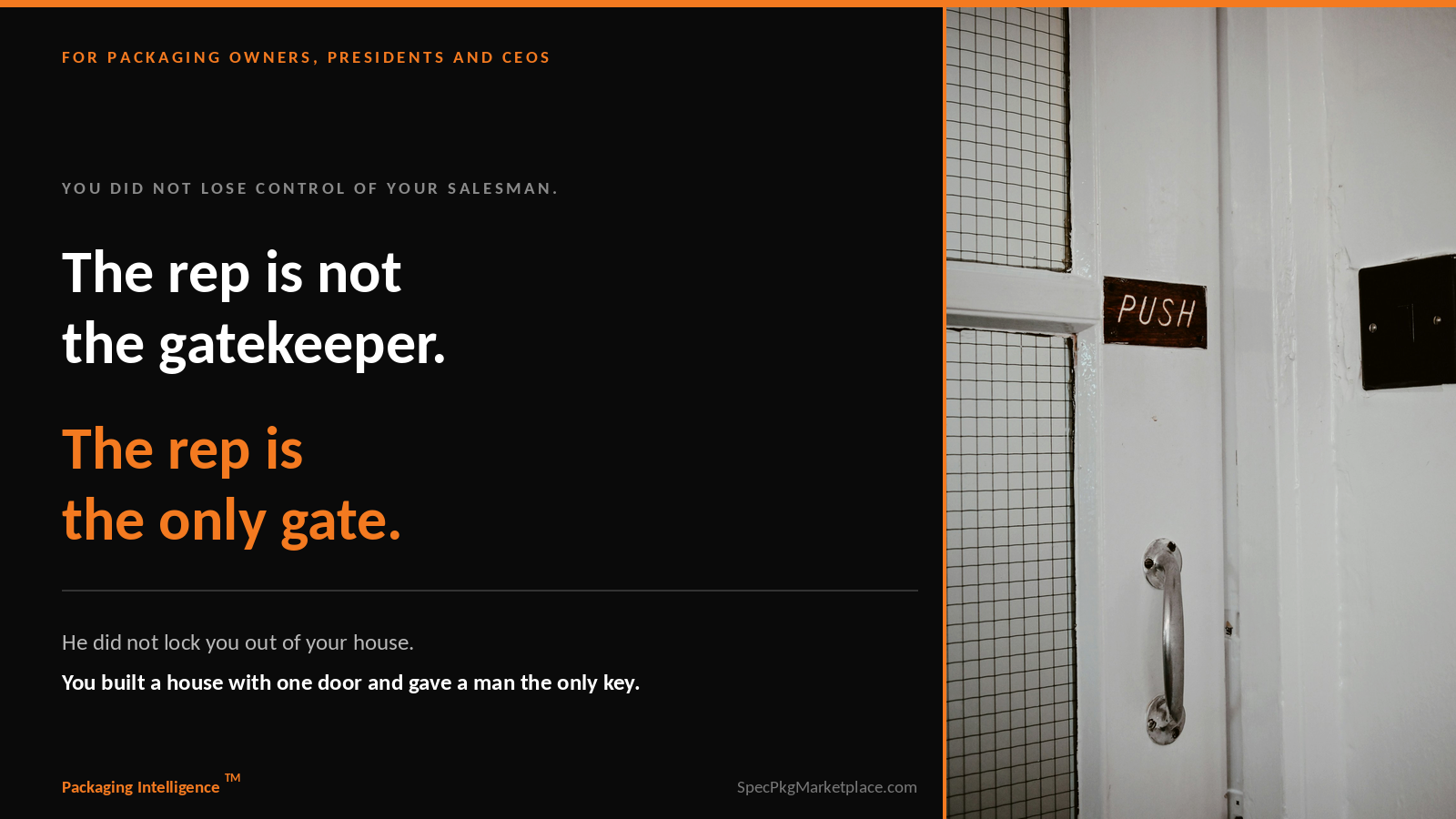
The Rep Is Not The Gatekeeper. The Rep Is The Only Gate.
For packaging owners, presidents and CEOs. An owner who cannot call his own customer did not lose control of his salesman last week. He lost control years ago. This is just the week somebody said it out loud.
An advisor named David Wanounou posted something a few days ago that I have not been able to put down.
A business owner told him this, about his own customer.
"My salesman doesn't let me speak to the client."
Not a broker. Not an independent rep with his own book. A W-2 employee. The owner signs the paycheck, and by his own account it is a very good paycheck.
Wanounou asked him the right question. If your kid locked you out of your house, would you check into a hotel?
The owner went quiet, then asked what he should do.
It is a good question and it landed on a lot of people. I want to take it somewhere he did not, because I have been in packaging since 1986 and in this industry that story is not a scandal. It is Tuesday or whatever day of the week you choose.
He was not locked out of the house
Here is the part nobody says.
That salesman did not take anything. He did not stage a coup. He did not lock a door.
He is standing in the only doorway that was ever built.
There is no second entrance into that account. No other reason that customer would take a call from that company. Nothing published, nothing the company is known for, no answer that company owns that the decision maker on the other end would recognize if the rep vanished tomorrow.
The owner did not hand over the keys to his house.
He built a house with one door and gave a man the only key, and then he was surprised to find himself knocking.
That is not a control problem. Control problems you fix with a conversation. This one you cannot fix with a conversation, which is exactly why the owner went quiet.
And in packaging, we build the house that way on purpose
I went looking at how this industry actually hires, because I did not want to argue from memory.
Here is a real posting, live, for an outside sales position in packaging distribution. The hiring company is not named, which is its own kind of answer.
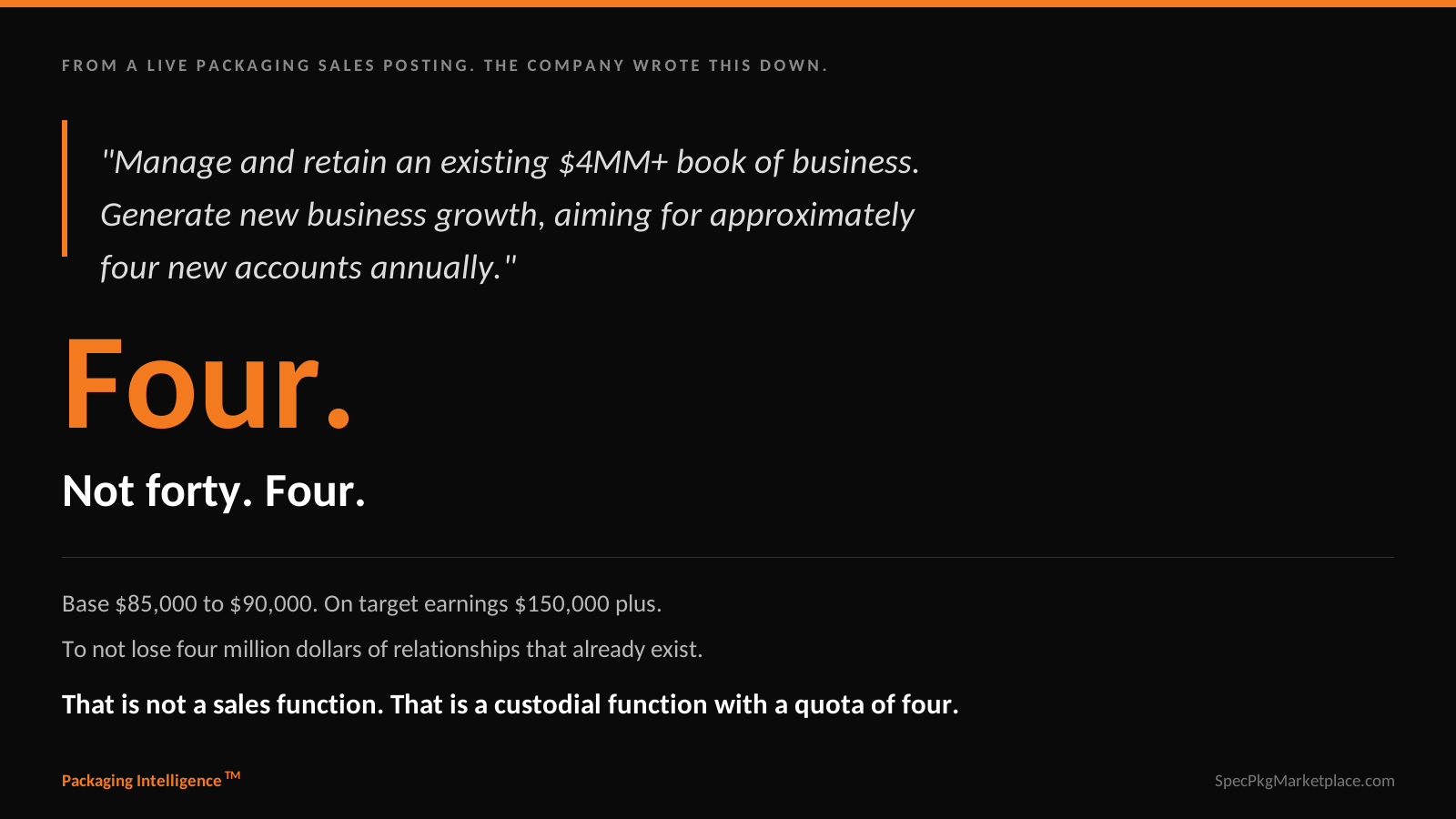
The job is to manage and retain an existing book of business of four million dollars ($4 million} and change. The territory is already built. The accounts are already there.
And the growth expectation, written down by the company, in public, is this.
"Generate new business growth, aiming for approximately four new accounts annually."
Four.
Not forty. Four.
The base is eighty-five to ninety thousand dollars. On target earnings are a hundred and fifty thousand plus.
Read that again and sit with it for a second, because this is not a bad company and this is not an unusual posting. This is the industry standard written down honestly for once.
A packaging company is prepared to pay a hundred and fifty thousand dollars ($150,000) a year to a man whose job is to not lose four million dollars of relationships that already exist, and to find four more.
That is not a sales function. That is a custodial function with a quota of four.
"Bring your book of business" is not a job requirement
It shows up everywhere once you start reading these.
Here is a national accounts posting for high-graphic corrugated. Under qualifications, in the company's own words.
"Leverage existing procurement-level relationships to gain access to target customer organizations."
And just below it.
"Bring insight into your existing book of business."
Here is another one, offering a multi-year guaranteed earning structure to support a new hire while he establishes his book of business.
Everybody in this industry reads those lines and nods, because that is how it has always been done.
Read them as an outsider for ten seconds.
That is a company writing down, in public, that it has no reliable way to get in front of a customer on its own, and would very much like to buy access from a man who already did that work somewhere else, for somebody else.
It is not a requirement. It is a confession.
And the owner who posts it is the same owner who, eighteen months later, cannot get into the room with the account that man brought.
Of course he cannot. He never built a way in. He purchased one, and he is renting it by the month, and the lease renews entirely at the discretion of a guy with a company car.
What my own list says, and I did not like it either
I keep a running list of open positions at packaging manufacturers. It is how I find companies worth talking to, because an open sales position tells you more about what an owner is thinking than any press release ever will.
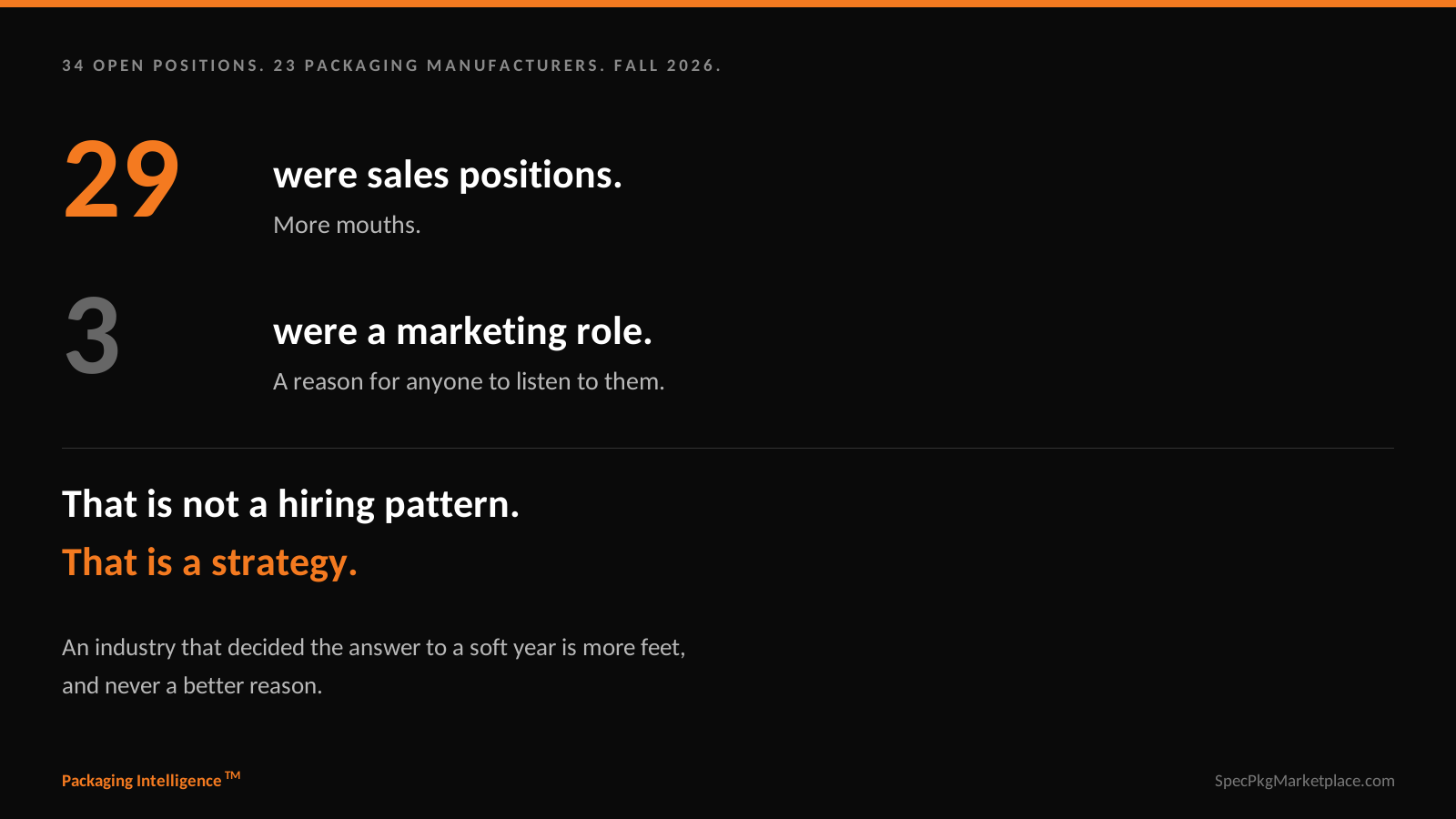
The current pull is thirty-four open positions across twenty-three packaging companies. Real companies, fifteen employees up to three hundred and forty-four. Corrugated, flexible, rigid, protective, pallets.
- Twenty-nine of the thirty-four were sales positions.
- Three were some version of a marketing role.
- Seven of the twenty-three companies were hiring more than one salesperson at the same time.
Sit with that ratio for a minute, because that ratio is the strategy.
Twenty-nine mouths. Three attempts at a reason for anyone to listen to them.
And seven companies simultaneously looking for two or three of the same position, which in this industry almost never means we are growing so fast we need more coverage. It means two left and we are replacing them, again, and we have decided the problem was the two.
That is not a hiring pattern. That is an entire industry that has concluded, collectively and without ever discussing it, that the answer to a soft year is more feet and never a better reason.
And then the position does not fill, and nobody asks why
Here is the next thing that happens, and every owner reading this already knows it because it is happening in his company right now.
The position sits.
Monster's hiring data puts the average time to fill an open position at seventy-one days, and found that only sixty-one percent of job postings result in a hire at all. For the hardest categories, more than half never produce a hire. Sales is consistently in that group, and the reason given is high turnover and compensation structures that make good candidates cautious.
In manufacturing specifically, it is getting worse, not better. ICIMS tracked job openings in the sector running twenty-nine percent above the prior year in July while actual hires came in six percent below. Openings up. Hires down. The widest gap of the year.
So the req sits. Sixty days. Ninety. It gets reposted. The recruiter gets a call. The base gets bumped five thousand dollars.
And here is what the owner says out loud, in his own conference room, to people who are paid to agree with him.
"You can't find good people anymore."
No.
The best rep in your segment saw your posting. He read it the same way I read those postings. Bring your book of business. Manage an existing territory. Four new accounts a year.
What he understood, in about eleven seconds, is that this company has nothing. No position in the market he could stand on. No answer that is already working. Nothing he could point a plant manager at that would make the first call easier than the one he makes today.
He understood he would be expected to supply the entire reason anybody buys, out of his own contact list, for a hundred and fifty thousand dollars and a car allowance.
So he did not apply. And neither did the next one.
You are not losing a hiring race. You are failing an inspection, and the candidates are the inspectors, and they are not going to tell you why they walked.
Leadership looks at a number and keeps pushing on a pull door.
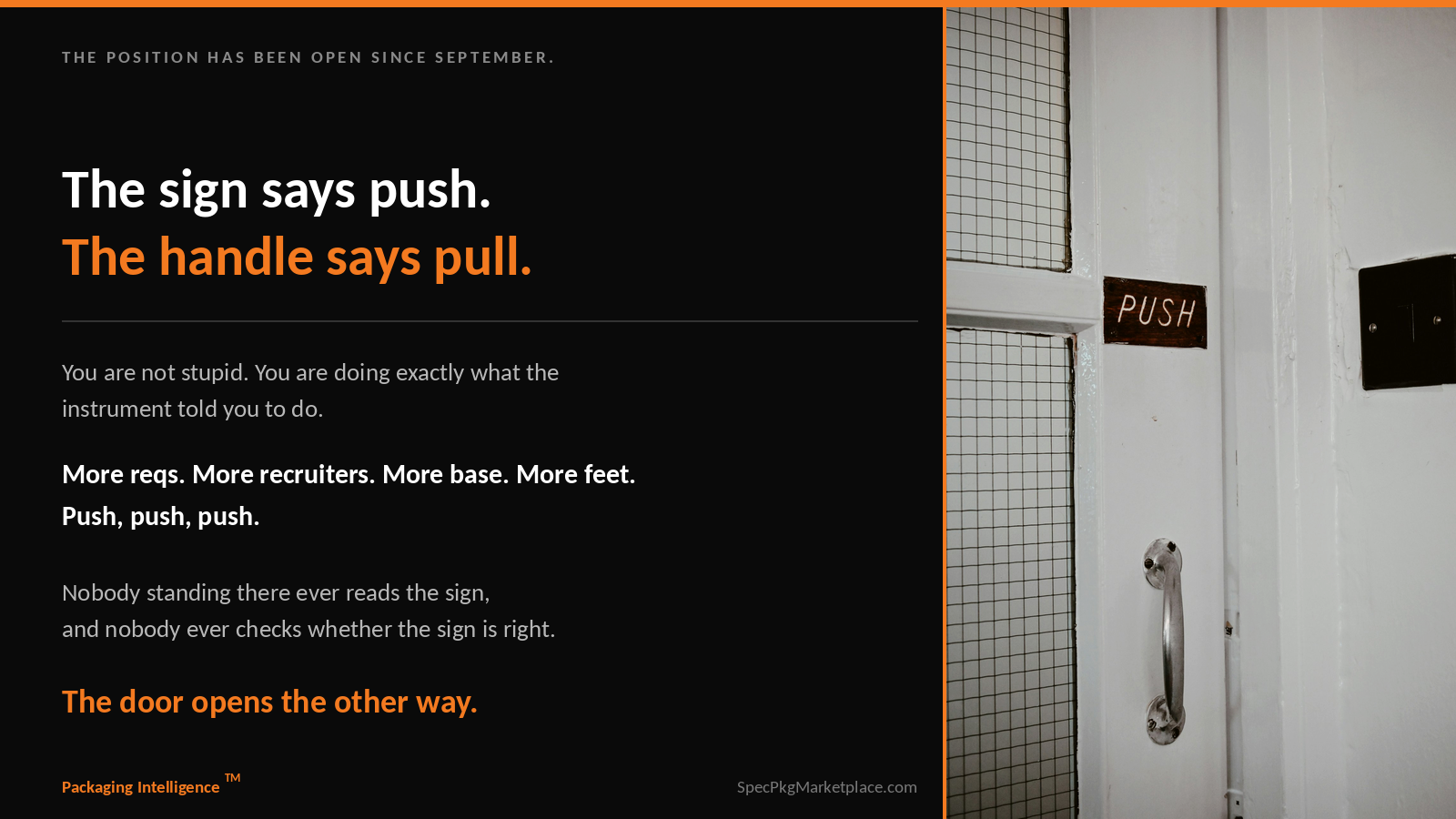
That is the whole thing. More reqs. More recruiters. More base salary. More feet. Push, push, push, and the door does not move.
And here is the part of that picture people miss.
On most of those doors, the sign actually says push. Somebody mounted it. Somebody has walked past it every day for eleven years. The sign is wrong and the handle is right, and the man leaning into that door with his shoulder is not stupid and is not lazy. He is doing precisely what the instrument told him to do.
That is the entire condition of this industry in one piece of hardware.
Your instruments say push. Revenue held. Schedule is full. The reorders came in. Hire two more and wait.
Every one of those readings is accurate and every one of them is pointing the wrong direction, and nobody has thought to question the sign in a decade because the sign has always been there.
The door opens the other way.
You do not need to be more attractive to salespeople. You need to be a company that a good salesperson could actually win at, and those are not the same project, and only one of them is yours to do.
Here is the ineptitude, and I mean that word precisely
Your new rep starts Monday.
He gets a territory, a line card, a price sheet, a laptop, and a handshake. Maybe a capabilities deck that has not been touched since before the pandemic, with a photograph of the building on the cover and the words quality, service and partnership somewhere on slide three.
Now answer this, and take your time.
What can that man say to a plant manager in Dayton that your competitor's rep cannot say word for word?
Not what is true about your company. What is sayable. What is provable. What is on the record somewhere that man can point at.
Go ahead.
If the honest answer is nothing, then you did not hire a salesman. You hired a human being, handed him a price sheet, and sent him out to fight with his bare hands against four other guys carrying the exact same price sheet.
He is going to lead with price, because you gave him nothing else to lead with.
He is going to lean on a personal relationship, because that is the only asset in the car.
And then in about fourteen months you are going to sit in your office and tell somebody that he was not a good fit, that the hire did not work out, that it is hard to find good people anymore.
It is not hard to find good people. It is hard to win with nothing, and you sent him out with nothing, and he could not say so because he needed the job.
Meanwhile three quarters of your margin conversation every month is about price, and nobody in that room ever connects the two things.
And here is the part that should actually sting
You already know all of this.
You have known it for years.
You know which account is held together by one man's cell phone. You could name him right now without looking anything up. You know that if he walked in on a Tuesday with an envelope, you would have a very bad month and a worse year, and that the number on the wall would never quite recover and you would stop talking about it by spring.
You know, and you have done nothing.
Not because you are lazy. Because nothing hurts.
The plant is running. The schedule is full into February. The twenty-year account reordered on time. The reports all look like the reports looked last year.
Carbon monoxide does not hurt either. That is the whole reason it kills people. You cannot smell it, you cannot taste it, you cannot see it, and your body has no alarm for it. That is why somebody had to invent one for the wall, and why miners carried a bird down the shaft. The bird feels it first. The men feel nothing at all until it is too late to walk out.
There is no alarm on your wall for this one.
Nothing in your month-end package measures how many accounts you won this year that did not come through a rep's personal relationship. Nothing measures whether your company name comes back when somebody goes looking for the problem you solve. Nothing measures what one man's resignation letter would do to the number somebody would eventually pay for this business.
Those are the alarms. Not one of them is on your wall, and you have never once asked why.
What walks out the door with him
Let me be plain about what actually happens, because the industry has a comfortable lie about this and the lie is that the accounts are sticky.
The relationship walks. That is obvious and everybody plans for it.
The specifications walk. Every bit of tribal knowledge about why that customer runs the board combination they run, what failed in 2019, which line jams at which speed, what their holiday pattern looks like.
The quoting history walks. Which means the next quote goes out blind.
The warning signs walk. He knew the plant manager was leaving. He did not write it down anywhere because nobody ever asked him to.
And the account does not slam a door on the way out. It never does. It just gets quieter. It splits an order. It asks for a bid it did not used to ask for. And eighteen months later it is somebody else's and the only thing that showed up on your P&L was a number slightly softer than last year, which you explained to yourself at the time as the market.
You will find out exactly how much of your company was ever actually yours on the day he gives notice.
Most owners find out on a Tuesday.
The second door
I am not going to tell you to fire anybody, and I am not going to tell you to go around your own salesman, which is terrible advice that will cost you the salesman and the account in the same quarter.
The rep is not the problem. The rep is the only gate because you built one gate.
Build a second one.
A second door is not a website refresh and it is not a brochure. It is the thing your company knows that nobody else in your segment has ever bothered to write down.
You have been doing this for thirty years. Somewhere in your plant is an answer to a problem that costs a specific kind of manufacturer real money, and you solved it so long ago that you have stopped noticing it is unusual. The pack-out that nobody else would run. The spec you fought for and won. The failure mode you can diagnose over the phone in ninety seconds because you have seen it four hundred times.
That is the asset. It is sitting in your building right now, unwritten, undefended and completely invisible to everyone outside it.
Packaging Intelligence is the practice of capturing a packaging company's niche expertise and organizing it so the company can find and win more of its best-fit customers.
Six steps, in order. Discover. Uncover. Capture. Develop. Put It to Work. Reach the Right People.
What that gets you is not traffic and it is not a brand. It is a door.
It is a reason a plant manager who has never met your salesman already knows what your company is for. It is something your rep can point at instead of discounting. It is the reason the next account you land did not have to be purchased from a competitor along with the man who brought it.
And it is the one asset in your building that does not drive home at five o'clock and cannot give two weeks notice.
Three questions, and then I will leave you alone
- Which of your top ten accounts could you not call tomorrow without clearing it with somebody on your payroll first?
- What can your newest salesman say about your company that your three closest competitors cannot say word for word?
- If every one of your reps resigned on the same morning, how would anyone find you?
If the third one made your stomach drop, that is the alarm. That is the only one you are going to get.
The question was never whether you are allowed to call your own customer.
The question is whether that customer would recognize your company's name if your salesman had never existed.
If the answer is no, you do not have a customer.
You have a rental, and somebody on your payroll is holding the lease.
I have been in packaging since 1986. If you want to walk through what your second door would actually be, I do a thirty minute Packaging Intelligence Briefing.



Ready to find your packaging partner?
Join hundreds of manufacturers and buyers already using PackageLink to streamline their sourcing process.