
The Southeast Dairy Processor Who Stopped Being Captive
How a mid-market processor qualified a second aseptic supplier without risking a single run, and got its incumbent to start answering the phone again.
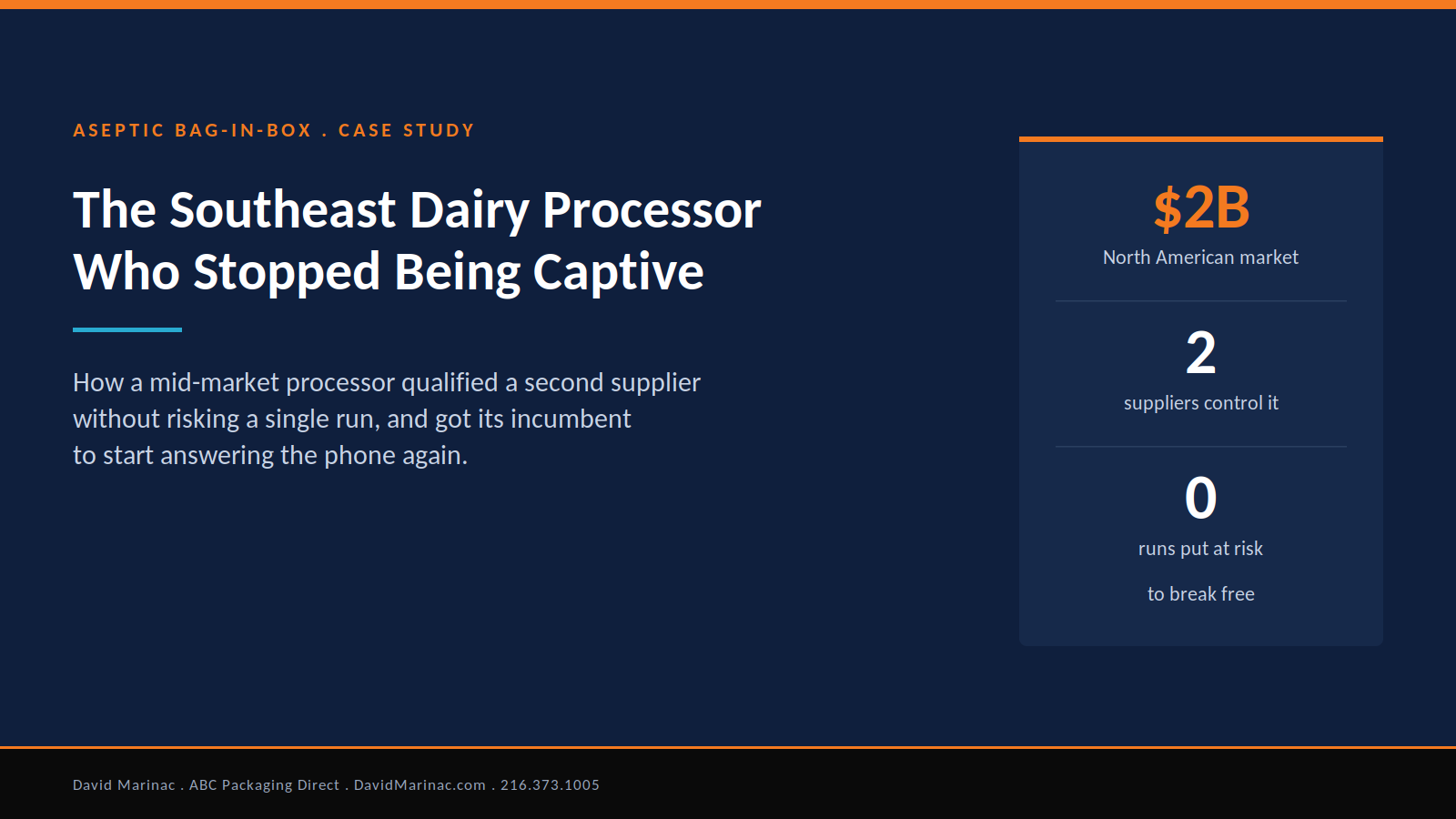
This is a true story. The company is real and the win is real. The name is not here, because the processor does not need its competitors or its incumbent supplier knowing its business, and because the lesson matters more than the logo. Call it a Southeast dairy processor. Mid-market. The kind of account the two big aseptic suppliers treat as a rounding error. Here is what it was stuck in, what it did about it, and what changed. If you run a mid-market processing operation and you feel trapped between two suppliers who do not seem to need your business, this one is for you.
What does it feel like to be a rounding error?
The North American aseptic bag-in-box market is roughly a two billion dollar business, and it is controlled by two names. Scholle IPN and Liquibox, which is now part of Sealed Air. They are capable companies. They are also enormous, and an enormous supplier sends its best service, its shortest lead times, and its fastest problem solving to its biggest accounts. That is not malice. It is math.
If you move 50 or 80 or 120 truckloads a year, you are real money to your own business and a rounding error to theirs. That is exactly where this processor sat. The symptoms were the ones every mid-market processor knows. Lead times that stretched whenever capacity got tight. A service contact who took days to call back. Quotes that were hard to compare because the spec underneath kept shifting. And the quiet, constant worry that if anything went wrong, they would be at the back of the line.
Why do mid-market processors stay stuck?
Because the thing that would fix it is the thing they are most afraid to do.
An aseptic failure is not a small problem. A bag that swells, a seal that leaks, a barrier that lets oxygen in, and you are looking at spoiled product, a possible recall, and a filling line down at the worst possible moment. The incumbents know this. The fear of that failure is the strongest lock they have. It keeps a frustrated buyer paying for poor service year after year, because the devil they know feels safer than the devil they do not.
So the buyer does nothing. And doing nothing is exactly what the incumbent is counting on.
So what did this processor actually do?
It did the one thing that breaks the trap. It did not switch. It qualified.
This is the distinction that changes everything, and almost nobody explains it. Switching means ripping out your supplier and betting your line on a new one in a single move to chase a lower price. That is the most expensive mistake a processor can make, and it is the mistake the incumbents are quietly counting on you being too smart to make, which is why they assume you will never move at all.
Qualifying is different. Qualifying means bringing a second source up to proven, line-ready status while your incumbent stays exactly where it is, carrying your volume, as a safety net. You are not replacing anyone on day one. You are earning a choice. And a choice is leverage long before a single truckload moves.
How do you qualify a new supplier without risking a run?
The processor ran the same disciplined process we walk every serious buyer through. Five steps, in order, no skipping.
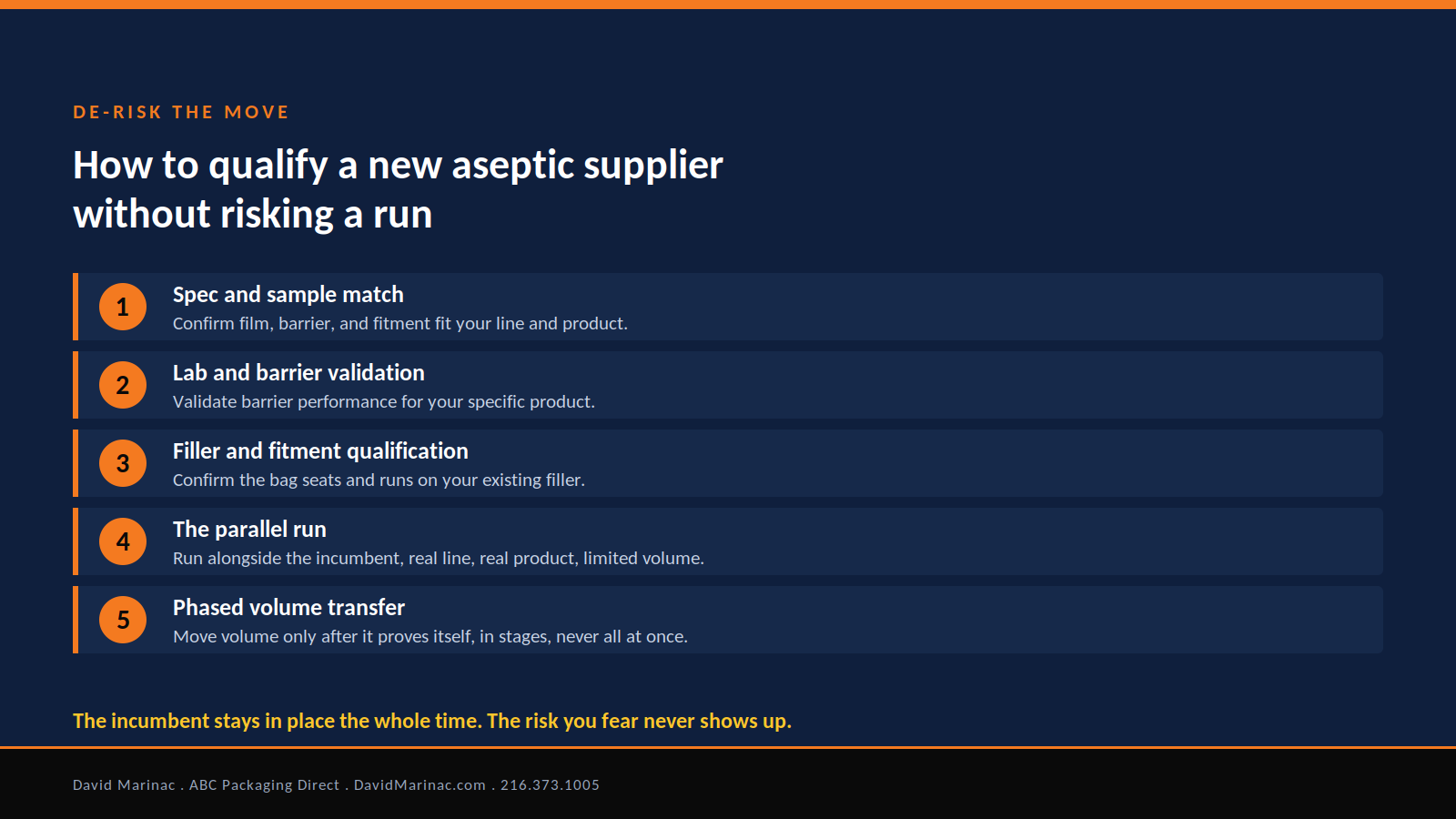
1. Spec and sample match. Get the candidate's real samples and confirm the film structure, the barrier, and the fitment match what your line and your product actually need.
2. Lab and barrier validation. Validate the barrier performance for your specific product, because a film that is right for juice is not always right for dairy.
3. Filler and fitment qualification. Confirm the bag seats and runs on your existing filler. In bag-in-box, the fitment is where trust is won or lost.
4. The parallel run. Run the new bag alongside the incumbent, on the real line, with real product, at limited volume, while the incumbent still carries the load.
5. Phased volume transfer. Only after the new source proves itself do you move volume, and you move it in stages, never all at once.
At no point in that process is the processor exposed. The incumbent is there the whole time. The risk the buyer was so afraid of never actually shows up.
What changed once they had a real second source?
Two things, and the first one surprised them.
The incumbent got better. The moment the processor had a qualified alternative, lead times tightened and the phone started getting answered. Nothing concentrates a supplier's attention like a customer who is no longer captive. The buyer had leverage before it ever moved a pound of volume, simply because it had a choice.
And the second source delivered the thing the giants would not. Responsiveness. Short runs without a fight. Complete shipments. A real person who picked up when there was a question. The processor stopped being a rounding error and became a priority, because to a right-sized supplier, its volume mattered.
It was never about price. It was about being treated like the business it is.
Who this works for, and who it does not
This is not a magic trick, and it is not for everyone.
It works for the mid-market processor who is tired of poor service, willing to run a disciplined qualification, and patient enough to do it right rather than fast. It works for the operation that wants leverage and a real second source, not just a lower number on a quote.
It does not work for the buyer who wants to rip and replace overnight to save a few cents. That buyer is the one who gets burned, and that buyer is the reason the rest of the market is afraid to move at all. If your only goal is the lowest price this quarter, qualify nobody, and good luck.
Questions buyers ask
What is the difference between switching and qualifying an aseptic supplier?
Switching means replacing your supplier in one move and betting your line on the new one. Qualifying means bringing a second source up to proven, line-ready status while your current supplier stays in place as a safety net. Switching is the expensive mistake. Qualifying is the safe path, and it gives you leverage before you ever move volume.
Will my incumbent find out I am qualifying a second source?
A qualification can be run quietly, and many buyers do exactly that. But there is also real power in the incumbent knowing you have a choice. The moment a supplier knows you are no longer captive, service tends to improve on its own.
How long does qualification take?
It varies by product and barrier requirements, but it is measured in weeks to a few months, not days. The point is not speed. The point is proving the new bag on your real line before you depend on it.
Does a second source mean I have to move my volume?
No. A qualified second source is leverage and insurance whether or not you ever shift a single truckload. Many buyers qualify a second source and keep most of their volume where it is, simply to stop being captive.
What should I look for in a second aseptic supplier beyond price?
Responsiveness, willingness to run your sizes and short runs, complete shipments, the right certifications, and fitment compatibility with your filler. In this niche, service and the fitment matter far more than the number on the quote.
The bottom line
The duopoly's whole game depends on you believing you have no choice. You do. A disciplined qualification, run with the incumbent left in place, takes the fear out of the move and puts the leverage back in your hands. This processor stopped being captive without ever putting a single run at risk. So can you.
If you are a mid-market processor and you want to know what a real, line-ready second source looks like for your product, that is the conversation to have. Reach me at the contact below.
On the other side of this table is a supplier who could serve a processor like this one better than the giants do, often an overseas supplier sitting on real capability. If that is you, read: How an Overseas Factory Becomes the Samsung of Aseptic Bag-in-Box. https://www.specpkgmarketplace.com/blog/how-an-overseas-factory-becomes-the-samsung-of-aseptic-bag-in-box
Complete Aseptic Buyer's Guide
David Marinac
ABC Packaging Direct
DavidMarinac.com
216.373.1005


Ready to find your packaging partner?
Join hundreds of manufacturers and buyers already using PackageLink to streamline their sourcing process.