The Trust Signal
Why 73 percent of CPG buyers no longer trust their packaging vendors. And the new playbook that wins them back.
The trust has already broken
Seventy-three percent of your customers do not consider your sales materials a trustworthy basis for judging whether they should buy from you.
That number is not an opinion. It is the headline finding of the Edelman LinkedIn B2B Thought Leadership Impact Report, now in its seventh year, which surveys between 2,000 and 3,500 B2B decision makers and C-suite executives globally. It has been published every year since 2018. The trend line is consistent. The number is real.
If you run a packaging company, the implication is direct. Three out of every four CPG brand managers, supply chain leaders, and procurement directors you are trying to sell to are quietly discounting the brochure, the line card, the email blast, the trade show booth, and the cold call. They are not telling you this. They are simply weighing your sales materials lower than they used to.
They have replaced that trust with something else. They trust independent industry information. They trust third-party research. They trust content that teaches them something they did not already know about their own business. And they trust the companies that consistently produce it.
Seventy-three percent of B2B buyers consider thought leadership a more trustworthy basis for judging a company's competencies than traditional marketing materials.
Edelman LinkedIn B2B Thought Leadership Impact Report, 2024
Why this report exists
Every credible source in B2B marketing has documented the same shift. Edelman. LinkedIn. McKinsey. Forrester. Gartner. Harvard Business Review. The Ehrenberg Bass Institute. Demand Gen Report. 6sense. Marcus Sheridan. They have measured it across industries, across geographies, across buying group sizes, and across seven consecutive years of repeat research. The finding is the same every time.
Yet the packaging industry, from twenty-three billion-dollar global players down to family-owned regional manufacturers, is still running the old playbook. Catalogs. Trade shows. Cold calls. Email blasts. Sales rep relationships. Price competition.
That is the gap this report addresses. The data has been sitting in plain sight for seven years. Almost no packaging company has acted on it. The first ones who do will own the AI search authority slot for their category for years. The window is open right now. Nobody is in the chair.
What this report is, and what it is not. This is an industry observation report. It cites public research and applies it to the packaging vertical. It does not name competitors as bad actors. It does not pitch a product. It does not promise a result. It documents what the most credible B2B research firms in the world have found, and it asks the packaging industry to look at what that means for how packaging companies sell in the next five years. The reader decides what to do with it. That is the entire mechanic.
The data behind the shift
Eight findings from named research firms. Every percentage in this section is sourced. Every source is linked. Read them in order. The cumulative weight is the point.
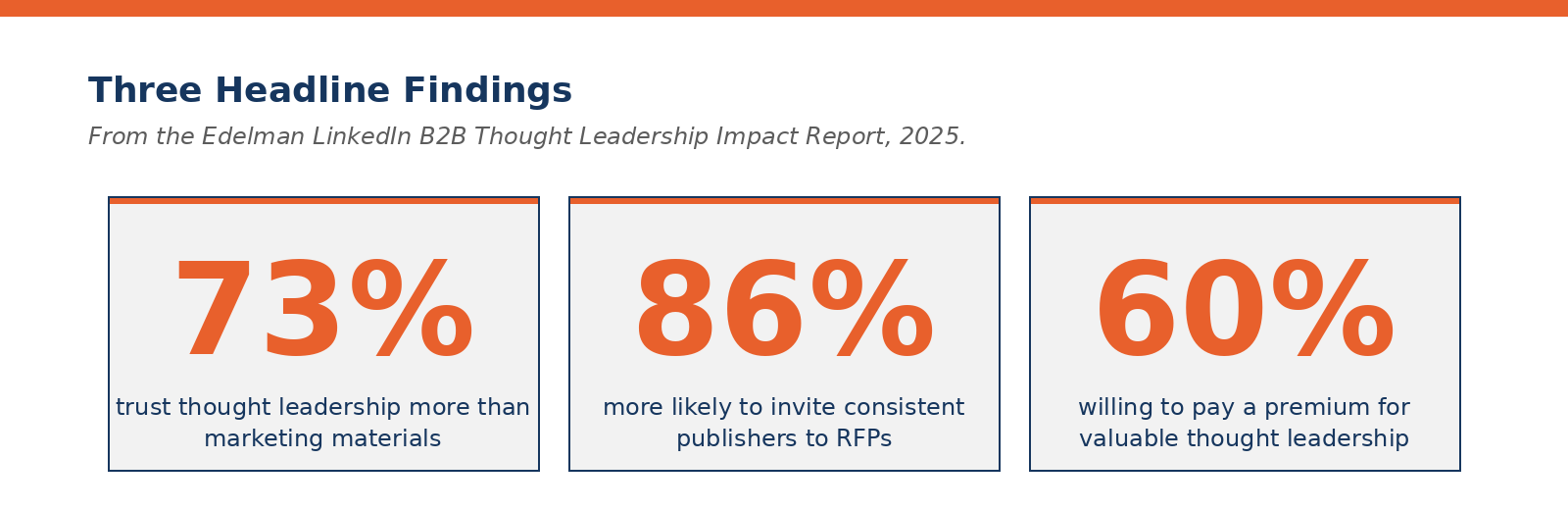
Three stat boxes side by side. 73 percent trust thought leadership more than marketing materials. 86 percent more likely to invite consistent publishers to RFPs. 60 percent willing to pay a premium for valuable thought leadership.
Finding 1. Trust has moved from marketing to industry information
According to the 2024 Edelman LinkedIn B2B Thought Leadership Impact Report, seventy-three percent of B2B buyers consider thought leadership a more trustworthy basis for judging a company's competencies than traditional marketing materials. The 2025 follow-up study, which focused on the influence of hidden decision makers in buying groups, found the trend has only deepened. Sixty-four percent of hidden buyers trust thought leadership content more than marketing materials and product sheets when assessing capabilities.
This is not a soft preference. The 2024 report finds that 86 percent of decision makers say they are moderately or very likely to invite an organization that consistently produces thought leadership to participate in an RFP. Seventy-five percent say a single piece of thought leadership has led them to research a product or service they were not previously considering.
The implication for packaging companies is direct. The way a brand manager decides which packaging supplier to invite to the next quote round is no longer driven primarily by the brochure, the rep, or the booth. It is increasingly driven by suppliers who consistently demonstrate they understand the buyer's industry.
Finding 2. Sixty percent will pay more for the company that publishes
According to the 2024 Edelman LinkedIn report, sixty percent of global B2B decision makers and C-suite leaders report they are willing to pay a premium to work with organizations that articulate a clear vision through valuable thought leadership.
This is the line that should keep packaging CEOs awake. Margin compression in this industry is not a market force. It is a consequence of how packaging companies sell. The same buyer who will not pay a premium for a commodity quote will pay a premium for a partner that demonstrates expertise. That is not a sentiment. It is a documented behavior.
Translated to packaging economics, a company that builds authority earns the right to compete at higher margins. A company that does not competes on price. There is no third option.
Finding 3. Seventy percent of the C-suite have already questioned a supplier because of content
According to the 2024 Edelman LinkedIn report, seventy percent of C-suite leaders say a piece of thought leadership has at least occasionally led them to question whether they should continue working with an existing supplier. The 2025 follow-up study reinforced the point from the buyer's side. 95 percent of hidden decision makers say strong thought leadership makes them more receptive to sales and marketing outreach.
Read that twice. Seven out of ten of the highest-level decision makers at your customers and at the customers you want to win have already had the experience of reading something from outside the relationship and asking themselves the question, "Are we with the right supplier?
This mechanic does not require the publisher to attack the incumbent. It only requires the publisher to teach the buyer something the incumbent never bothered to teach them. Edelman writes the corollary plainly. If you are not helping your customers think about their challenges in new ways, someone else will.
Finding 4. Buyers are 57 to 70 percent through their decision before they call you
According to Forrester research, repeated by Gartner and 6sense, B2B buyers are between 57 and 70 percent of the way through their buying process before they ever contact a sales representative.
6sense puts the median at 69 percent. Forrester documents the wider range. Two-thirds of buyers say they prefer to engage sales only in the late stages of the cycle.
For packaging, this is the structural reason cold calling produces diminishing returns year over year. By the time a brand manager picks up the phone, the supplier shortlist is mostly built. The companies on that shortlist are the ones the buyer encountered earlier in the process, when they were researching, not buying. That earlier window is owned by the suppliers who publish.
Finding 5. The 95-5 rule. Only 5 percent are buying right now
According to Professor John Dawes at the Ehrenberg Bass Institute, in research now standard in B2B marketing curricula, at any given moment, only 5 percent of potential buyers in a B2B category are actively in market. The other 95 percent are not currently buying, but they are forming opinions about who they will buy from when they are ready.
This single finding explains why a packaging sales pipeline can feel empty even when activity is high. Sales activity reaches the 5 percent who are in the market today. Authority content reaches the 95 percent who will be in the market over the next twelve to twenty-four months.
Edelman builds directly on this point. Thought leadership prompts out-of-market buyers to rethink their assumptions and reexamine their existing vendor relationships. Some percentage of those readers convert from out of market to in market because of what they read. That is where the future pipeline comes from. Not from cold calls. From the content the buyer encountered six months before the call.
Finding 6. Eighty-one percent are deterred by early sales pressure
According to Harvard Business Review's applied B2B buyer behavior research, eighty-one percent of B2B buyers report they are deterred by sales pressure that arrives too early in their decision process.
Eighty-one percent. Not a minority. The overwhelming majority of the people receiving cold sales outreach are quietly downgrading the vendor in their consideration set as a result of receiving it. The harder the early push, the more damage to the brand.
Demand Gen Report adds the corollary. Sixty-seven percent of B2B buyers rely more on content to inform their decisions than on sales representatives. Sixty-one percent prefer to engage with content from third parties. The buyer is telling the industry what they want. Most of the industry is not listening.
Finding 7. Buying groups now have 6 to 10 stakeholders
According to Gartner B2B buying research, seventy-seven percent of B2B buyers describe their most recent purchase as extremely complex or difficult. The typical buying group now includes between 6 and 10 decision makers, each conducting independent research.
The implication is that no single sales relationship can close a modern packaging program. There are too many stakeholders. The procurement director, the operations VP, the brand manager, the supply chain leader, the sustainability officer, the design team, and the finance partner. Each one is doing their own research. Each one needs to be reached. No sales rep, no matter how skilled, sits in front of all of them.
Authority content is the only mechanism that scales to ten stakeholders simultaneously. The article the brand manager reads is the same article the sustainability officer reads is the same article the CFO reads. The vendor that published it is the one all ten remember when the supplier shortlist gets built.
Finding 8. Eighty-one percent are dissatisfied with their current supplier
According to Gartner's B2B buyer dissatisfaction research, eighty-one percent of B2B buyers report dissatisfaction with their chosen providers.
Almost nobody is happy. That is not a packaging-specific finding. It is a B2B wide one. And it is the structural reason why authority content works. The market is full of buyers who are not actively shopping today but who would, in a quiet moment, admit they are not sure their current supplier is the right one for the next five years.
Authority content is what reaches that buyer in that quiet moment. Sales activity does not.
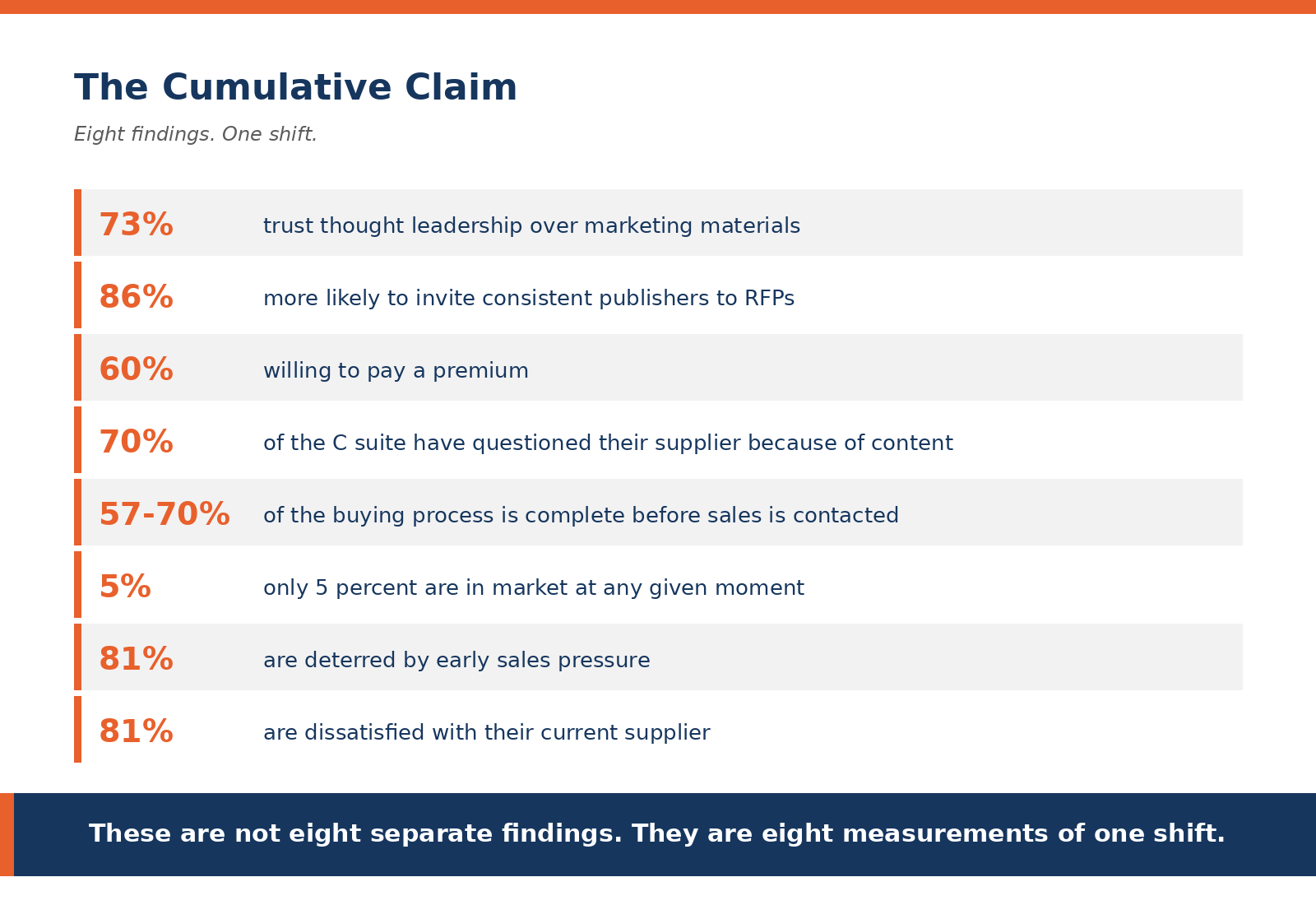
The cumulative claim card. Eight findings stacked. 73 percent trust thought leadership over marketing materials. 86 percent more likely to invite consistent publishers to RFPs. 60 percent are willing to pay a premium. 70 percent of the C suite have questioned their supplier because of content. 57 to 70 percent of the buying process is complete before sales is contacted. Only 5 percent are in the market at any given moment. 81 percent are deterred by early sales pressure. 81 percent are dissatisfied with their current supplier. These are not eight separate findings. There are eight measurements of one shift.
The proof. Companies that built empires on industry information content
The playbook is not theoretical. Six companies built billion-dollar businesses on the principle that publishing industry information from a third-party voice outperforms publishing sales material. Their categories ranged from fiberglass swimming pools to payment infrastructure. The mechanic was identical.
River Pools and Spas. The five hundred thousand dollar article
Marcus Sheridan ran a struggling fiberglass swimming pool company in Virginia. The 2008 recession nearly killed it. Instead of cutting marketing or buying advertising, Sheridan started answering every question his customers had about pools openly and publicly on his company website. Including the questions his industry refused to answer.
He wrote an article titled, Who are the best pool builders in Richmond, Virginia. He did not include his own company in the article. He named his competitors and described them honestly. He attributed over five hundred thousand dollars in pool sales directly to that one blog post.
River Pools went from near collapse to a national brand with twenty-six locations and the most visited swimming pool website in the world. The book Sheridan wrote about the experience, They Ask You Answer, has become the foundational reference for inbound content marketing across every B2B industry that has adopted it.
Source: Marcus Sheridan, They Ask You Answer, Wiley 2017, revised 2019. marcussheridan.com/they-ask-you-answer.
HubSpot. A thirty-billion-dollar company built on a free blog
HubSpot launched in 2006 with a free blog teaching marketers a new approach they called inbound marketing. They wrote the textbook for the category before they ever sold a license to the software. By the time prospects discovered the software, they had already read the blog, downloaded the e-books, taken the certification courses, and adopted the vocabulary. The sale was already made before the sales call.
HubSpot is today a publicly traded company with a market capitalization exceeding thirty billion dollars. Every marketing director in the Western world references the HubSpot blog as the standard reference for the discipline. None of that content sells HubSpot. It teaches the industry. The industry then buys HubSpot.
Salesforce. State of Sales. State of Marketing. State of Service
Salesforce publishes annual industry reports under titles such as the State of Sales, the State of Marketing, and the State of Service. Each report is built on survey data from thousands of business leaders. The reports are quoted in B2B sales meetings, marketing strategy decks, and analyst briefings every day of the year.
Salesforce never has to sell its software in those reports. The reports do the selling. The act of being the company that publishes the definitive annual data on the industry is what positions Salesforce as the default platform for managing it. The competitive moat is the data.
McKinsey, Bain, and BCG. The highest margin consulting in the world
The entire management consulting industry is built on giving away research for free. McKinsey publishes hundreds of free white papers, industry reports, and analytical briefings every year. Bain does the same. BCG does the same. None of those publications sell consulting services in any direct sense.
Every C-suite executive in every Fortune 500 company reads them. When those same executives have a problem they cannot solve internally, they call McKinsey, Bain, or BCG. McKinsey is the highest margin consulting firm in the world. Bain and BCG are not far behind. Their content strategy is the reason.
Stripe. Technical content as a competitive moat
Stripe, the payment infrastructure company, publishes some of the most deeply technical engineering content on the internet. None of it sells Stripe. It teaches developers how to build payment systems. The result is that Stripe became the default payment infrastructure for the internet. Every developer who learned how payments work learned it from Stripe.
When those developers grow up to be CTOs and founders making payment infrastructure decisions, the company they default to is the one whose content taught them the discipline in the first place. The content is the moat.
Gartner, Forrester, and IDC. The companies that sell context, not product
Gartner, Forrester, and IDC do not sell software. They do not sell hardware. They do not sell consulting in the traditional sense. They sell research. They sell industry analysis. They sell context. Companies pay them tens of thousands of dollars a year for access to their reports, which are then used to justify and validate every major B2B technology buying decision in the Western economy.
Each of these firms is worth billions. Their entire business model is the documented proof that B2B buyers will pay real money for third-party industry information. The packaging equivalent of a Gartner Magic Quadrant does not yet exist. The first company to publish it owns the citation slot.
The pattern is identical across every category. Fiberglass pools. Marketing software. Enterprise sales platforms. Management consulting. Payment infrastructure. Industry research itself. Different industries. Different categories. Different price points. Same mechanic. The companies that publish credible, helpful industry information win. The companies that publish commercial content get ignored. There is no documented exception to this pattern over the last fifteen years.
Why has the packaging industry been left behind?
If the data has been sitting in public view for seven years, and the cross-industry proof goes back fifteen, the obvious question is why almost no packaging company has acted on it. The answer has four parts. None of them are about intelligence or capability. All of them are about habit, structure, and timing.
Reason 1. The industry runs on relationships, and relationships feel sufficient
Packaging is a relationship business. Always has been. A regional manufacturer with twenty-five years of customer history can survive on repeat orders, referrals, and the relationships its senior sales reps maintain. The pipeline rarely runs dry. The phone keeps ringing. The annual revenue grows three to five percent in a normal year.
That is the trap. Relationships feel sufficient right up until they are not. When a key customer is acquired, when a brand manager retires, when a procurement function gets centralized, when a private equity sponsor takes over the customer and demands cost reduction, the relationship that produced reliable revenue for fifteen years disappears in a quarter. The replacement does not come from the existing relationship base because the existing relationship base is already maxed.
Authority content is what populates the replacement pipeline. By the time a packaging company realizes they need it, they are five years behind the companies that started building it earlier.
Reason 2. The industry equates marketing with selling, and underinvests in both
Most packaging companies between $5 million and $75 million in revenue have one to three people in marketing. Those people produce trade show graphics, catalog updates, capability brochures, and email campaigns to existing customers. None of those activities are wrong. None of them produce authority.
Authority content production is a different discipline. It requires industry research, source verification, a written voice, design execution, distribution mechanics, and search optimization. It is not a brochure update. It is the work of a specialized publishing operation. Almost no packaging company between $5 million and $75 million in revenue has that operation today.
Reason 3. The category leaders are structurally invisible to AI search
This is the discovery that opened the window. The largest companies in the packaging industry, including a twenty-three billion dollar global player whose name is in every trade publication, are running websites built on JavaScript frameworks that AI search crawlers cannot read. The product pages render as blank text to ChatGPT, Perplexity, Claude, and Google AI Overviews.
View the page source on those sites, and what comes back, in many cases, is a single line saying the page requires JavaScript to run. The buyer using AI search to research packaging suppliers does not see those companies at all. The technical decision the giants made years ago to chase visual polish over crawlability has locked them out of the discovery surface the buyer now uses.
This creates an open field for any packaging company willing to publish industry content on a crawlable site. The category leaders cannot be cited. The companies that publish first become the cited authorities by default.
Reason 4. The window of confidence is short
Every category eventually catches up. The first company in any industry to publish industry information content earns a window of first mover authority that compounds for years before the rest of the industry notices. By the time the third or fourth competitor starts publishing, the citation slots are already filled.
In packaging, that window is open right now. No major manufacturer, no major distributor, and no overseas supplier has begun the work at the level the Edelman data justifies. The first company in any given packaging category to publish twenty to thirty pieces of credible, sourced, third-party industry content will own the AI search citation slot for that category for the next three to five years. After that, the slot is closed.
The window framing. This is not competitive fear. This is an open field opportunity. The companies that move first are not racing competitors. They are claiming a space. By the time competitive fear becomes the right framing, the first movers will already have the citation slots. The companies that wait will be reading articles published by the ones who moved.
What to do about it
The shift in B2B buyer behavior creates two distinct strategic responses depending on what kind of packaging company you run. A manufacturer that produces a specialized capability has one set of moves. A distributor whose value is curation and expertise has a different set. Both responses use the same mechanic. The execution differs because the economics differ.
If you are a packaging manufacturer
Your strategic asset is the trapped expertise inside your team. The plant manager who has run a flexographic press for twenty-two years knows things that no AI model has ever been trained on. The quality engineer who has resolved fifty SQEP audits knows things that do not appear in any published source. The structural designer who built the multi-vendor pallet program for a national retailer knows things that nobody outside that program knows.
None of that knowledge is visible to a buyer doing research. None of it is indexable by an AI crawler. None of it is reachable by a cold call from a competing manufacturer.
The work is to extract that expertise, structure it as industry information content with proper attribution and sourcing, publish it to a crawlable site that AI search engines can read, and route the qualified readers into a buying conversation that has already been pre educated. Done properly, the result is a pipeline of prospects who arrive at the first sales call already knowing what your company does, why it matters, and what to ask.
That is a different motion from cold calling. It is also a different economic outcome. According to the 2024 Edelman LinkedIn report, 60 percent of B2B decision makers say they are willing to pay a premium to organizations that demonstrate a clear vision through valuable thought leadership.
For packaging manufacturers in the five million to seventy-five million revenue band. The Hyper Focused Account-Based Sales Engine is the operational system that runs this play. Pick the niche. Extract the intelligence. Publish AI-optimized content. Build a national decision-maker list. Deploy targeted sequences. Qualify with an AI agent that works around the clock. Hand off educated, ready to talk to buyers to the sales team. Not a lead service. Not a marketing agency. Not an SEO product. A complete operational replacement for the cold calling motion that the data shows is no longer working. Details at SpecPkgMarketplace.com.
If you are a packaging distributor
Your strategic asset is different. You do not manufacture anything. Your value to the customer is curation, problem solving, supplier vetting, and the ability to find the right packaging for the right job across thousands of suppliers and tens of thousands of SKUs. The buyer comes to you because you save them the work of figuring it out on their own.
That value proposition is being eroded in real time by online marketplaces, by procurement platforms that bypass distributors entirely, and by buyers who use AI to do supplier research themselves. The traditional distributor model of catalog and rep is being squeezed from both ends. The buyer no longer needs the catalog. The buyer increasingly does not want the rep call either, at least not until late in the cycle.
The strategic response is to stop competing on the breadth of your catalog and start owning a specific packaging niche at a national level. Pick one category where your expertise, your supplier relationships, and your problem-solving make you the only logical choice for buyers with a very specific need. Then build the authority content, the AI search visibility, and the qualified pipeline to be the named answer when buyers nationally search for that category.
This is not a regional play. The internet does not respect regional boundaries. The AI search engines do not surface regional answers. A distributor who owns a national niche in biodegradable food service packaging, or in industrial chemical containment, or in custom direct-to-consumer subscription box solutions, is positioned to win business from buyers anywhere in the country. The local relationships still matter. They are simply no longer the constraint.
For packaging distributors. The Create a Niche You Can Own program is the operational system that runs this play. Pick the niche. Position the company as the national category leader. Build AI search dominance for the category. Map every decision maker in the country with that specific need. Deliver qualified opportunities to the reps with subject matter expertise support on the close calls. Not a leads list. Not a content service. Not a digital marketing agency. A complete category ownership system designed specifically for packaging distributors who already have real reps and real customer relationships but need a specialty that the platforms cannot commoditize. Details at SpecPkgMarketplace.com.
The honest fit test
This report is not for every packaging company. The mechanic described in it requires conditions that not every business meets. Before doing anything with what you have read, work through the questions below honestly.
This approach is a fit if
- Your annual revenue is between five million and seventy-five million, and you are looking for a structural improvement in how you compete, not a tactical adjustment.
- You have a specialized capability or a niche category position that is worth defending and worth growing.
- You are willing to commit to a publishing cadence that lasts longer than a quarter, because authority compounds over twelve to twenty-four months and not over thirty-day trade show cycles.
- You have ownership or senior leadership alignment on the shift. Authority content cannot be built by middle management alone.
- You are willing to be quoted, sourced, and visible as the named expert in your category. The mechanic does not work if the founder stays anonymous.
This approach is not a fit if
- You are looking for a leads list, a single trade show campaign, or a thirty-day pipeline fix. The data says those do not work, and there is no version of this work that delivers them.
- You are unwilling to invest in publishing on the same horizon as the buying cycle, which is six to eighteen months.
- Your business genuinely competes only on price, and the customers you want are buying purely on price. Authority content does not change the economics of pure commodity buying. It only matters where specialized expertise is a buyer criterion.
- You are operating under a business model where every customer is a one-time transaction. Authority content compounds across a customer base that buys repeatedly.
The Edelman finding is most relevant to this fit test. When thought leadership is not high quality, insightful, or relevant, 45 percent of decision makers and 53 percent of C-level executives report that it actively damages their respect for the publishing organization. Doing this work badly is worse than not doing it. The fit test exists to prevent that outcome.
Questions packaging CEOs ask
Is this just SEO with a new name?
No. Search engine optimization, as traditionally practiced, is about ranking on Google for keyword searches. The shift documented in this report is about being cited by AI search engines such as ChatGPT, Perplexity, Claude, and Google AI Overviews when a buyer asks them a question. The two mechanics overlap but are not the same. AI search rewards credible, sourced, third-party voiced content. Traditional SEO often rewards keyword density and link velocity. The first win in 2026. The second is increasingly obsolete.
Is this just content marketing?
No, in the sense most people mean the term. Content marketing, as commonly practiced in B2B, is the publishing of blog posts, social media updates, and sales collateral with the goal of generating leads. The data in this report explicitly documents that the approach has lost effectiveness. Edelman finds that low-quality or commercial content actively damages B2B brand credibility. The approach described here is the production of industry information content from a third-party voice. It is a different discipline.
How long before we see results?
Authority compounds over twelve to twenty-four months. Some inbound activity appears within ninety days. Pipeline impact is typically measurable in the second and third quarters of execution. The material competitive moat is built in year two. Companies that expect ninety-day pipeline results from authority content are misreading the mechanic. The buyer cycle does not run on a ninety-day schedule. The publishing cycle that wins those buyers cannot either.
How is this different from hiring another sales rep?
A sales representative earning a hundred and twenty thousand dollars, all in costs, depends on whether or not the pipeline produces. The data in this report shows that 81 percent of buyers are deterred by early sales pressure, and 67 percent of buyers prefer to engage with content rather than sales reps in the early stages of the buying process. Hiring another rep doubles down on a motion the data says is losing effectiveness. Building authority content reaches 95 percent of buyers who are not yet ready to talk to a rep at all. The two are not substitutes for each other. Authority content is the upstream system that feeds qualified buyers to the reps you already have.
What about the buyers who are not on LinkedIn?
The data in this report is not about LinkedIn. It is about the broader B2B buyer behavior shift across every channel. The Edelman LinkedIn report is one source. Forrester, Gartner, McKinsey, HBR, the Ehrenberg Bass Institute, Demand Gen Report, and 6sense corroborate the findings independently. The shift shows up wherever buyers research, including direct site visits, AI search, peer referrals, industry trade publications, and yes, LinkedIn. A buyer who never uses LinkedIn still encounters the same mechanic when they ask ChatGPT for a supplier recommendation.
What if our competitors start doing this too?
Some will. Most will not, for the reasons documented earlier in this report. The companies that move first establish citation authority that compounds and is difficult to displace. The companies that move third or fourth in a given category are not catching up to the first mover. They are sharing the leftover citation slots. The math favors moving early and decisively. The penalty for waiting is not lost market share. It is lost access to the discovery surface itself.
What does it cost?
That depends on the scope. A single thought leadership article, professionally researched, written, sourced, and published with a capture mechanism, is a multi-thousand-dollar piece of work. A full-year program covering twenty to thirty pieces with proper distribution, AI search optimization, qualification routing, and sales handoff is a six-figure investment that compares directly to the all-in cost of one additional sales representative. The relevant comparison is not what does authority content costs. It is what the cold calling motion already costs, and what is it producing. The Edelman premium pricing data answers that comparison.
The bottom line
The packaging industry is running an outdated sales playbook while AI search has replaced how B2B buyers find suppliers. No packaging company is currently winning through AI-optimized or content-led strategies. The first mover dominance window is real and closing.
Seventy-three percent of B2B buyers no longer consider sales materials a trustworthy basis for choosing a supplier. Sixty percent will pay a premium to the company that earns their trust through industry information instead. Eighty-six percent will invite that company to the RFP. Seventy percent of the C-suite have already questioned a supplier because of something they read.
The mechanic is documented. The proof is documented. The window is documented. The only variable left is whether the packaging companies reading this decide to act on it before the citation slots fill in.
There is no packaging company today that is winning through AI-optimized, content-led strategies. That sentence is the entire opportunity. It does not stay true much longer. The first companies in each category to claim the empty chair will own it for the next three to five years. The companies that wait will be reading the articles those first movers publish.
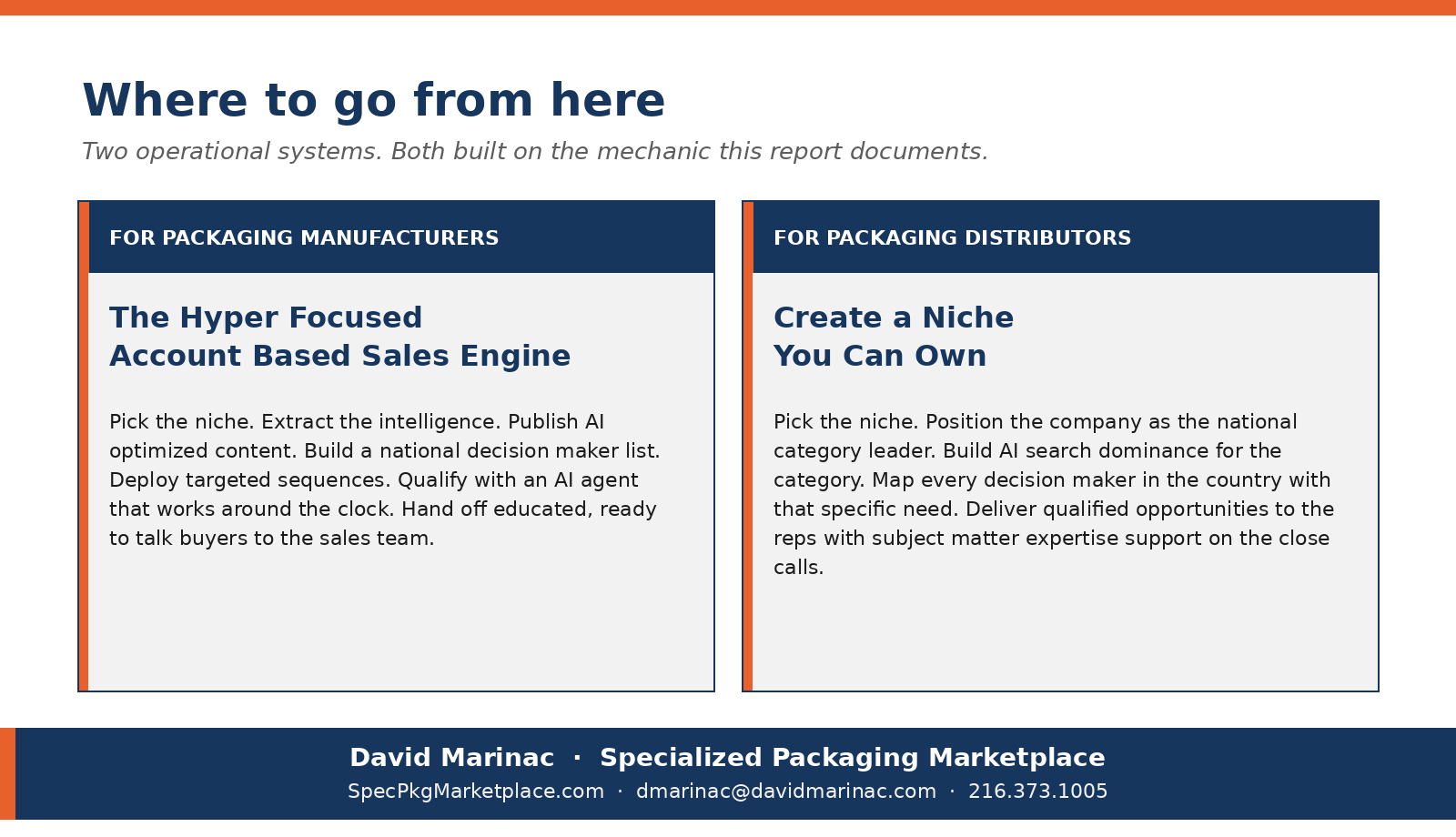
Two paths. Left side. For packaging manufacturers. The Hyper Focused Account Based Sales Engine. Right side. For packaging distributors. The Create a Niche You Can Own program.
Sources and citations
Every percentage and finding in this report traces to a public source. The full citation list follows for the reader who wants to verify the underlying research independently.
Edelman LinkedIn B2B Thought Leadership Impact Report
- 2024 Report (Reaching Beyond the Ready). The source for the 73 percent trustworthy basis finding, the 86 percent RFP invitation finding, the 60 percent premium pricing finding, the 70 percent C suite supplier question finding, and the 75 percent product research finding. Surveyed nearly 3,500 management-level professionals across seven countries in December 2023. Available at edelman.com/expertise/Business-Marketing/2024-b2b-thought-leadership-report
- 2025 Report (Invisible Influence: Unlocking the Power of Hidden Buyers). The follow-up study, in its seventh annual edition. Surveyed 1,934 global business executives in March and April 2025. The source for the 95 percent hidden buyer receptivity finding, the 71 percent hidden buyer effectiveness finding, and the 64 percent hidden buyer trust finding. Available at edelman.com/expertise/Business-Marketing/2025-b2b-thought-leadership-report
- 2025 Report direct PDF. Available at edelman.com/sites/g/files/aatuss191/files/2025-07/2025%20Edelman-LinkedIn%20B2B%20Thought%20Leadership%20Impact%20Report_FINAL.pdf
- LinkedIn commentary on the 2025 report. Available at linkedin.com/business/marketing/blog/research-and-insights/b2b-thought-leadership-influence-hidden-buyers
- Edelman supporting article on hidden buyers. Available at edelman.com/insights/hidden-buyer-b2b
Marcus Sheridan and the They Ask You Answer framework
- Book. They Ask You Answer, Marcus Sheridan, Wiley, 2017, with revised edition 2019.
- Author site. marcussheridan.com/they-ask-you-answer
- Story summary. impactplus.com/blog/the-story-of-they-ask-you-answer
The 95-5 Rule. Ehrenberg Bass Institute and LinkedIn B2B Institute
- Professor John Dawes, Ehrenberg Bass Institute. Research is now standard in B2B marketing curricula and is widely available through the institute's publications.
Aggregated B2B buyer behavior research
- Forrester, Gartner, 6sense, McKinsey aggregated statistics. omnibound.ai/blog/b2b-buying-statistics
- Additional B2B buying behavior data. mixology-digital.com/blog/must-know-stats-about-b2b-buying
- Education-led marketing guide. marketingprofs.com/articles/2025/53674/education-led-marketing-guide-b2b-buying-decisions
Edelman direct comparison research
- Edelman research on thought leadership versus traditional marketing. edelman.com/news-awards/new-research-edelman-linkedin-thought-leadership-influences-b2b-sales
Methodology note. Where this report aggregates findings across multiple sources, the underlying percentages have been verified against the original publications. Where a single statistic appears in multiple secondary citations, the original primary source is named first. No statistic in this report is calculated, estimated, or extrapolated. Each is reported as published by the original research firm.
---
BIO LINE: David Marinac. ABC Packaging Direct. Specialized Packaging Marketplace. 35 years in specialized packaging. SpecPkgMarketplace.com. DavidMarinac.com. dmarinac@davidmarinac.com. 216.373.1005.

Ready to find your packaging partner?
Join hundreds of manufacturers and buyers already using PackageLink to streamline their sourcing process.