

And What It’s Costing You Beyond the Return Label
Published by the Specialized Packaging Marketplace
She signed up for your activewear subscription because she loved the concept. Curated workout clothes, delivered monthly, styled for her preferences. No more scrolling through endless options. Just open the box, love the outfit, hit thegym.
The first box arrives. She tears it open. Pulls out the leggings.
They’re a size large. She ordered a medium.
Now she’s holding clothes she can’t wear, looking for a return label, and questioning whether this subscription is worth the hassle.
You just lost her.
Not because your product is bad. Not because your curation was wrong. Not because your marketing over promised. You lost her because somewhere between her size profile and her doorstep, the wrong leggings went into the wrong box.
This is the wrong size problem. And it’s why apparel subscriptions have the highest return rates in all of e-commerce often 2-3x higher than standard retail. For subscription brands like Ellie, Fabletics, and the growing wave of activewear boxes, this single fulfillment failure is the silent killer of retention, margins, and growth.
The Numbers Nobody Wants to Talk About
Let’s get specific about how bad this problem actually is.
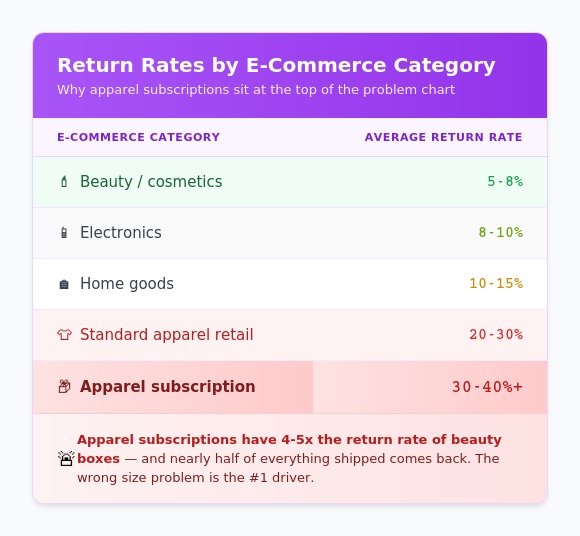
Apparel subscriptions sit at the top of the return rate chart. Some brands see rates exceeding 40% meaningnearly half of everything shipped comes back.
Why Subscriptions Are Worse Than Retail
Standard retailreturns are high because customers can’t try before they buy. But at least theychose the item. They looked at the size chart. They made a decision.
Subscriptionapparel removes that control. You’re choosing FOR the customer based on a sizeprofile they filled out once, months ago. You’re selecting items they’ve neverseen, in sizes they didn’t specifically request for that item, shipped on aschedule they don’t control.
Every assumptionin that chain is an opportunity for error.
The Size Profile Lie
Here’s the dirty secret: customersize profiles are often wrong from day one.
• Customers guess their size rather than measuring
• Sizes vary wildly across brands (your “medium”is another brand’s “small”)
• Customers’ sizes change over time (weightfluctuation, preference shifts)
• Customers fill out profiles quickly withoutthinking carefully
• One size doesn’t work across all garment types(fitted vs. loose, tops vs. bottoms)
You’re building your entirefulfillment operation on foundation of sand.
Where Size Errors Actually Happen
Sizeerrors aren’t random. They cluster around specific failure points in thefulfillment process.
Failure Point #1: Inventory Receiving
When apparel arrivesat your fulfillment center, every item must be correctly identified by style,color, AND size.
What goes wrong:- Items arrive with unclear or inconsistent labeling - Size tags are insidegarments and easy to misread - Workers scan style/color but don’t verify size -Items get binned in wrong size location - Similar items with different sizeruns get mixed
Once an item is in thewrong bin, it will ship to the wrong customer. The error happened at receiving,but you won’t know until the return comes back.
Failure Point #2: Inventory Storage
Even items that werereceived correctly can end up in wrong locations.
What goes wrong:- Size-adjacent bins (S next to M next to L) enable grab errors - Partialreplenishment mixes sizes in same location - Returns get restocked without sizeverification - High-velocity picking disrupts organization - Seasonal inventoryinflux overwhelms storage discipline
The chaos compounds. Asmore items end up in wrong locations, error rates accelerate.
Failure Point #3: The Pick
This is where most size errorsbecome permanent when a worker picks an item for a specific order.
What goes wrong: - Worker grabs from adjacent size bin - Worker reads size chart wrong (M vs. ML vs. W-M) - Worker is rushing and doesn’t verify - Lighting makes size tags hard to read - Similar-looking garments in different sizes get confused -Substitution without verification when correct size is out of stock
Most fulfillment operations measure pick accuracy by “did they pick the right SKU?” But for apparel, the SKU might be correct while the size is wrong. Standard metrics miss this entirely.
Failure Point #4: The Pack
Even after picking, errors can still happen at pack station.
What goes wrong: -Multiple items for same order get mixed up - Packer doesn’t verify size againstorder - Items from different orders on same table get swapped - No final sizecheck before box closes
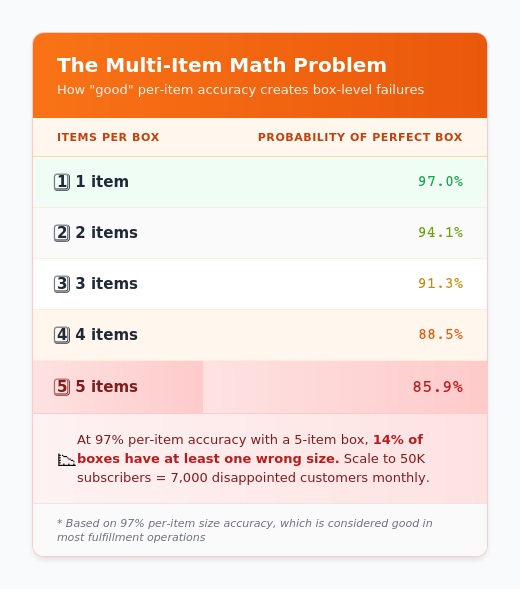
For a subscription box with 3-5apparel items, each item is an opportunity for error. The probability of aperfect box drops with every piece.
The Math: Why Small Error Rates Create Big Problems
Let’ssay your per-item size accuracy is 97%. That sounds good, right?
Here’swhat 97% accuracy means for multi-item apparel boxes:
What Size Errors Actually Cost
Returnsaren’t free. And the costs go far beyond the return shipping label.
Direct Costs
Return shipping: $5-10 per return, depending on label type and carrier rates.
Processing labor: Someone has to receive the return, inspect it, determine disposition, restock or dispose.That’s $3-5 per return in labor.
Reshipment: If the customer wants the correct size, you’re shipping again. Another $6-12 in fulfillment and shippingcosts.
Inventory carrying cost: The wrong-size item sitting in transit isn’t available to sell. That’s working capital tied up in returns.
Product loss: Some returns can’t be resold stained, damaged, worn, or out of season. Write-off rates of 10-20% onreturns are common in apparel.
Direct cost per size-error return: $20-40
Indirect Costs (The Real Damage)
Customer churn: A subscriber who receives wrong sizes isn’t just frustrated they’re questioning the entire value proposition. Research shows that customers who experience fulfillment errors are 3-4x more likely to cancel.
Lifetime value destruction: An activewear subscription customer who stays 18 months is worth 3x a customer who cancels at 3 months. Every wrong-size shipment accelerates churn.
Customer service burden: “My sizes are wrong” is the most time-consuming ticket type. It requires back-and-forth about what happened, what they want to do, generating return labels, processing exchanges. Budget 15-20 minutes of agent time per incident.
Brand perception: “They can’t get sizes right” spreads through reviews, social media, and word of mouth. It’s the most common complaint in apparel subscription reviews.
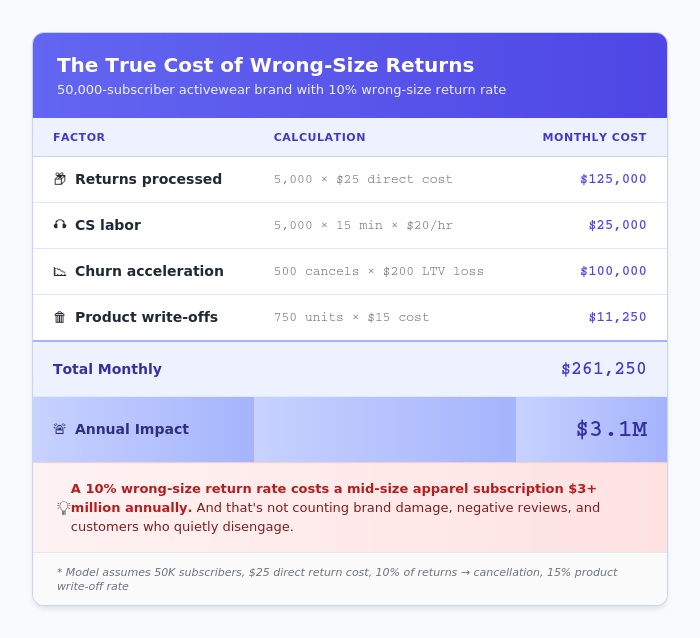
The Total Cost Calculation
Why Standard 3PLs Fail at Apparel Subscriptions
Most third-party logistics providers were built for different products. They’re optimized for discrete units things with barcodes that either match the orderor don’t.
Apparel breaks this model.
The SKU-Level Thinking Problem
Standard fulfillment tracks accuracy at the SKU level. Did the worker pick the right product code? Yes or no.
But apparel SKUs often encode style and color, not size. Or they encode size in ways that aren't obvious to workers. Or the physical tag on the garment doesn’t match the system.
A fulfillment partner might report 99.5% SKU accuracy while actually shipping wrong sizes 5% of the time. The metrics don’t capture the problem.
The Speed Incentive Problem
Most fulfillment operations optimize for speed. Workers are measured on units per hour. The incentive is to pick fast, pack fast, ship fast.
Verifying sizes takes time. Checking that the tag inside the leggings actually says “M” takes longer thanglancing at the bin label. When workers are pressured for speed, verification gets skipped.
The Returns Competency Gap
Apparel subscriptions require robust returns processing something many 3PLs treat as an afterthought.
When returns come back: - Items need to be inspected for wearability - Sizes need to be RE-verified (don’ttrust the customer return label) - Items need to be correctly restocked by size- Damaged items need to be dispositioned - Data needs to be captured forquality analysis
A fulfillment partner who treats returns as “throw it back in inventory” will compound your sizeproblems, not solve them.
The Presentation Problem
Apparel subscription isn’t just about shipping clothes it’s about presenting an outfit. The unboxing should feel like a gift, not a warehouse shipment.
General 3PLs pack for protection. They’ll fold items adequately and prevent damage. But they won’t arrange the outfit thoughtfully, place tissue paper intentionally, or ensure the hero piece is visible on top.
For an activewear subscription where the unboxing is part of the product, generic packing undermines theentire experience.
What High-Accuracy Apparel Fulfillment Actually Looks Like
The brands achieving sub-5% return rates aren’t doing it by accident. They’ve built systems specifically designed for size-variant apparel.
Receiving Verification
Every item, every size, every time. Not batch scanning individual verification.
• Item is removed from case pack
• Style AND size are scanned or verified
• Discrepancies are flagged immediately
• Items are photographed for quality record
• Items go to size-specific locations with physical separation
This is slower than standard receiving. It’s also the only way to prevent upstream errors from infecting your entire inventory.
Size-Segregated Storage
Size-adjacent storage (S next to M next to L in one bin) is a recipe for grab errors. High-accuracy operationsuse:
• Physical separation between sizes(different shelves, not same shelf)
• Color coding by size category
• Clear labeling that’s visible from picking angle
• Single-size locations (never multiple sizes in same bin)
• Slotting optimization to reduce adjacent-size reach errors
Multi-Point Pick Verification
The pick is the highest-risk moment. High-accuracy operations verify at multiple points:
Pre-pick: System confirms size is available in correct location
At-pick: Worker scans item barcode AND verifies size tag matches
Post-pick: Visual verification before item enters order container
At-pack: Final size check against order requirements before box closes
Four verification points. Any single point might catch an error. Together, they reduce wrong-sizeshipments to near-zero.
Size-Aware Technology
The WMS (Warehouse Management System) matters. High-accuracy systems:
• Treat size as a primary attribute, not secondary
• Flag size mismatches as high-severity errors
• Track accuracy by size, not just SKU
• Prevent picks when system inventory disagrees with expected location
• Generate size-specific quality metrics
If your fulfillment partner’s system treats size as “just another attribute,” their technology isn’t built for apparel.
Returns Processing Rigor
Returns are where errors get recycled or caught.
High-accuracy operations: -Inspect every returned item (no auto-restock) - Re-verify size independent of return reason - Quarantine items with unclear sizing - Track return reasons to identify systematic issues - Feed returns data back to pick-team training
Returns processing is quality control for your size problem. Treat it as afterthought, and your error rate compounds.
The Size Profile Integration Challenge
Even with perfect fulfillment, wrong sizes can ship if the size profile is wrong.This is a system integration issue.
The Profile-to-Order Gap
Customer fills out size profile (once, at signup).
Profile lives in subscription platform (Recharge, Bold, etc.).
Order generates with size requirements.
WMS receives order and directs picks.
Question: At each handoff, does size information transfer correctly?
Many subscription operations have gaps in this chain. The profile says Medium. The order passes through the integration. The WMS receives… no size information. Or a default size. Or an outdated size.
The fulfillment partner picks what the WMS says. They did their job. The customer gets the wrong size. Everybody points fingers.
Integration Requirements
High-accuracy apparel fulfillment requires:
• Size profile data in the order payload (not just style selection)
• Per-item size specifications (not assumed from profile)
• Profile update timestamps (was this updated recently?)
• Size preference notes (runs large, prefers fitted, etc.)
• Clear hierarchy when conflicts exist
Your fulfillment partner should be asking about this integration. If they’re not, they don’t understand apparel.
Questions to Ask Apparel Fulfillment Partners
If you’re evaluating fulfillment partners for an activewear or apparel subscription, these questions separate the capable from the pretenders:
Size-Specific Accuracy
1. What is your size-specific accuracy rate (not just SKU accuracy)?
2. How do you measure and report on wrong-size errors?
3. What verification points exist between receiving and shipping?
4. How is your warehouse organized to prevent size grab-errors?
Process and Systems
5. How do you verify size at the receiving stage?
6. Does your WMS treat size as a primary attribute?
7. What happens when system inventory disagrees with physical inventory?
8. How do you handle similar-looking items indifferent sizes?
Returns and Quality
9. What’s your returns processing procedure for apparel?
10. Do you re-verify size on returns before restocking?
11. How do you track and analyze return reasons?
12. What quality metrics do you share with clients?
Presentation
13. Do you understand apparel presentation standards?
14. Can you fold and arrange items to brand specifications?
15. What’s your experience with activewear/fitness brands specifically?
Red Flags: - Reports SKU accuracy but can’t answer about size-specific accuracy - Size is “just another attribute” intheir system - Returns get bulk-restocked without inspection - No apparel-specific experience or references
The Bottom Line
The wrong size problem isn’t a customer problem. It isn’t a product problem. It isn’t a marketing problem.
It’s a fulfillment problem that masquerades as all of those things.
When customers receive wrong sizes, they blame your brand not your 3PL. When return ratesspike, finance blames product selection. When churn accelerates, marketing gets asked what went wrong.
But the root cause is often simple: somewhere in a warehouse, the wrong leggings went intothe wrong box. And nobody’s system caught it.
Apparel subscription brands that solve the size problem don’t just reduce returns. They transform unit economics, improve retention, and build reputations forreliability that become competitive advantages.
The brands that don’t solve it? They’re buried in returns, bleeding money on logistics, and wondering why customers keep leaving.
For apparel subscriptions, size accuracy isn’t an operational metric. It’s the entire business.
Looking for an apparel fulfillment partner who understands size-variant accuracy?
The Specialized Packaging Marketplace connects activewear and apparel subscription brands withvetted fulfillment partners who specialize in size-variant products. Search by accuracy metrics, apparel experience, and processing capability.
Bay Cities is a 100% employee-owned direct manufacturer of retail packaging, POP displays, and packout services. Preferred vendor at major retailers.
Search Apparel Fulfillment Partners



Ready to find your packaging partner?
Join hundreds of manufacturers and buyers already using PackageLink to streamline their sourcing process.