

How Long Does a Walmart POP Display Program Actually Take from Design to Delivery?
The honest answer most suppliers will not give you, and what it costs when the timeline is wrong.
If you have ever asked a packaging supplier how long a Walmart POP display program takes, and gotten a vague answer, a shrug, or a number that turned out to be wildly optimistic, you are not alone.
Lead time is the single most consequential variable in a Walmart display program. Get it right, and your product lands on the floor during the peak selling window. Get it wrong, and you are paying OTIF fines, missing promotional windows, and explaining to your Walmart buyer why your display showed up two weeks after the event.
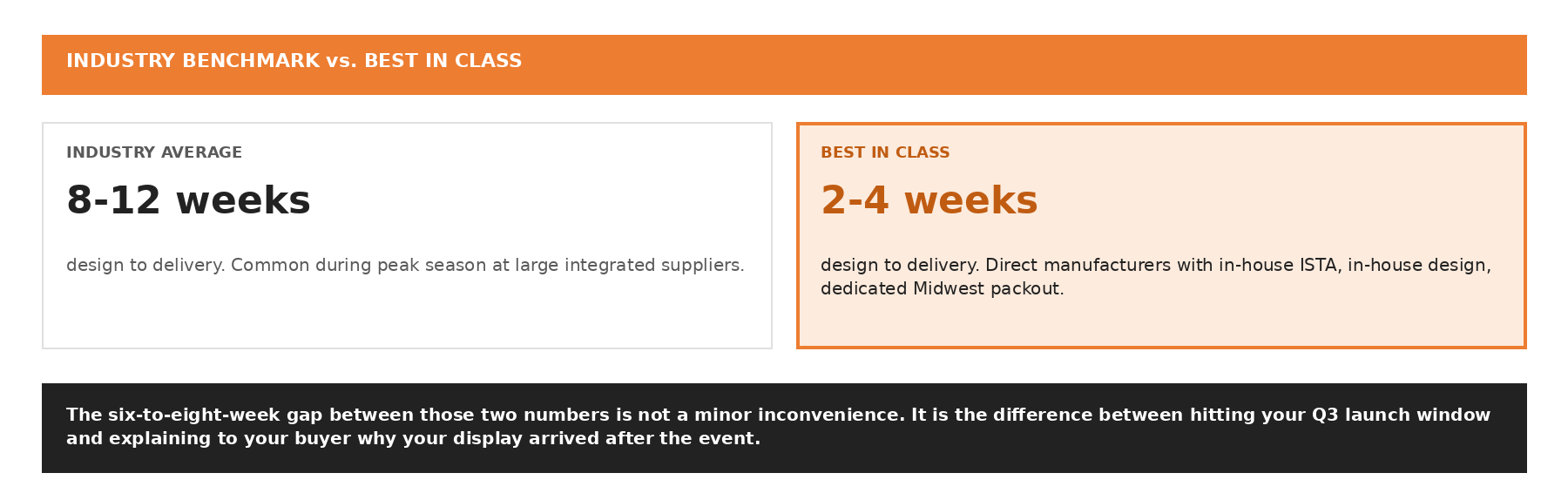
This guide breaks down the actual phases of a Walmart corrugated POP display program. What happens in each phase, how long each phase realistically takes, and what separates a supplier who can execute in two to four weeks from one who needs eight or more.
The Five Phases of a Walmart POP Display Program
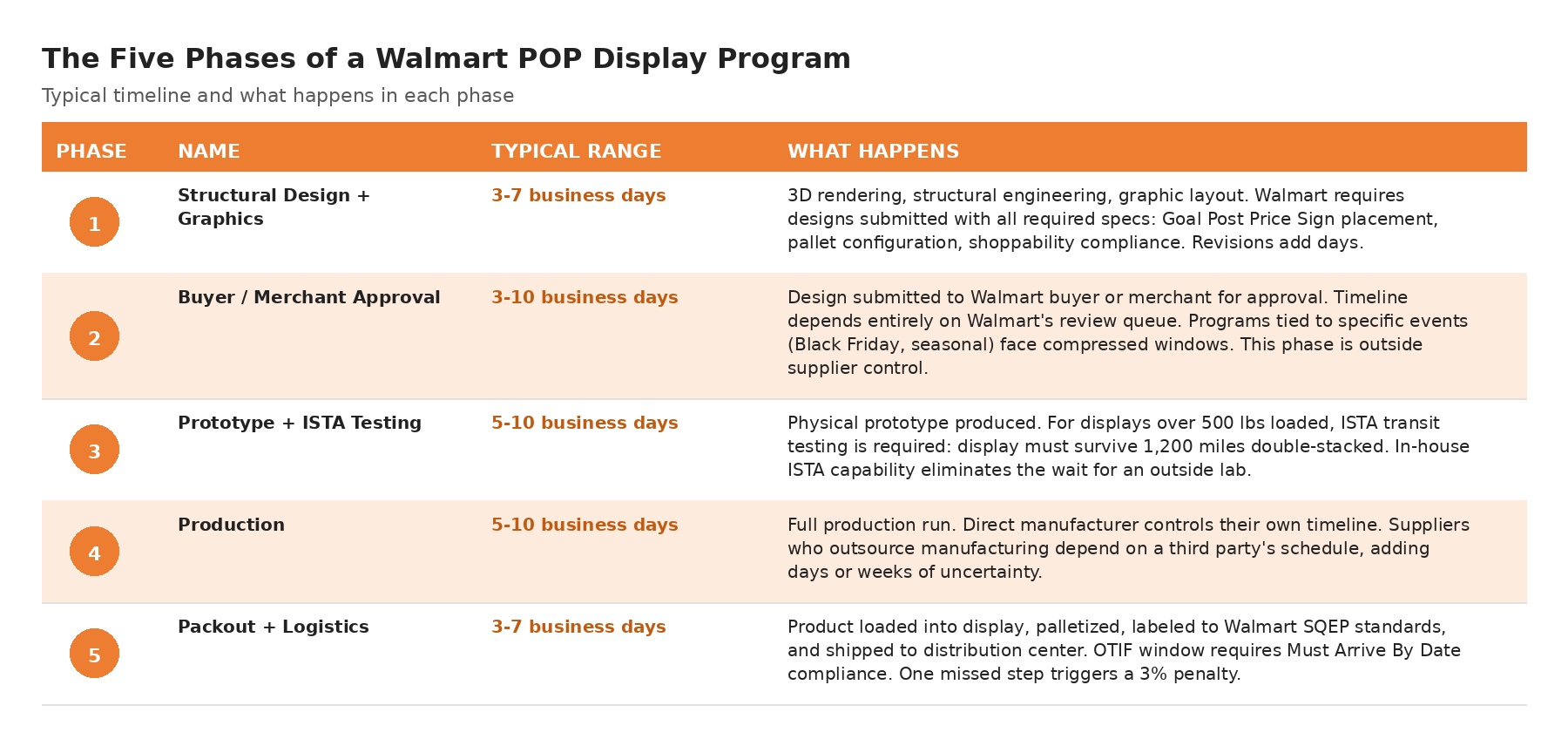
Every Walmart corrugated POP display program, whether it is a full pallet display, a half pallet, a PDQ tray, or a sidekick, moves through the same five phases. The total elapsed time depends on how fast each phase moves and how many handoffs happen along the way.
Phase by Phase: Where Programs Get Stuck
Phase 1. Design: Where Supplier Capability Separates Winners from Losers
Walmart's structural and graphic requirements are detailed. The Walmart Secondary Packaging Standards guide runs over 250 pages. Displays must meet specific requirements for pallet type, shop-ability, Goal Post Price Sign placement, stacking weight, and material specifications.
Suppliers with in-house structural designers who know Walmart's requirements can turn a first design in three to five business days. Suppliers who outsource design or lack Walmart-specific experience routinely take two to three weeks just to produce an approvable first concept, before Walmart has even seen it.
Speed at Phase 1 is entirely within the supplier's control. It is the first place to evaluate any potential display partner.
Phase 2. Buyer Approval: The Phase You Cannot Rush
Walmart's merchant review process has its own timeline, and it is not negotiable. What you can control is how clean and complete your submission is. Incomplete submissions, missing specifications, or designs that require significant revision restart the clock.
Suppliers experienced with Walmart programs know exactly what goes into an approvable first submission. They do not send designs that will come back with questions. First-time approvals move faster than revised submissions by days or weeks.
Phase 3. ISTA Testing: The Hidden Timeline Killer
This is where many programs stall unexpectedly. Walmart requires ISTA Series 3 transit testing for displays. The display must survive 1,200 miles double-stacked. For displays loaded with product weighing 500 pounds or more, ISTA testing is mandatory before production begins.
If a supplier sends a prototype to an outside ISTA-certified lab, the wait for testing and results adds five to ten business days minimum. If the prototype fails, the clock restarts. Suppliers with in-house ISTA testing capability eliminate that wait entirely. The display gets tested in-house, results come back the same day or the next day, and production starts immediately.
Bay Cities operates in-house ISTA testing across its facilities, including the 320,000 square foot Royal Bay Midwest packout center in Chicago. This means no outside lab wait, no external scheduling dependency, and no surprise retest delays. See their testing capabilities at SpecPkgMarketplace.com.
Phase 4. Production: Direct Manufacturer vs. Broker
This is the most significant differentiator in the total program timeline. A direct manufacturer controls their own production schedule. They know exactly when their press is available, when their die cut line runs, and when production completes. They can give you a hard date because they own the timeline.
A broker, regardless of how they present themselves, depends on a manufacturing partner's schedule. When that partner's plant is running at capacity during peak season, your program waits. The broker cannot control that wait. They can only report it.
This distinction is especially consequential during August through December, Walmart's peak POP display season, when every manufacturer in the supply chain is running at or above capacity. A direct manufacturer with dedicated capacity can still deliver in two to four weeks. A broker running through a third-party plant during the same period routinely stretches to eight weeks or more.
Phase 5. Packout and Logistics: Where OTIF Is Won or Lost
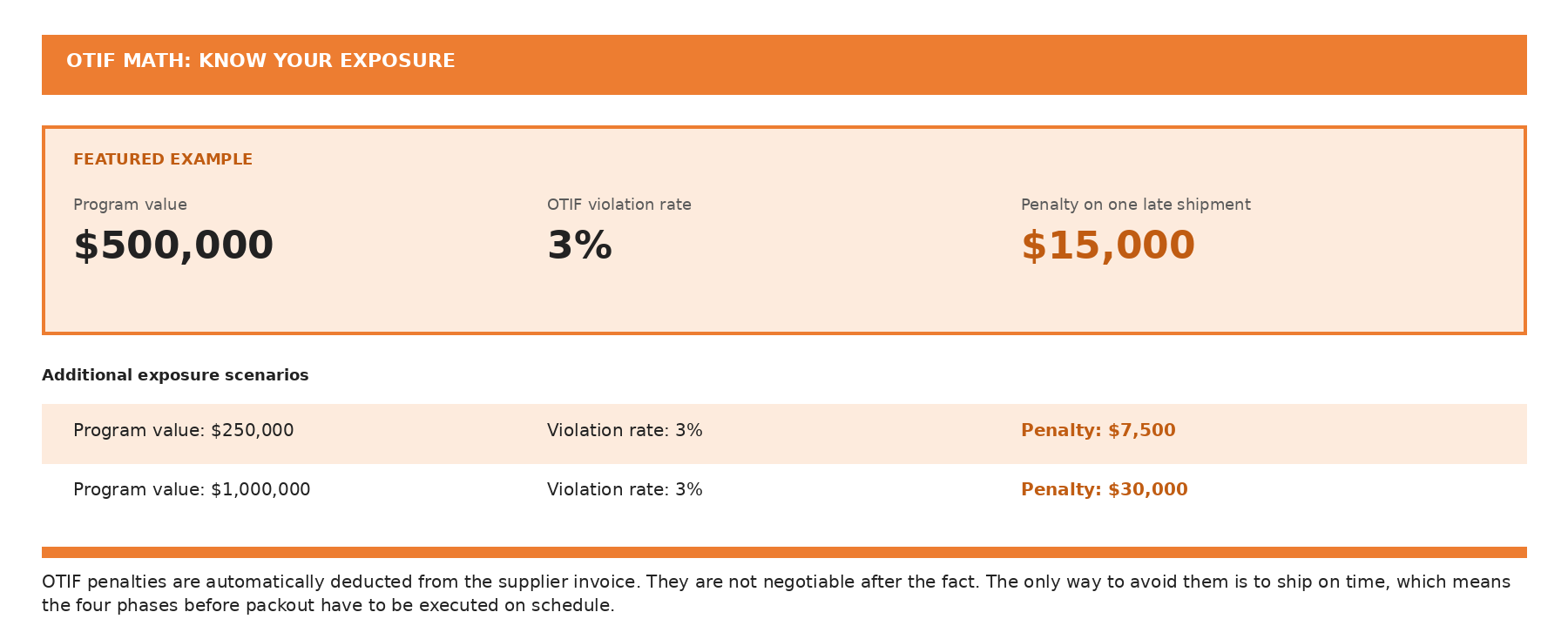
Packout is where the display gets loaded with product, palletized, labeled, and shipped. Walmart's OTIF program measures whether shipments arrive on time and in full at the distribution center. The current penalty for OTIF violations is 3% of the cost of goods on the non-compliant purchase order.
Packout facilities with proprietary logistics software, dedicated dock capacity, and experienced teams that know Walmart's labeling and pallet standards are built to protect OTIF compliance. A Midwest-based packout facility like Bay Cities' Royal Bay center, centrally located for Walmart distribution centers, reduces transit time and provides additional buffer against OTIF exposure compared to a West Coast-only supplier.
The Questions That Reveal What Your Supplier's Timeline Actually Is
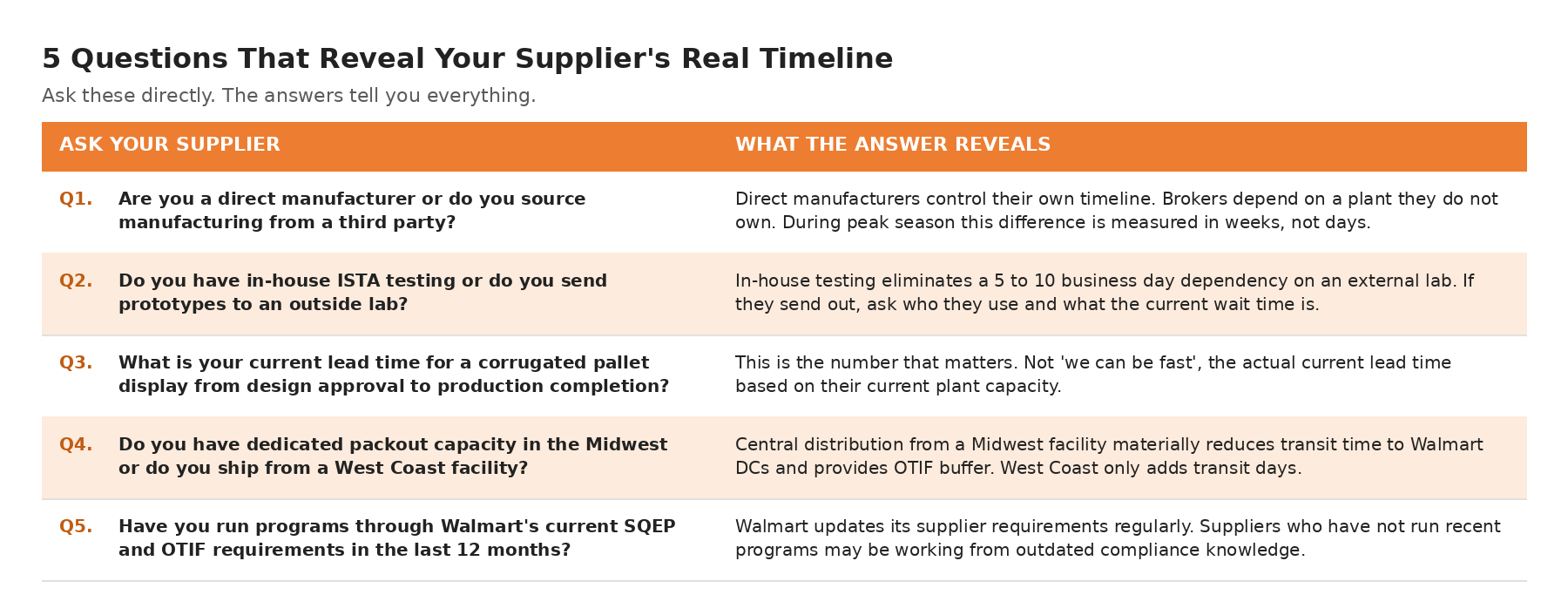
Before committing to any supplier for a Walmart POP display program, ask these five questions directly. The answers will tell you everything you need to know about their actual timeline capabilities.
What a 2 to 4 Week Timeline Actually Looks Like
For brands asking whether a two-to-four-week timeline is realistic, the answer is yes, under specific conditions. Here is what enables it.
- In-house structural design team with Walmart program experience. First concepts in three to five days, not three weeks.
- In-house ISTA testing capability. Prototype is tested the same week it is produced, not sent to an outside lab with a multi-week wait.
- Direct manufacturing. Production scheduled on the supplier's own press, not waiting on a third-party plant's availability.
- Dedicated packout capacity. Product loaded, palletized, and labeled without competing for space at an oversubscribed facility.
- Midwest distribution center. Reduced transit time to Walmart DCs, and more OTIF buffer was built into the delivery window.
Bay Cities' combination of direct manufacturing, in-house ISTA testing, dedicated Midwest packout capacity at Royal Bay, and a Bentonville team that works directly with Walmart merchants allows programs to run at two to four weeks consistently, including during peak season when most suppliers are quoting eight weeks or more.
Need a packout partner who can handle volume? Kitting, assembly, co-packing & direct import fulfillment from our 233,000 sq ft Chicago facility. Let's talk.
Learn more about Bay Cities' packout and logistics capabilities at SpecPkgMarketplace.com.
Download the Walmart POP Display Program Timeline Checklist
We have put together a one-page checklist that walks through every phase of a Walmart POP display program. With the questions to ask your supplier at each step, the OTIF exposure calculation, and the compliance requirements that trip up programs most often.
The checklist covers:
- Phase-by-phase timeline benchmark, what fast looks like vs. what average looks like.
- ISTA testing requirements by display type and weight.
- OTIF exposure calculator. Your program value x 3% = your penalty risk.
- The 5 supplier questions from this article in a print-ready format.
- Walmart SQEP compliance quick reference. Phase 1 through Phase 3.
Download at SpecPkgMarketplace.com.
Published by Specialized Packaging Marketplace | SpecPkgMarketplace.com
David Marinac



Ready to find your packaging partner?
Join hundreds of manufacturers and buyers already using PackageLink to streamline their sourcing process.