We Tore Down a Packaging Company's AI Search Position. Here Is What 90 Days of Ad Spend Should Have Bought Instead.
Teardown article hero showing three indexed competitor pages and one missing, a packaging company invisible in AI search
A real teardown of a mid-size packaging manufacturer, anonymized. What we found in a few days is the same thing: nearly every paid-ads budget in this industry is failing to buy.
A packaging company spends money every month to get found. Google ads, sponsored posts, the occasional trade show booth. The invoices are real. The clicks are real. And almost none of it shows up in the one place a growing share of buyers now start their research, the AI tools.
We took one real packaging manufacturer and tore down its AI search position from the outside, the way a buyer's ChatGPT or Perplexity question would see it. We are not naming the company, and we are not naming its competitors, because the lesson is the pattern, not the logos. What the teardown found is exactly what 90 days of ad spend should have bought and did not. It is also a fraction of the cost. Here is the whole thing.
What did we actually tear down?
We took a mid-size, family-owned specialty packaging manufacturer with a genuinely strong position. Decades in business. A top-tier food-safety certification that major retailers specifically require and that most of its competitors do not hold. A product that matches the category leader spec for spec. By every traditional measure, a company that should be easy to find.
Then we asked the AI tools the questions its buyers actually ask. Who makes this kind of packaging? What is the best supplier for this application? How does one brand compare to another? We ran the real buyer questions across ChatGPT, Perplexity, and Google's AI layer, and we watched who came back.
The manufacturer did not come back. Not once. Its competitors did. The company with the better certification, the better story, and a website AI could actually read was invisible in the exact conversation its buyers were having. That is the teardown in one sentence. Here is what was underneath it.
What does a competitive AI-search audit find that a Google ad never could?
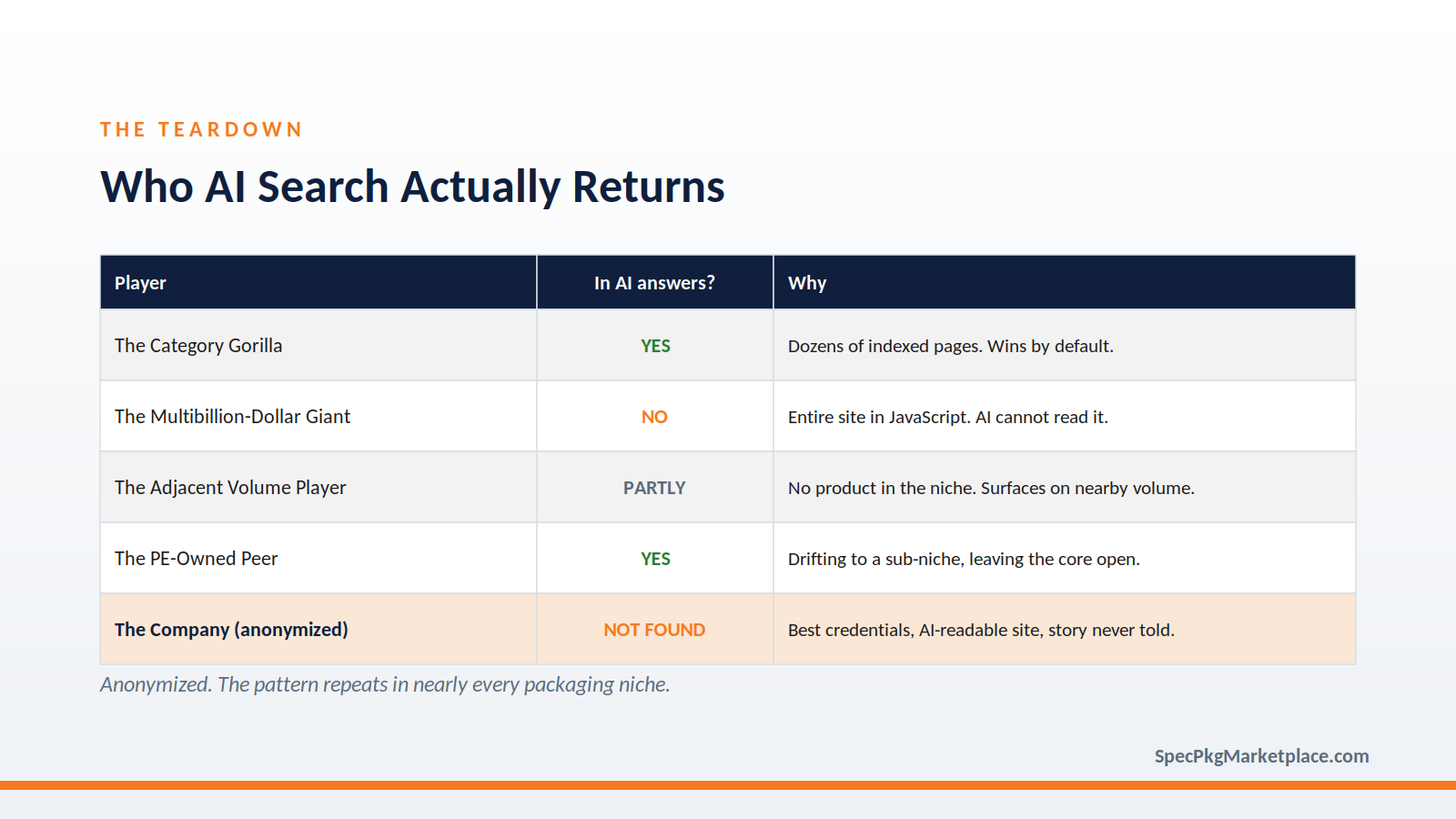
Table titled Who AI Search Actually Returns, showing four competitor types and one anonymized packaging company that does not appear in AI answers
A Google ad tells you nothing about the battlefield. It buys you a slot and a click. A competitive AI-search audit maps the whole field.
We identified every competitor that surfaced in the AI answers ahead of our manufacturer, and we sorted them by why they were winning. One was the category gorilla, the default name with dozens of pages of indexed content, winning simply because it was the only name the AI had ever read. One was an adjacent player with no real product in the niche at all, surfacing only because it publishes so much nearby content. One was a private-equity-owned peer drifting toward a narrow sub-niche. And one was a multibillion-dollar global giant that, on paper, should have owned the category outright.
That last one is where the teardown got interesting.
The finding that should scare every packaging CEO
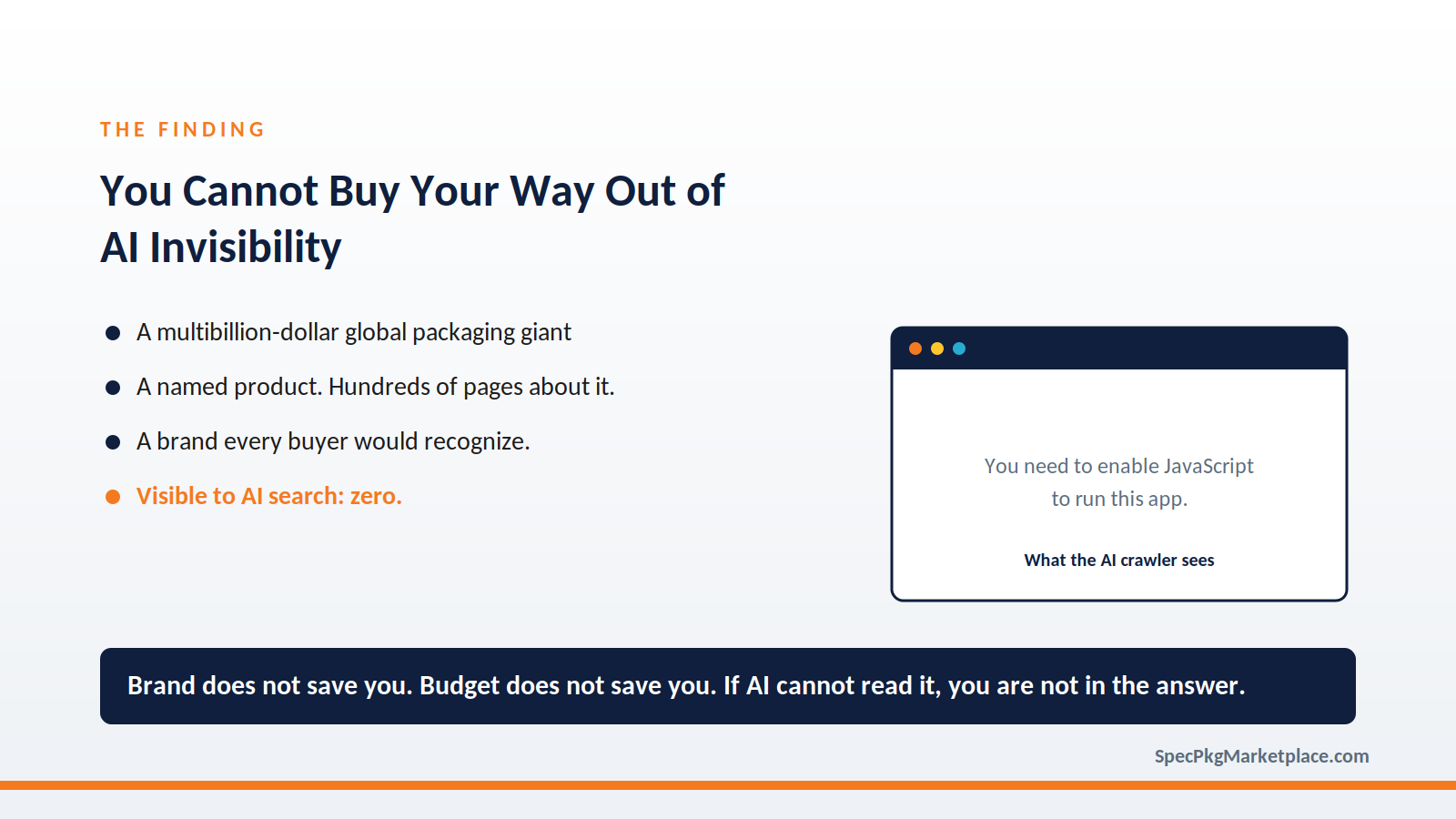
Graphic showing a multibillion-dollar packaging giant invisible to AI search because its site runs on JavaScript, with the enable JavaScript message an AI crawler sees
The global giant has a named product in this exact category. It has hundreds of pages published about it. It has a brand every buyer in the industry would recognize. And it is invisible to AI search.
Why? Because its entire website is built in JavaScript. When an AI crawler tries to read those pages, it gets a blank screen and a line of code asking it to enable JavaScript. The pages exist for a human with a browser. They do not exist for the AI tools doing the buyer's research. A multibillion-dollar company, with a named product and a marketing budget bigger than most of its competitors combined, is functionally absent from the conversation its own buyers are having right now.
Read that twice, because it is the whole point. You cannot buy your way out of AI invisibility. Brand does not save you. The budget does not save you. If the AI cannot read your pages, you are not in the answer, and the size of your company does not matter. The giant's weakness was not strategy or spend. It was a technical choice nobody on the marketing team understood was costing them the future.
Where was the open territory hiding?
Once you can see the field, the opening is obvious. The gorilla owns the generic top-of-category question by default, but it has never published an honest comparison, because the leader does not invite the comparison. The giant is invisible. The adjacent player has no product to defend the niche with. And the peer is drifting toward a narrowing specialty and quietly leaving the core territory open.
The core of the niche, the exact ground our manufacturer is strongest on, had no clear, AI-readable authority answering the buyer's real questions. None. That is the blank canvas, niche-sized. The company with the best credentials and the only fully readable website was the one company not showing up, in the one space nobody had claimed.
What should they have published, and how would each piece have won?
Not blog posts. Not an about-us page. Specific buyer-question content, each piece built to own a piece of ground the competitors cannot or will not take.
The honest comparison the leader will never write, because the leader does not invite comparison. The cost and specification answer the giants hide. The failure-mode piece that captures the buyer who already had a problem and is searching at the highest intent there is. The best-of guide for the specific application, written by the one company actually qualified to be on it. And the real case study the giants cannot produce, because their smallest accounts are too small for their sales teams to bother documenting.
Each of those answers a question thousands of buyers ask, and each one names the real decision factors, the certification, the spec, the service model, so the buyer making the comparison finds our manufacturer first. The leader cannot respond without legitimizing the challenger. That is how a smaller company wins the search against bigger ones. Not by spending more. By answering the questions the big ones are structurally unable to answer.
How does this find the actual buyers instead of anonymous clicks?
Here is the part the ad budget can never do. A Google ad sprays a slot at whoever clicks and tells you nothing about who they were. The teardown runs in the other direction. The same intelligence that maps the competitors also maps the buyers, the specific processors and brands that fit this manufacturer's best-client profile, the named decision makers inside them, and the exact pain that puts them in the market.
So instead of paying for anonymous clicks and hoping one converts, the company gets a named list of the buyers who should be talking to it, and the content that pulls them in when they search. Inbound that arrives already educated, and outbound aimed at real people, not a demographic. Ads buy attention from strangers. This identifies the strangers worth knowing and gives them a reason to come to you.
What would 90 days of ad spend have bought instead?

Two-column graphic comparing paid ads as rent that stops when you stop paying to the teardown and roadmap as an owned asset that compounds
Everything above. The competitive teardown. The technical finding on the giant. The open-territory map. The content roadmap that claims it. The named buyer list. An owned authority position that keeps working every month after it is built.
For a fraction of what 90 days of paid ads costs. And here is the difference that matters most. The day a company stops paying for ads, the ads stop. The clicks vanish. There is nothing left to show for the spend. The teardown and the roadmap it produces are an asset the company owns, that compounds, that keeps getting found and cited long after it is published. One is rent. The other is equity. Ninety days of ad spend buys ninety days of clicks. The same money, pointed at this, buys a position competitors have to fight to take back for years.
So why do almost no packaging companies do this?
Because the company that would have to authorize it is usually the company most invested in the old model. The marketing team is measuring the ad clicks. Leadership is approving next quarter the way it approved last quarter. Nobody wants to be the one who says the program we have funded for a decade is aimed at a buyer who has already left.
It is fear wearing the costume of analysis. The data is in plain sight. The opening is in plain sight. And the company that moves while the others hesitate owns the ground before they wake up. The teardown above took days. The hesitation costs years.
Honest Fit-Test
This is for the packaging manufacturer or distributor that is spending real money to get found and suspects, correctly, that the money is not landing where the buyers now look. It is for the leader willing to see their own teardown, including the parts that sting.
It is not for the company that is comfortable. Comfortable companies do not move until they have lost an account or watched a competitor own the niche first. By then the canvas is no longer blank, and the price of catching up is many times the price of moving now.
If you read the giant's JavaScript problem and felt a flicker of doubt about your own website, that flicker is the most useful thing this article will give you. It is worth running down.
Frequently Asked Questions
Did you really do this for a real company?
Yes. The teardown is real. The company and its competitors are anonymized on purpose, because the value is in the pattern, which repeats across nearly every packaging niche, not in the specific names.
How long does a teardown like this take?
The competitive and technical audit is a matter of days, not months. Building the content and the buyer list that follow is a longer effort, but the diagnosis that tells you whether the opening exists for your company is fast.
Our website looks fine to us. How would we know if AI cannot read it?
The way the giant did not. A site can look perfect in a browser and be a blank screen to an AI crawler, usually because of how it is built. It is a specific, checkable thing, and most companies have never checked it.
Is this just SEO with a new name?
No. SEO optimizes for a ranked list of blue links. This is about being the answer an AI tool reads, synthesizes, and cites, and about the competitive and buyer intelligence underneath it. Different targets, different work.
What is the first step to see our own teardown?
A diagnosis of your current AI search position against your real buyer questions and your named competitors. It is the smallest possible commitment, and it tells you whether the opening exists for your company before you build anything.
The bottom line
We tore down one packaging company's AI search position and found a credentialed, capable manufacturer invisible in the conversation its buyers were having, a multibillion-dollar competitor invisible for a technical reason it did not understand, and an open niche with nobody defending it. That is not a rare case. It is the rule in this industry right now.
Ninety days of ad spend buys ninety days of clicks and nothing you keep. The same money, pointed at the teardown and the roadmap it produces, buys a position that compounds for years. The companies that see their own teardown and move will own their niches. The ones that keep paying for clicks will be fighting to take that ground back at ten times the cost.
See your own teardown
We will run the same diagnosis on your company, your real buyer questions, your named competitors, and your website's actual AI readability, and show you where you stand and what the opening is worth. It is the smallest step, and it tells you everything before you commit to anything. Reach out at SpecPkgMarketplace.com.
Download the AI Citation Visibility Audit for Packaging Companies. A self-scoring assessment that walks you through categories and scores your current AI visibility in each. It takes 20 minutes and is built for the leader who wants to see the opportunity in their own data before booking a conversation.
Reach David Marinac directly. dmarinac@davidmarinac.com, 216-373-1005, SpecPkgMarketplace.com.
About the author
David Marinac has spent 35 years in specialized packaging. He writes about the dollars, the margins, and the truths the packaging industry rarely says out loud.
David Marinac, ABC Packaging Direct, DavidMarinac.com, 216.373.1005.

Ready to find your packaging partner?
Join hundreds of manufacturers and buyers already using PackageLink to streamline their sourcing process.