What the Smurfit Westrock Merger Means for Brands That Need POP Displays in Q3 and Q4

The merger that reshaped the industry, year two
On July 5, 2024, Smurfit Kappa and WestRock closed the largest packaging combination in the industry's history - a $20 billion deal that created Smurfit Westrock, a company with more than 500 sites, 63 paper mills, and roughly 100,000 employees across 40 countries.
That was twenty-two months ago.
Year one of any merger this size is dominated by integration planning, leadership consolidation, and synergy commitments to investors. Year two is when those commitments turn into announcements. And that is the year we are in right now.
This is not a piece about whether the merger was a good idea. It was a strategic move at scale, and the executives running it are working through it the same way every large industrial integration gets worked through. This is a piece about what the public record now shows - and what brand owners with retail programs scheduled for Q3 and Q4 of 2026 need to do about it.
What the public record shows
In April 2025, the company announced the permanent closure of two North American mills - coated recycled board operations in St. Paul, Minnesota and containerboard production in Forney, Texas - along with consultations to close two converting facilities in Germany. The combined action affected approximately 650 employees and reduced containerboard and CRB capacity by more than 500,000 tons.
The pace continued through the rest of 2025 and into 2026:
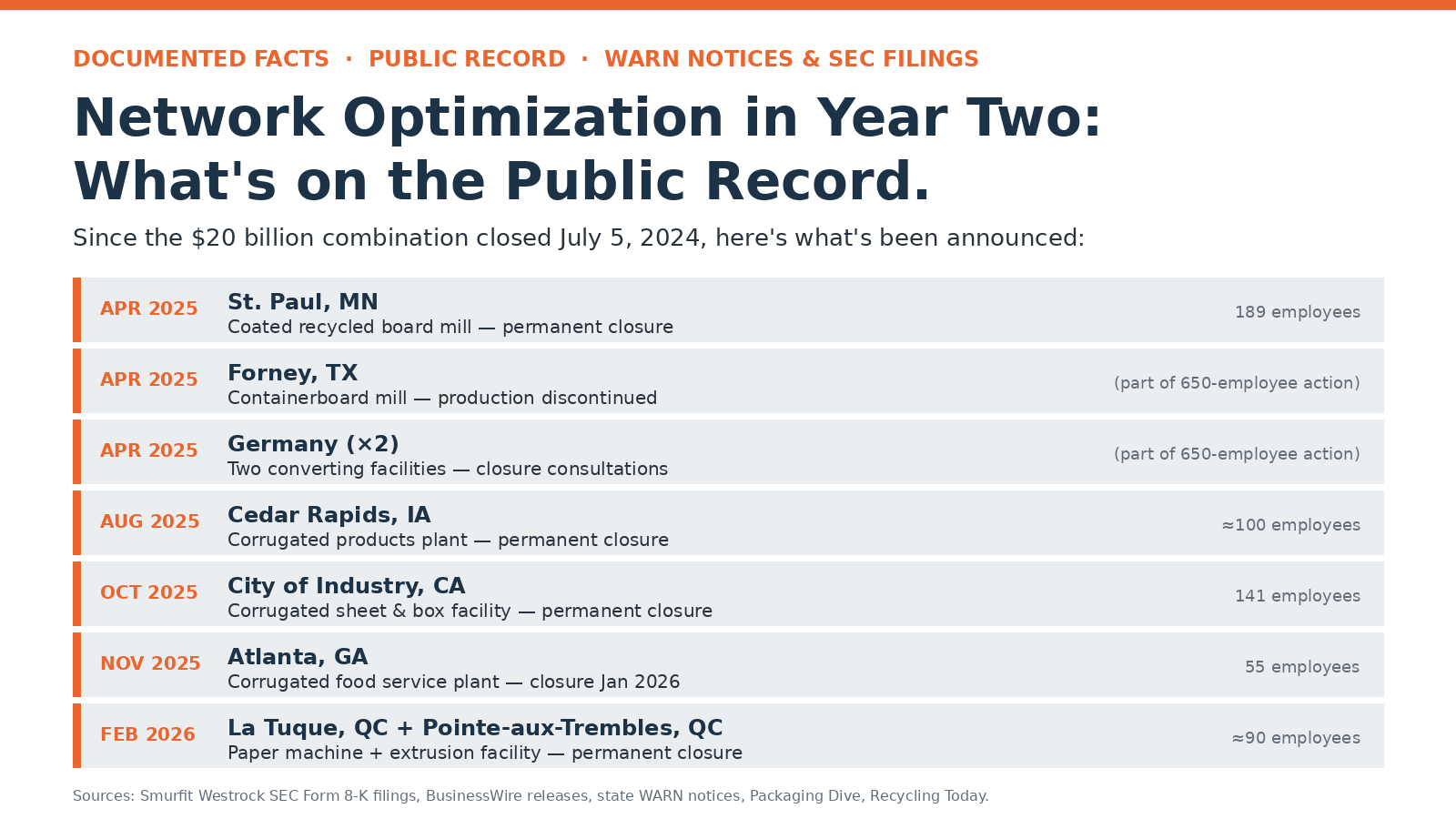
Every item on that list is sourced from public filings - SEC Form 8-K disclosures, BusinessWire releases, state WARN notices, and trade publications including Packaging Dive, Recycling Today, and the company's own investor relations announcements. None of it is speculation. None of it is rumor.
The CEO's own framing on these moves has been consistent: "While closing facilities is never an easy decision, it is based on a realistic expectation of current and future capacity needs, operating costs and an unrelenting focus on improving our business."
That language is the language of optimization. And optimization is what year two of a large industrial merger is for.
Why this matters for brands with Q3 and Q4 POP display programs
Most brand owners with retail packaging programs are not paying close attention to packaging-industry M&A news. That is reasonable. Their job is to ship product to retail on schedule, not to track who acquired whom in Dublin two summers ago.
The problem is that the consequences of an industrial merger this size do not arrive as headlines. They arrive as quiet conversations:
- A new account manager joins the call because the previous one took a different role inside the consolidation.
- A quote that used to come back in three days now takes ten.
- A production window that was historically four to six weeks starts being quoted at eight to ten.
- A facility footprint that used to feel local to your distribution becomes "part of a broader optimization plan."
None of those conversations include the words "plant closure" or "network optimization." But each one is a downstream effect of those decisions being made at the parent-company level.
By the time a brand owner connects the dots, the calendar has moved. POP display programs for back-to-school, fall promotions, Q4 holiday, and end-of-year reset windows operate on tight production timelines. A program that needs to be at retail by mid-September has to be in production by early July. A program that needs to be on shelves Black Friday has to be in production by early September.
PULLQUOTE: If your primary supplier disrupts in August, you do not have time to qualify a new vendor for September production. The decision to qualify a backup happens in April and May, or it does not happen at all.
Four signals worth checking - without naming names
Brand owners do not need an industry analyst to tell them whether their POP display supplier is in the integration path. The signals are visible from inside the relationship if anyone is looking for them.
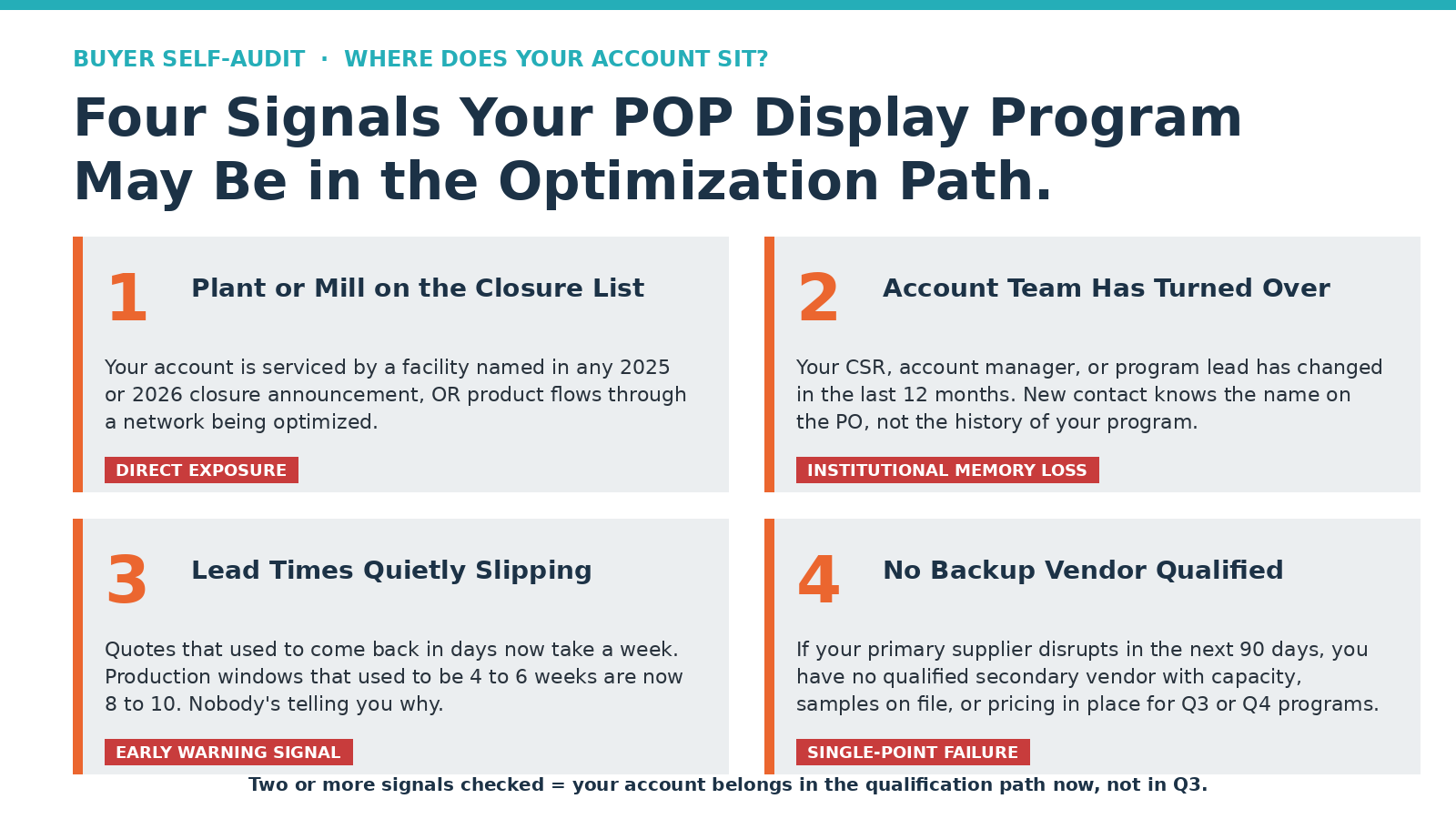
None of these signals on their own mean a program is in trouble. Two or more of them stacked together is the buying signal. That is the moment a smart packaging buyer starts qualifying a stable secondary vendor - not because the primary relationship is failing, but because the cost of being wrong is unacceptable when retail commitments are on the line.
What "stable" looks like in this market
The vendors least exposed to integration disruption right now share a common profile. They are independently owned. They were not acquired into the consolidation cycle. Their leadership is not reporting to a parent company holding quarterly earnings calls in Dublin. Their employees are not waiting to find out which facility is on the next optimization announcement.
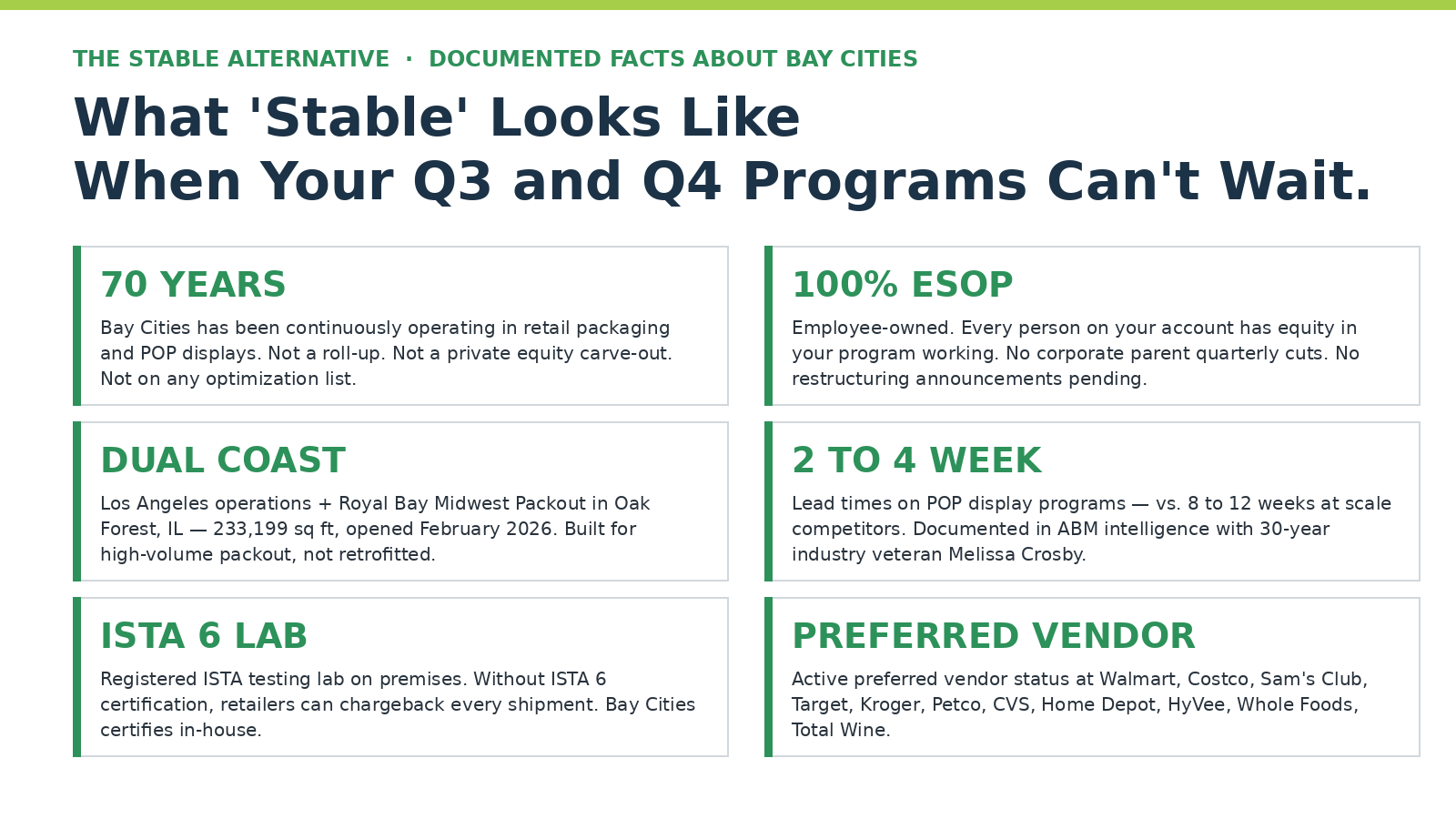
Bay Cities does not appear on any closure list because Bay Cities is not part of any consolidation. It is a 70-year-old company, 100% employee-owned through an ESOP, with primary operations in Los Angeles and a 233,199 square foot Midwest packout facility in Oak Forest, Illinois that opened February 2026. It is a preferred vendor at every major U.S. retailer brand owners care about. And it has the lead times and ISTA testing infrastructure to keep Q3 and Q4 programs on schedule.
More importantly, the people who answer the phone at Bay Cities own equity in the answer. That is a different kind of accountability than what brand owners get from a consolidated network managed at headquarters two thousand miles from the production floor.
What to do in the next sixty days
Brand owners reading this fall into three groups.
GROUP ONE has a POP display supplier whose facility footprint and account team have been completely stable through the merger period. There is nothing to do here except keep an eye on lead time quotes and stay close to the account team. The relationship is working. Do not break it.
GROUP TWO has noticed two or more of the signals above. They have seen quotes slip, account teams turn over, or facility names mentioned in trade press. This group's correct move is to qualify a stable secondary vendor in the next sixty days - not to switch primary, but to have a real backup with capacity, samples on file, and pricing in place before Q3 production windows open.
GROUP THREE has a primary vendor that is directly named in 2025 or 2026 closure announcements, or whose servicing facility has changed. This group does not have sixty days. They have until the next quote cycle. The window to qualify a stable alternative for Q3 programs closes in May.

Is Your WestRock Account Stable? - A 12-Question Self-Audit for Q3 and Q4 POP Display Programs
If you have a POP display program with any vendor inside the Smurfit Westrock network - or you suspect you might - the first move is not a sales call. It is a self-audit.
Bay Cities has built a 12-question self-audit checklist that walks brand owners through the specific signals worth checking before Q3 production windows open. It scores your account on direct exposure, account team continuity, lead time stability, and backup vendor readiness - and tells you exactly where on the risk curve your program sits.
No sales conversation. No commitment. Just the diagnostic, in your inbox, in three minutes.

About Bay Cities
Bay Cities is a 70-year-old, 100% employee-owned (ESOP) packaging and POP display company headquartered in Los Angeles, with a 233,199 square foot Midwest packout facility in Oak Forest, Illinois. We are a preferred vendor at Walmart, Costco, Sam's Club, Target, Kroger, Petco, CVS, Home Depot, HyVee, Whole Foods, and Total Wine. We design, print, manufacture, kit, assemble, and ship POP displays and retail packaging programs for established brands across the country. Lead times: 2 to 4 weeks. ISTA-registered testing lab. ESOP-owned. Independent.
Need a packout partner who can handle volume? Kitting, assembly, co-packing & direct import fulfillment from our 233,000 sq ft Chicago facility. Let's talk.

Ready to find your packaging partner?
Join hundreds of manufacturers and buyers already using PackageLink to streamline their sourcing process.