
The Variables Most Brands Miss
Published by the Specialized Packaging Marketplace
You called three contract packagers. You gave them the same specs. You got three wildly different quotes.
One came in at $1.85 per unit. Another at $2.40. A third at $3.10.
What's going on?
The frustrating reality is that contract packaging pricing isn't like buying a commodity. There's no standard rate card. No industry benchmark you can point to. Every quote is a calculation based on dozens of variables and most brands don't know which variables matter most.
This guide breaks down what actually drives contract packaging pricing, which factors move the needle the most, and what you should be asking to ensure you're comparing apples to apples.
The Baseline: What You're Actually Paying For
Before we get into the variables, let's establish what's typically included in a contract packaging quote:
Direct costs: Labor (the hands touching your product), materials (boxes, inserts, tape, labels, shrink wrap), and equipment time (shrink tunnels, labelers, conveyors).
Indirect costs: Facility overhead (rent, utilities, insurance), supervision and quality control, receiving and staging your product, warehousing during production, and administration/account management.
Pass-through costs: Outbound freight (sometimes included, sometimes separate), special materials you specify, and compliance testing or certifications.
The challenge: Every packager bundles these differently. One quote might include materials; another might break them out. One includes 30 days of storage; another charges extra after day seven. If you're not asking the right questions, you're not actually comparing quotes you're comparing different products.
The 8 Variables That Move the Needle
Variable #1: Complexity Tier
This is the single biggest pricing driver. Contract packagers mentally slot your job into a complexity tier the moment they see the specs.
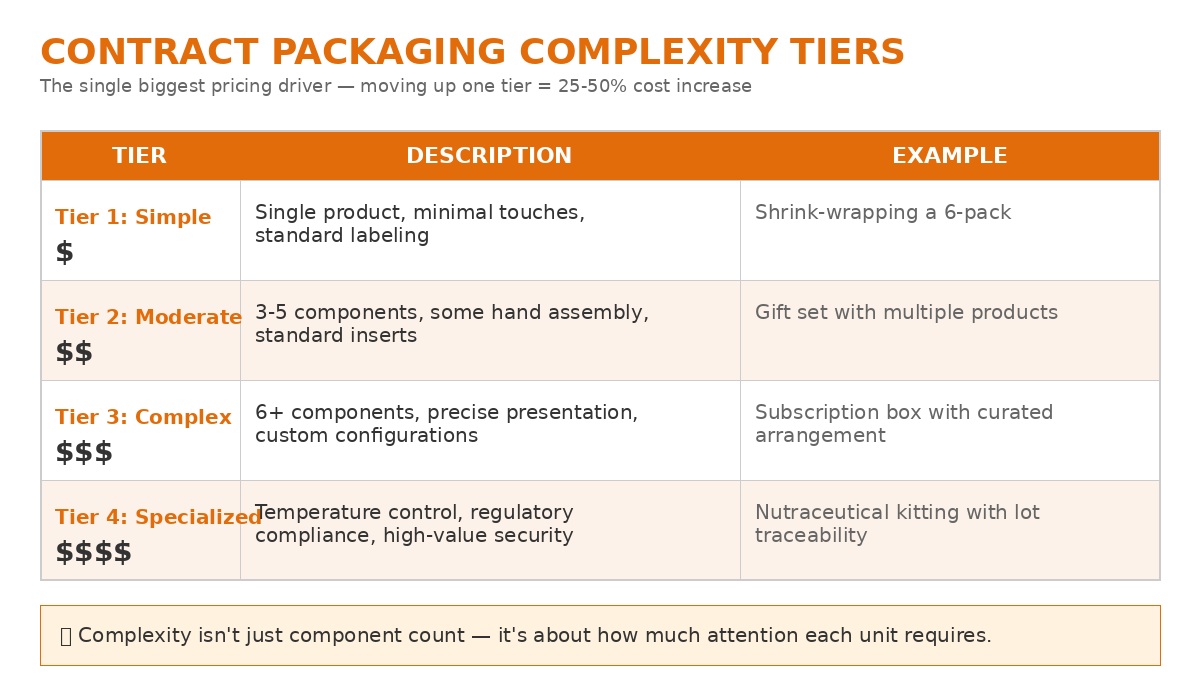
Moving up one complexity tier can increase your per-unit cost by 25-50%. And complexity isn't always about component count it's about how much attention each unit requires.
What to ask: "How are you categorizing the complexity of this job? What would move it to a lower tier?"
Variable #2: Volume and Commitment
Contract packaging has significant economies of scale. Setup costs (line configuration, training, quality checkpoints) get amortized over volume. Labor becomes more efficient. Material purchases get better pricing.
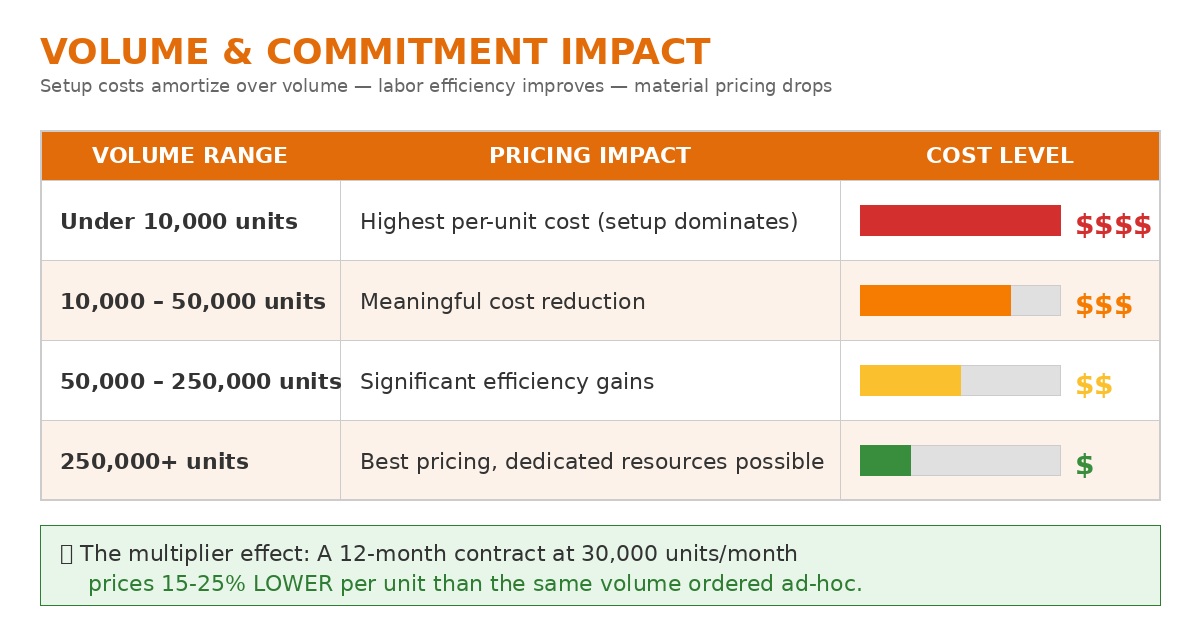
The multiplier effect: A 12-month contract at 30,000 units/month will typically price 15-25% lower per unit than the same volume ordered ad-hoc.
What to ask: "What's the pricing difference between a one-time order and a 6-month or 12-month commitment at this volume?"
Variable #3: Labor Rate Geography
Not all labor costs the same. A facility in downtown Los Angeles operates in a different labor market than one in rural Illinois.
Coastal urban locations command premium rates with higher benefits requirements. Midwest and Southeast facilities typically run 20-35% lower labor costs. Rural locations offer the lowest rates, though potentially with workforce limitations.
This is why many brands are moving packout operations to the Midwest... the labor arbitrage is real, and when combined with central geography for shipping, the math often works.
What to ask: "What's your labor market like? What's your turnover rate?"
.png)
Variable #4: Materials Who Buys, Who Specs
Materials can be 20-50% of your total packout cost, depending on the project. And how materials are handled varies widely.
Option 1: You provide materials: You purchase and ship materials to the packager. Packager charges only for labor and facility. You control cost and quality. Risk: Material delays can halt production.
Option 2: Packager provides materials: Packager purchases materials on your behalf. Typically marked up 10-20%. Simpler for you to manage. Risk: Less control over specifications.
Option 3: Packager manufactures materials: Vertically integrated packager makes your boxes, inserts, etc. Can reduce total cost by eliminating margin stacking. Faster turnaround (no waiting on third parties).
The third option is vertical integration and is increasingly attractive for brands tired of coordinating multiple vendors. One partner handling design, materials, and packout can reduce total landed cost even if their line item looks higher.
What to ask: "Can you manufacture our packaging materials in-house? What's the cost difference between us providing materials versus you sourcing them?"
Variable #5: Certifications and Compliance
If your product requires food-grade handling, pharmaceutical compliance, or retailer-specific certifications, pricing goes up. Not because packagers are gouging but because maintaining these certifications costs real money.
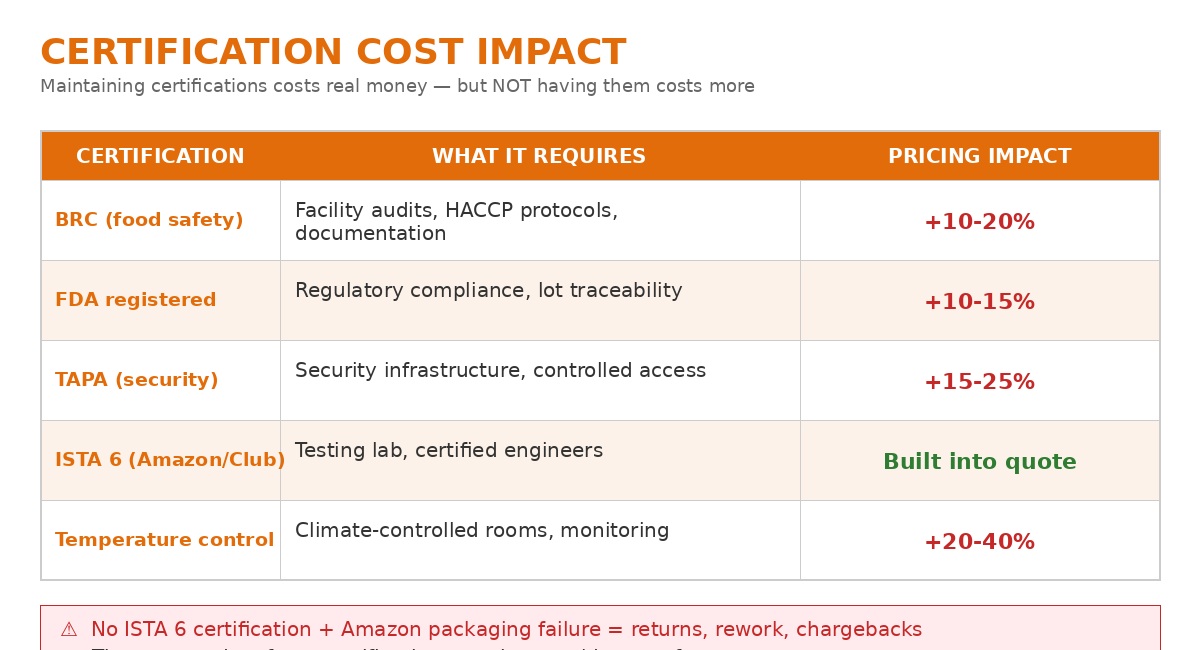
Here's what most brands miss: Not having the right certification costs more in the long run. If your packager isn't ISTA 6 certified and your product fails Amazon's packaging requirements, you're paying for returns, rework, and chargebacks costs that dwarf the certification premium.
What to ask: "What certifications does your facility carry? What happens if my retailer requires a certification you don't have?"
Variable # 6: Seasonality and Timing
Contract packaging capacity isn't infinite. Most facilities run hot in Q4 (holiday season) and have more availability in Q1-Q2.
Q4 (Oct-Dec): Premium pricing, capacity constraints, longer lead times.
Q1 (Jan-Mar): Best pricing, most flexibility.
Q2-Q3: Normal pricing, reasonable availability.
If you can shift volume into slower periods, you'll save money. If you must run in Q4, book early facilities that are full don't negotiate.
Rush charges are real: Need it done in two weeks instead of four? Expect a 15-30% premium.
The 2-4 week vs. 12 week reality: Lead times vary dramatically between packagers. Some facilities quote 12 weeks standard; others (often those with better systems and flexible capacity) can turn work in 2-4 weeks. Faster lead times have value.
What to ask: "What's your standard lead time? What does rush capacity cost? When are you typically at capacity?"
Variable # 7: Freight and Location Strategy
Where a packager sits affects more than just their labor costs it affects your total landed cost.
Shipping from a coast to the opposite coast is expensive. Shipping from a central location(Midwest) is often 30-40% lower average freight. For brands importing product from overseas, a packager who can receive containers directly from port, handle packaging, and ship domestically eliminates an entire leg of handling (andcost).
The hidden multiplier: If your packager is 2,000 miles from most of your customers, every inefficiency in their operation gets multiplied by freight costs.
What to ask: "Where are most of my customers? What's the freight cost difference between your location and alternatives?"
Variable # 8: The Hidden Costs Most Brands Miss
These are the line items that don't appear in the per-unit quote but show up on your invoice:
Receiving fees: Charges for unloading and staging your inbound product. Typically $25-75 per pallet.
Storage beyond grace period: Most packagers include 7-30 days of storage. Beyond that, you're paying warehouse rates.
Quality holds: If your product arrives out of spec and needs inspection or rework, that's extra labor.
Change orders: Mid-run changes to specs, labels, or configurations. These disrupt flow and add cost.
Minimum order charges: Below a certain volume, you might pay a minimum fee regardless of actual work.
A quote that looks $0.15/unit cheaper can end up $0.30/unit more expensive when these hidden costs hit.
What to ask: "Can you show me a sample invoice from a job similar to mine? What fees am I likely to see beyond the per-unit cost?"
How to Actually Compare Quotes
Given all these variables, here's a framework for apples-to-apples comparison:
Step 1: Standardize the Request
Create a detailed RFQ that specifies exact component count and weights, packaging materials and who provides them, volume per run and expected frequency, certifications required, and timeline/delivery requirements.
Step 2: Ask for Line-Item Breakout
Request that each packager break out: Labor cost per unit, materials cost per unit, freight estimate, storage terms, and any minimum fees.
Step 3: Calculate Total Landed Cost
Don't just compare per-unit rates. Calculate: Per-unit cost × volume, plus receiving fees, plus estimated storage, plus freight to your destination(s), plus any certification or compliance costs.
Step 4: Factor in Risk
The cheapest quote isn't always the best value. Consider: What's the packager's error rate? What happens when something goes wrong? Do they have rework capabilities? What's their track record with your specific retailers?
The Questions That Reveal True Cost
Before you sign with any contract packager, get clear answers to these:
1."What's included in this per-unit price, and what's extra?"
2."How does pricing change if I commit to 12 months?"
3."What's your error rate, and who pays for rework?"
4."Can you show me a recent invoice for a similar job?"
5."What certifications do you hold, and which would my product require?"
6."What's your capacity situation for my timeline?"
7."Do you manufacture packaging materials or source them?"
The Bottom Line
Contract packaging pricing isn't mysterious it's just multi dimensional. The per-unit rate you see in a quote is the result of complexity, volume, geography, certifications, timing, and a dozen other factors interacting.
The brands that get the best pricing aren't necessarily the ones with the most volume. They're the ones who understand the variables, ask the right questions, and structure deals that align their interests with their packager's efficiency.
Because at the end of the day, a packager who can run your job smoothly with minimal disruption, rework, or coordination overhead can afford to price it competitively. Your job is to make that easy for them.
Looking for contract packaging pricing that makes sense?
The Specialized Packaging Marketplace connects brands with vetted packout, kitting, and fulfillment providers across North America. Search by capability, certification, and location to find partners who can give you transparent pricing on your specific requirements.



Ready to find your packaging partner?
Join hundreds of manufacturers and buyers already using PackageLink to streamline their sourcing process.