Because Your Packaging Either Proves Your Brand Promise or Breaks It
Publishedby the Specialized Packaging Marketplace
You've spent years building a brand that means something. Every ingredient is non-toxic. Every bottle is reusable. Every refill eliminates single-useplastic. Your customers pay a premium because they believe in what you’redoing.
Andthen your fulfillment partner ships their order in plastic bubble wrap.
Thisis the sustainable brand paradox: You can control your product, yourformulation, your messaging but the moment your product leaves for thecustomer, someone else is representing your brand. And if that someone doesn’tunderstand what you stand for, every package becomes a potential betrayal.
Forsustainable cleaning brands like Blueland, Branch Basics, Cleancult, and thegrowing wave of eco-conscious home products, choosing a fulfillment partnerisn’t just an operations decision. It’s a brand decision. It’s a valuesdecision. It’s a decision that shows up on your customer’s doorstep and eitherreinforces everything you’ve told them or contradicts it.
Thisguide is the complete checklist for evaluating fulfillment partners whensustainability isn’t a nice-to-have. It’s the whole point.
Why Standard 3PLs Fail Sustainable Brands
Beforewe get to what to look for, let’s be clear about what you’re up against.
Mostthird-party logistics providers are optimized for one thing: moving productsefficiently and cheaply. They’re very good at this. But “sustainable” rarelyintersects with “cheapest,” and that creates fundamental misalignment.
The Default Materials Problem
Standard 3PLs stock standardmaterials: - Plastic bubble wrap (cheap, effective, terrible for your brand) -Poly mailers (lightweight, durable, not recyclable in practice) - Styrofoampeanuts (good protection, environmental nightmare) - Non-FSC corrugate(functional, but breaks chain of custody for certification)
When your products gothrough a standard facility, they get packed with whatever’s on the shelf.Nobody’s checking whether those materials align with your brand promise.
The “We Can Do That” Problem
Ask a general 3PL if they canhandle sustainable packaging, and they’ll say yes. They’ll order some recycledmailers. They’ll find paper void fill. Problem solved, right?
Not quite. There’s a differencebetween accommodating sustainable packaging and being built for it. Accommodation means special handling, exceptions to standard process, materialsstored in a corner that workers have to remember to use for your orders. That’sa recipe for errors, inconsistency, and the occasional plastic-wrapped shipmentthat ends up on social media.
The Certification Gap
Here’s where it gets serious: many sustainable brands need documentation for certifications. B-Corp audits. FSC chain of custody. Climate neutral verification. Retailer sustainabilityscorecards.
A general 3PL can’t provide whatthey don’t have. If they’re not FSC certified, they can’t give you FSC chain ofcustody documentation. If they don’t track carbon footprint, they can’t supportyour climate reporting. These aren’t minor issues they’re audit failures,certification risks, and retailer compliance problems.
The Complete Evaluation Checklist
Here’swhat to look for, organized by category. Not every brand needs every capabilitybut knowing what’s possible helps you evaluate fit.
1. SUSTAINABILITY CERTIFICATIONS
This is table stakes. Ifsustainability is core to your brand, your fulfillment partner’s certificationsneed to support your claims.
Must-Ask Questions:
☐ Are you FSC (ForestStewardship Council) certified? FSC certification means the facility maintains chain of custody for forest products. If you’re claiming FSC-certified packaging, your fulfillment partner needs to be part of thatchain.
☐ Are you SFI(Sustainable Forestry Initiative) certified? Similar to FSC, SFI certification covers sustainable forestry practices and chain of custody.
☐ Can you providedocumentation for our B-Corp audit? B-Corp certification requires evidenceof sustainable practices across your supply chain. Your fulfillment partnershould be able to provide operational data, materials documentation, andenvironmental metrics.
☐ Do you track and reportcarbon footprint / Scope 3 emissions? If your brand makes climate claims,you need partners who can quantify their impact. Ask for their methodology andwhat data they can provide.
☐ What othersustainability certifications do you hold? Look for: ISO 14001(environmental management), carbon neutral certifications,zero-waste-to-landfill programs, renewable energy usage.
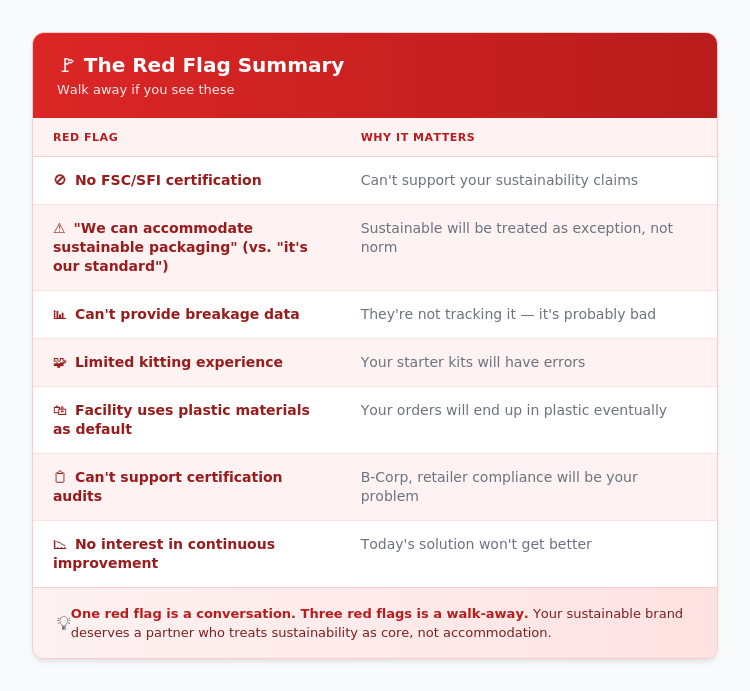
Red Flags: - “We canget certified if you need it” (certification takes time and investment if they don’t have it, they’re not serious) - Can’t produce certificationdocumentation on request - Vague answers about chain of custody
2. PACKAGING MATERIAL OPTIONS
Your fulfillment partner shouldoffer sustainable materials as standard options, not special requests.
Must-Ask Questions:
☐ What corrugate options doyou offer? Look for: FSC-certified corrugate, recycled content options,right-sized box programs to minimize waste.
☐ What void fill options doyou offer? Sustainable options include: paper void fill, corrugatedinserts, molded pulp, air pillows made from recycled content (if plastic isacceptable). Ask what they DON’T use you want to hear “no styrofoam, no plasticpeanuts.”
☐ What mailer options do youoffer? Look for: paper mailers, recyclable poly mailers (if plastic isacceptable), compostable mailers. Ask about custom printed options to maintainbrand experience.
☐ Do you offer plastic-freetape and labels? Often overlooked. Paper tape with natural adhesive. Paperlabels. These details matter to customers who scrutinize every element.
☐ Can you accommodate customsustainable packaging? If you’ve designed specific packaging, can theyreceive it, store it properly, and use it consistently? What’s their trackrecord with custom materials?
☐ Do you manufacturepackaging or source it? Partners who manufacture packaging in-house canoften offer better pricing, faster turnaround on custom work, and tighterintegration between packaging design and fulfillment operations.
Red Flags: - Sustainablematerials are “available upon request” at significant upcharge - Limitedoptions (one paper mailer, take it or leave it) - Can’t show you samples ofsustainable packaging they’re currently using
3. FRAGILE ITEM HANDLING (GlassBottles)
If you’re shippingglass bottles like Blueland’s reusable bottles or Branch Basics’ glasscontainers breakage is an existential issue.
Must-Ask Questions:
☐ What is yourbreakage rate on glass products? Industry standard is 1-3%. Best-in-classis under 1%. Above 3% is a serious problem. Ask for actual data, not estimates.
☐ How do you packglass items? Look for: specific packaging protocols for glass, not “same aseverything else.” Molded pulp inserts, corrugated partitions, or custompackaging solutions.
☐ Do you have ISTA testing capabilities? ISTA (International Safe Transit Association) testingsimulates drops, vibration, and compression. Partners with ISTA certificationcan test your packaging before you ship thousands of units.
☐ What’s yourprocess when breakage occurs? Look for: documentation of breakage rates by SKU, root cause analysis, packaging improvement recommendations. You want apartner who treats breakage as a problem to solve, not a cost of doingbusiness.
☐ Can you show mepackaging you’ve designed for glass products? Ask for examples. A partnerwith glass experience should be able to show you solutions they’ve implemented.
Red Flags: -Can’t provide breakage data - “We just use extra bubble wrap” (which probablyisn’t sustainable) - No ISTA testing capability - Treats breakage as inevitablerather than solvable
4. KITTING AND COMPLEXITY HANDLING
Sustainable cleaningbrands often have complex fulfillment requirements: starter kits with multiplecomponents, variety packs, subscription boxes with rotating products.
Must-Ask Questions:
☐ What’s yourexperience with multi-component kits? Starter kits might include: reusablebottles, tablets or refills, instruction cards, accessories. Ask how manycomponents their most complex current kit has.
☐ What’s your errorrate on kitted orders? Industry average is 2-5%. Best-in-class is under 1%.For starter kits where first impressions matter enormously accuracy iscritical.
☐ How do you handlesimilar-looking products? Cleaning brands often have products that lookalike: same bottle, different scent; same tablet, different formula. How dothey prevent mix-ups?
☐ What quality controlcheckpoints exist? Look for: station-by-station verification, scan-basedconfirmation, final inspection before pack-out. Not just one check at the end.
☐ Can you handlesubscription + one-time hybrid models? Many cleaning brands have starterkits (one-time) plus refill subscriptions (recurring). Different fulfillmentprofiles. Can they handle both efficiently?
Red Flags: -Limited kitting experience (“we mostly do single-SKU fulfillment”) - Can’tprovide error rate data - No specific protocols for look-alike products
5. PRESENTATION AND UNBOXINGEXPERIENCE
For sustainablebrands, the unboxing IS part of the product. It’s where the brand promisebecomes tangible.
Must-Ask Questions:
☐ Do youunderstand “experience packing” vs. “protective packing”? Protection is baseline. Experience means intentional presentation: products arranged acertain way, tissue paper or branded elements placed deliberately, heroproducts visible first.
☐ Can you execute branded presentation standards consistently? Ask to see examples. Can theyshow you consistent pack-outs where every box looks the same?
☐ Can you include inserts, cards, or promotional materials? Instruction cards, sustainability messaging, promotional offers can they include these accurately and consistently?
☐ How do you train workers on presentation standards? Look for: documented standards, training programs, quality audits. Not “we tell them to make it look nice.”
Red Flags: -Views packing as purely protective function - Can’t show examples of branded presentation - High turnover without strong training programs
6. SUSTAINABILITY BEYOND PACKAGING
True sustainable operations go beyond the box.
Must-Ask Questions:
☐ What’s your facility’s energy situation? Look for: renewable energy usage, energy efficiency programs, LED lighting, efficient HVAC.
☐ Do you have recycling and waste diversion programs? What happens to corrugate scraps, damaged products, and other waste? Look for recycling programs, composting, waste-to-landfill reduction targets.
☐ How do you handle damaged or returned products? Sustainable brands should care about what happens to product that can’t be sold. Is it donated? Recycled? Or does it go to landfill?
☐ What’s your water usage / wastewater situation? Less relevant for fulfillment than manufacturing, but if your brand cares about water, ask.
☐ Do you have any carbon offset or climate programs? Some fulfillment partners purchase carbon offsets, invest in renewable energy credits, or have carbon neutral programs.
Red Flags: - No knowledge of facility energy or waste programs - Damaged products automatically go to landfill - No sustainability initiatives beyond “we use recycled boxes”
7. LOCATION AND CARBON FOOTPRINT
Where your fulfillment partner is located affects the carbon footprint of every shipment.
Must-Ask Questions:
☐ Where is your facility located? Central locations (Midwest) reduce average shipping distance to customers nationwide. Coastal locations mean longer transit to the opposite coast.
☐ What’s your ground shipping coverage map? A Midwest facility can reach ~80% of the US population within 2-day ground. That’s fewer miles, less fuel, lower carbon footprint per shipment.
☐ Do you offer carbon-neutral shipping options? Some partners have relationships with carriers offering carbon-neutral programs, or purchase offsets for shipping emissions.
☐ Can you provide shipping distance / emissions data for our reporting? If you’re tracking Scope 3 emissions, you need partners who can provide data on shipping distances and methods.
Red Flags: - Facility location adds significant transit distance for your customer base - No awareness of shipping emissions impact - No data available for carbon reporting
8. TECHNOLOGY AND INTEGRATION
Modern sustainable brands need modern systems.
Must-Ask Questions:
☐ What subscription management platforms do you integrate with? Recharge, Bold, Ordergroove, etc. Seamless integration means fewer errors and better customer experience.
☐ Do you support order consolidation for subscription brands? Customers who order both starter kits and refills should get them in one shipment when possible. Can they consolidate?
☐ What visibility do you provide? Real-time inventory levels, order status, shipping tracking what can you and your customers see?
☐ Do you support EDI for retail orders? If you’re selling through retailers, EDI integration is often required. Does the partner support it?
Red Flags: - Manual processes for subscription management - Limited integration options - No real-time visibility into operations
The Site Visit Checklist
If you’re serious about a partner, visit the facility. Here’s what to look for:
What you want to see:
☐Sustainable materials prominently stocked (not in a corner) ☐ Clean, organized facility with clear workflows ☐ Quality control checkpoints visible in process☐ Workers who can explain sustainability protocols ☐ Temperature control if you have any sensitive products ☐ Professional handling of glass/fragile items ☐Examples of your category (cleaning products, subscription boxes) ☐Certifications displayed and documentation available
What you don’t want to see:
✗Plastic packaging materials everywhere ✗ Disorganized facility with unclear processes ✗ Workers unsure about sustainability requirements ✗ Glass products stored or handled carelessly ✗ No visible quality control ✗ Generic operations with no category expertise
Questions for References
Ask to speak with current clients, ideally other sustainable brands. Questions to ask:
1. Has the partner ever shipped your products in non-sustainable packaging?
2. What’s the actual breakage rate you’ve experienced?
3. Have they supported your certification auditssuccessfully?
4. How do they handle it when something goes wrong?
5. Would you choose them again?
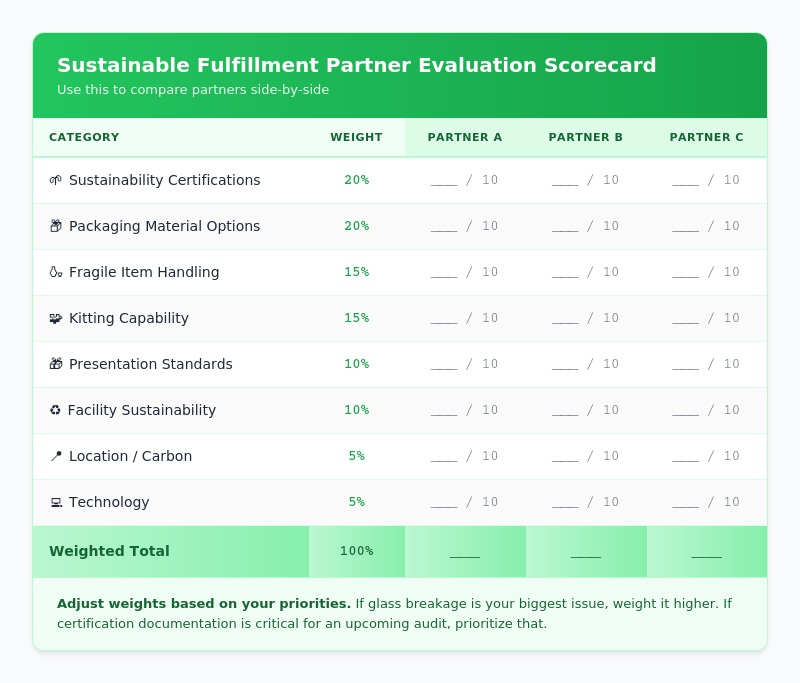
The Evaluation Scorecard
The Bottom Line
Forsustainable cleaning brands, fulfillment isn’t logistics. It’s brandexpression.
Every package that arrives at a customer’s door is either proving your brand promise or undermining it. Every material choice, every presentation detail, every certification document either supports what you stand for or contradicts it.
The rightfulfillment partner understands this. They’re not just moving your products they’re protecting your brand. They’re not just packing boxes they’re creatingthe moment where your customer sees your values in action.
Choose a partner who gets it. Your brand and your customers deserve nothing less.
Looking for a sustainable fulfillment partner who understands eco brands?
The Specialized Packaging Marketplace connects sustainable home and cleaning brands with vettedfulfillment partners who hold FSC/SFI certifications, offer sustainablepackaging options, and specialize in the unique requirements of eco-consciousproducts. Search by certification, capability, and sustainability commitment.
Bay Cities is a 100% employee-owned direct manufacturer of retail packaging, POP displays, and packout services. Preferred vendor at major retailers.

Ready to find your packaging partner?
Join hundreds of manufacturers and buyers already using PackageLink to streamline their sourcing process.