

Why Your $200 Styling Box Arrives Looking Like a $12 Amazon Order
Published by the Specialized Packaging Marketplace
The marketing photos are perfect. A crisp white box tied with a ribbon. Tissue paper in your brand colors folded just so. Each garment revealed like a gift.The sweater on top, casually draped. The accessories nestled beside. Ahandwritten note from the stylist peeking out.
Thisis the experience you’re selling. This is what justifies the premium price.This is what customers imagine when they subscribe.
Then the box actually arrives.
The tissue paper is crumpled. The ribbon is missing or stuffed in the corner. The clothes are jammed in haphazardly, wrinkled from transit. The “handwritten”note is buried under a packing slip. The whole thing looks like it was packedin 30 seconds by someone who had 500 more boxes to do that hour.
Your $200 styling subscription just arrived looking like a $12 Amazon order.
The customer doesn’t think “the fulfillment center must be under pressure.” They think “this brand doesn’t care.” They think “this isn’t worth what I’m paying. ”They think “maybe I’ll skip next month.”
This is the fashion fulfillment presentation crisis. And it’s killing premium brands from the inside out.
The Gap Between Marketing and Reality
Fashion brands invest heavily in the imagery of their product. Photo shoots. Lifestyle content. Unboxing videos with perfect lighting. Influencer partnerships showcasing the “experience.”
Then they hand fulfillment to a partner optimized for speed and cost.
The result is a gap sometimes a chasm between what customers expect and what they receive.
What Marketing Promises
• Curated presentation that feels personally assembled
• Premium packaging materials that signal quality
• Items arranged thoughtfully, not thrown together
• Brand elements (tissue, ribbon, cards) in place
• An unboxing that feels like unwrapping a gift
What Fulfillment Often Delivers
• Items packed efficiently (read: crammed)
• Standard brown corrugate or poly bag
• Whatever orientation fits fastest
• Inserts and brand elements inconsistently included
• An unboxing that feels like opening a return
The Disconnect
Why This Happens
Thepresentation crisis isn’t caused by bad intentions. It’s caused by systems andincentives that work against premium presentation.
The Speed Imperative
Fulfillment operations are measured on throughput. More units per hour. More orders per shift. Faster cycle times.
Presentation takes time.
• Folding a sweater properly: 15-20 seconds
• Throwing it in the box: 3 seconds
• Arranging tissue paper intentionally: 10-15seconds
• Stuffing it on top: 2 seconds
• Placing items in a specific order: 20-30 seconds
• Packing in whatever order they were picked: 0extra seconds
At scale, these seconds become hours. A fulfillment center packing 10,000 boxes per day that adds 30 seconds ofpresentation time per box needs an additional 83 labor hours daily. That’s 10+extra workers.
When managers are under pressure to hit cost targets, presentation is the first thing sacrificed.
The Consistency Problem
Even when presentation standards exist, consistency is nearly impossible without systems.
Worker variability: Some workers care about presentation. Some don’t. Some are having a good day. Someare exhausted at hour nine of their shift.
Training gaps: Presentation standards require training. High turnover means constantly retraining. Standards degrade over time.
Volume pressure: During peak periods, even workers who usually maintain standards will cut corners tokeep up.
Supervision limits: Supervisors' can’t watch every pack station. Spot checks catch some issues, but most boxes are never reviewed.
The result: massive variability. One customer gets a beautifully presented box. The next gets a disaster. Same brand. Same price point. Completely different experience.
The Measurement Gap
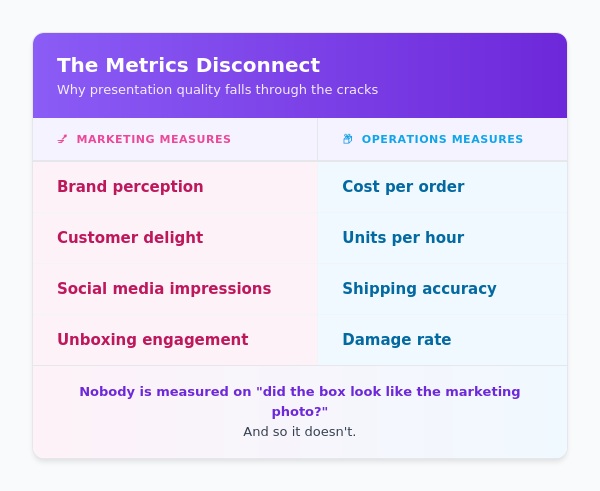
What gets measured gets managed. Presentation usually doesn’t get measured.
Standard fulfillment metrics: -Order accuracy (was the right item shipped?) - On-time shipping (did it leave on schedule?) - Damage rate (was anything broken?) - Cost per order (how much did fulfillment cost?)
What’s usually NOT measured: -Presentation quality (did it look good?) - Brand standard compliance (were all brand elements included?) - Customer perception (what did they think when they opened it?)
Without measurement, there’s no accountability. Without accountability, there’s no consistency. Withoutconsistency, premium presentation is accidental.
The Customer Impact
Presentation failures don’t just disappoint customers. They change how customers perceiveyour entire brand.
The First Impression Cascade
For subscription services, the unboxing IS the product experience. There’s no retail store. No try-on room. No sales associate. The first physical interaction with your brand is opening that box.
When it looks premium: “This brand gets it. This is worth what I’m paying. I can’t wait to try these on.”
When it looks generic: “This is it? For $200? I could’ve just gone to the mall.”
That first impression colors everything that follows. The clothes might be perfect. The styling might be exactly right. But if the unboxing felt cheap, the whole experience feels cheap.
The Social Media Multiplier
Fashion customers share unboxings. It’s a category where customer-generated content is massive.
Positive unboxing posts: Free marketing. Social proof. Aspirational content that drives new subscriptions.
Negative unboxing posts: Brand damage. Competitor ammunition. Screenshots that live forever.
The asymmetry is brutal. Happy customers might post. Disappointed customers definitely post. One viral “is this what $200 gets you?” tweet can undo months of marketing spend.
The Repeat Purchase Psychology
Presentation quality directly affects retention in ways that don’t show up in obvious metrics.
The “skip” decision: “I’m not sure I need this month’s box” is often really “I wasn’t that impressed last time.”
The cancellation trigger: Nobody cancels because “the box wasn’t presented well.” They cancel because “it didn’t feel worth it.” But presentation shaped that perception.
The reactivation barrier: Former subscribers remember how they felt opening those boxes. A cheap feeling lingers. It makes reactivation campaigns less effective.
The Specific Failures
Let’s get concrete about what goes wrong.
Tissue Paper Disasters
Tissue paper is supposed to create reveal moments. Peel back the tissue, see the garment.
What goes wrong: - Tissue torn or crumpled from packing - Tissue placed on top as an afterthought, not wrapped around items - Tissue missing entirely (ran out, forgot, skipped) -Wrong color tissue (brand standards ignored) - Tissue wadded up as void fill instead of presentation element
Ribbon and Closure Failures
That signature ribbon or sticker that closes the box? It’s supposed to signal care.
What goes wrong: -Ribbon missing - Ribbon tied poorly (rushed, crooked, wrong style) - Ribbon thrown into box instead of tied on - Sticker applied crooked or not at all -Multiple half-attempts visible (tried, failed, gave up)
Garment Presentation Failures
How clothes are placed in the box matters enormously.
What goes wrong: -Clothes crammed rather than folded - Items wrinkled from compression - No attention to “hero piece” positioning - Prints and colors hidden instead of displayed - Items packed in pick order rather than reveal order
Insert and Card Failures
Handwritten notes, styling cards, promotional inserts these personal touches matter.
What goes wrong: - Cards buried at the bottom - “Handwritten” notes crumpled or stained - Missinginserts (forgot, ran out) - Inserts placed randomly instead of intentionally -Packing slip on top instead of hidden
Box Condition Failures
The outer box itself sets expectations before it’s even opened.
What goes wrong: - Damaged boxes used for shipping - Excess tape making opening difficult - Crushedcorners from poor handling - Dirty or stained exteriors - Wrong size box (items swimming or crammed)
What Premium Presentation Actually Requires
The brands that maintain presentation quality at scale aren’t doing it through heroics. They’ve built systems.
Defined Standards (That Are Actually Documented)
Not “make it look nice.” Actual specifications:
• Tissue paper: Brand color #XXX, folded in thirds, wrapped around top item
• Ribbon: 14” length, bow style B, positioned center-left on closed box
• Garment 1: Folded to 12”x8”, print facing up, placed first
• Note card: Right side, on top of tissue, handwritten side visible
• Total presentation time allocation: 45 seconds per box
Written. Photographed. Trained. Tested.
Visual Standards at Every Station
Workers can’t maintain standards they can’t see.
• Photo examples of “correct” at every pack station
• Photo examples of “incorrect” what failures look like
• Reference samples of properly folded items
• Color-coded placement guides in box
• Presentation “recipes” for different box types
Quality Control Checkpoints
Presentation is verified, not assumed.
• Random sampling of packed boxes (opened and reviewed)
• Presentation scoring rubric (specific criteria, not subjective)
• Feedback loops to workers whose stations fail QC
• Trend tracking over time (is quality improving or degrading?)
• Escalation protocols when standards slip
Time Allocation (Not Just Speed Targets)
Presentation time is built into expectations.
• Packing standards include time for presentation
• Workers measured on quality, not just quantity
• Presentation steps are part of standard work
• Rush periods have presentation minimums that don’t flex
Training and Reinforcement
Standards degrade without constant reinforcement.
• Initial training on presentation standards(hands-on, not just video)
• Regular refreshers as standards evolve
• Recognition for presentation excellence
• Coaching for workers who struggle
• New worker mentorship on presentation
The Fulfillment Partner Question
For most fashion brands, fulfillment is outsourced. Which means presentation quality depends entirely on the partner.
What to Evaluate
Do they understand fashion? - Have they worked with apparel brands before? - Do they understand why presentation matters? - Can they show you examples of premium pack-outs?
Do they have presentation systems?- Are standards documented? - Are visual references at pack stations? - Is quality measured and reported?
Will they maintain standards under pressure? - What happens during peak volume? - How do they train seasonal workers? - What are their quality minimums during crunch?
Can they customize to your brand?- Will they implement YOUR standards, not their generic ones? - Can they accommodate specific materials, sequences, and elements? - Will they treat your brand standards as requirements, not suggestions?
Questions to Ask
1. Can you show me your presentation standards documentation?
2. What’s your quality control process for packed boxes?
3. How do you train workers on presentation standards?
4. What happens to presentation quality during peak periods?
5. Can you show me examples of premium fashion brands you currently pack for?
6. How do you handle custom presentation requirements?
7. What percentage of boxes do you QC for presentation?
8. How do you track and report presentation quality?
Red Flags
• “We focus on accuracy and speed presentation is up to the individual worker”
• Can’t show documented presentation standards
• No QC process that specifically evaluates presentation
• “We’ve never really done premium fashion”
• Treats presentation as a “nice to have” rather than core requirement
• Dismissive about unboxing importance
The Presentation Cost Reality
Premium presentation costs more. There’s no way around it.
The Honest Math
Standard fulfillment: 60 seconds per pack, $0.80-$1.20 labor cost
Premium presentation: 90-120 seconds per pack, $1.20-$2.00 labor cost
Delta: $0.40-$0.80 per box in additional labor
Plus materials: Premium tissue, ribbon, custom inserts add $0.50-$2.00 per box
Total premium presentation cost:$1.00-$3.00 more per box than standard
The ROI Argument
That $2 premium buys:
Retention improvement: If presentation quality improves retention by even 2-3%, the LTV gain dwarfs thecost
Social media value: One positive unboxing video from the right influencer is worth thousands in marketing
Competitive differentiation: In a crowded subscription market, presentation quality is a moat
Brand perception: Premium presentation reinforces premium pricing
Reduced complaints: Fewer “this looked cheap” support tickets
The False Economy
Saving $2 per box on presentation while losing customers to disappointment is the worst possible trade.
Cost saved per year (100K boxes):$200,000
Customers lost to presentation disappointment: Unknown, but even 1% = 1,000 customers
LTV of 1,000 customers:$200,000-$500,000
The “savings” from cutting presentation likely cost more than they save.
The Path Forward
Solving the presentation crisis requires acknowledging that presentation is product, not overhead.
Step 1: Define Your Standards
Document exactly what premium presentation means for your brand: - Specific materials and placements -Photographic examples of “correct” - Time allocation for presentation steps -Minimum standards that don’t flex
Step 2: Find the Right Partner
Choose fulfillment partners who understand that fashion is different: - Presentation expertise and systems- Quality control that includes presentation - Willingness to implement your specific standards - Fashion/apparel category experience
Step 3: Measure What Matters
Add presentation to your metrics: - Presentation quality scores from QC sampling - Customer feedback specifically on unboxing - Social media monitoring for unboxing content -Before/after tracking when standards change
Step4: Pay for Quality
Budget for presentation as a feature, not a cost to minimize: - Labor time for proper presentation - Premiummaterials that match brand standards - QC resources to maintain consistency -Training investment for new workers
The Bottom Line
The fashion fulfillment presentation crisis is a choice. Brands choose to prioritize speedover experience. Partners choose to measure throughput over quality. Operations choose to cut presentation when under pressure.
But customers also choose. They choose whether to post their unboxing. They choose whether to skip next month. They choose whether to recommend your brand to friends. They choose whether to cancel.
And when they’re choosing, they’re remembering how it felt to open that box.
Did it feel like a gift, carefully curated just for them?
Or did it feel like a $200 disappointment packed by someone who didn’t care?
Your fulfillment partner is making that choice for you thousands of times per day.
Make sure they’re choosing right.
Looking for a fashion fulfillment partner who understands premium presentation?
The Specialized Packaging Marketplace connects fashion and apparel brands with vetted fulfillment partners who specialize in premium presentation standards. Searchby capability, category experience, and quality systems.
Search Fashion Fulfillment Partners



Ready to find your packaging partner?
Join hundreds of manufacturers and buyers already using PackageLink to streamline their sourcing process.