
Your reps are quoting like crazy.
Your pipeline looks full.
But revenue is flat. Margins are shrinking. And the phone isn’t ringing with new business the way it used to.
Sound familiar? You’re not alone.
If you run a packaging company, contract packaging, co-pack, specialty manufacturing, or fulfillment, you already feel it. Sales are down. Not just at your company. Across the industry.
But here’s what most packaging CEOs get wrong about why.
They blame the economy. They blame tariffs. They blame their sales team. And while those factors are real, they’re not the root cause.
The root cause is structural. The way buyers find packaging suppliers has fundamentally changed and most manufacturers haven’t changed with it.
Problem #1: Your Reps Have Become Order-Takers
Every manufacturer I talk to has the same problem. Plenty of order-takers, zero hunters.
Your sales reps are experienced. They’re knowledgeable.They’re working hard. But ask yourself honestly: when was the last time a rep brought in a genuinely new account? Not a referral. Not a re-quote on existing work. A new, qualified buyer who had never heard of your company before.
For most packaging companies, the answer is uncomfortable.
Your reps have become reactive. They’re quoting all day responding to RFQs that came in through the website, the phone, or a distributor. They’re busy. They look productive. But they’re not hunting. Nobody is out there finding new, qualified opportunities.
60% of a typical packaging sales rep’s time is spent on unqualified prospects
And it’s not entirely their fault.
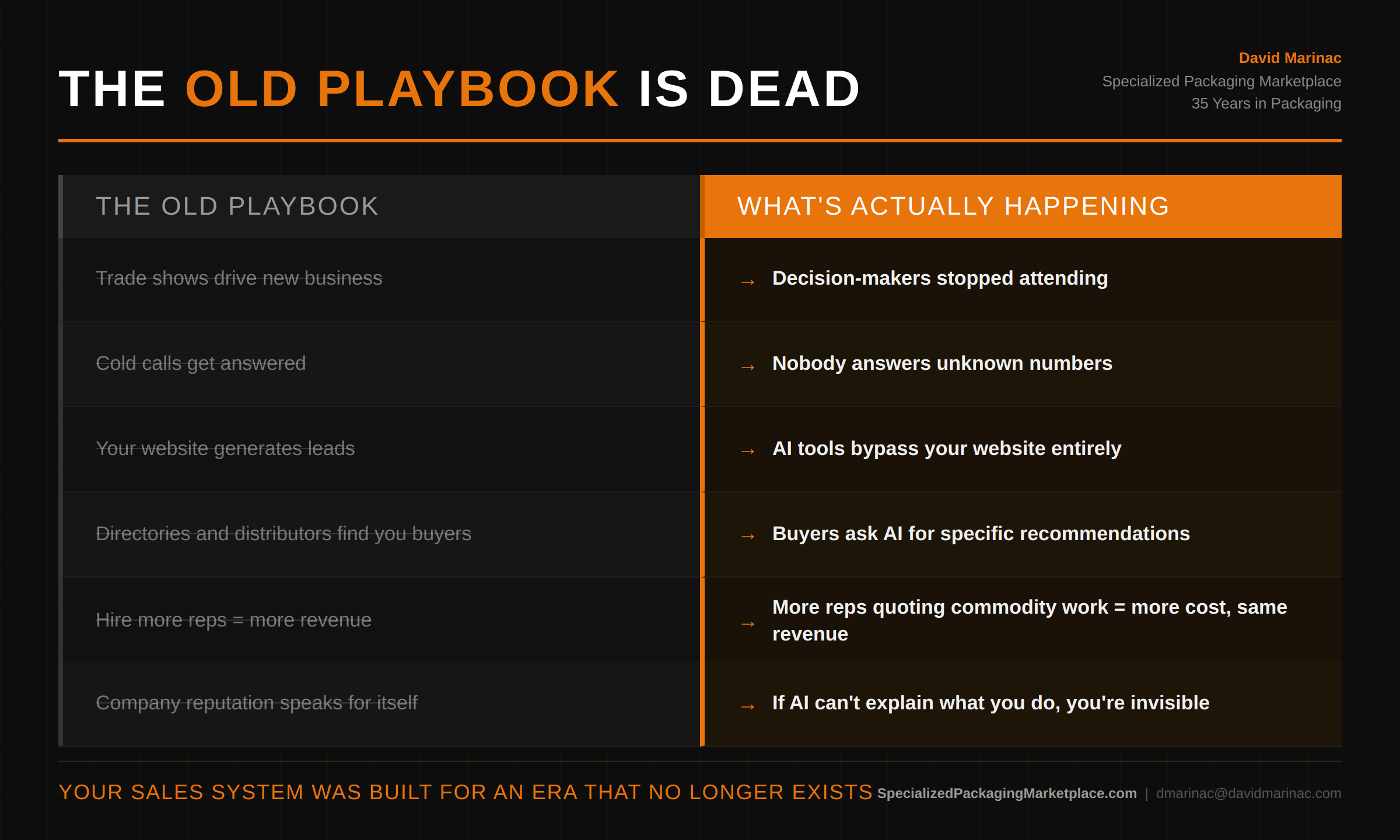
The infrastructure that used to support new business development, trade shows where decision-makers walked the floor, cold calls that actually got answered, directories that buyers used that infrastructure is either broken or gone. Your reps are going into battle without intelligence. They don’t know where the competitors are weak. They don’t know what buyers are actually searching for. They don’t know which accounts are undefended.
That’s not a sales problem. That’s an intelligence problem.
Problem #2: The Trade Show Math Is Broken
Let’s run the numbers that nobody in packaging wants to talk about.
Average cost for a packaging company to exhibit at a major trade show: $25,000–$40,000. That includes the booth, travel, hotels, materials, and the time your best people are off the floor.
Average qualified leads generated: 5–15.
And here’s the part that really hurts: decision-makers stopped attending. The VP of Operations who actually signs the contract packaging agreement? She’s not walking the floor at Pack Expo anymore. She’s asking ChatGPT.
$1,600 – $8,000
Cost per qualified opportunity at a major packaging trade show
Meanwhile, you’re spending $120K–$180K per year on a sales rep who may or may not close enough to cover their own cost. Add the trade show spend. Add the CRM nobody uses properly. Add the marketing agency that gives you impressions and clicks instead of orders.
The total cost of your current sales system is staggering and the return is declining every year.
The Real Question:
What is the cost per closed order in your current system? If you don’t know that number, you’re flying blind.
Problem #3: Your Website Is Invisible to AI
This is the one that catches every packaging CEO off guard.
Go to ChatGPT, Perplexity, or Google’s AI Overview right now. Ask it a question that your best customer would ask:
“Who are the best contract packaging suppliers with SQF certification and less than 6-week production lead time in the Midwest?”
Is your company in the answer? For 90%+ of packaging manufacturers, the answer is no. And that’s the problem.
Buyers have changed how they search. It’s not just Google anymore. B2B buyers are using AI tools to research, shortlist, and even pre-qualify suppliers before a human ever picks up the phone. These AI tools look for specifics certifications, capabilities, industry experience, case studies, depth of expertise.
What does your website say? For most packaging companies, it’s some version of “custom packaging solutions since 1987.” That’s it. No specifics. No depth. No indication that you’re world-class at anything inparticular.
AI doesn’t guess. If you haven’t told it what you do, in specific, detailed, AI-discoverable language, you don’t exist.
Meanwhile, a competitor with half your capability but twice your content specificity is getting recommended. They’re winning opportunities you never even knew existed.
Problem #4: Your Expertise Is Trapped
Here’s the cruel irony.
You have 20, 30, 40 years of specialized expertise locked inside the heads of your best people. Your plant manager knows exactly why acertain film performs differently at high temperatures. Your quality director can explain the nuances of FDA compliance for nutraceutical packaging in hersleep. Your senior sales engineer has solved problems for customers thatcompetitors couldn’t touch.
But none of that expertise exists anywhere a buyer or anAI tool can find it.
We call this Invisible Expertise. It’s the most valuable competitive asset a packaging manufacturer has and it’s completely wasted.
That expertise is your moat. It’s the reason your best customers chose you and stay with you. But because it’s never been extracted, documented, and deployed where buyers search, you’re competing on price forcommodity work instead of winning on specialization at higher margins.
Your competitors have the same problem. Which means the first company in your space that solves it captures a 6–12 month head start that’s extremely difficult to close.
Problem #5: The Follow-Up Gap Is Killing Your Pipeline
A packaging project takes 6, 12, sometimes 18 months from first conversation to purchase order. Everyone in this industry knows that.
And yet what does follow-up look like at most packaging companies?
A rep sends a quote. Follows up once or twice. Gets busy with the next shiny lead. The prospect goes cold. Six months later, that prospect places the order with a competitor who stayed in touch.
80% of packaging sales require 5+ follow-up touches. Most reps stop at 2.
Your reps can’t sustain systematic follow-up acrossdozens or hundreds of prospects over months and years. They get distracted.They chase new leads. They forget. And every dropped follow-up is a potential six-figure order that walks out the door.
This isn’t a discipline problem. It’s a capacity problem. Human beings cannot maintain consistent, intelligent, personalized follow-up atthe scale required to fill a packaging company’s pipeline. The companies that solve this using systems, not just willpower are the ones that will control thenext decade.
The Real Diagnosis: You Don’t Have a Sales Problem. You Have a System Problem.
Let’s be direct.
What the Best Packaging Companies Are Doing Differently
The small percentage of packaging manufacturers that areactually growing right now share three characteristics:
1. They’ve extracted their Invisible Expertise and turned decades of specialized knowledge into specific, discoverable content that AI tools can find and recommend.
2. They’ve built TrustSignals , proof points, case studies, and depth that earn AI recommendations and buyer confidence simultaneously.
3. They’ve automated the follow-up using intelligent systemsthat stay in touch for 6, 12, 18 months without a human dropping the ball.
These companies aren’t spending more money. They’re spending smarter. They’re competing on specialization, not price. And they’re capturing opportunities that their competitors don’t even know exist.
The Window Is Open But Not for Long
Right now, the vast majority of packaging manufacturersare invisible to AI search. Their websites are generic. Their expertise istrapped. Their follow-up is inconsistent.
That means there’s a massive first-mover advantage available to any company willing to act.
The first packaging company in your niche that solves these five problems captures a competitive position that’s extremely difficult and expensive for competitors to replicate.
But AI search is evolving fast. The companies building their visibility now are establishing trust signals and content depth that compounds over time. The longer you wait, the harder it gets to catch up.
What’s Your Next Move?
If you recognized your company in any of the five problems above, you have a choice.
You can keep doing what you’re doing, same reps, same trade shows, same generic website and hope things improve. History suggests they won’t.
Or you can find out where you actually stand.


Ready to find your packaging partner?
Join hundreds of manufacturers and buyers already using PackageLink to streamline their sourcing process.