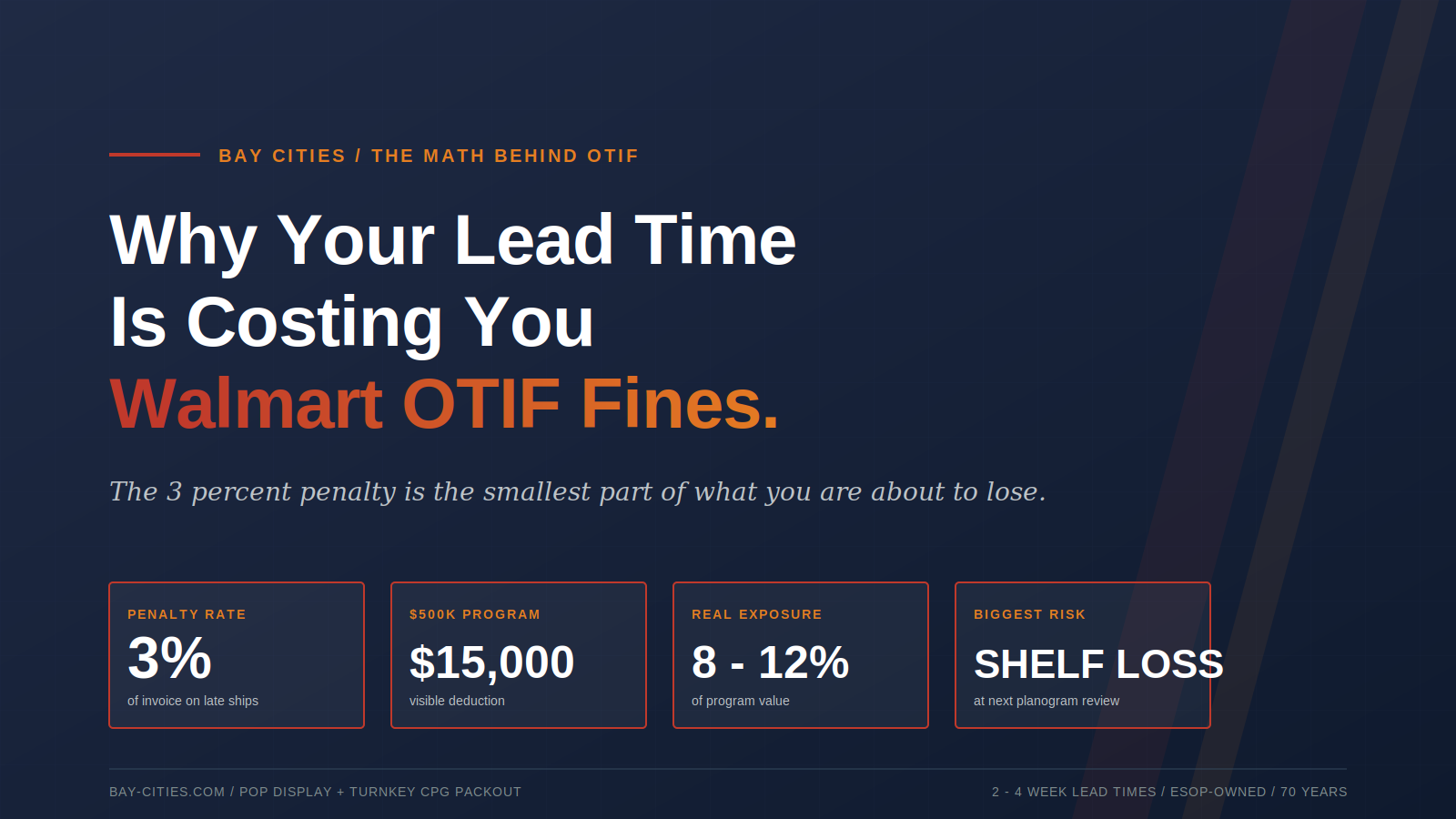
Why Your Lead Time Is Costing You Walmart OTIF Fines
Your supplier just told you eight weeks. You have six. The launch is locked. The merchant is expecting product on a specific Must Arrive By Date. You already know what is coming.
Walmart is going to fine you. And the fine is the smallest part of what you are about to lose.
Most brand managers we talk to know OTIF exists. They know it is a 3 percent penalty. What they have never actually done is sat down and run the math on what slow lead times cost their program over a full year. This is that math. The numbers are bigger than you think.
WHAT OTIF ACTUALLY IS
OTIF stands for On-Time, In-Full. It is Walmart's supplier performance program, and it measures whether your shipment arrived at the distribution center on the exact day it was scheduled and whether the full quantity was delivered. Miss either condition and you get a deduction off your invoice.
The current penalty rate is 3 percent of the cost of goods sold for the affected order. That is the published rate. There are layers underneath it that make the real number worse. SQEP fines stack on top of OTIF when the issue is a quality or compliance failure. Pallet configuration errors trigger their own deductions. Labeling issues trigger their own deductions. A single late shipment with a labeling error can run 5 to 7 percent in stacked penalties.
OTIF is enforced through automated chargebacks. There is no negotiation. The deduction lands on your remittance statement weeks after the fact, and your accounting team is left chasing it down.
THE CORE NUMBER: 3 percent of invoice. On a $500,000 program, that is a $15,000 deduction. On a $2 million program, $60,000. The line item appears on your remittance with no warning.
THE MATH NOBODY SHOWS YOU
Here is what most brand managers never calculate. Take a look at the math at four program sizes.
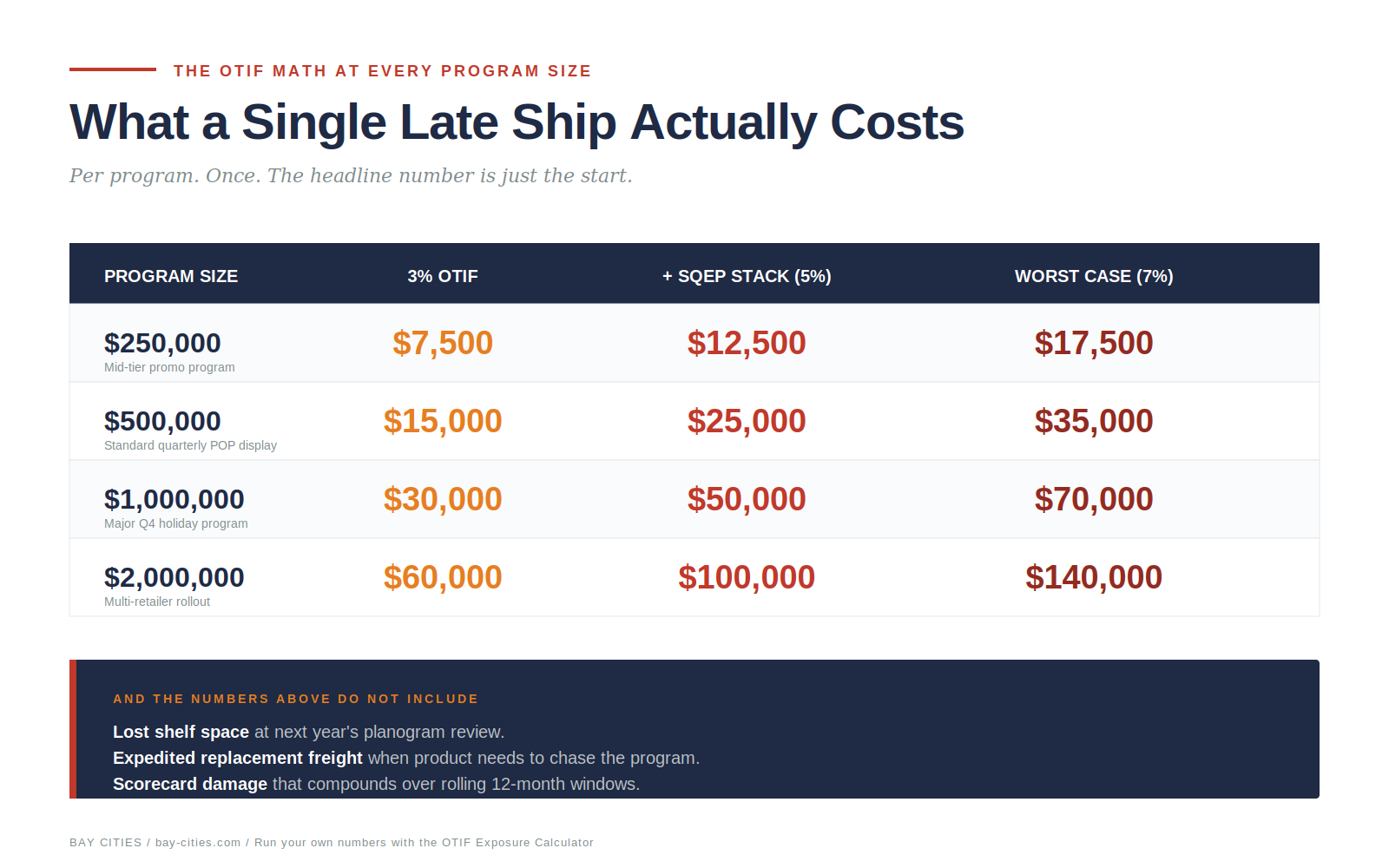
These are per-program figures. If you run four POP display programs a year and two of them ship late, you are looking at a six-figure annual exposure on a mid-tier brand. The penalty itself is just the start.
THE BIGGER NUMBER NOBODY TALKS ABOUT
The 3 percent fine is the visible cost. The invisible cost is bigger, and it shows up in three places.
1. The Margin Hit on Promo Pricing
POP display programs already run on compressed margins. The buyer negotiated a promotional price for the feature window. You took the margin hit because the volume justified it. Now the OTIF penalty comes out of an already thin margin, and on a typical 12 to 18 percent margin POP program, a 3 percent deduction can wipe out a quarter of the program's profit. A 5 to 7 percent stacked penalty can take you to break-even or below.
2. The Replacement Cost
If your shipment is short or late, the merchant team often demands replacement product on an expedited basis. That means air freight or expedited LTL on top of the original shipping. A pallet that should have moved on standard freight for $400 now costs $1,800 to expedite. Multiply by 24 pallets on a missed program and you are at another $30,000 to $40,000 of unbudgeted cost. None of that hits OTIF reporting. It hits your P&L.
3. The Shelf Space Risk
This is the one that keeps brand managers up at night. Walmart tracks supplier performance over rolling 12-month windows. Repeat OTIF failures show up in supplier scorecards. They are visible to merchants when next year's planogram decisions get made. A brand with a clean OTIF record is at the table for line extensions, secondary placements, and feature opportunities. A brand with two strikes in the past 18 months is fighting to keep current placements.
Lost shelf space is the existential risk. You can absorb a $15,000 fine. You cannot absorb being delisted from a Walmart category.
THE FULL EXPOSURE: OTIF penalty plus margin hit on promo pricing plus expedited replacement freight plus scorecard damage. The 3 percent number is the headline. The real exposure on a single late program is closer to 8 to 12 percent of program value, plus your future shelf real estate.
WHERE THE LEAD TIME MATH ACTUALLY COMES FROM
The reason brands run into OTIF problems is almost never because their team missed the launch date. It is because the supplier's quoted lead time was not the real lead time.
The standard industry lead time on a Walmart POP display program is 8 to 12 weeks from approved design to delivery to the DC. That is what most suppliers quote. What that quote does not show you is the buffer math underneath.
Design and revisions: 1 to 2 weeks if your supplier has in-house design. 3 to 4 weeks if they outsource.
Sample approval cycle: 5 to 10 business days per round if samples are cut at a third party. 24 to 48 hours if your supplier has in-house sample cutting.
ISTA testing: 5 to 10 days at an outside lab plus retest risk if the first round fails. Same-day to 48 hours if your supplier has in-house ISTA capability.
Production: 2 to 4 weeks at a direct manufacturer. 4 to 6 weeks if your supplier is a broker running orders through a third-party plant.
Packout and freight: 1 to 2 weeks. Compressed if you have central distribution proximity to the retailer DC, longer if not.
Add up the slow version of every step and you get 12 to 14 weeks. Add up the fast version and you get 4 to 6 weeks. The difference is not magic. It is whether the supplier owns the steps or hands them off to someone else.
LEAD TIME COMPARISON: SLOW SUPPLIER VS. DIRECT MANUFACTURER
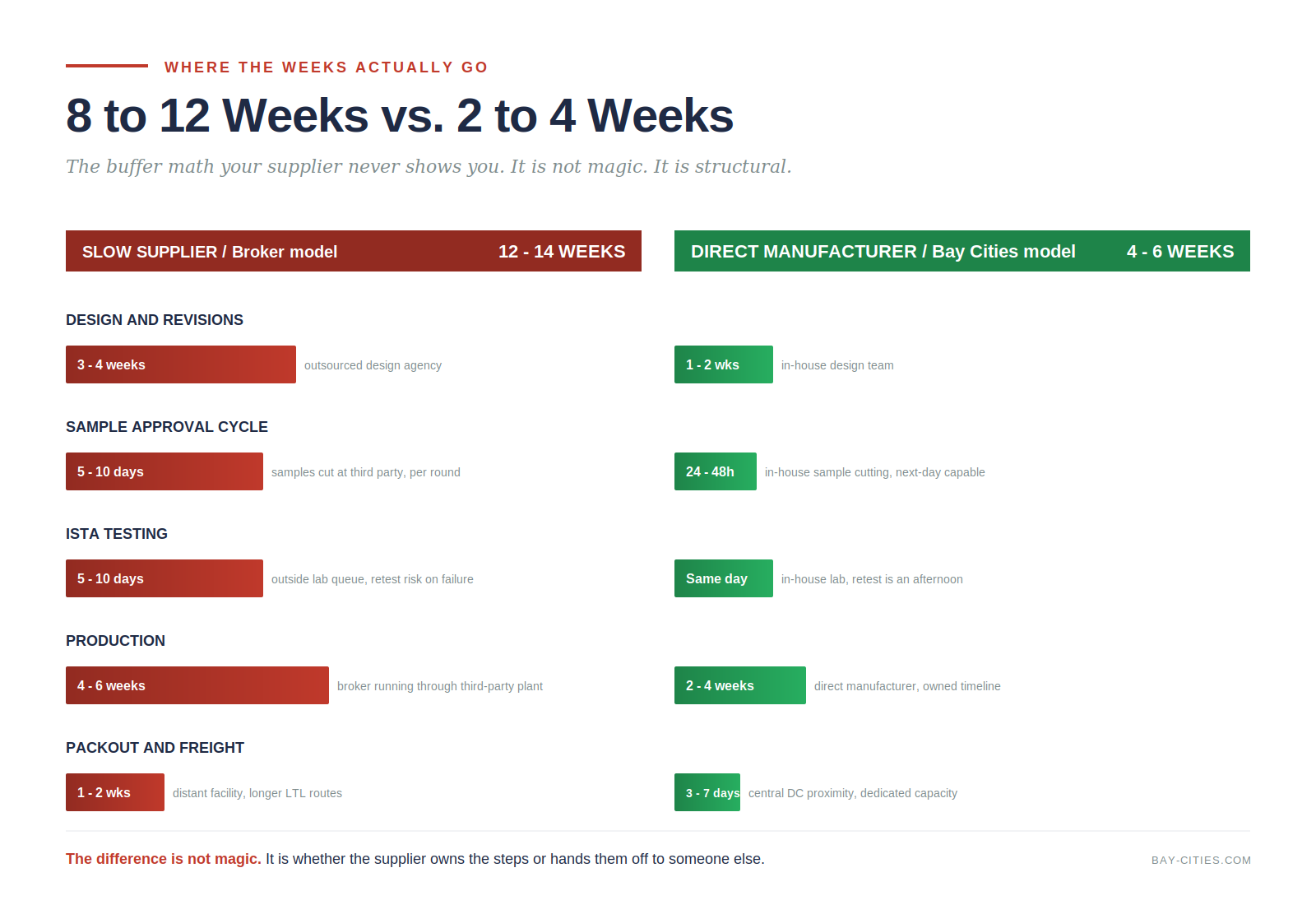
THE BUFFER YOU NEVER SEE: When a supplier quotes you 8 weeks and you discover at week 6 that they are running 10, the extra 2 weeks were always there. They lived inside the handoffs you never saw on the timeline. By the time you find out, the launch window has already closed.
WHAT FAST ACTUALLY LOOKS LIKE
A direct manufacturer with in-house design, in-house sample cutting, in-house ISTA testing, in-house production, and dedicated packout capacity does not run on industry-average timelines. The lead times are structurally different because the handoffs do not exist.
On a Walmart POP display program with a confirmed design and approved structure, a direct manufacturer can move from final approval to delivered-on-pallet in 2 to 4 weeks. Sample turnaround can be next-day. ISTA testing happens in the same building as the production line, which means a failed test does not add a week to the timeline. It adds an afternoon.
That is the math behind hitting OTIF every single time. Not heroic effort. Not last-minute scrambles. Structural lead time advantage built into the supplier model.
THE DECISION MOST BRANDS ARE QUIETLY MAKING
Brands that have been through one OTIF cycle with a slow supplier are quietly evaluating alternatives. The decision usually starts with a single Q3 or Q4 program where the timeline is too tight for the current supplier to make work, and the brand needs a backup that can actually execute on a 4-week or 6-week window.
Once a brand runs one program through a faster supplier and hits OTIF clean, with no expedited freight, no scorecard damage, and the merchant relationship intact, the conversation changes. The next program goes to the same supplier. The one after that. Within a year, the slow supplier is in single-program territory and the fast supplier is the primary.
This is how packaging supplier relationships actually shift. Not in a single RFP. One program at a time, starting with the one that the current supplier cannot deliver on time.
===============================================================
===============================================================
RUN YOUR OWN MATH
OTIF Exposure Calculator
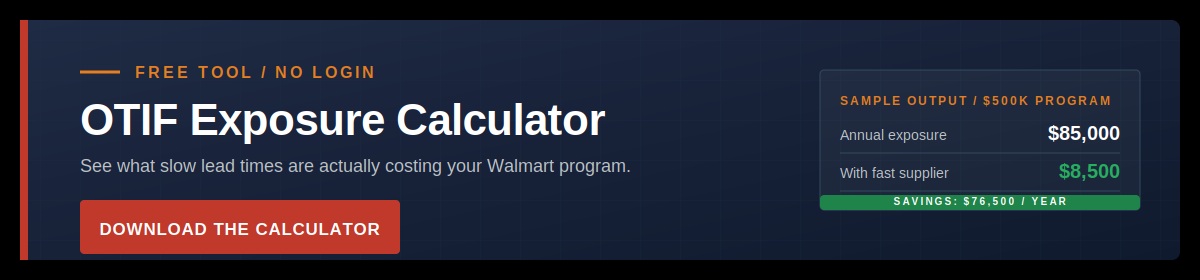
We built a one-page Excel calculator that takes the work out of estimating your real OTIF exposure. Plug in your program size, lead time, and shelf space at risk. The math runs automatically. You see the visible penalty, the stacked SQEP exposure, the expedited freight cost, and the margin impact in one view.
It is yours to keep. No app, no login, no follow-up unless you ask for one. Open it in Excel, run your numbers, and see exactly what slow lead times are costing your program.
Download the OTIF Exposure Calculator
===============================================================
ABOUT BAY CITIES
Bay Cities is a 70-year ESOP-owned direct manufacturer of POP displays, retail packaging, and turnkey CPG packout programs. With facilities in Los Angeles and the new Royal Bay Midwest Packout Center in Oak Forest, Illinois, Bay Cities runs 2 to 4 week lead times on Walmart, Costco, Target, and HEB programs. In-house design, in-house ISTA testing, in-house sample cutting, and dedicated retailer teams. Confirmed multi-vendor pallet vendor of record at Walmart, Target, HEB, and Meyers.
Need a packout partner who can handle volume? Kitting, assembly, co-packing & direct import fulfillment from our 233,000 sq ft Chicago facility. Let's talk.
Learn more at SpecPkgMarketplace.com or speak with our team about your next program.


Ready to find your packaging partner?
Join hundreds of manufacturers and buyers already using PackageLink to streamline their sourcing process.