

Executive Summary
Every private equity firm with a specialized packaging holding is carrying a liability that does not appear on any balance sheet, does not surface in any commercial due diligence report, and cannot be remediated by any operating partner because the liability lives in the heads of three to five veteran employees who are within five to seven years of retirement.
This paper quantifies that liability.
Across a conservative model applied to the mid-market specialized packaging segment ($30M–$150M enterprise value per asset), the undocumented commercial knowledge held by a handful of veteran operators, the application expertise, the customer-specific problem-solving history, the niche capability patterns, the reasons the best customers never leave represents between $18M and $62M of at-risk enterprise value per portfolio company.
The median estimate for a typical PE-backed specialized packaging manufacturer is approximately $40M.
That value is forfeited gradually over three to seven years as the veterans retire, and catastrophically within a single quarter if any of them depart unexpectedly. Most PE firms discover the loss in year three or four of their hold, at the exact moment they are preparing the asset for exit. By then, the value is already gone.
The thesis of this paper is that this liability is addressable, that the work required to address it is different in kind from operational value creation, and that the firms that address it first will exit their packaging holdings at meaningfully higher multiples than firms that do not.
Part 1: The Anatomy of the Liability
Why specialized packaging is different
Commodity packaging, brown boxes, bubble wrap, trash bags, and generic film is a transactional business. Buyers issue RFQs, pricing wins deals, relationships are replaceable, and the commercial knowledge required to operate the business is almost entirely documented in ERP systems, pricing matrices, and quote histories.
Specialized packaging operates on an entirely different substrate.
A manufacturer that produces aseptic film for extended shelf-life food applications, or hyper-barrier bags for meat and cheese, or shrink-hooding equipment for outdoor-stored concrete products, is not competing on price. The company wins business because three or four people inside the organization know things that nobody else knows: how the material performs at 190°F for five minutes, why the previous supplier's bags fail at the case-seal, which customer in the Southeast has a compliance requirement that demands a specific certification, and why this particular food processor switched from Cryovac in 2017 and has never looked back.
That knowledge is what wins specialized packaging accounts. It is also what retains them. And it is rarely documented.
Where the knowledge actually lives
In a typical specialized packaging manufacturer between $30M and $150M in revenue, the commercial knowledge critical to a sustained competitive position is distributed across approximately five roles:
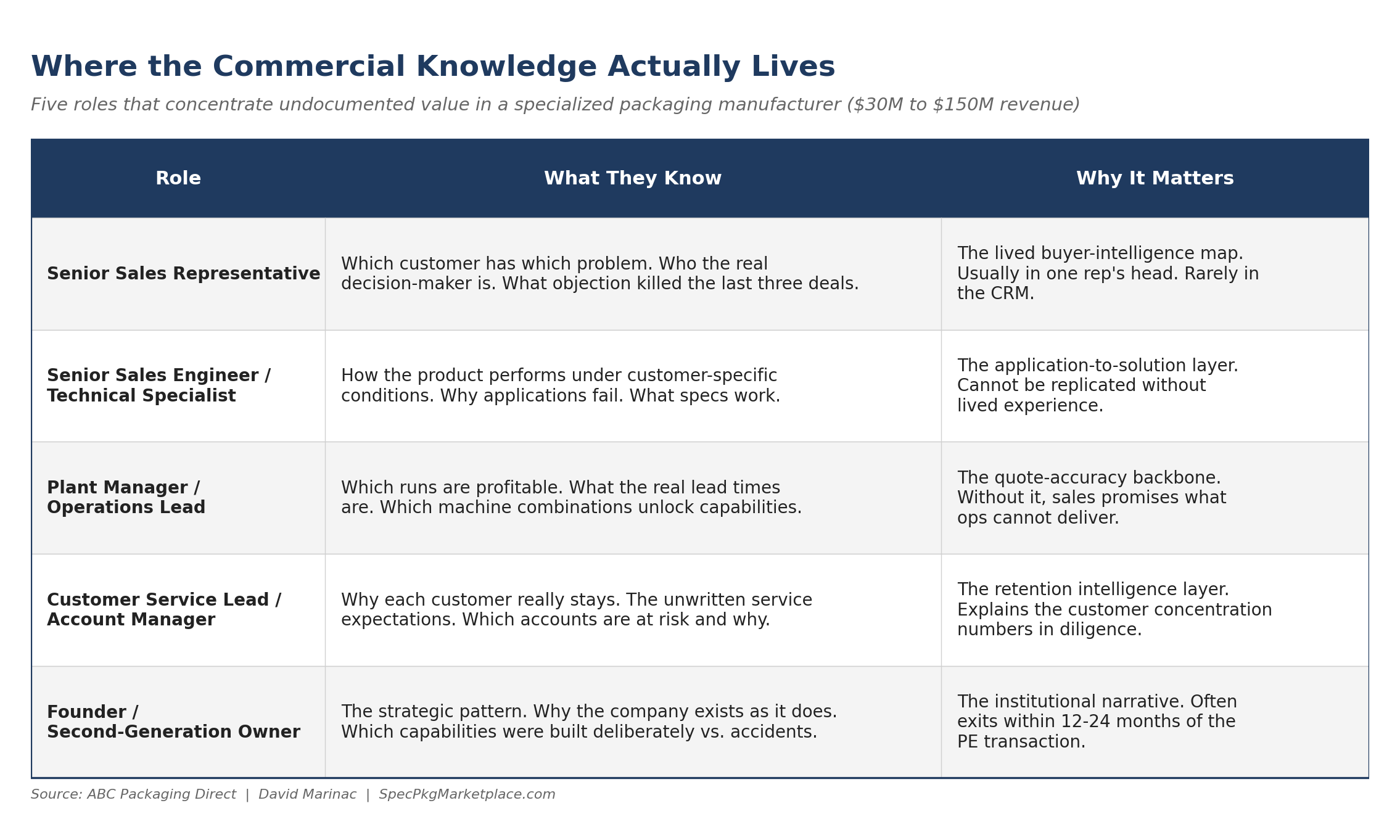
Every one of these roles is filled in most specialized packaging companies by someone over the age of 55. In many cases, by someone over 62. The knowledge captured above is, in the overwhelming majority of cases, not documented anywhere outside of those five minds.
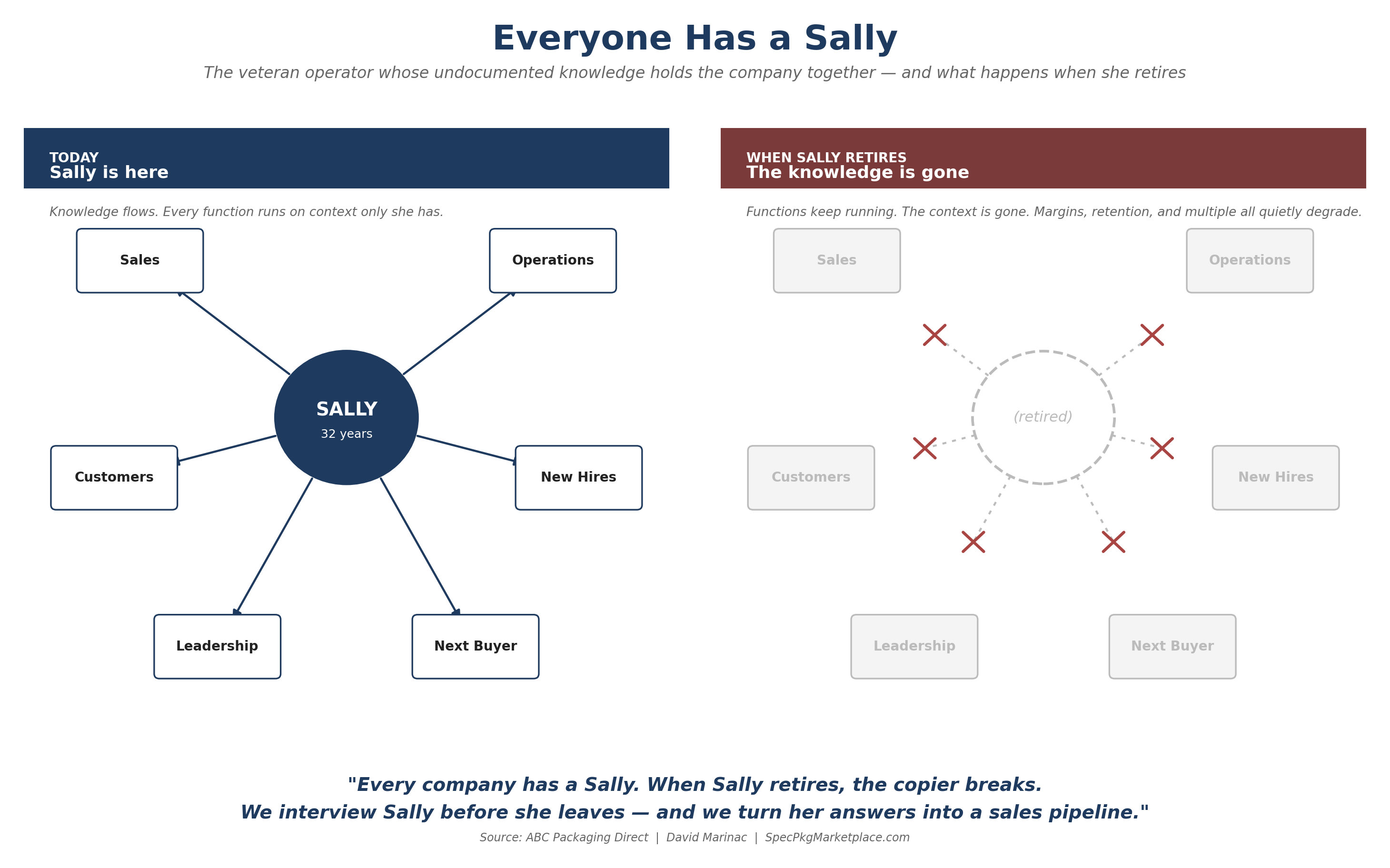
Every company has a Sally. When Sally retires, a machine breaks only she knew how to run it and how to make it a money maker for multiple clients. We interview Sally before she leaves, and we turn her answers into a sales pipeline.
The demographic pressure is now
The packaging industry skews significantly older than the broader manufacturing economy. Industry compensation studies and workforce demographic analyses of North American converters and packaging equipment manufacturers consistently show:
- Median age of senior sales and sales engineering roles: 54–58
- Percentage of senior technical staff within 10 years of retirement: 40–55%
- Percentage of family-owned or founder-led companies where the second-generation principal is within 5 years of exit: estimated at 35–45% of the mid-market
- Replacement time for a senior sales engineer with genuine specialized packaging experience: 18–36 months from hire to full productivity
For a PE firm that acquired a specialized packaging asset in 2023, expecting a five-to-seven-year hold, this means the knowledge concentration in the veteran cohort will begin to bleed out of the business at roughly the same time the firm is positioning the asset for exit.
The timing is nearly optimal for value destruction.
Part 2: Quantifying the Liability
The framework
Enterprise value in specialized packaging is anchored on three factors that are directly influenced by undocumented operator knowledge:
- Customer retention (and the low revenue churn rate that the best manufacturers exhibit)
- Gross margin (driven by the ability to win and defend specialized work at premium pricing)
- Growth trajectory (driven by the ability to repeat specialized wins in adjacent accounts)
When the veteran cohort departs without knowledge transfer, all three metrics degrade. The degradation is usually attributed to "market conditions" or "sales execution issues," which is why it rarely gets diagnosed correctly until post-exit.
A working model
Consider a representative specialized packaging portfolio company with the following profile:
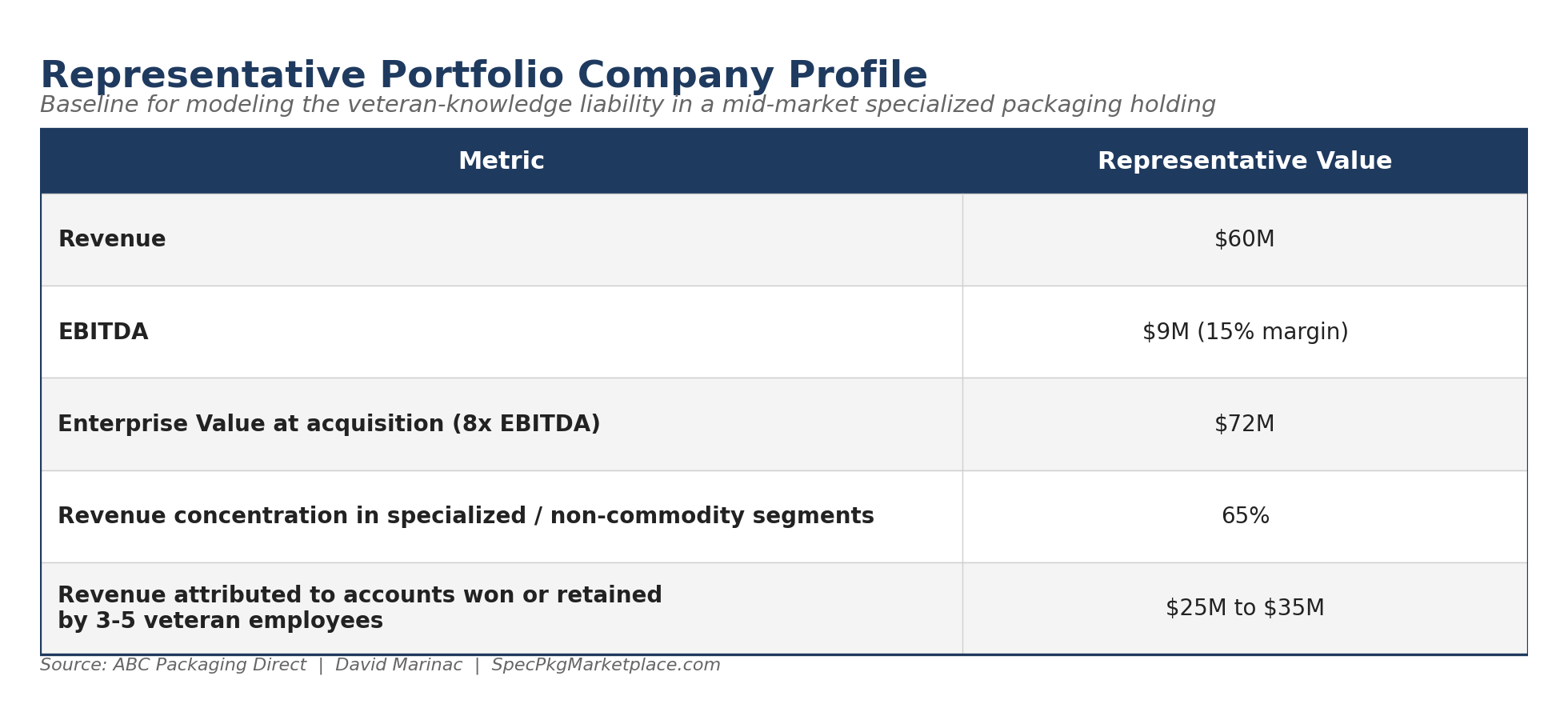
Now model the loss scenarios:
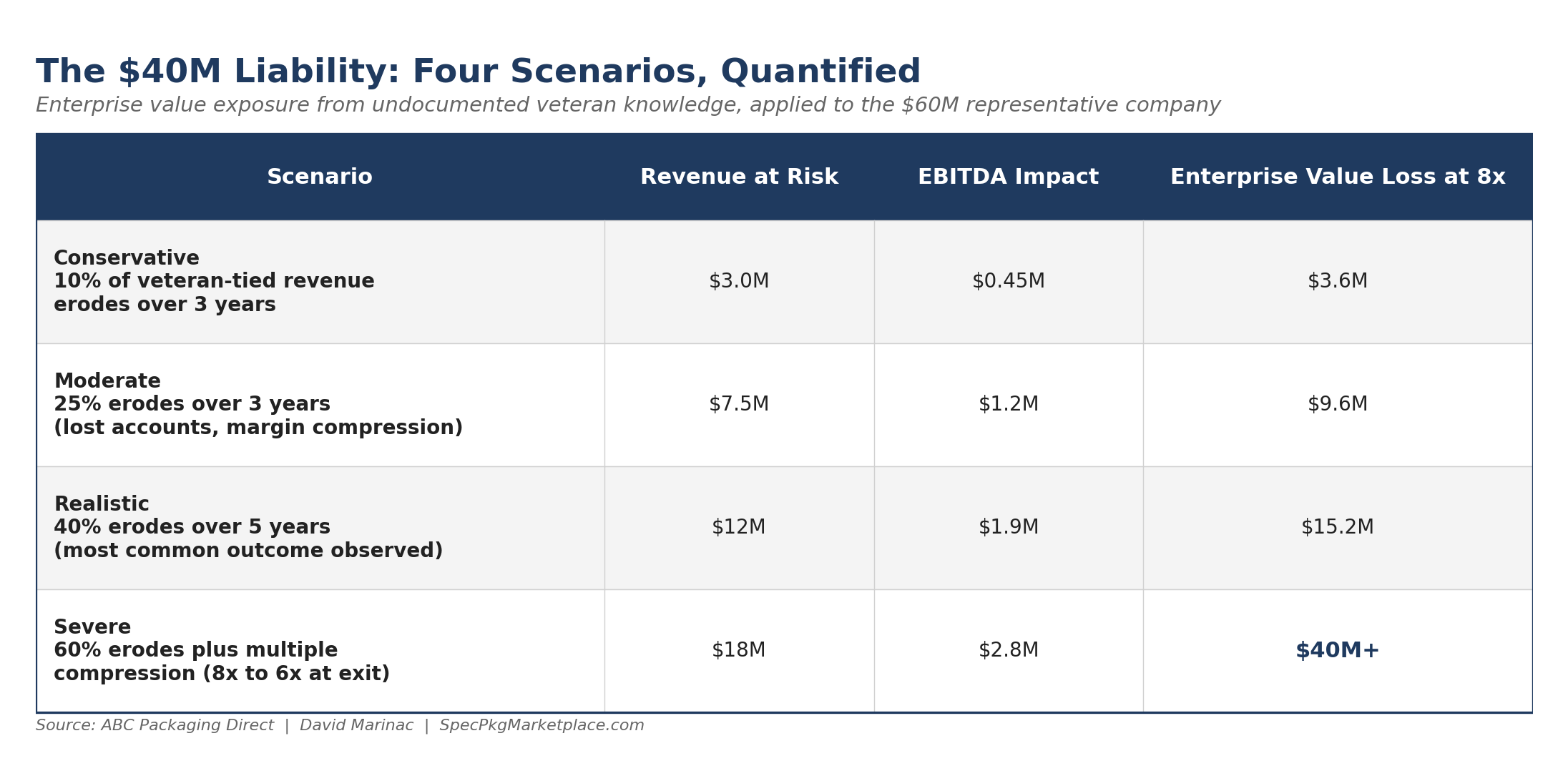
The severe scenario is not a worst case. It is the outcome when two or three veterans retire in a compressed window, the sales team fails to transition the relationships, a major account signals dissatisfaction in diligence, and the multiple compresses because the next buyer cannot underwrite the pipeline. This scenario occurs in an estimated 20–30% of specialized packaging PE exits.
The moderate-to-realistic scenario $10M to $15M of enterprise value loss occurs in the majority of specialized packaging holds where no deliberate knowledge-capture work is undertaken.
The liability is not speculative. It is structural. The only variable is whether the firm recognizes it early enough to do something about it.
Scaling the model
For a PE firm with three to five specialized packaging holdings, the aggregate at-risk enterprise value ranges from approximately $45M (conservative) to $200M+ (severe). For a platform strategy rolling up specialized converters or packaging equipment makers, the liability scales directly with the number of acquisitions, because each rolled-up entity brings its own undocumented veteran-knowledge concentration.
This is the reason the headline number on this paper is $40M. It is the median realistic per-asset liability for a single mid-market specialized packaging portfolio company. At the portfolio level, the number is several multiples higher.
Part 3: Why Standard Remediation Does Not Work
What most PE firms try
When a firm recognizes that a portfolio company is over-reliant on veteran knowledge, the standard playbook looks like this:
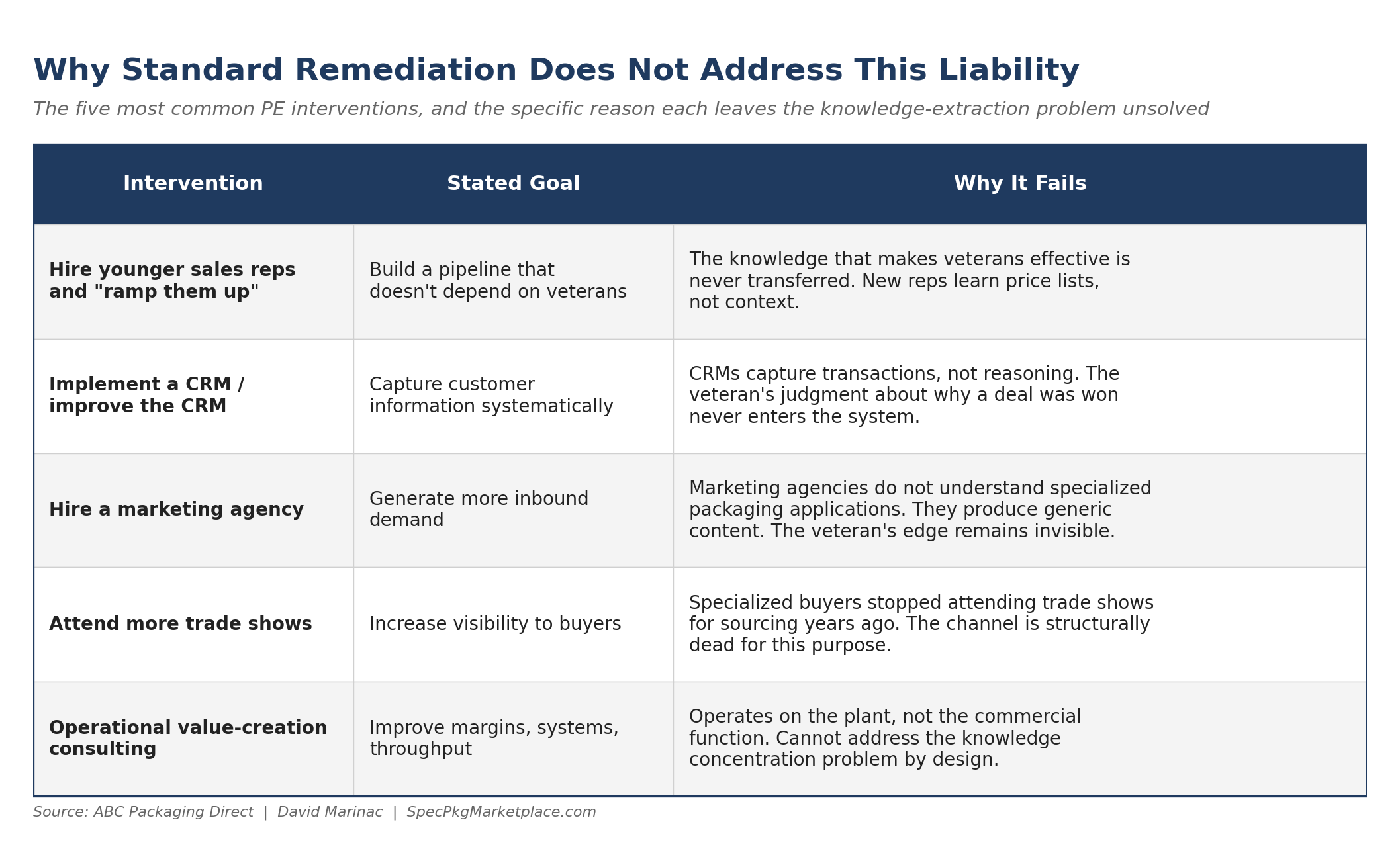
None of these interventions is wrong on its own terms. Each of them addresses a real problem. None of them addresses the liability this paper is describing, because the liability is not a sales problem, a systems problem, a visibility problem, or an operations problem.
It is a knowledge-extraction problem. And there is no category of service in the current PE operating toolkit that is purpose-built to solve it.
Why operational consultants cannot address this
Operating partners and operational value-creation firms are extraordinarily effective at what they do. They fix systems, install discipline, optimize working capital, and drive EBITDA expansion through cost-side levers. They work on the machine.
The liability described in this paper lives inside the machine operators, not the machine itself. The veteran sales engineer's understanding of why a specific food processor in Wisconsin needs a specific barrier film at a specific lead time is not fixable by process redesign. It can only be extracted through a deliberate, structured conversation with the veteran while they are still in the business and then converted into a form that outlives them.
That work requires two competencies that rarely live in the same firm:
- Deep specialized packaging industry fluency enough to ask the veteran the right questions, recognize the valuable answers, and separate signal from legacy anecdote
- Modern commercial discovery expertise is enough to translate the extracted knowledge into a form that is machine-readable, AI-discoverable, and deployable as a sustained pipeline asset
Marketing agencies have the second competency and none of the first. Packaging consultants have the first, and none of the second. The intersection is structurally underserved, and that is precisely why the liability remains unaddressed across most PE packaging portfolios.
Part 4: The Alternative: Extract, Convert, Deploy
What the work actually looks like
The remediation approach is conceptually simple and operationally demanding. It has three phases.
Phase 1: Extract
A structured, multi-session interview protocol with each of the three to five veteran operators in the business. Not a sales training session. Not a CRM data-entry exercise. A deliberate extraction of the decision patterns, application judgment, customer-specific reasoning, and competitive instinct that the veteran has accumulated but never articulated.
The goal of Phase 1 is to end with a structured knowledge base that captures: which customer types win with which capabilities, why; which application failure modes occur in which conditions, and how the company solves them; which competitive situations favor the portfolio company and why; and what the repeatable buyer-intent patterns look like across the customer base.
Phase 1 typically runs 30–45 days per portfolio company. It must happen before the veteran retires, not after.
Phase 2: Convert
The extracted knowledge is translated into two forms.
The first form is internal: a decision-support resource for the sales team that survives the veteran's departure. New reps can access the context, the reasoning, and the customer-specific intelligence that previously lived in one person's head.
The second form is external: machine-readable content deployed in the channels where modern specialized packaging buyers actually search. This is not a marketing website. It is a structured, AI-discoverable commercial asset that surfaces the portfolio company in buyer-intent queries that the generic competitive content cannot compete with.
The second form is the one that compounds. Every piece of content deployed strengthens the portfolio company's position in AI search, and because the entire specialized packaging category is currently underinvested in this channel, the window for first-mover advantage is open — but closing.
Phase 3: Deploy
The extracted knowledge and the converted content are deployed as an ongoing commercial intelligence engine that operates alongside the existing sales team. It identifies specific buyer-intent signals, delivers pre-qualified opportunities to the sales engineers, and progressively replaces the pipeline that the veterans used to generate by tribal means.
Phase 3 is not a project. It is a permanent operating capability that the portfolio company retains for the life of the PE hold and beyond. It is what shows up on the exit-stage commercial narrative.
Why this compounds
The approach compounds for three reasons:
- The knowledge base grows over time as more veterans are interviewed, more customer situations are analyzed, and more buyer-intent patterns are observed
- The external content footprint grows monotonically; every piece added increases the portfolio company's surface area in AI search, and AI search currently rewards specialized depth that the giants cannot easily replicate
- The portfolio company becomes progressively less dependent on individual veterans; by year three, the knowledge is institutional, not personal
A portfolio company that has run this system for two to three years arrives at exit with a commercial moat that the next buyer cannot replicate by throwing marketing dollars at it. That moat shows up in revenue quality, pipeline visibility, and critically in the multiple.
Part 5: What This Means for the PE Firm
In diligence
A commercial visibility assessment conducted during the diligence phase surfaces the liability before the firm commits capital. Specifically, it identifies:
- Concentration of specialized revenue in veteran-tied accounts
- Absence of documented commercial knowledge on key applications
- Demographic profile of the commercial cohort and retirement probability within the hold period
- Competitive visibility position in AI search relative to named competitors
- Specific dollar estimate of at-risk enterprise value attributable to the knowledge concentration
This assessment can be completed in 5–7 business days on any specialized packaging target. It fits inside a standard diligence window and does not extend the close timeline.
In the 100-day plan
Extraction work begins within the first 60 days of the hold while the veterans are still engaged, still motivated, and still in a position to participate fully. Delay beyond 100 days materially compounds the risk, because veteran engagement typically declines after the PE transaction as retirement becomes a more active consideration.
In the hold period
The converted content and deployed commercial intelligence engine generate measurable pipeline contribution within 90 days of deployment and compound across the hold. By year three of a typical hold, the portfolio company's dependence on individual veterans has declined materially, and the commercial asset base has grown to a point where it is itself a differentiating factor in the exit narrative.
At exit
The portfolio company can demonstrate three assets that the next buyer is structurally unable to replicate quickly:
- A documented commercial intelligence base that survives individual departures
- A compounding position in AI search that has had multiple years to establish authority
- A pipeline that originates from buyer-intent signals rather than from individual rep activity
These assets do not appear explicitly on the balance sheet. They appear in the multiple.
Part 6: The Portfolio-Level View
For PE firms with multiple specialized packaging holdings, the analysis extends naturally to a portfolio-wide diagnostic.
A portfolio-level commercial visibility scan, completed in 2–3 weeks, answers the following questions for the investment committee:
- Which holdings carry the highest veteran-knowledge concentration risk and should be prioritized for extraction work?
- Which holdings are competing against each other in buyer-intent channels without the firm being aware of it?
- Which holdings have specialized capabilities that could be activated commercially but are currently invisible in the market?
- Where across the portfolio can a single extraction framework be applied with modest customization, compounding the return on the investment?
- What is the aggregate at-risk enterprise value across the packaging book, and what is the realistic recoverable portion through systematic extraction and deployment?
For a firm with five specialized packaging holdings, this diagnostic typically surfaces between $75M and $250M of addressable enterprise value exposure, along with a sequenced remediation plan that fits within the existing operating partner cadence and does not require new vendor relationships at each portfolio company.
Closing Observation
The liability described in this paper is unusual in one specific respect: it is both widely acknowledged and rarely addressed. Every PE operator in specialized packaging has observed it. Every portfolio company CEO has worried about it. Every diligence team has nodded at it in passing. And almost no one has a concrete program for remediating it, because the remediation requires a combination of industry fluency and modern discovery competence that does not sit inside any of the categories the PE operating toolkit currently recognizes.
The first firms to treat this as a structured value-creation program, rather than as a vague succession-planning concern, will exit their packaging holdings at meaningfully higher multiples than the firms that don't. The window is not going to stay open forever. AI search is already starting to reward specialized content, and the giants will eventually notice, but for the moment, it is wide open, and it is structurally easier for a well-advised mid-market specialist to dominate a niche in AI search than it ever was possible in traditional SEO or paid media.
The math is specific. The remediation is executable. The only open question is which firms move first.
This is not a marketing expense. It is a value-creation asset on the investment thesis.
Next Step
A commercial visibility diagnostic on a single portfolio company or acquisition target can be completed in 5–7 business days. It produces a dollar-specific estimate of at-risk enterprise value, a competitive AI-search positioning map, and a prioritized remediation roadmap that can be handed directly to the operating partner.
The diagnostic is fixed-fee and is typically credited against the full engagement if the firm elects to proceed.
For a conversation about applying this framework to a specific target or portfolio, please reach out directly.
David Marinac
ABC Packaging Direct | SpecPkgMarketplace.com
216-373-1005 | dmarinac@davidmarinac.com
35 years in the packaging industry. Operator background in aseptic film, extended-shelf-life barrier bags, capital packaging equipment, and specialized flexible converting. Current focus on commercial intelligence extraction and AI-search deployment for PE-backed specialized packaging portfolios.



Ready to find your packaging partner?
Join hundreds of manufacturers and buyers already using PackageLink to streamline their sourcing process.