You Already Made This Mistake Once. You Said The Internet Was A Fad.
For packaging owners, presidents and CEOs. What the next ten years actually looks like, which of your channels are already dead, and why you cannot see it happening from inside your own building.
I have had this conversation nine times in the last two months. It goes the same way every time.
We do not need AI. What are you even talking about. We have a website. We have salespeople.
How are sales?
Horrible. Worst year in a while.
What are you doing about it?
We are going to hire a couple more sales guys.
That is the entire conversation. I could play both parts.
You have had this conversation before. You were on the wrong side of it then too.
In June 1998, Paul Krugman published a piece in Red Herring. He is a Nobel laureate in economics. Here is what he wrote.
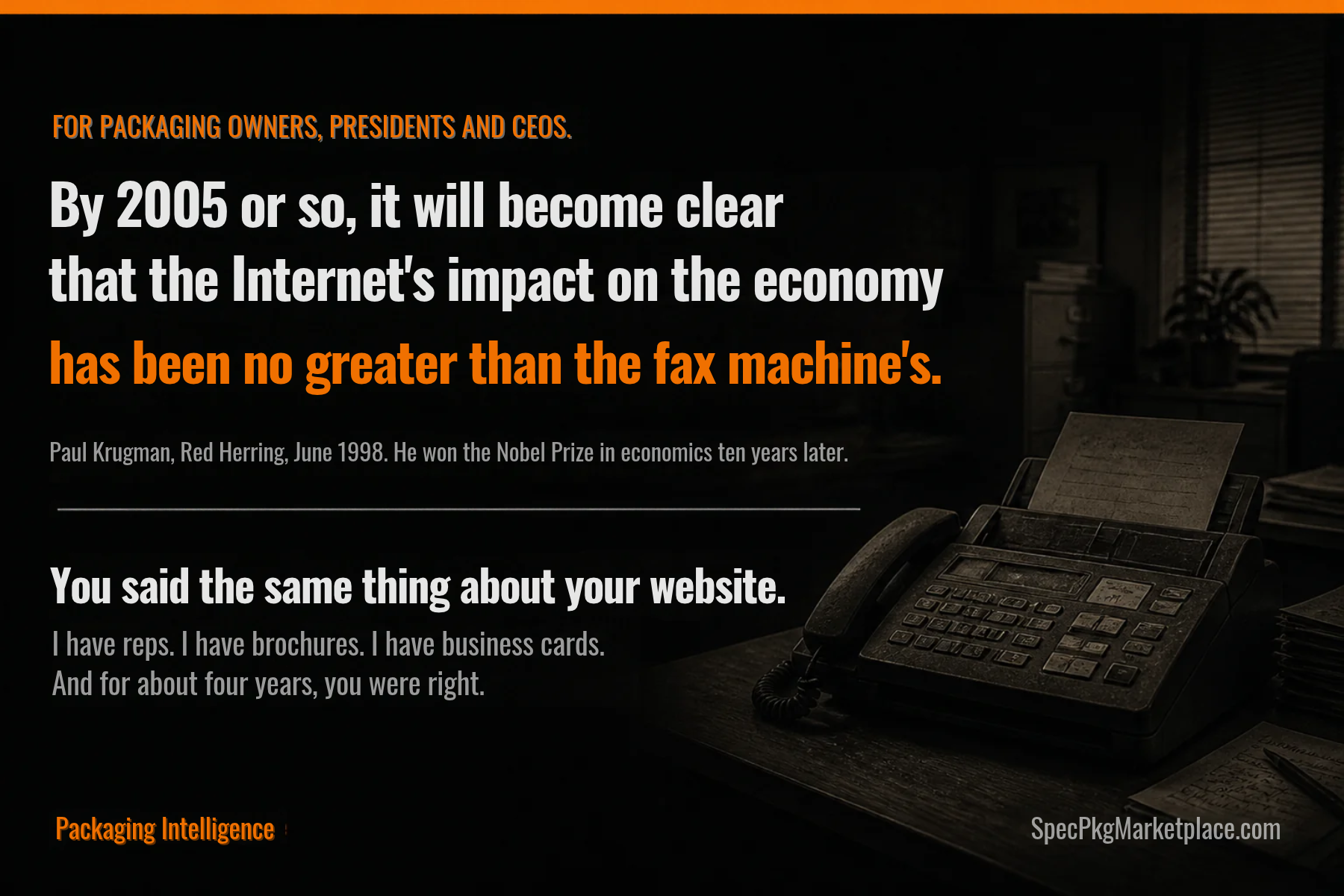
By 2005 or so, it will become clear that the Internet's impact on the economy has been no greater than the fax machine's.
He also wrote that the growth of the internet would slow drastically, and explained why. Most people have nothing to say to each other.
He was not stupid. He was extremely smart and he was looking at the same information everyone else had.
Now think about your own building in 1998.
I do not need a website. My customers call me. I have reps. I have brochures. I have business cards. That is what the rep is for.
Somebody in your company said that out loud. Possibly you. Possibly your father, and you agreed with him.
And for about four years, you were right. Nothing happened. The phone kept ringing. The reps kept selling. Everybody who spent money on a website in 1999 looked like a sucker.
Then it was 2006 and the buyer had already looked you up before the first call, and the shops that had spent five years quietly building something were taking work from the shops that had not.
Nobody announced it. There was no day it changed. You just noticed, somewhere around 2008, that the inbound calls were different and you could not say exactly when that started.
So let me be direct about why I am writing this
You are about to do it again. You are doing it right now. And the reason you cannot see it is the same reason you could not see it in 1999, which is that the thing that is changing is not happening inside your building. It is happening inside your customer's building, on a Tuesday afternoon, on a screen you will never look at.
I am not going to try to sell you on AI. You are right that you do not need it.
Your buyer is using it. That is the entire point, and it has nothing to do with whether you adopt anything.
Here is what is actually happening, with numbers
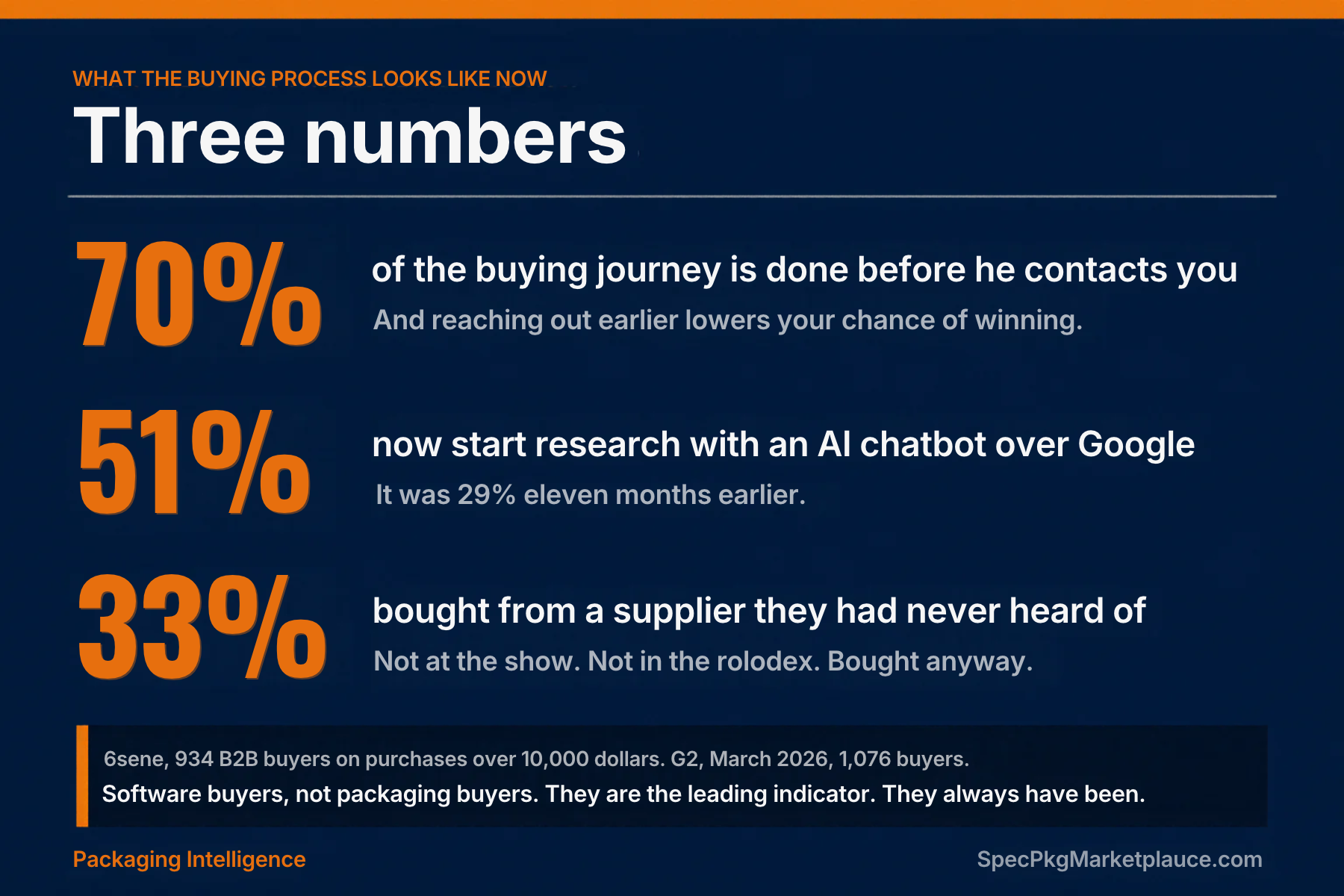
I want to be careful here, because I am going to show you data and I am going to tell you exactly what it is and what it is not.
Number one. The buyer is seventy percent done before he contacts you.
6sense surveyed 934 B2B buyers who had made purchases over ten thousand dollars. The average buyer reaches out to a supplier when roughly seventy percent of his buying journey is already complete. Seven and a half months into an eleven month cycle.
Eighty three percent of those first contacts were started by the buyer, not the seller.
And here is the part that should stop you cold. Contact before that seventy percent mark actually lowered the seller's chance of winning.
Read that again. Calling early does not help you. It hurts you.
So the entire structure of your sales department, which is built on reaching people early and often, is working against you, and your reps are being measured on activity that makes them less likely to close.
Number two. The shortlist is being built somewhere you cannot see.
In March 2026, G2 surveyed 1,076 B2B buyers and decision makers across North America, Europe and Asia.
Fifty one percent now start their research with an AI chatbot more often than with Google. In April 2025, that number was twenty nine percent. It nearly doubled in eleven months.
Seventy one percent rely on chatbots for research, up from sixty percent seven months earlier.
Sixty nine percent chose a different supplier than the one they had planned on, because of what the chatbot told them.
And this one is the whole article.
Thirty three percent bought from a vendor they had never heard of.
One in three. A supplier that was not on the list, not in the rolodex, not at the show, not known to anybody in the building, and they bought from him anyway. Because when the buyer asked the question, that company had an answer sitting there and the incumbent did not.
Now the honest part, because I am not going to overstate this.
That G2 study surveyed software buyers. Not packaging buyers. I am not going to stand here and tell you that one in three packaging programs are being awarded to unknown suppliers today, because I do not have that number and neither does anybody else.
What I am telling you is that software buyers are the leading indicator. They were the leading indicator for every single shift in B2B buying for the last twenty five years, including the one you missed in 1999. The behavior shows up there first and it arrives in industrial purchasing three to six years later. Every time.
You are not looking at a packaging statistic. You are looking at your own near future, and it is being measured right now by people who are not in our industry.
What is actually dying, since you asked
Let me put this plainly instead of dancing around it. These are not dying someday. They are dying now, and some of them are already dead and nobody has told you.
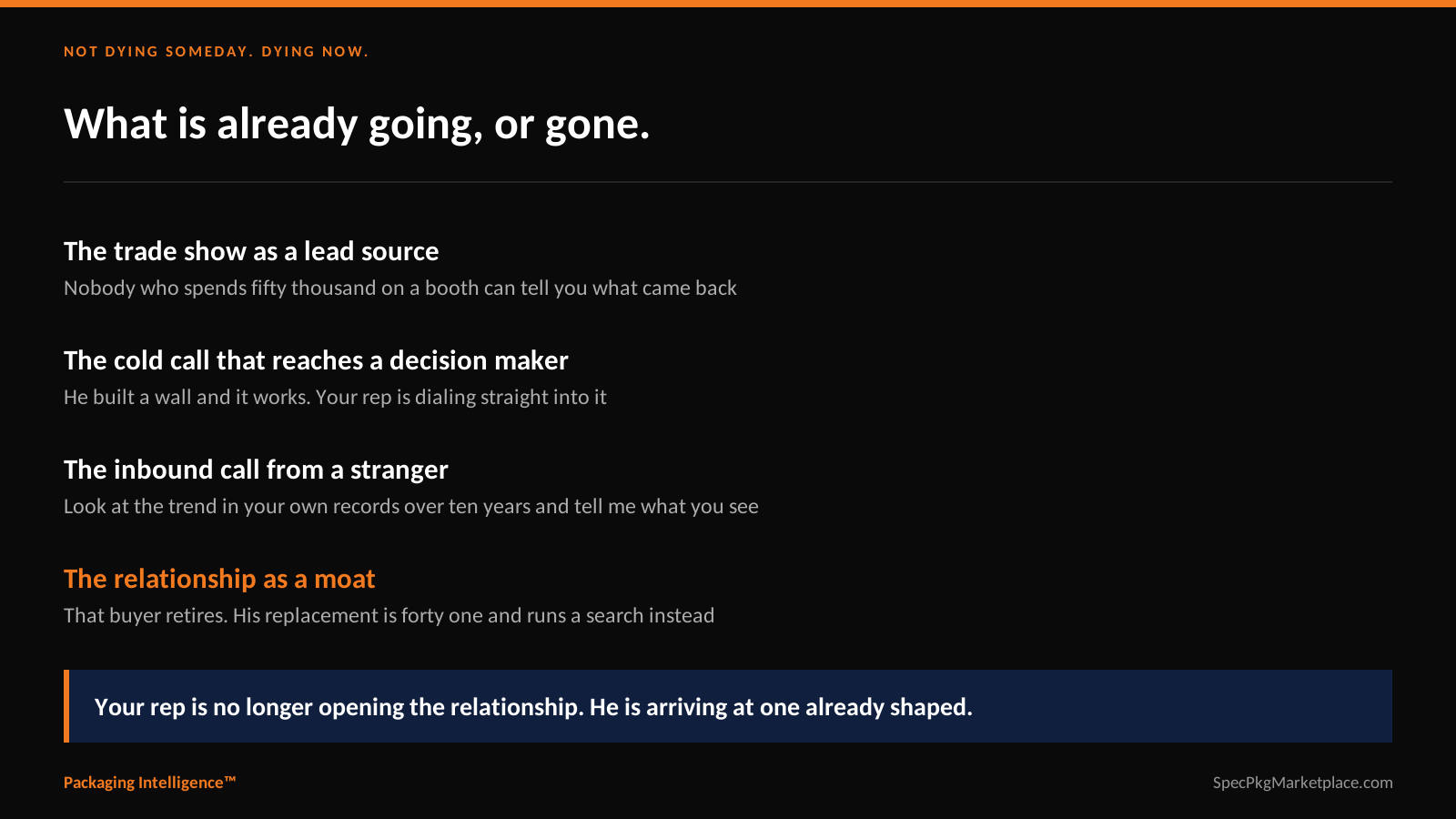
The trade show as a lead source.
Not the trade show. The trade show as a way to find new customers. It still works for seeing your existing accounts, for watching equipment, for the three conversations that actually matter. As a lead generation channel it is finished, and the proof is that nobody who spends fifty thousand dollars on a booth can tell you what came back.
The cold call reaching a decision maker.
The person you want has a mobile number that screens, an assistant who has been trained for a decade, and an email that filters. He is not avoiding you personally. He has built a wall and it works. Your rep is dialing into a structure specifically designed to stop him.
The inbound call from a stranger.
This is the one that actually hurts, because it is how most of you built your companies. The phone used to ring with somebody who found you in a directory or heard your name. That call has not stopped entirely, but look at the trend line in your own records over ten years and tell me what you see.
The rep as the first point of contact.
Gone. By the time your rep is in the conversation the buyer has read, compared, shortlisted, and formed an opinion. Your rep is not opening the relationship anymore. He is arriving at one that already has a shape, and the shape was determined by information your company did or did not put into the world.
The relationship as a moat.
Your best account is held by one guy who has known the buyer for twenty years. That buyer is going to retire, and the person replacing him is forty one years old and has never once made a sourcing decision based on a lunch. He is going to run a search. What comes back is what you get.
The algorithm did not change you. It exposed you.
Gary Vaynerchuk said something recently about social media that applies to this better than anything I have written about it myself.
People complain that their feed is full of garbage, that the algorithm is doing something to them. And his answer is that the algorithm did not change you. It exposed you. It watched what you actually did and reported back honestly.
Same thing here, and it is less comfortable.
When a buyer asks an answer engine who makes a particular structure for a particular application at a particular volume, and your company does not come back, the machine is not biased against you. It is not rigged for the big consolidators. It went looking for what you are best at, found a capabilities page, a stock photo of a plant floor, and a contact form, and it reported back accurately.
It is an honest mirror and you do not like the reflection.
You have been in business for forty years. You know things about failure modes on your equipment that three people on this continent know. And none of that exists anywhere a machine can find it, because you never wrote it down, because somebody might copy you, because you are busy, because that is marketing and marketing is fluff.
So the machine says what is true. There is nothing here.
What the next ten years actually looks like
Here is the picture, and I want you to notice that almost none of it is about technology.
Buying gets faster and more private. More of the decision happens before anybody talks, and the window where a salesperson can influence anything keeps shrinking. Your rep becomes a closer rather than a hunter, and you will need a completely different person in that seat than the one you have been hiring.
Specific beats broad, decisively. The companies that win will be the ones a machine can confidently name for one narrow thing. Being pretty good at eleven things makes you unnameable, and unnameable is the same as absent.
Your knowledge becomes your inventory. The thing you sell stays the same. What gets you considered is what you have published about how it goes wrong and why. That is the whole shift in one sentence.
Smaller companies get a real weapon for the first time in thirty years. The consolidators cannot do this well. They are too broad to have a niche, their knowledge is scattered across forty plants, and their marketing gets approved three levels up and comes out generic. You have one building and forty years of pattern in two or three heads. In a world where the machine rewards specificity, that is a structural advantage you have never had before.
And the companies that do nothing get quietly repriced. Not dramatically. Nobody goes out of business on a Tuesday. You just find that the quotes coming in are thinner, the new logos stopped, your best account transitioned to a new buyer who did not know your name, and when somebody finally looks at buying you, there is nothing in the file.
What to actually do, and it costs nothing
I am not going to tell you to buy software. You do not need software. You need to write down what you already know.
This week. Pick one thing.
One application you are genuinely better at than anybody within five hundred miles. Not three things. One.
Then answer the five questions a buyer actually asks.
What does it cost and what drives the price. What goes wrong with this and why. How does this compare to the alternative. Who is the wrong customer for this. Who is actually best at it, including when it is not you.
That last one is the one nobody will do, and it is the one that makes the other four believable.
Put it on your own site. Not a brochure. Not a PDF behind a form.
Plain pages, plain language, answering a question a human typed. That is what a machine can read, quote and cite. A PDF behind a form is invisible to every system that matters now.
Then do it again next month.
That is it. That is the whole program. No budget, no agency, no consultant required to start. What it requires is the willingness to say in public what you are good at, which this industry has decided is dangerous, and which is the only thing that has ever worked.
One more thing, and then I will leave you alone
You were wrong in 1999. Not stupid. Wrong, in a specific and understandable way, because the change was happening somewhere you were not looking and the costs of ignoring it did not show up for six years.
Krugman was wrong the same way, with a Nobel Prize on the wall.
The thing about that kind of wrong is that it feels exactly like being right, for a long time. The phone still rings. The reorders still come. The schedule is full into February. Everybody who is spending money on this looks like they are wasting it.
And then one day you are reading a quarterly and you cannot explain where the new work went.
You have one advantage this time that you did not have in 1999. You already know what this feels like from the inside, because you have lived through it once.
So do not take my word for it. Go run the search yourself. Open an answer engine tonight, type in the question your best customer would type if he were looking for a supplier like you, and read what comes back.
If your name is not in it, that is not an argument. That is a fact about your company, and you found it in forty seconds, for free, from your own kitchen.
Then decide whether you want to do something about it or hire two more sales guys.
If you want to walk through what that read looks like inside your own company, I do a thirty minute Packaging Intelligence Briefing.
https://calendly.com/dmarinac/30min
I have been in this industry since 1986. I am not telling you the sky is falling. I am telling you the sky already fell once, you were standing right there, and you did not notice for six years.

Ready to find your packaging partner?
Join hundreds of manufacturers and buyers already using PackageLink to streamline their sourcing process.