

Your Cheapest Packaging Decision Is the Most Expensive Line on Your P&L. It Just Has a Delay.
On July 2, 2026, the Consumer Product Safety Commission posted a run of recalls that had nothing to do with a product not working. Medicated wipes. Coin batteries. Nasal spray. Iron supplements. Baby oil. In case after case, the product was fine. The packaging was the problem. A closure that was not child-resistant when federal law required it to be. That was the recall.
Read that again, because it is the whole point. The product performed. The company still got pulled off the shelf, refunded customers, and put its name in a federal recall notice. Not because of what was inside the package. Because of the package.
If you have ever pushed a supplier for a nickel off a closure or a label, this is the other side of that trade. The savings landed this quarter. The recall lands later. They are the same decision, separated only by time. Here is how packaging actually triggers a recall, what one really costs, whether yours is compliant, who is on the hook, and how to pressure-test it before a regulator does.
What actually triggers a packaging recall?
Most people picture a recall as a product that failed. Contaminated food, a device that broke. But a large share of recalls are packaging failures, and the packaging is the thing that fails, not the product.
Four patterns cover most of it. A non-compliant closure, where a product that can poison a child is not in certified child-resistant packaging. A wrong label, where an undeclared allergen turns a bag of food into a health hazard. A contaminated packaging surface, where something on the material that touches the food forces a pull. And a mix-up, where the wrong thing ends up in the right package, or the right thing in the wrong one.
None of those is a failure of the product. Every one of them is a failure of the package, and every one of them is a recall.
The uncomfortable truth for a buyer: the part of the spec you treat as a commodity, the closure and the label, is the part most likely to put your brand in a recall notice.

What does a recall really cost, beyond the units?
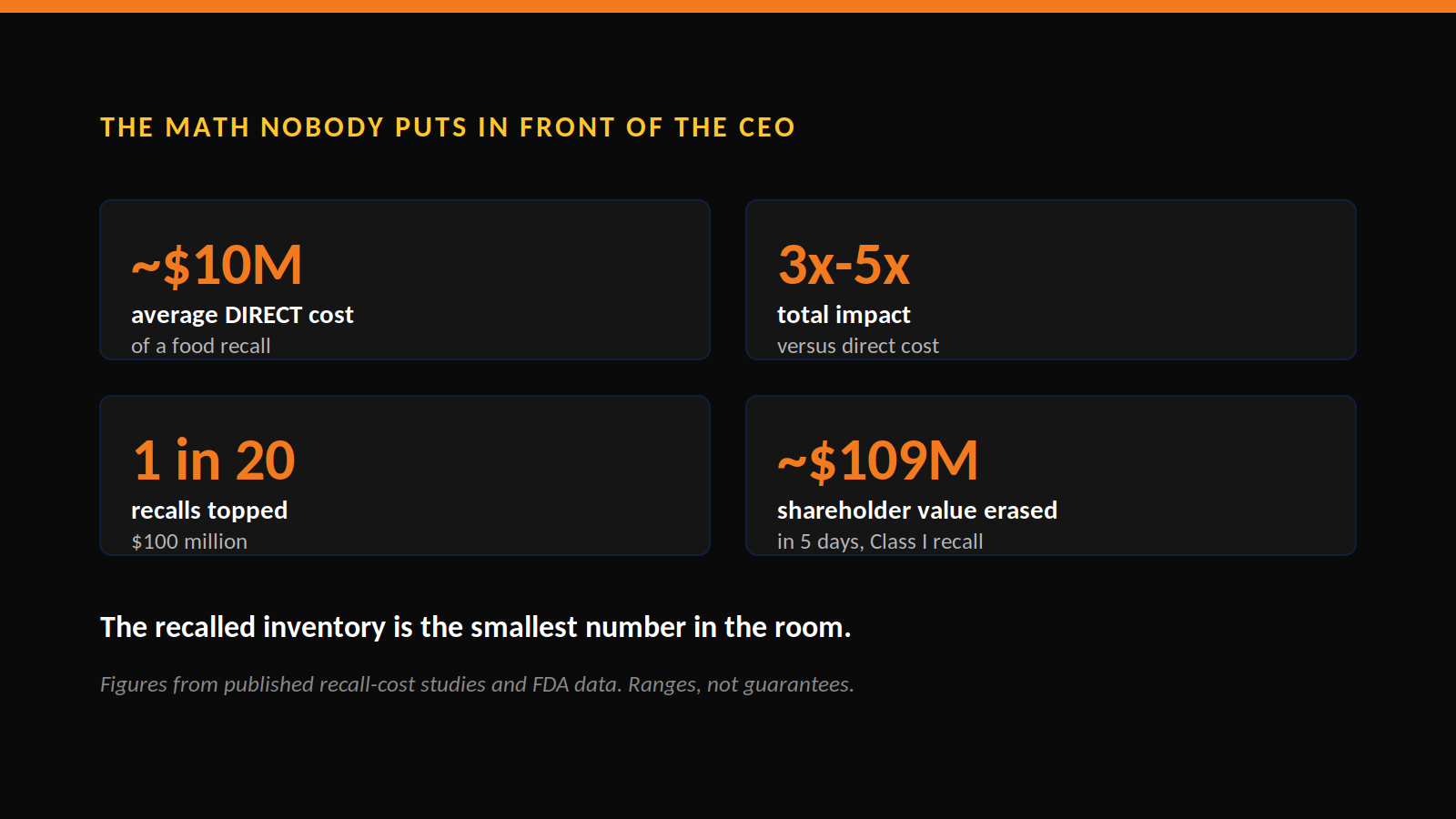
This is where the nickel gets expensive. The cost of the recalled inventory is the smallest number in the room.
An industry study of food companies put the average direct cost of a recall near $10 million, and that figure covers only the direct work: notification, retrieval, disposal, regulatory response. The total economic hit typically runs three to five times higher once you add business interruption, lost contracts, litigation, and higher insurance. In that same body of research, more than half of companies reported total impact above $10 million, and roughly one in twenty topped $100 million. An event study of Class I recalls found roughly $109 million in shareholder value erased within five trading days.
Now hold that against the savings. You negotiated a few cents off a closure across a production run. Call it real money, tens of thousands of dollars a year. A single recall event starts in the seven figures before the lawyers are even retained. That is not a saving. It is a bet, placed quietly, that your cheapest packaging decision will never be the one that fails.
The math nobody puts in front of the CEO
Is my closure and label legally compliant?
The rules are not vague, and "we assumed it was compliant" is not a defense.
The Poison Prevention Packaging Act requires certified child-resistant packaging for a long list of products that can poison a child, from certain drugs to supplements to household chemicals. Reese's Law adds specific child-resistant packaging and warning requirements for products containing button cell and coin batteries. If your product falls under either, the closure is not a design preference. It is a legal requirement, and a certification you either have on file or you do not.
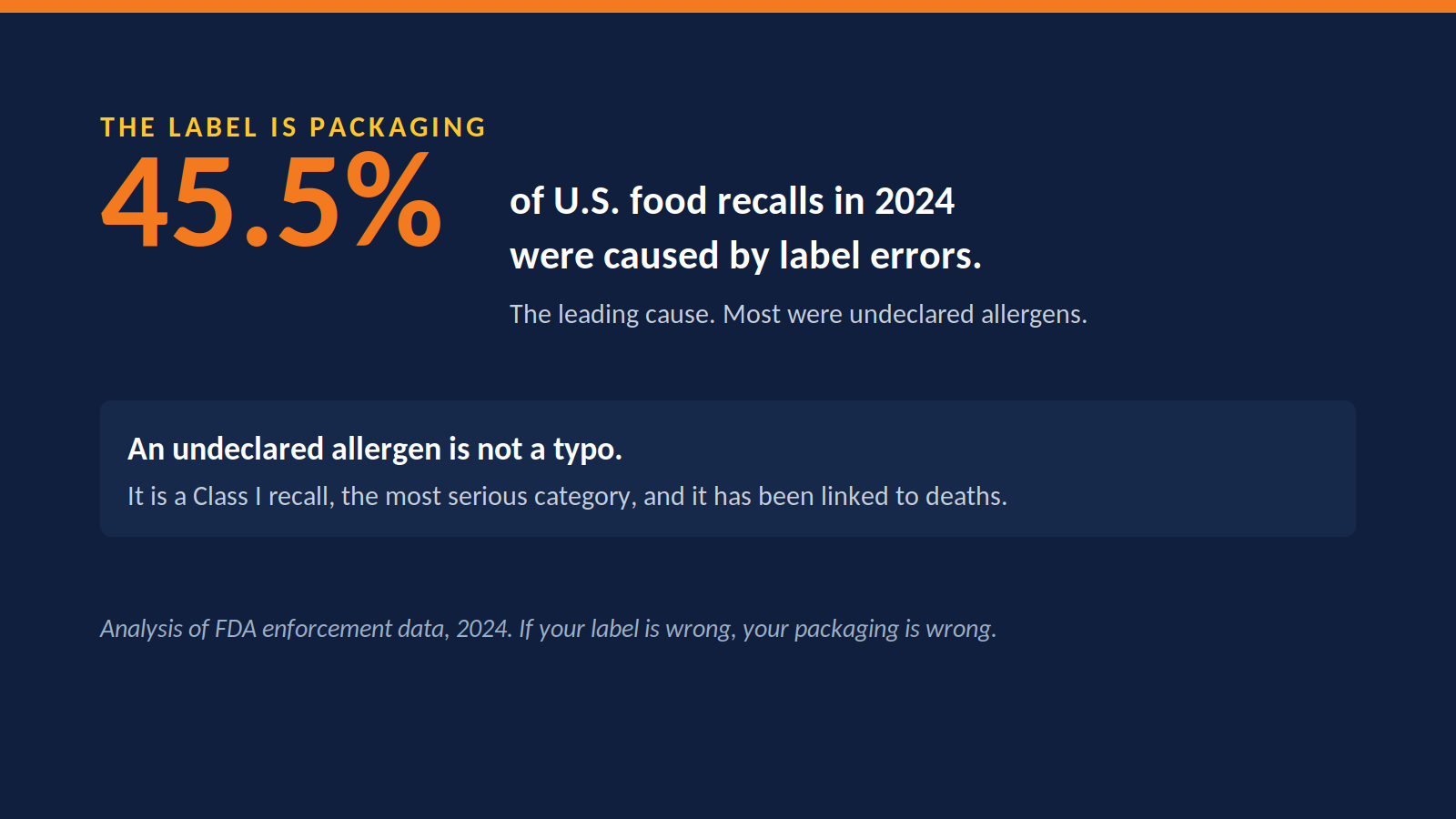
The label is packaging too, and it is the single biggest recall trigger in food. An analysis of FDA data found label errors were the leading cause of food recalls in 2024, at roughly 45.5 percent of events, and the large majority of those were undeclared allergens. An undeclared allergen is not a typo. It is a Class I recall, the most serious category, and it has been linked to deaths. If your label is wrong, your packaging is wrong.
Who is liable, the brand or the packaging supplier?
The instinct is to assume the supplier owns the risk. Look at how these recalls are actually filed and that comfort disappears.
In the July 2 batch, a CVS-branded product was recalled, and the manufacturer was a separate contract packager. The brand's name was on the box. When a recall hits, it is your name in the notice, your customers getting refunded, your shelf space at risk, regardless of who ran the line. You can outsource the manufacturing. You cannot outsource the liability that attaches to your brand.
That does not mean the supplier relationship is irrelevant. It means the opposite. Your specifications, your certification requirements, and your supplier agreements are where recall exposure is actually controlled. If compliance is not written into what you buy, you are absorbing a risk you never priced. Confirm how liability is allocated in your contracts with qualified counsel, because the default is rarely in your favor.
How do I pressure-test my packaging before a regulator does?
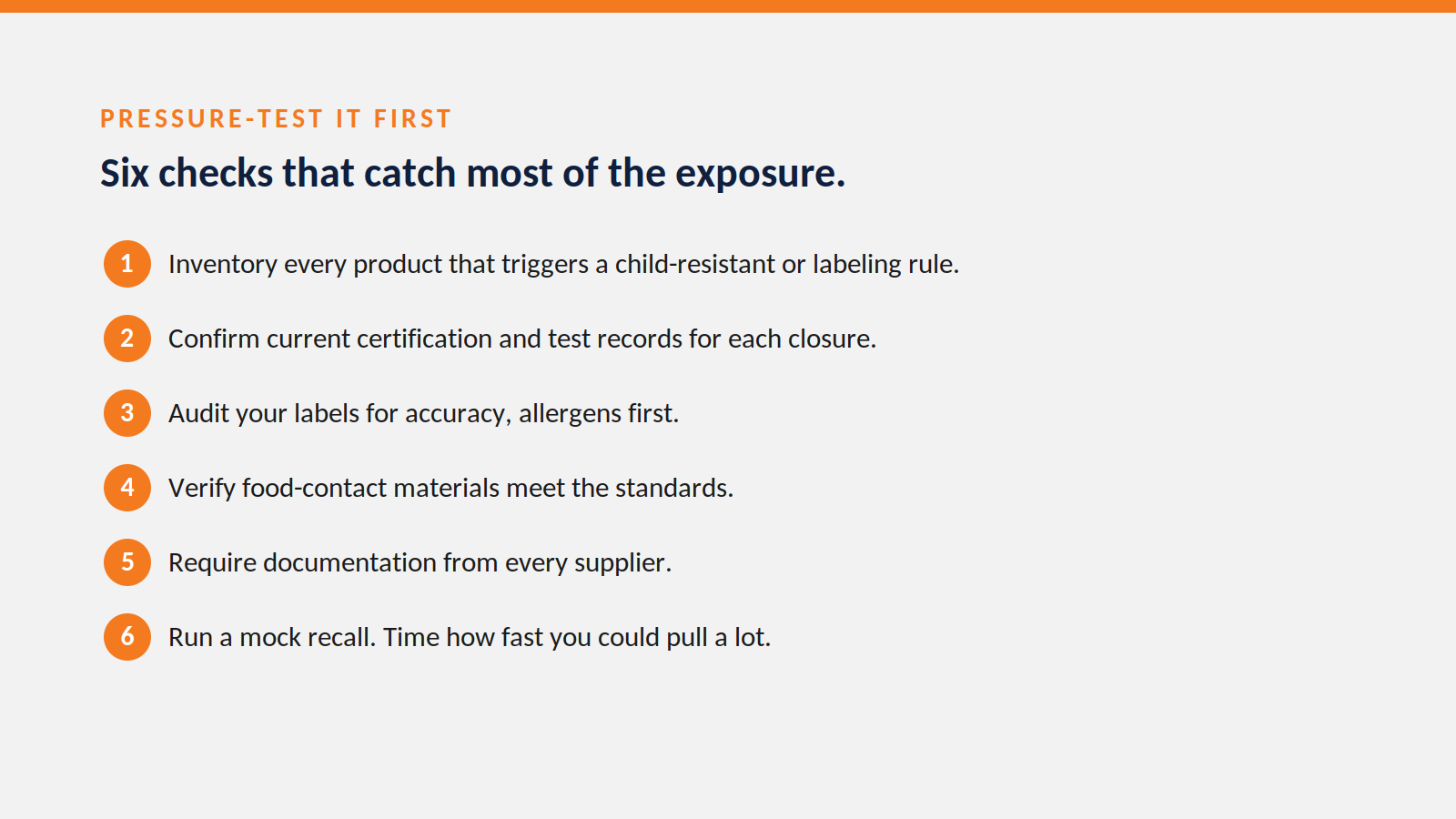
You do not wait for the CPSC or the FDA to audit your packaging. You audit it first. Six checks catch most of the exposure.
Inventory every product that could trigger a child-resistant or labeling requirement. Confirm you hold current certification and test records for each child-resistant closure. Audit your labels for accuracy, with allergens at the top of the list. Verify that food-contact materials meet the applicable standards. Require documentation from every packaging supplier rather than assuming it exists. And run a mock recall, on paper, to find out how fast you could actually locate and pull an affected lot.
If you cannot answer those six today, that is not a reason to panic. It is a reason to build the file before someone else opens it for you.
Why does nobody frame packaging this way to the CEO?
Because of where packaging gets decided. It is bought on price, three levels below the corner office, measured against a cost target. And it is recalled at the top, where the cost target never appears and the recall notice does.
That disconnect is the whole problem. The person negotiating the closure is optimizing a line item. The person who eats the recall is running a company. They are almost never the same person, and the packaging decision travels a long way from one to the other before anyone connects them.
Re-frame it and the picture changes. Packaging is not an expense to be minimized. On anything that can poison a child, mislabel an allergen, or contaminate a product, packaging is insurance, and the premium is trivial next to the claim. The independent voice that says that plainly, in the language a CEO uses, becomes the one buyers trust when the stakes are this high. When a buyer asks an AI tool what triggers a packaging recall or whether their closure is compliant, the answer gets built from whoever wrote it down in plain terms on a source the engines trust. On a question this consequential, almost no one has.
That is what the Specialized Packaging Marketplace is built to do. Put the recall math and the compliance reality on the CEO's desk, where the decision actually belongs.

Run the audit before someone runs it for you
If any of this made you unsure whether your closure is compliant or your label is clean, download the Packaging Recall Exposure Audit and work through it with your team. And if you are a packaging company that would rather be the source buyers trust on recall risk than the cheapest quote in the inbox, that is exactly what we help you build. Grab the audit below, or message me.
David Marinac | SpecPkgMarketplace.com | DavidMarinac.com | 216.373.1005
Note: This is general information for packaging buyers, not legal advice. Confirm your obligations under the Poison Prevention Packaging Act, Reese's Law, FDA and USDA labeling rules, and your supplier contracts with qualified counsel.

Ready to find your packaging partner?
Join hundreds of manufacturers and buyers already using PackageLink to streamline their sourcing process.