
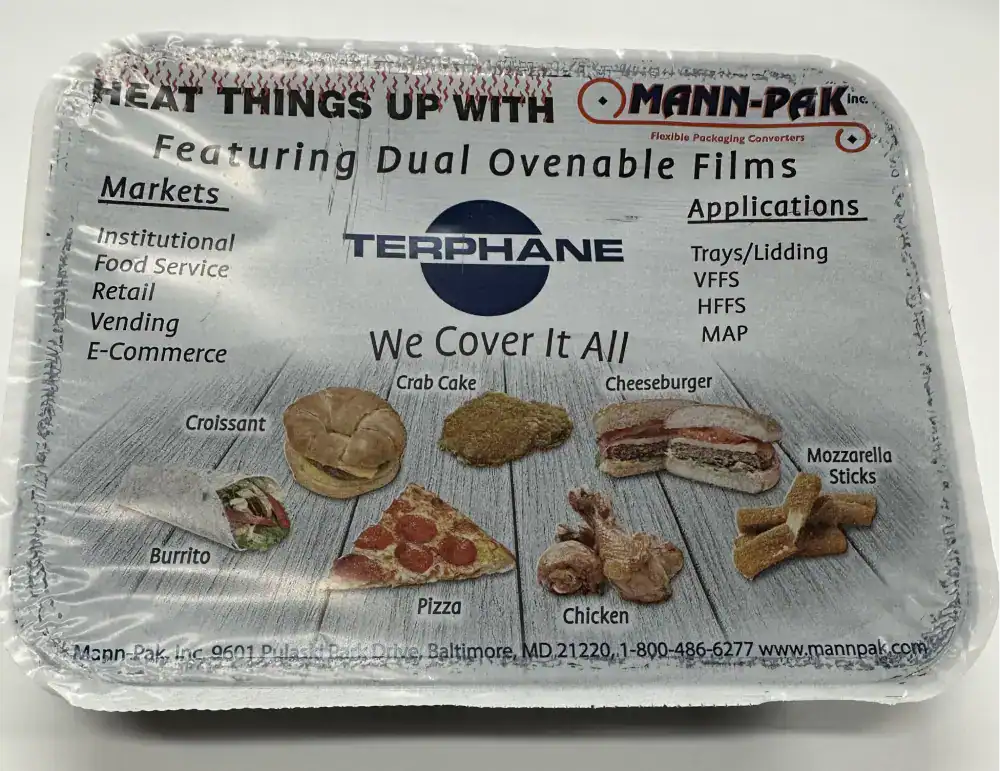
The vocabulary of dual ovenable film lives on spec sheets,quote forms and the occasional conversation on a plant floor. It is rarely written down anywhere a buyer can find it, and two people in the same plant can use the same word to mean different things.
This is the reference we wished existed: the terms you will run into when you buy lidding and overwrap film for food that gets heated in its package, explained the way the people who run the film would explain them.
Where a term is loose, informal or not standardized across the industry, we say so.
FILMS, TRAYS AND MATERIALS
Lidding film
Film sealed across the top of a tray to close it. Also called lidding stock. A lidding film has to seal reliably to the tray material underneath it, which is why the tray and the lid are usually chosen together.
Overwrap
Film wrapped around the product itself instead of sealed onto a tray. A single slice of pizza or a burrito in a convenience store case is usually over-wrapped.
FUN FACT: The same base film can often serve as either lidding or overwrap. What changes is how it is converted and how it runs on the machine.
Roll stock
Film supplied on rolls to be formed, filled and sealed on a packaging machine, as opposed to premade bags or pouches. Most food plants running lidding or overwrap buy roll stock.
Polyester film (PET)
Film made from polyethylene terephthalate. It tolerates heat well, which is why most dual ovenable lidding and overwrap films are polyester based.
BOPET
Biaxially oriented polyester film: polyester stretched in both directions during manufacture, which makes it stronger, clearer and more stable. Many lidding films start as BOPET.
Mylar
A brand name for polyester film, often used on plant floors as a generic word for any shiny polyester film.
IMPORTANT NOTE: Mylar is a trademark, not a material type. In 2024, DuPont Teijin Films rebranded globally as Mylar Specialty Films. If your spec sheet says Mylar or names a DuPont part number,it is worth confirming exactly what film it refers to today.
CPET
Crystalline polyester. An opaque tray material that tolerates oven heat. CPET trays are the usual partner for a dual ovenable lid.
APET
Amorphous polyester. A clear tray material that performs well cold but is not oven rated on its own. Often combined with CPET in one tray.
PETG
A modified, glycol based polyester, clear and easy to form.Shows up in some trays and lidding applications.
rPET
Polyester made with recycled content. Whether a lid seals reliably to an rPET tray is a real question to test, not a marketing one.
Post consumer recycled content (PCR)
Material recovered from products consumers have already used and thrown away, as opposed to factory scrap. For food contact, PCR content needs FDA approval for that use.
LET US HELP: If a retailer or brand owner is asking you about recycled content, ask your film supplier for the specific FDA food contact status of each PCR option before you commit.
Polyolefin shrink film
A shrink film made from polyolefins such as polyethylene and polypropylene, widely used for bundling and over-wrapping. It is a different family from the polyester films used for dual ovenable applications.
Glassine
A smooth, dense paper that resists grease. Used as a wrap or overwrap in bakery and confectionery.
HEATING, SEALING AND PERFORMANCE
Dual ovenable
Safe in both a microwave and a conventional oven. For a lidding or overwrap film, that means holding the seal cold, surviving oven heat, venting steam and releasing from the food, all in one package.
IMPORTANT NOTE: Dual ovenable and microwavable are not the same rating, even though they often get used as if they were. If a product might ever go into a conventional oven, check which one your film is actually rated for.
Microwavable
Rated for microwave heating only. A microwavable film may not hold up in a conventional oven.
Self venting
A film that lets steam escape in a controlled way while the food heats, instead of ballooning or blowing the seal.
FUN FACT: Without venting, a sealed package in a microwave is a small pressure vessel. That is why so many older packages tell you to pierce the film first.
Food release
How cleanly a film comes away from the food after heating.With cheese, sauces and sugary fillings, release is often the deciding performance test. This is a working term, not a standardized industry measurement.
Heat seal
A seal made by pressing film onto a tray or onto itself with heat and pressure. Every film has a range of sealing temperatures it works within.
Peelable seal
A seal designed to open by hand without tearing the film.Sometimes called easy open.
Lock seal
A permanent seal that has to be cut or torn to open. Chosen when tamper resistance or a very secure closure matters more than easy opening.
LET US HELP: Decide between peelable and lock seal before you finalize the tray. Changing your mind after tooling is expensive.
Seal through contamination
Whether a film still seals when sauce, grease or crumbs land on the tray rim. Rarely written into a spec, and one of the most common causes of seal failures on a real line.
Anti fog
A treatment that makes condensation spread into a clear sheet instead of beading into droplets, so the product stays visible in a refrigerated case.
Barrier
How well a film blocks oxygen and moisture. Higher barrier generally means longer shelf life, but not every product needs it. Food that turns over in days often does not.
MAP (modified atmosphere packaging)
Replacing the air inside a package with a gas mix to slow spoilage. MAP only works if the seal holds, which puts extra demands on the lidding film.
Shelf life
How long a packaged product stays saleable. Depends on the food, the storage temperature, the barrier and the seal. A film supplier can tell you what the film does, but shelf life has to be tested on your product.
PRINTING AND CONVERTING
Converter
A company that takes film from a film producer and turns it into what a packaging line needs: printed, slit to width, wound on cores, in usable quantities. Most film producers do not print, and most do not sell directly to food plants.
Flexographic printing
Printing from raised, flexible plates, one plate per color.The standard method for printing packaging film.
Wide web and narrow web
The width of the press. Wide web presses print large widths at high speed and suit longer, repeating runs. Narrow web presses suit shorter runs and many small designs.
FUN FACT: Press width is one of the main reasons minimum order quantities vary so much between printers. It is a question of what the equipment is built to do well.
Surface print
Printing on the outside of the film. Common for overwrap and simple branding.
Reverse print
Printing on the inside of a clear film so the ink is protected by the film itself. Usually part of a laminated structure.
Four color process
Printing full color images from four inks: cyan, magenta,yellow and black. Often combined with spot colors.
Spot color
A single, premixed ink used to hit an exact color, such as a brand color.
Plate
The raised printing surface for one color in flexographic printing. A new design or a color change usually means new plates.
IMPORTANT NOTE: Ask how plate costs are handled before you approve artwork, and what happens to printed film already on hand if the artwork changes.
Print repeat
The length of one complete printed design along the film before it repeats. It affects how designs are laid out on the press and how efficiently a run uses film.
Eye spot
A small printed mark that tells the packaging machine whereto cut or seal. Even film with no other printing usually needs one.
FUN FACT: This is why a lot of"plain" film is not actually plain. If your machine needs an eye spot, your film is already being printed.
Slitting
Cutting a wide roll of film into narrower rolls at the width your machine runs.
Centerfolding
Folding film down the middle as it is wound, so a wrapping machine can open it around the product.
Toll converting
Converting work done on material the customer supplies, fora fee.
BUYING, ORDERING AND SUPPLY
Gauge
A measure of film thickness. 100 gauge equals 1 mil. Food overwrap often runs well under 100 gauge.
Mil
One thousandth of an inch, a common unit for film thickness.One mil is about 25 microns.
Yield
How much film area you get per pound. Thinner film gives more area per pound, so going down in gauge, where the application allows, can lower cost.
LET US HELP: If your film spec has not changed in years, ask whether a thinner gauge would still do the job. Films improve, and many products are packaged heavier than they need to be.
Minimum order quantity (MOQ)
The smallest run a supplier will produce. In film it depends on the base film producer's minimum, the gauge, the print repeat and how many designs share a run. Often measured in pounds.
Lead time
The time from order to delivery. For printed film it includes getting base film in, preparing plates and printing. First orders usually take longer than reorders.
Blanket order
An agreement to buy a set quantity over a period, released in scheduled shipments. It lets the supplier plan production and usually shortens lead times.
Safety stock
Extra inventory held so a customer is never left waiting.Some suppliers hold it for customers on committed programs.
Qualification run
A trial of a new material on the customer's own product and equipment before a production order. Confirms the film seals, runs and performs as expected.
IMPORTANT NOTE: A data sheet tells you what a film can do. A qualification run tells you what it does on your line. Treat them as two different things.
Second source
An approved backup supplier for a material, so production does not stop if the main supplier runs late or short.
Form fill seal (HFFS and VFFS)
Machines that form a package from roll stock, fill it and seal it in one pass. HFFS runs horizontally, VFFS vertically.
OD and core
Outside diameter of a finished roll, and the size of the tube it is wound on. Both have to match the packaging machine. 3 inch cores are common for food film.
Spec sheet
A supplier's document listing a film's properties:thickness, seal range, temperature range, barrier and approvals. Also called a data sheet. Worth reading against your actual application, not just filing.
SQF
Safe Quality Food, a food safety certification program used by food manufacturers and packaging suppliers. Many food buyers require packaging suppliers to hold a recognized food safety certification.
Specialized Packaging Marketplace | David Marinac |216-373-1005 | dmarinac@davidmarinac.com
Questions about dual ovenable film for your line? Ready to Get Started? Click Here

Ready to find your packaging partner?
Join hundreds of manufacturers and buyers already using PackageLink to streamline their sourcing process.