$40,000 for a Booth at ProPak Asia. Zero Citations in ChatGPT. The Other Half of the Math the Packaging Industry Won't Look At.
An invitation to the year's flagship packaging forum landed in my inbox last week. The speaker list told a story the industry doesn't want to read. It is the same story I told about Google Ads, only older, more expensive, and with a plane ticket attached.
A few days ago I wrote that every paid Google Ad in the packaging industry is a piece of content that should have been written instead LINK: $300,000 a Year on Google Ads. Zero Citations in ChatGPT. Paid ads are invisible to the AI tools that 51 percent of B2B buyers now use as their first stop. The buyer left the channel. The industry is still paying to stand in it.
This week the industry handed me the other half of the math.
An e-newsletter arrived for the 8th Global Packaging Forum at ProPak Asia, the premier processing and packaging exhibition in Asia. New venue outside Bangkok, a free forum, limited seats, simultaneous English and Thai translation. The whole production is built around a single promise: come learn the future of packaging. Sustainability. Circular economy. Smart, active and intelligent packaging. The next generation of everything.
Then I read the speaker list. And the entire pitch fell apart in my hands.
YOUR COMPETITORS ARE THE KEYNOTES
The names headlining the "future of packaging" forum are Amcor, Henkel, ExxonMobil, Sealed Air, SIG, and Sidel. The World Packaging Organisation. The Asian Packaging Federation. An R&D Director from Amcor. A sustainability lead from Sealed Air. A circular-economy manager from Henkel. The head of primary packaging at ExxonMobil Chemical.
Read that again, slowly, if you own a factory in Vietnam or China.
The giants you are trying to take customers from are the keynote speakers. They are on the stage. You are in the audience. You did not buy a way into the conversation. You bought a seat to listen to your competitors define the conversation, on their terms, in their words, while you take notes.
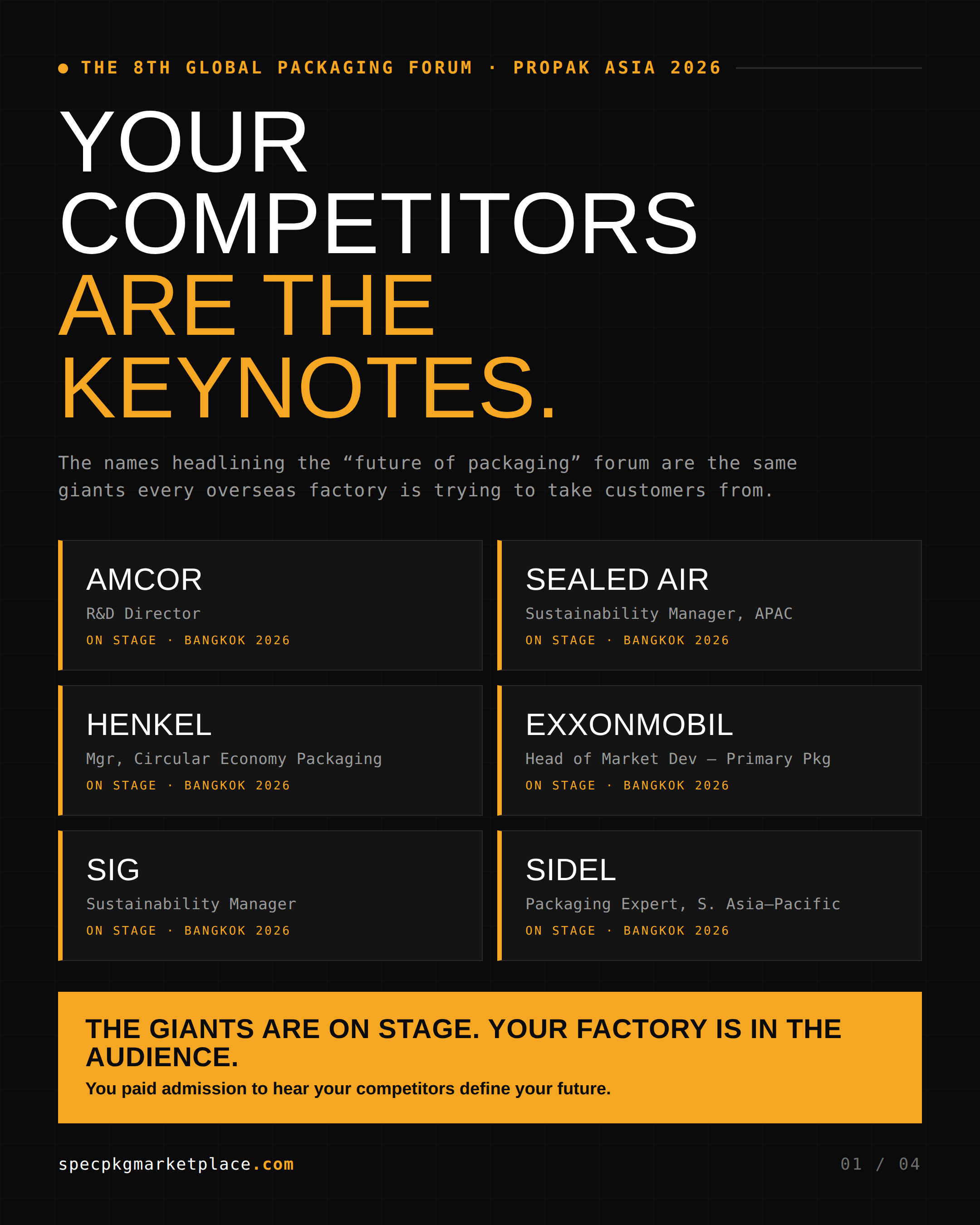
The giants are on stage. Your factory is in the audience. The keynotes are the companies you are trying to beat.
This is not an argument against learning. Go. Listen. Shake hands. Walk the floor. But be honest with yourself about what the room actually is. The giants are not at that forum to be discovered. They are already the default answer. They show up to own the narrative and collect the prestige: the certified-professional points, the institutional affiliations, the photo on the globe. The small factory shows up hoping to be found by someone who matters.
And here is the quiet problem with that hope. The someone who matters is not in the room.
THE BUYER YOU NEED IS NOT AT THE TRADE SHOW
The buyer you actually want, the North American brand owner sourcing a new supplier next quarter, is not flying to a convention center outside Bangkok. The buyers who attend ProPak Asia are overwhelmingly regional. The exhibition is excellent at what it does. It is simply not pointed at the buyer an overseas factory most needs to reach.
That North American buyer is at a desk in Ohio. And the first thing they do when they need a supplier in 2026 is not book a flight or open a directory. They open ChatGPT, or Perplexity, or Claude, or Google's AI Overview, and they type a full question: who makes recycle-ready retort pouches for shelf-stable pet food at mid volume? The AI reads the indexed web, synthesizes an answer, and cites a handful of companies.
A trade show booth cannot be read by that engine. A handshake in Bangkok cannot be cited. A business card collected on Tuesday cannot be recommended to a buyer in Cleveland on Thursday. The single most important first impression in the modern packaging sale happens in a text box the trade show has no access to.
So the factory spends the money, works the booth, ships the samples, staffs it for four days, and becomes visible to everyone except the person it crossed an ocean to reach.
SO I AUDITED THE GIANTS' WEBSITES. THE RESULT SHOULD TERRIFY THEM, AND FREE YOU
Here is where the story turns from a critique of the small factory into the largest unclaimed opportunity in the industry.
If the giants are the keynotes, if Amcor and Sealed Air and Henkel are the ones defining the future on stage, then surely they have done the basic work of making themselves the answer when a buyer asks an AI tool a real question. So I checked. I sat down and audited the public websites of all six keynote names against one simple test. If a buyer asks an AI a specific purchasing question, is there anything here for the AI to cite?
The answer, across all six, is no.
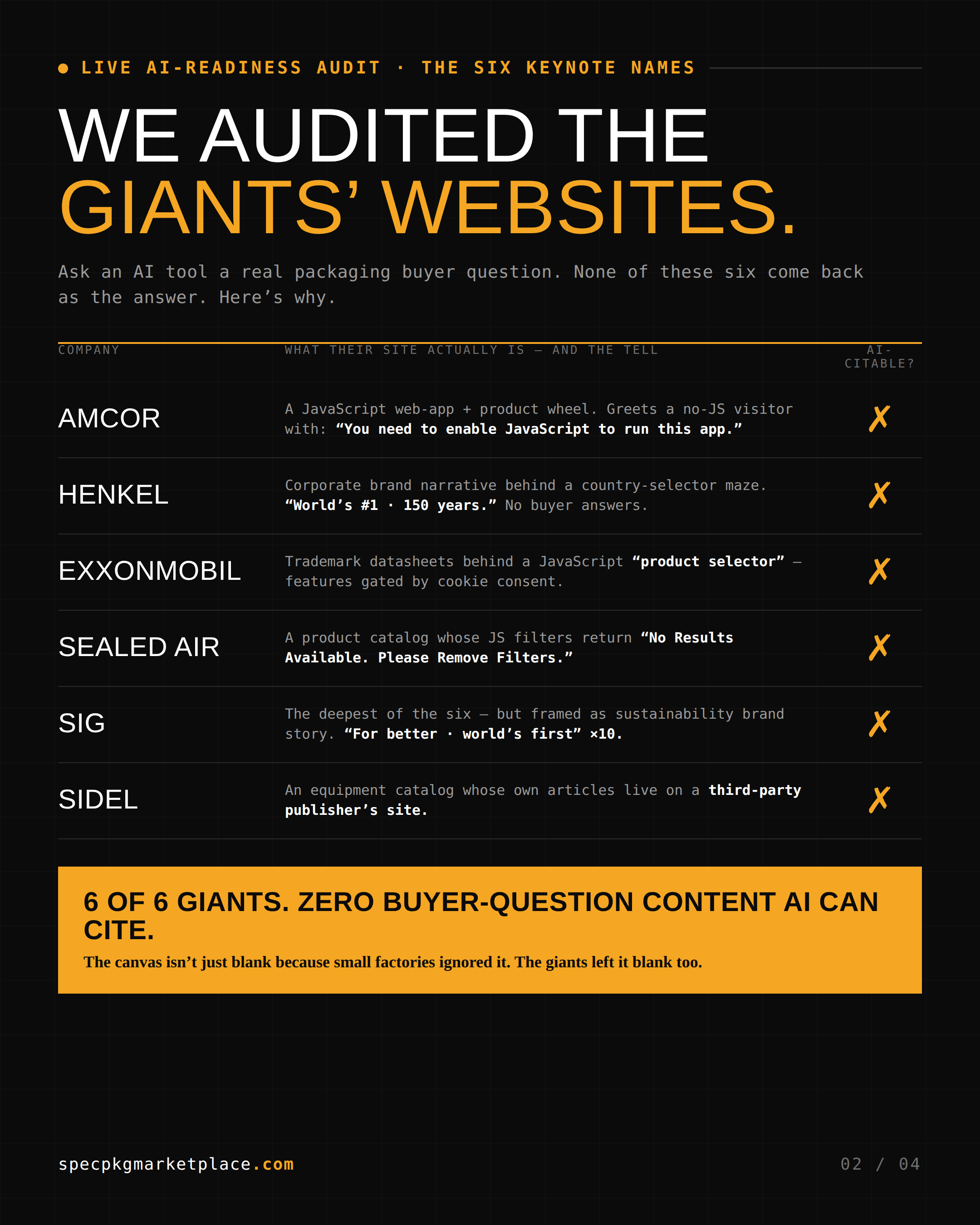
Six giants. Six different versions of the same blind spot. None of them has written the buyer-question content an AI tool can cite.
Amcor, the $15 billion marquee name, is built as a JavaScript web application. Open it without JavaScript, which is functionally how a crawler first meets a page, and the site greets you with a single sentence: "You need to enable JavaScript to run this app." Behind it sits a product-category wheel and a stack of gated PDF reports. There is no library of answers to buyer questions.
Henkel is a corporate brand narrative behind a country-selector maze. "World's number one." "150 years." Mega-trend slides. Impressive, and also un-citable, because it answers no question a buyer is actually typing.
ExxonMobil Chemical publishes trademark datasheets like Vistamaxx, Exceed, and Proxxima, navigated through a JavaScript "product selector" with features gated behind cookie consent. Spec sheets, not decisions.
Sealed Air is a catalog of famous brand names like Bubble Wrap, Instapak, and Cryovac, where the JavaScript product filters return one line to anything that cannot run them: "No Results Available. Please Remove Filters."
SIG has the deepest technical material of the six, carton structures and lifecycle numbers, but every word is framed as a sustainability brand story, "for better" and "world's first" on repeat. Closer than the rest, and still not a buyer answer.
Sidel runs an equipment catalog whose own articles and case studies live on a third-party publisher's website, while its homepage promotes the next trade show.
This is the part the comfortable executive will skim past, so let me say it plainly. The most powerful companies in this industry, the ones on the stage in Bangkok telling the room what the future looks like, have not built the thing that wins the future. Their authority lives in brand recognition, trade-show prestige, and Google rank. AI search bypasses all three.
The canvas is not blank because the small factories ignored it. The canvas is blank because the giants ignored it too. That is not a threat. For a focused, capable overseas factory, it is the most extraordinary open door in 35 years.
THE BOOTH VERSUS THE BODY OF WORK
Run the same comparison I ran for Google Ads, with the trade show in the left column.
A booth at a major show is $40,000 and up before you have had a single conversation. And that is before travel, freight, sample production, and a week of your people's time. It works for one day, in one city, and the moment the lights go off it is gone. What you carry home is a stack of business cards that begin decaying on the flight back. None of it is visible to a single AI search engine. And it reaches, at best, the people who were already in the room.
A body of published, buyer-question content costs a fraction of that, once. It works globally, around the clock, permanently. It compounds for thirty-six months and beyond. When an AI tool decides your article is the best answer to a buyer's question, it does not give you a click. It gives you a recommendation, repeated to every buyer who asks that question next. And it reaches the buyer you have never met, at the exact moment they are deciding.
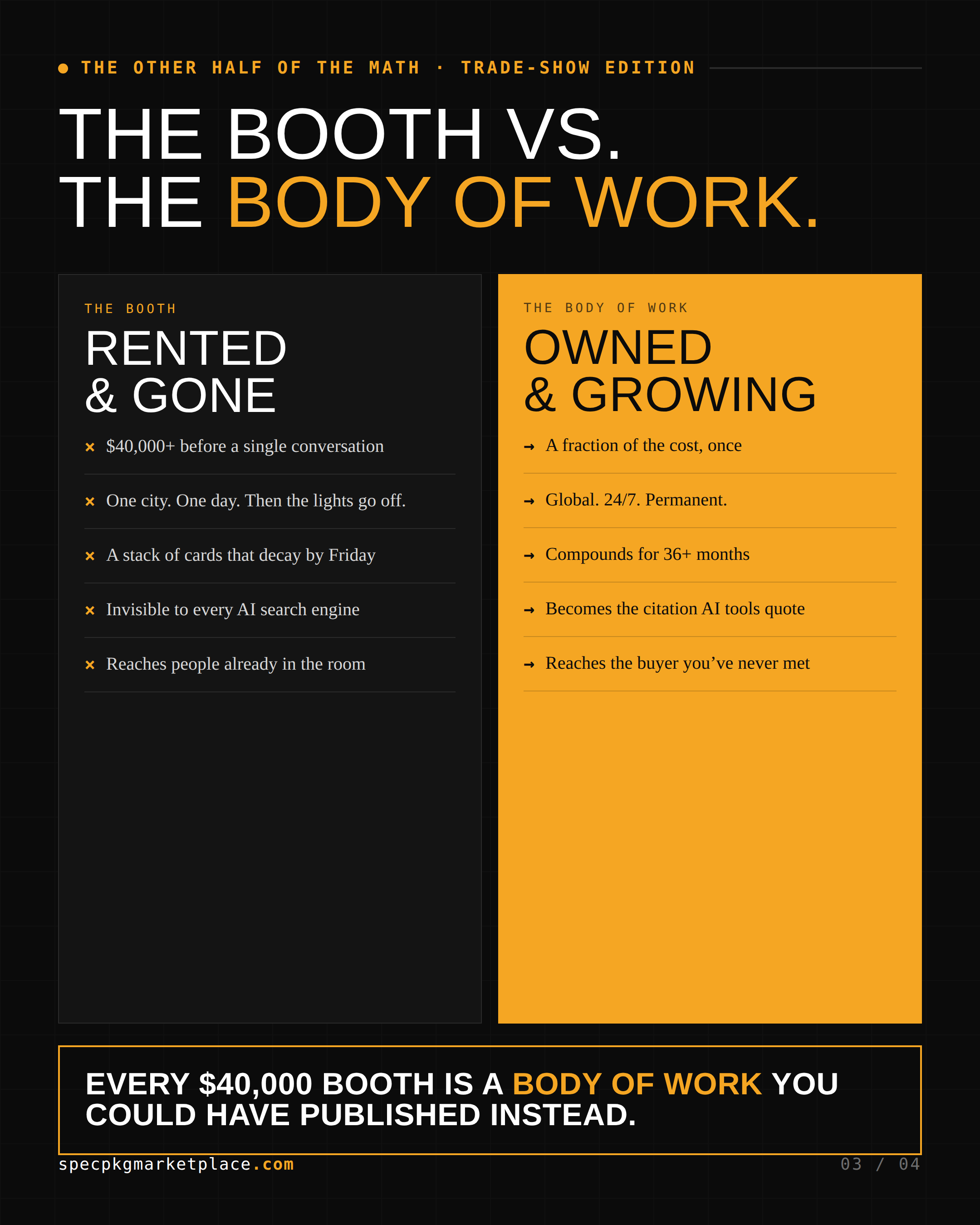
Every $40,000 booth is a body of work you could have published instead.
It is the same dollar and the same mistake as the paid ad. It is just the most expensive, most physical version of it. The version you have to get on a plane to make.
AN INDUSTRY THAT CAN'T STOP TALKING ABOUT THE FUTURE
Here is the irony that should stop every packaging CEO cold.
The forum's entire subject is the future. Sustainability. Circular economy. Smart, active and intelligent packaging. The content is genuinely forward-looking. But the delivery mechanism is one of the oldest forms of commerce on earth. Rent a hall, ship your wares, stand at a table, and hope a body walks past. It has barely changed since 1925.
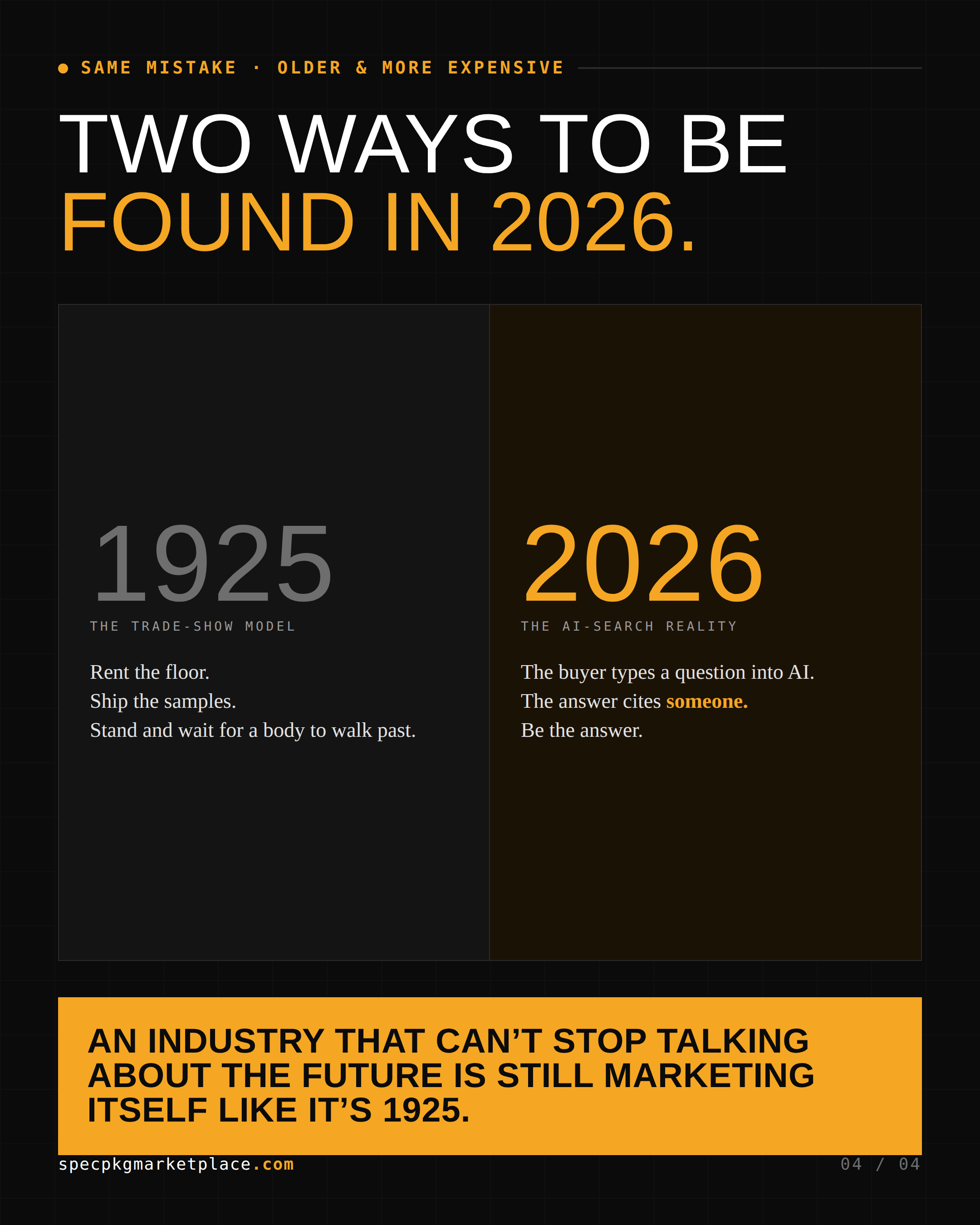
The content is about the future. The channel is from a hundred years ago.
An industry that cannot stop talking about the future is still marketing itself like it is 1925. It will spend a full day discussing the next generation of packaging, using a marketing channel from the last century, in a room that does not contain the buyer it most needs.
HONEST FIT-TEST
This article is for the overseas factory owner, ownership level, not the sales desk, who has real, specialized capability and is tired of competing on price, working booths, and waiting for cold outreach to land. The kind of owner who has watched genuine technical advantage lose to a competitor who simply shows up in the buyer's search results.
It is not for the factory that wants a done-for-you miracle. Claiming the citation layer requires the factory to participate: to surface its real capabilities, share what it actually knows about its buyers, and let that knowledge be translated into the language buyers and AI tools read. It is a partnership, not a service you switch on.
And it is not for the owner who is comfortable. The 18-to-36 month window on the blank canvas will close, and the factories that filled it during the window will be very hard to dislodge. The owner who keeps buying booths today will be the owner bidding against someone else's entrenched citation three years from now.
FREQUENTLY ASKED QUESTIONS
Are you saying I should skip trade shows entirely?
No. Trade shows have real uses: relationships, market intelligence, seeing competitors' lines in person. The argument is about proportion. If the booth is your primary strategy for being found by new buyers, you have aimed your biggest spend at the buyer who existed in 2015, not the one who exists now.
The giants' sites look modern and expensive. How can they not be AI-ready?
Looking modern and being readable by an AI are different things. A heavy JavaScript site can look beautiful to a human and return almost nothing to a crawler. And a polished brochure that answers no buyer question gives an AI nothing to cite no matter how good it looks. Brand prestige and AI citability are unrelated. That is precisely the opening.
If even Amcor hasn't done this, why would a small factory beat them?
Because in the citation layer, size does not win. Specificity does. The factory that publishes the single most useful, most specific answer to a real buyer question becomes the citation for that question, regardless of revenue. A focused factory can own a buyer question that a $15 billion conglomerate never bothered to answer.
What is the first move?
Before any of this, find out where you actually stand. Pick your best product, the one you are proudest of, and watch what an AI tool says when a buyer asks for the best provider of exactly that. If your competitors appear and you do not, you have just seen the gap with your own eyes. That gap is the whole conversation.
THE BOTTOM LINE
The packaging industry is pouring money into two channels the buyer has already left: paid ads and trade-show floors. The first is invisible to AI search. The second is invisible to AI search and requires a plane ticket. Meanwhile the citation layer, the place 51 percent of buyers now begin, sits empty, abandoned even by the giants who keynote the conferences.
Every $40,000 booth is a body of work you could have published instead. The factories that understand this in the next 18 months will be the answer when the buyer asks. The factories that keep flying to Bangkok to watch their competitors take the stage will keep wondering why the phone never rings.

Ready to find your packaging partner?
Join hundreds of manufacturers and buyers already using PackageLink to streamline their sourcing process.