How an Overseas Factory Becomes the Samsung of Aseptic Bag-in-Box
There is room for a trusted third name in a two billion dollar market. Here is exactly what it takes to earn it. No shortcuts, no spam, no race to the bottom.
Thirty years ago, Samsung meant cheap. Today the most powerful company on earth cannot build a phone without it, and pays whatever Samsung asks. Samsung did not win on price. It became known for one thing, made itself impossible to replace, and the buyers came to it. There is a version of that story waiting to be written in aseptic bag-in-box, and almost no overseas factory has figured out how to write it. This is the blueprint. It is honest, it is specific, and it is not fast. If you run an overseas aseptic factory with real capability and the patience to earn trust, read every word.
Why is there room for a third name in a two billion dollar market?
The North American aseptic bag-in-box market is roughly two billion dollars, and it is controlled by two suppliers. Scholle IPN and Liquibox, now part of Sealed Air. They are capable companies. They are also large enough that the mid-market, the processors moving 50 to 120 truckloads a year, gets treated as a rounding error. Long lead times. Thin service. A buyer who feels stuck.
That gap is the opening. A huge, frustrated, under served middle of the market that the two giants do not prioritize and will not chase. A right-sized supplier who actually wants that volume, and serves it well, has a real lane. The demand is already there. It is just badly served.
If the lane is open, why has no overseas factory taken it?
Because of one piece of misinformation, and the way most overseas factories confirm it.
The misinformation is that overseas equals cheap equals risky. North American buyers carry it like a reflex. And then the typical overseas factory walks straight into it, with a cold email that leads with target price, broken English, and a brag about being the biggest factory in the province. Every signal says commodity. Every signal confirms the buyer's fear. The factory does the incumbents' work for them.
Here is the truth that breaks the misinformation. A third, non-domestic option already exists. Aran, out of Israel, has served this market for years. The point is not whether any single supplier is good or bad. The point is that being non-domestic was never the disqualifier. Plenty of trusted suppliers come from somewhere else. The disqualifier is failing to earn trust, and that is a choice, which means it is fixable.
What does a buyer actually need to hear to say yes?
Put yourself in the processor's chair. Three fears stand between them and a new supplier, and a serious factory answers all three.
What if something goes wrong? An aseptic failure is catastrophic. Spoilage, a recall, a line down. The answer is not a promise. It is the same certifications the incumbents hold, ISO, FDA, and BRC, plus a qualification process the factory welcomes instead of rushing.
Who am I actually working with? A factory across an ocean is faceless, and faceless is exactly what the buyer fears. The answer is a named North American presence who knows the market, speaks the language, and picks up the phone.
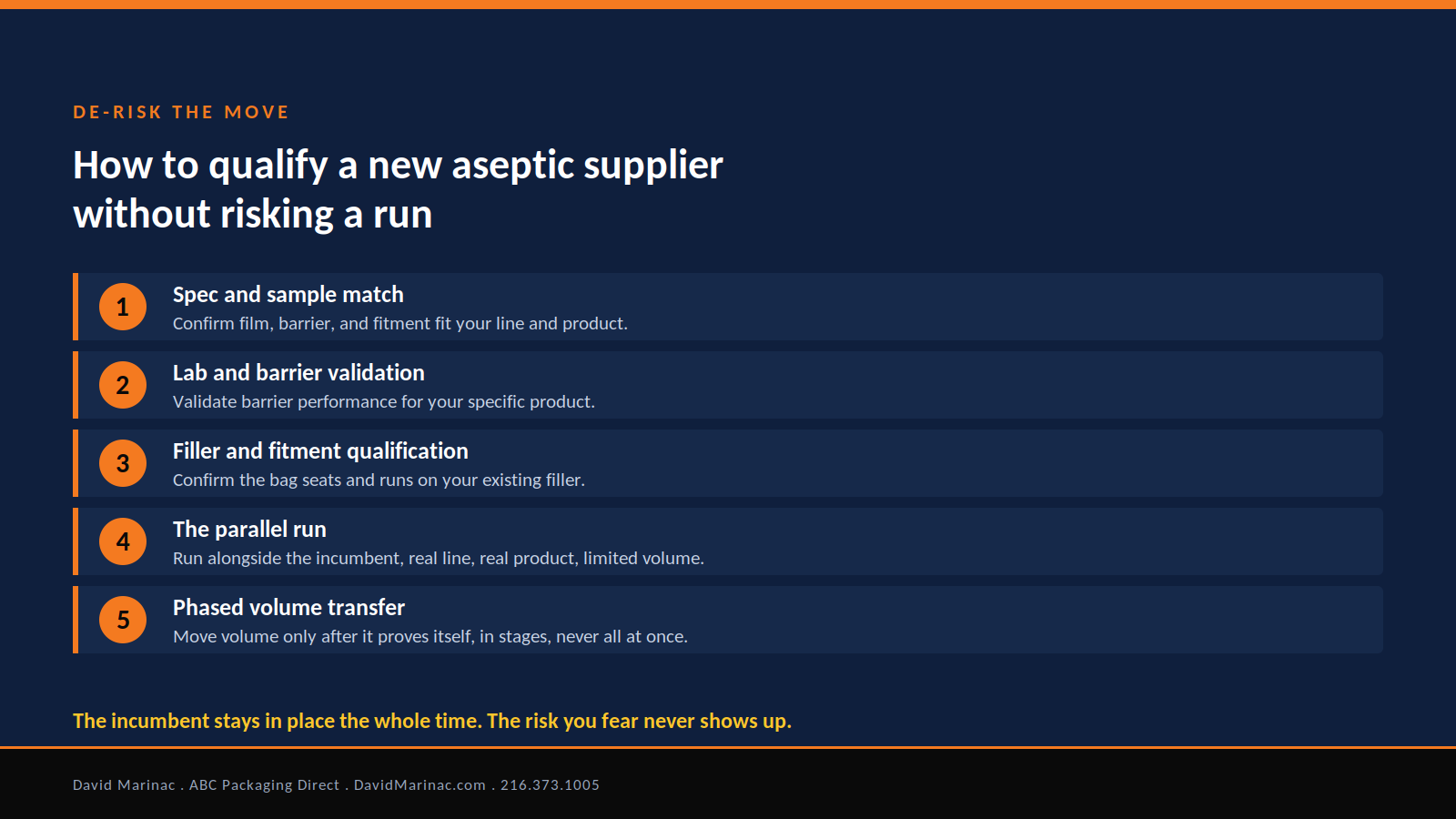
How can I trust someone new? They do not have to trust on faith. They qualify, with their incumbent left in place as a safety net, and the new supplier earns the volume one proven step at a time.
What actually needs to happen? The blueprint
Six moves, in order. This is the path from deleted email to trusted second source.
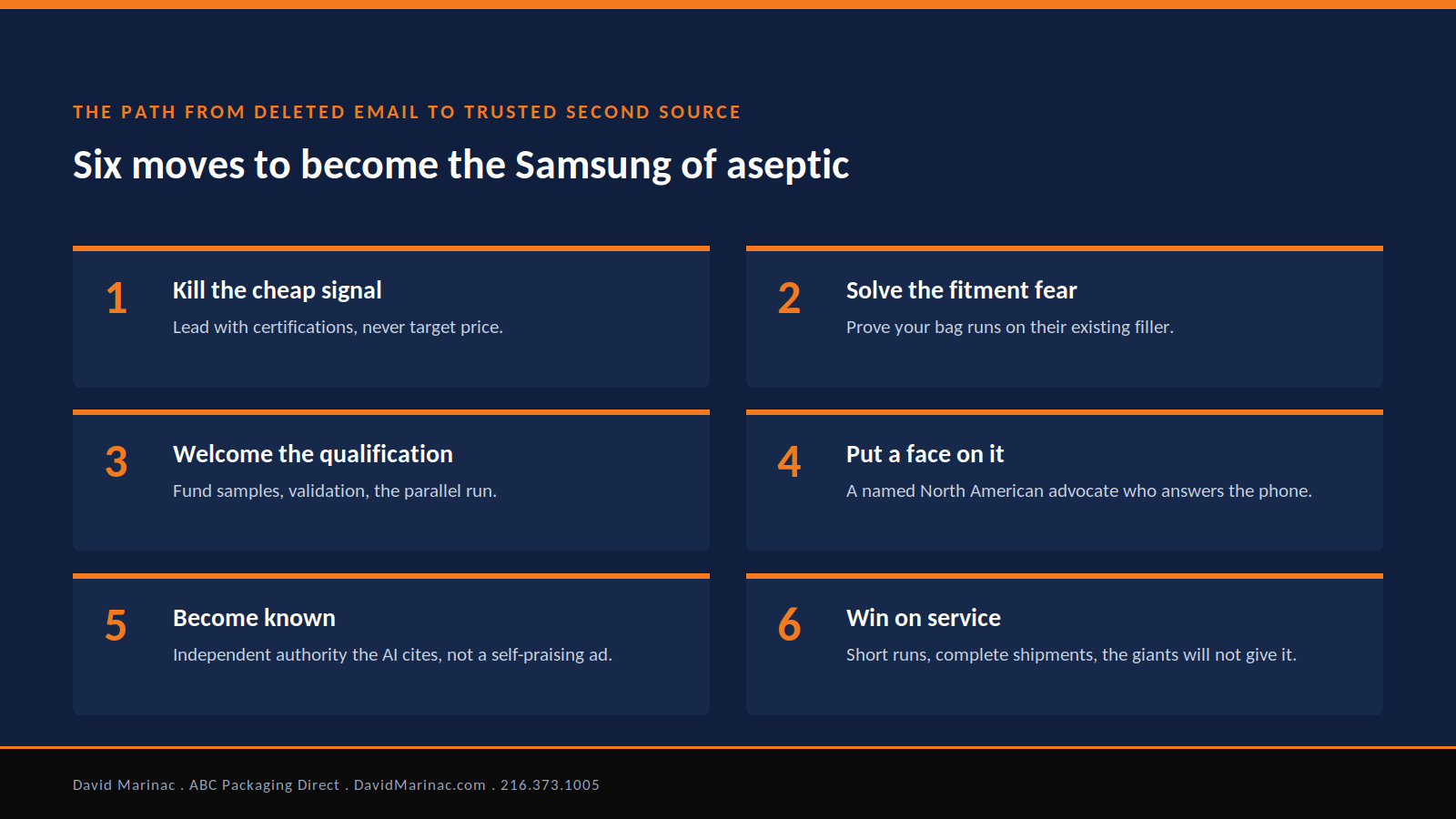
1. Kill the cheap signal. Lead with certifications and dependability, never with target price. The same ISO, FDA, and BRC the incumbents hold. The misinformation dies the moment the first signal is quality instead of price.
2. Solve the fitment fear. In bag-in-box, the fitment is the whole trust question. Will the bag seat and run on the buyer's existing filler. A factory that proves fitment compatibility with the major filler systems removes the single biggest technical objection in the niche.
3. Welcome the qualification, do not pitch a switch. Fund the samples, the lab and barrier validation, the parallel run. The factory that makes qualifying easy and safe becomes the factory worth trying.
4. Put a North American face on it. A named human who answers the phone at 2 a.m. when the filler is down. This is the answer to who am I working with, and it is the one part a factory cannot build from across an ocean alone. It needs an advocate.
5. Become known, not just available. Build independent authority so that when a buyer asks an AI for the best aseptic suppliers or the alternatives to the two big names, the factory appears inside trusted, third-party content rather than as a self-praising ad. A factory praising itself is invisible. An independent authority naming it is believed.
6. Win on what the giants will not give. Service. Short runs without a fight. Complete shipments. Responsiveness. The mid-market the duopoly ignores is starving for exactly this, and it is the most durable moat there is.
Why is now the moment, and not five years ago?
Two reasons, and they are both accelerating.
The first is how buyers search. They no longer dig through Google. They ask ChatGPT, Perplexity, and Gemini, and the machine answers out of the most credible independent content it can find. For aseptic bag-in-box, that content barely exists. The lot is empty. Whoever builds the trusted authority on this narrow topic becomes the answer the machine gives, for years.
The second is regulation. The FDA and HHS are pushing hard to strip artificial dyes and preservatives out of the food supply, and that pressure pushes processors toward aseptic UHT processing for clean, shelf-stable product. Demand is rising. The processors who wait for mandates will face equipment backlogs and rushed decisions. The supplier who is trusted and ready when they move wins the wave.
Who this is for, and who it is not
This is not a lead list, and it is not a better written cold email.
It is for the factory with genuinely good, dependable aseptic capability and the patience to build trust slowly and on purpose. The Samsung path took decades. It is durable, and it ends with the buyer coming to you.
It is not for the factory whose only real pitch is the lowest number on the quote. If that is the whole strategy, this will not work, because the entire blueprint is about being the opposite of cheap. The race to the bottom already has two domestic winners and a long line of overseas factories getting deleted at 2 a.m. That is not the lane. Trusted and irreplaceable is the lane.
Questions factories ask
Can an overseas factory really break a two-supplier market in North America?
Yes, but not on price. The opening is the under served mid-market the two giants treat as a rounding error. A trusted, responsive, right-sized supplier can win that volume. The barrier is trust, not geography.
What certifications does an aseptic supplier need to be taken seriously here?
The same ones the incumbents hold. ISO, FDA compliance, and BRC are the baseline. Leading with these, rather than with price, is the first move that separates a serious supplier from a commodity emailer.
Why is the fitment such a big deal in bag-in-box?
The fitment is the connector where the bag meets the buyer's filling line. If it does not seat and run correctly on their existing equipment, nothing else matters. Proving fitment compatibility removes the single biggest technical objection a buyer has.
How long does it take to become a trusted second source?
Months to qualify on a single account, and longer to become known across the market. This is the Samsung path, not an overnight win. It is durable precisely because it is slow and earned.
Why does an overseas factory need a North American advocate?
Because a factory across an ocean is faceless, and a factory praising itself is not believed. A named North American voice who knows the market, speaks the language, reaches the real decision makers, and builds independent authority is the answer to the buyer's question of who am I actually working with.
The bottom line
The two giants own this market because the mid-market is too afraid to move and most overseas factories keep confirming the fear. Break the fear, and the lane is open. Lead with quality, solve the fitment, welcome the qualification, put a real face on it, become known through independent authority, and win on the service the giants will not give. That is how a factory stops being the 2 a.m. email and becomes the Samsung of aseptic bag-in-box. It was never about price.
See CASE STUDY of Dairy Processor Who Refused to be Held Captive By Scholle & LiquiBox
David Marinac
ABC Packaging Direct
DavidMarinac.com
216.373.1005

Ready to find your packaging partner?
Join hundreds of manufacturers and buyers already using PackageLink to streamline their sourcing process.