
What Does Aseptic Bag-in-Box Actually Cost?
Nobody will give you a straight answer, so here is how the cost really works. The four drivers, the real ranges by size and supply path, and how to read a quote so you stop overpaying.
Search "what does aseptic bag-in-box cost" and you get almost nothing useful. Every supplier hides the number behind "contact sales," and the few pages that exist are written by machine vendors trying to sell you a line. So buyers walk into quotes blind, get two numbers that look wildly different, and have no way to tell whether they are being played. I have sat on both sides of that table for thirty-five years. Here is the part nobody will write down: the honest map of what drives the price, what range is normal, and how to read a quote so you stop overpaying.
This is not a price list. A price to the penny would be wrong tomorrow anyway, because resin moves, volume changes, and no two specs are the same. What you actually need is the shape of the cost. That is what this is. And the shape is worth knowing, because brands that move to aseptic tend to see a 15 to 25 percent total cost reduction over time once logistics, storage, and waste savings are counted. The upfront number is only part of the picture.
What actually drives the price of an aseptic bag-in-box?
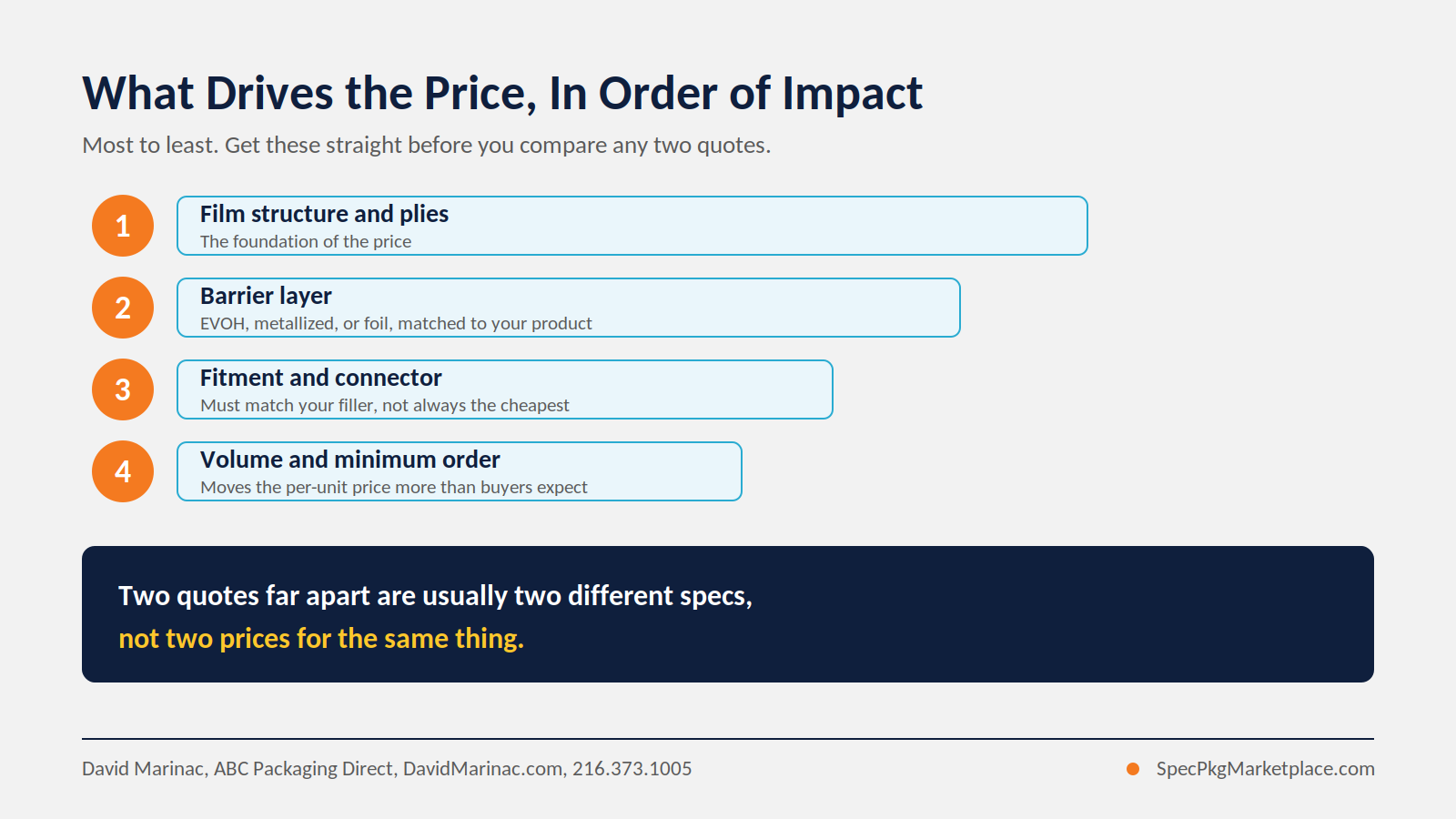
Four things, in order of impact.
The film structure and the number of plies. A simple structure costs less than a heavy multi-ply build. This is the foundation of the price.
The barrier layer. A high-barrier film for dairy or a sensitive juice costs more than a basic structure, because the barrier is what protects shelf life. You pay for the barrier your product actually needs, and you should not pay for more than that.
The fitment and connector. Connector style and quality vary widely, and the fitment that matches your filler is not always the cheapest one on the sheet.
Volume and the minimum order quantity. This moves the per-unit price more than buyers expect. Run length and MOQ can swing the number further than the film itself.
Here is the part nobody explains. When you are staring at two quotes that look far apart, you are almost always comparing two different film and fitment specs, not two different prices for the same thing. Line the specs up first. Then compare the prices.
How does the cost change with size, from retail to bulk?
Size changes the math completely. A small retail bag, the 3 to 5 liter range that goes on a shelf, carries a higher cost per liter, because you are paying for more film, more fitments, and more handling per liter of product. As you move up into bulk, the 220 liter and 1000 liter sizes that feed a plant or a filler, the cost per liter drops sharply, because one large bag carries far more product per fitment and per unit of film.
So the first cost question is not "what does a bag cost." It is "what size am I actually buying, and how much product moves through it." A retail program and a bulk program are two different cost worlds, and a quote for one tells you almost nothing about the other.
Should you use a co-packer or bring filling in-house?
This is the biggest cost fork, and it is a capital question, not a per-unit question.
The co-packer path means low upfront cost and a higher cost per unit. Someone else owns the line and the risk, and you pay for that convenience in the per-unit price. It is the right path when you are launching, testing a market, or running volume that is low or unpredictable.
Bringing filling in-house means high upfront cost and a lower cost per unit. You carry the capital and the operating burden, and in exchange the per-unit number comes down. There is a middle path too, a modular system, that sits between the two on both capital and per-unit cost.
The whole decision turns on one thing: volume. More steady volume justifies more capital, because it spreads the equipment cost across more units. Below a certain volume the co-packer wins on total cost. Above it, the line pays for itself. The crossover point is where the real decision lives, and it is specific to your numbers.

How does aseptic bag-in-box compare on cost to the alternatives?
Cost only means something next to the alternative you would otherwise pick. Here is the honest read on the main ones.
Versus the aseptic carton. Cartons can win on per-unit cost at very high retail volumes and on retail-shelf presentation, but they lock you into a narrow size range and a filler relationship. Bag-in-box wins on bulk, on flexibility of size, and on lower entry cost.
Versus drums and totes for bulk liquid. Drums and totes carry real costs people forget: return logistics, cleaning, and far heavier handling. Bulk bag-in-box is usually lighter, single-trip, and cheaper to ship and dispose of, though drums still win for certain heavy industrial duties.
Versus the spouted pouch. Pouches win for small retail single-serve and shelf appeal. Bag-in-box wins the moment volume per unit goes up, because the pouch cost per liter climbs fast at larger sizes.

What hidden costs show up when you switch suppliers?
This is where it was never about price. The sticker on a new quote is not the real cost of switching. The real costs are validation and qualification runs, the spec match work, the parallel run while you prove the new bag holds up, and the risk of downtime if it does not. A new supplier whose bags fail where the old ones did not can cost you a production run, which dwarfs the per-unit savings that tempted you.
That is not a reason to stay captive. It is a reason to qualify, not switch on price alone. Price the move with the qualification cost included, and the comparison gets honest.
How do resin prices and tariffs affect the cost this year?
Film is a resin product, so the price tracks resin markets and tariffs, and it moves. Any quote is a snapshot of a moving number. When you get a quote, ask what it is indexed to and how it adjusts, so you are not surprised when the market shifts. A supplier who will not talk about the index is telling you something.
When is aseptic bag-in-box not the cheapest answer?
Be honest with yourself before you buy. If your volume is very low and unpredictable, a co-packer or even a different format may beat bag-in-box on total cost. If your product is fine refrigerated with a short shelf life and a tight distribution radius, you may be paying for shelf stability you do not need. And if you sell single-serve on a retail shelf, a pouch or carton may serve the product better. Aseptic bag-in-box earns its cost when you need shelf stability, flexible sizes, and bulk or mid-volume economics. When you do not, the cheapest answer is a different one, and a straight broker will tell you that.
What does the cost look like when it works?
Here is the payoff done right. A cold brew coffee brand moved to aseptic and took its shelf life from 60 days to 9 months. Shipping weight dropped by about 65 percent, which pulled freight costs down by roughly 18 percent. Ambient distribution opened up national reach that a refrigerated product could not touch, and sales grew 40 percent in the year that followed. None of that shows up on a per-bag quote. All of it shows up on the P and L. That is the difference between pricing the bag and pricing the decision.
How much does aseptic bag-in-box cost per unit?
There is no single number, because the per-unit price is set by the four drivers: film structure, barrier, fitment, and volume. A retail bag and a bulk bag are different cost worlds. The useful question is not the price of a bag, it is the price of your spec at your volume.
Is aseptic bag-in-box cheaper than cartons?
It depends on volume and size. Cartons can win at very high retail volume and on shelf presentation. Bag-in-box wins on bulk, on size flexibility, and on lower entry cost. Compare them at your actual volume, not in the abstract.
What is a typical minimum order quantity, and how much does it move the price?
MOQ moves the per-unit price more than most buyers expect, often more than the film spec itself. A higher MOQ usually buys a lower per-unit price, which is exactly why a low-volume buyer pays more per unit. Know your real annual volume before you negotiate.
What does aseptic filling equipment cost if I bring it in-house?
Bringing a line in-house is a capital decision with a wide range depending on whether you choose a modular system or a full line. The per-unit savings only pay off above a certain steady volume. Below that volume, a co-packer is usually cheaper all-in.
The bottom line
Aseptic bag-in-box does not have a price. It has a cost structure. Four drivers set the per-unit number, size changes the math, and the co-packer versus in-house fork is a capital decision that turns on your volume. The smartest thing you can do before you ask for a quote is know your real volume and your real spec, so you can tell whether two quotes that look far apart are two prices or two different products. They are usually two different products. It was never about price. It was about knowing what you are actually buying.
Want the real numbers for your product and volume? That is exactly the conversation I have. Reach out and I will give you a straight read, no pitch. For the deeper cost breakdown and real examples, see our foundational aseptic cost guide and case studies. Compare the two incumbents in our honest Scholle vs Liquibox breakdown, and see who else can supply you in Alternatives to Scholle and Liquibox.
CLICK: Scholle vs Liquibox comparison cornerstone
CLICK: Alternatives to Scholle and Liquibox cornerstone
CLICK: standuppouches.net cost advantages breakdown
CLICK: standuppouches.net aseptic case studies
CLICK: Complete Aseptic Buyers Guide
Reach out for the real numbers on your product. No pitch, just thirty-five years of read on where the traps are. dmarinac@davidmarinac.com
David Marinac . ABC Packaging Direct . DavidMarinac.com . 216.373.1005


Ready to find your packaging partner?
Join hundreds of manufacturers and buyers already using PackageLink to streamline their sourcing process.