
Aseptic Bag-in-Box vs Aseptic Carton: The Honest Decision
Both keep a product shelf stable for months with no refrigeration. After that they are different animals. Here is when the carton wins, when bag-in-box wins, and the two things the carton makers do not put on the front of the brochure.
If you make a shelf-stable liquid, at some point you have to choose a format, and the carton companies are very good at making the carton look like the only serious answer. It is a good package. For some products it is the right one. But it is not the only one, and it is not always the best one, and a buyer who only ever hears the carton pitch ends up locked into a format that may not fit the product, the volume, or the channel.
I have spent thirty-five years on both sides of this table. Here is the honest read. Where the carton genuinely wins, where bag-in-box wins, and the two places, shipping space and recycling, where the difference is bigger than anyone tells you.
What is the real difference between aseptic bag-in-box and aseptic carton?
Both are aseptic, which means the product and the package are sterilized separately and combined in a sterile environment, so the product is shelf stable for months without refrigeration and without preservatives. That part is a tie. Both typically deliver something in the range of 6 to 12 months of ambient shelf life depending on the product and the barrier.
The difference is the package itself. An aseptic carton is a rigid or semi-rigid paperboard box, built from layers of paper, polymer, and usually a thin aluminum barrier, in fixed retail sizes. Aseptic bag-in-box is a flexible barrier bag with a fitment or tap, sitting inside a corrugated box, in sizes from about 1 liter all the way up to 1500 liter bulk. One is a finished retail unit. The other is a flexible system that scales from a retail pack to a plant-feeding tote.
Which one wins on the retail shelf?
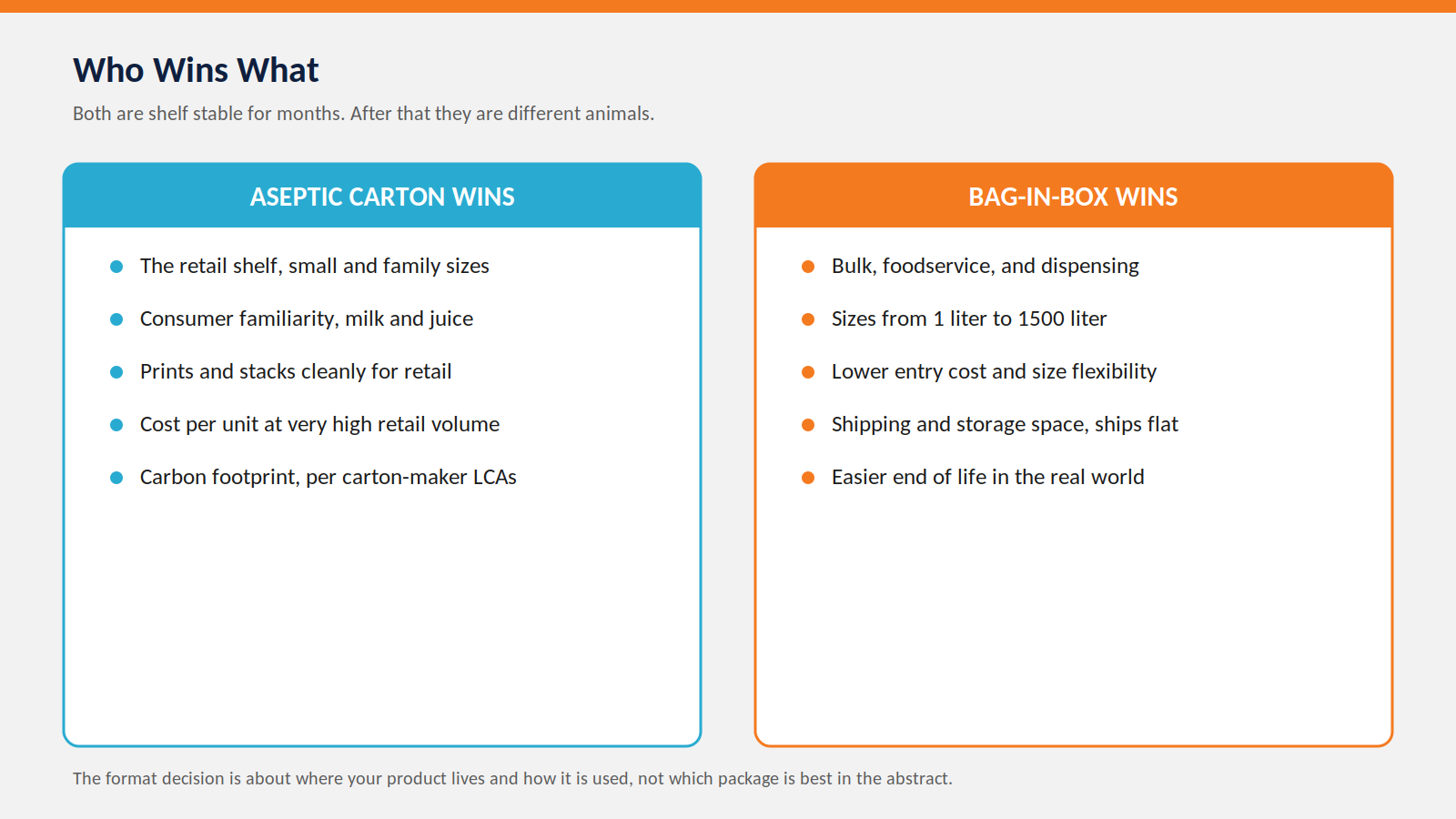
The carton, and it is not close. If your product is a consumer item that lives on a grocery shelf, single-serve or family-size milk, juice, plant-based drinks, broth, the carton is purpose-built for it. It stacks cleanly, it prints beautifully, consumers know exactly what it is, and it comes in the tidy 200 milliliter to roughly 1 or 2 liter sizes that retail wants. Bag-in-box at retail exists, but the carton owns the center-store beverage shelf for a reason.
If your buyer picks your product off a shelf, start with the carton in mind.
Which one wins on bulk, food service, and dispensing?
Bag-in-box, and it is not close the other way. The moment your product is dispensed rather than handed to a consumer, bag-in-box takes over. Food service syrup, dairy and coffee behind the counter, juice on tap, bulk ingredients moving between plants, anything from a 3 liter food service pack up to a 1000 or 1500 liter tote or IBC. The tap and fitment are built for controlled, clean dispensing. The carton simply does not play in this space.
If your product is dispensed, poured in a kitchen, or shipped as a bulk ingredient, bag-in-box is the format.
Which one wins on cost?
It depends on volume and size, and anyone who gives you a single answer is selling. At very high retail volumes in small sizes, the carton's automated, high-speed lines can win on cost per unit. But bag-in-box usually wins on entry cost, on flexibility of size, and on the cost of getting into the market without committing to a single high-speed carton line and the filler relationship that comes with it. And as size goes up, bag-in-box pulls away hard, because the cost per liter of a bulk bag is a different world from the cost per liter of a small carton.
So the cost answer tracks the shelf answer. Small retail sizes at big volume can favor the carton. Bulk, mid-volume, and dispensed favor bag-in-box.
Which one really wins on shipping and storage space?
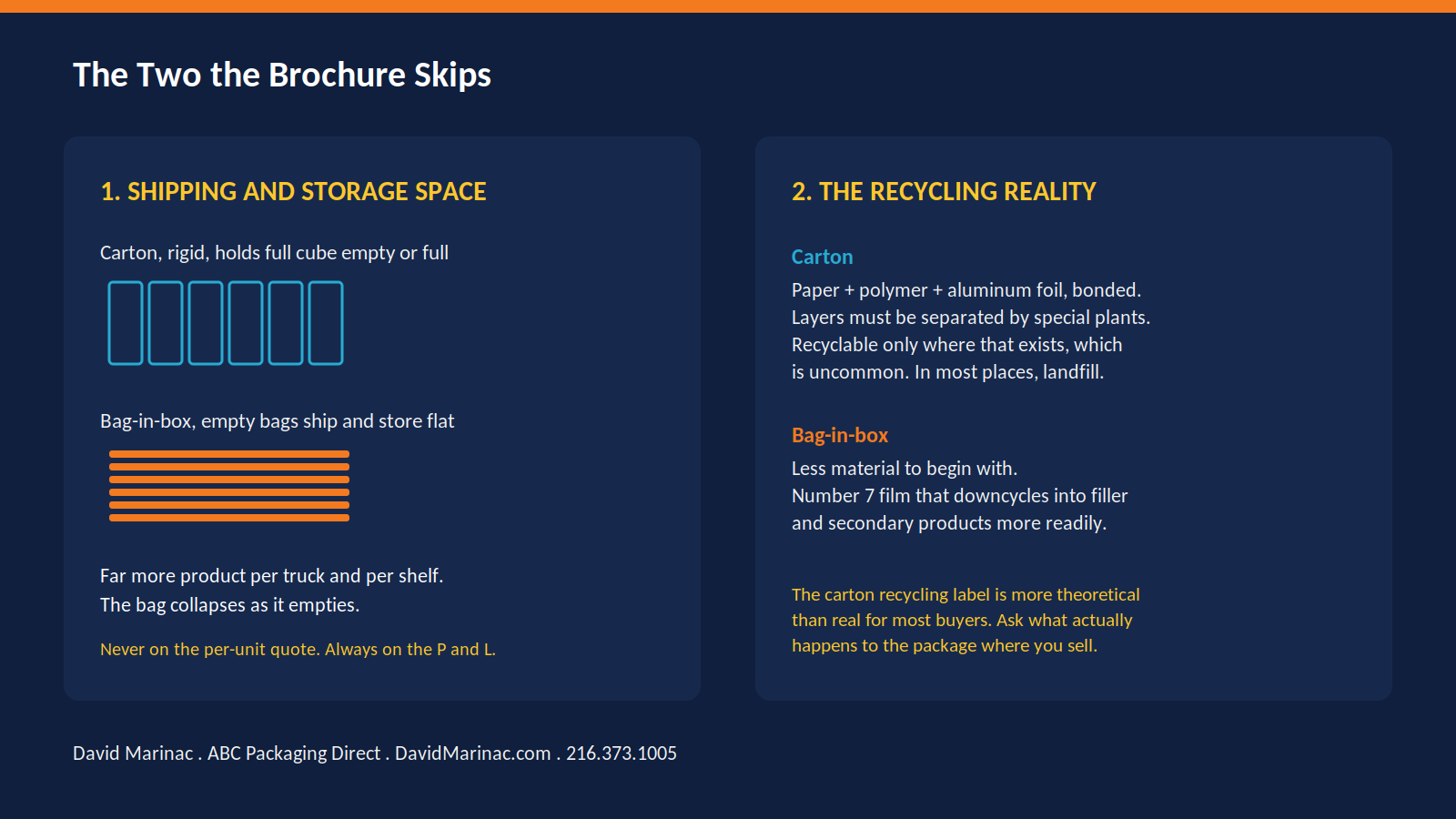
This is the one the carton pitch skips, and it is worth real money. An empty bag-in-box bag ships and stores flat. You can bring in an enormous number of empty bags in a fraction of the space and freight of pre-formed rigid packaging, and the bag collapses as it empties, so it takes almost no space on the way out either. A carton is rigid or semi-rigid and holds its full cube whether it is full or empty. Over a year of inbound freight, warehouse space, and outbound logistics, the flat-shipping, collapsing bag is a quiet, continuous saving that never shows up in a per-unit quote but shows up clearly on the P and L.
If freight and warehouse space matter to your operation, weigh this heavily. It is the advantage nobody quotes.
Which one is actually recyclable, in the real world?
Here is the honest version, because the marketing on both sides is slippery.
The carton is described as recyclable, and technically it is. But read the fine print, including the carton makers' own. A carton is a bonded sandwich of paper, polymer, and a thin layer of aluminum, and to recycle it those layers have to be separated by specialized equipment. That only happens where dedicated carton-collection and separation infrastructure exists at scale, and in most of the country it simply does not. The carton companies say as much in their own language, that cartons are recyclable where the collection and sorting infrastructure is in place. In plain terms, for most buyers in most places, the aseptic carton goes to landfill, because almost nobody is running the separation operation that its recyclability depends on.
Bag-in-box is not a clean recycling story either, and I will not pretend it is. But the flexible film is a multilayer plastic, generally a number 7, that in practice moves through the waste stream and can be down-cycled into filler and lower-grade plastic products far more readily than a fused foil-lined carton that has to be pulled apart layer by layer. Less material to begin with, and an easier end of life in practice.
So the honest read is this. The carton's recyclability is more theoretical than real for most buyers, and bag-in-box uses less material and down-cycles more easily. If sustainability is part of your decision, do not take the recycling label at face value. Ask what actually happens to the package in the places your product is sold.
What about glass, PET bottles, cans, and pouches?
Cartons and bags are not the only two options, and an honest look at the whole shelf helps you choose.
Glass wins on premium shelf presence and is inert and endlessly recyclable, but it is heavy, fragile, expensive to ship, and usually filled by hot-fill or retort rather than true aseptic. PET bottles are lighter than glass, have strong shelf presence, and are widely recycled as a number 1, and aseptic PET filling is common for juices, teas, and dairy, though a bottle uses more material per liter than a bag. Cans and metal are tough, high-barrier, and very recyclable, but heavy and energy-intensive to make, and they are a retort or fill format, not a flexible one. Spouted pouches are light and low-material for small single-serve and refills, but the cost per liter climbs fast as size goes up.
Bag-in-box sits where none of those are strong, in bulk, food service, dispensing, and mid-volume, with the best shipping economics of the group. The format decision is really a question of where your product lives and how it is used, not which package is best in the abstract.

So which should you choose?
Choose the carton if your product is a consumer retail item in small or family sizes, if shelf presence is central to how it sells, and if you have the volume to justify a high-speed carton line.
Choose bag-in-box if your product is dispensed, sold into food service, or shipped as a bulk ingredient, if you need a range of sizes from retail to tote, if you want lower entry cost and supplier flexibility, or if freight and warehouse space are real costs for you.
And if you are honestly in between, price both at your real volume, and weigh the two things the carton pitch leaves out, the shipping-space saving and the recycling reality. It was never about which package is fanciest. It was about which one fits your product, your volume, and your channel.
Is an aseptic carton cheaper than bag-in-box?
Sometimes, at very high retail volume in small sizes, where high-speed carton lines are efficient. But bag-in-box usually wins on entry cost, on size flexibility, and on cost per liter as size increases. Compare them at your actual volume and size, not in the abstract.
Do aseptic cartons and bag-in-box last the same amount of time?
Broadly yes. Both are aseptic and both typically deliver roughly 6 to 12 months of ambient shelf life, set by the product and the barrier, not by which format you pick.
Can I move a product from carton to bag-in-box?
Yes, and it is common when a product moves into food service, bulk, or dispensed formats, or when freight and space costs start to matter. Qualify the new format the same careful way you would qualify any aseptic change, do not switch blind.
Are aseptic cartons really recyclable?
Only where specialized carton collection and separation infrastructure exists, which is uncommon. The paper, polymer, and aluminum layers must be separated. In most areas that infrastructure is not in place, so in practice most aseptic cartons are not recycled.
The bottom line
Both formats keep a liquid shelf stable for months, so that is not the deciding factor. The carton wins the retail shelf. Bag-in-box wins bulk, food service, dispensing, size flexibility, shipping space, and, in the real world, end of life. Pick the format that fits where your product lives and how it is used. And do not let a recycling label or a per-unit price make the decision for you, because the two biggest differences, space and what actually happens to the package, are the two the brochure leaves out.
Want a straight read on which format fits your product and volume? That is the conversation I have, no pitch. For the money side, see what aseptic bag-in-box actually costs, and if you are weighing suppliers, start with our honest Scholle vs Liquibox breakdown and the guide to alternatives.
CLICK: Compete Aseptic Buyer's Guide
CLICK: What Aseptic Bag-in-Box Actually Costs
CLICK: Scholle vs Liquibox comparison
CLICK: Alternatives to Scholle and Liquibox
Reach out for a straight read on your product and volume. No pitch, just thirty-five years of read on where the traps are. dmarinac@davidmarinac.com
CLICK HERE to LEARN MORE: David Marinac . ABC Packaging Direct . DavidMarinac.com . 216.373.1005


Ready to find your packaging partner?
Join hundreds of manufacturers and buyers already using PackageLink to streamline their sourcing process.