
How a Contract Manufacturer Stopped Competing on Pennies
They were chasing the same accounts as everyone else, packing in the same glass and buckets, winning on price or not at all. Then they stopped competing and built a lane nobody else could enter. Start to finish, here is what happened.
Every detail below is real. The company is anonymized, as every client is in anything I publish, but nothing about the situation, the method, or the outcome has been dressed up. This is the piece I get asked for most, because it is the one thing a supplier cannot show you: proof that a mid-size manufacturer can stop fighting for scraps and build something nobody else can copy.
What was the problem?
A second-generation contract manufacturing facility. Family owned. They ran BBQ sauce, Italian sauces, condiments, mayonnaise, real food products, and they ran them well.
Their problem was not quality. Their problem was that quality did not matter in the room where the decision got made.
They were chasing the same accounts as everybody else, quoting against direct competitors who packed in the same glass jars and the same buckets, using the same processes. When every bidder offers the same thing in the same package, the only lever left is price. So they were competing on pennies. Win some, lose more, margin shrinking either way, and a next generation coming up behind them with no clear future to inherit.
That is the trap. Not being bad at the work. Being undifferentiated at the work, in a category where undifferentiated means cheapest.
What were the two options?
Keep chasing, or chart a new course.
Keep chasing meant more of the same. Quote against the same competitors, on the same product in the same packaging, and hope to be a few cents better than the last guy. The big players had scale they could never match. The direct competitors were all in the same glass and buckets. There was no move on that board that did not end in a smaller number.
Charting a new course meant offering their customers something no other contract manufacturer in their competitive set could offer, and being willing to invest to do it. That is the fork, and almost everyone takes the first road because the second one costs money and nerve.
They took the second road.
What did they actually change?
Aseptic. And this is the part people miss: not just the package, the process.
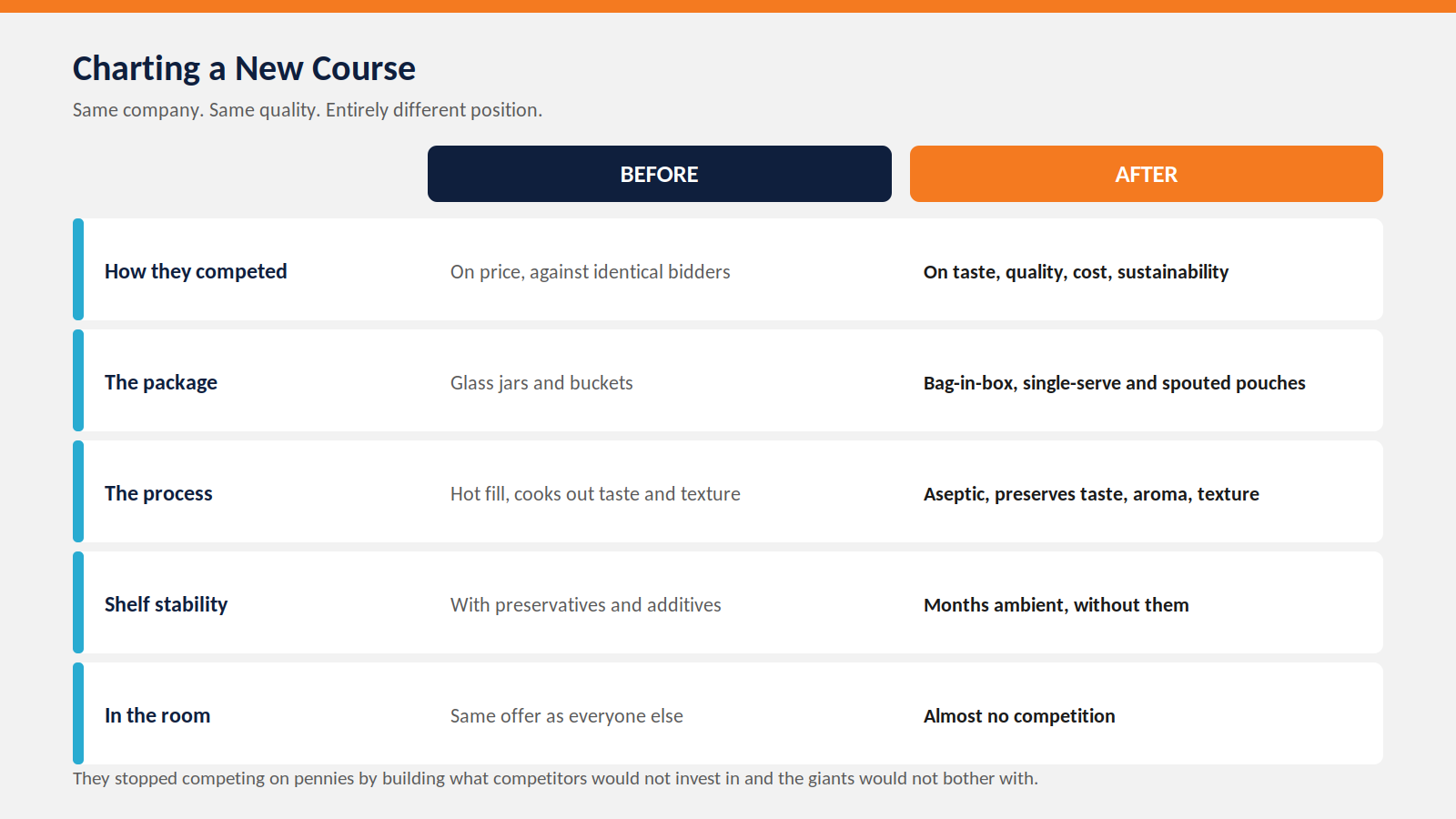
Their competitors hot filled. Hot filling works, it is proven, and it is also brutal on a sauce. The heat strips taste, flattens aroma, and damages texture. Every hot-filled sauce on the shelf is a compromise between shelf life and how the product actually tastes.
Aseptic changes that trade. The product and the package are sterilized separately and combined sterile, so you get months of ambient shelf life while preserving the taste, aroma, and texture that hot filling cooks out. For a company whose whole identity is that their sauce is genuinely good, that is not a packaging decision. That is the entire value proposition, finally protected all the way to the customer.
Then the formats opened up. Bag-in-box for food service and bulk. Single-serve pouches. Spouted pouches with caps for multi-serve. One process, a whole range of packages their glass-and-buckets competitors could not offer at all.
Why could their competitors not follow?
Two reasons, and both are durable.
The direct competitors would not invest. Aseptic requires real capital and a real change in process, and the companies around them chose to keep running what they had. That is a choice, and years later it is still a choice they have not reversed.
And the big players will not run small and medium volumes. A medium-size customer with a medium-size run is not interesting to a very large manufacturer. So there is an entire band of business sitting between what the giants will touch and what the small shops can do, and almost nobody serves it well.
This company put themselves precisely in that band, with a capability nobody around them had. Their reps started walking into target accounts with almost no competition in the room. Not a better pitch. A different category.
How was the risk actually managed?
This is the part I care about most, because the strategy is worthless if the buyer is too scared to move. And they should be scared, because their existing operation was their bread and butter and nobody sane bets that on a new process.
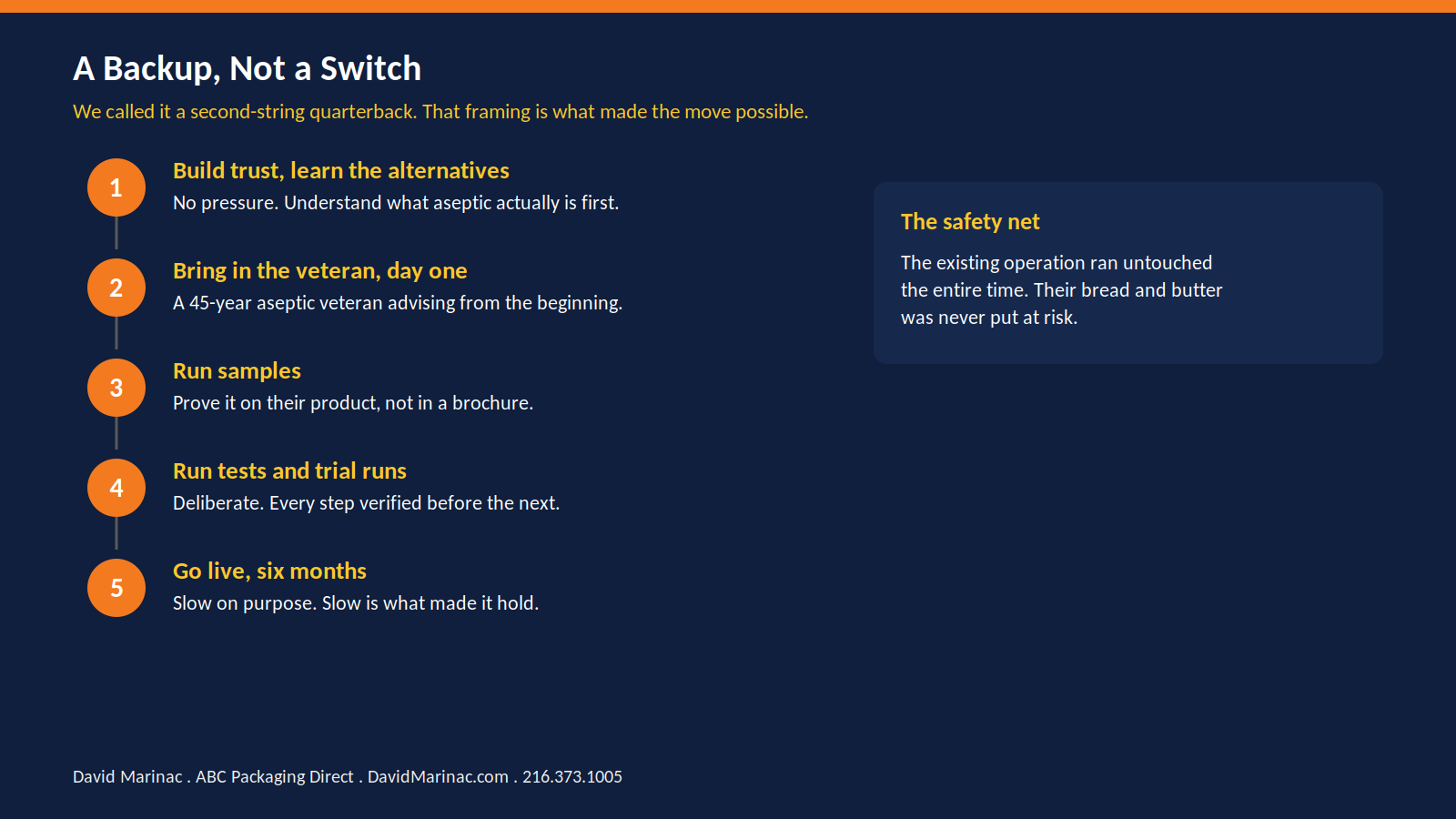
So we never called it a switch. We called it bringing in a backup. A second-string quarterback.
That framing changed everything. Nobody was being asked to abandon what worked. The existing operation stayed exactly as it was, running the business, paying the bills, untouched. The aseptic capability was being built alongside it, on the bench, ready. No pressure, no ultimatum, no bet-the-company moment. Just a capable backup being brought along the right way.
I brought in a 45-year aseptic veteran from day one, one of the first people to build and run an aseptic filling and packaging operation, to advise from the beginning rather than after the decisions were already made. Then we ran the real work in order. Learn what the alternatives actually are. Run samples. Run tests. Run trials. Prove it on their product, on their terms.
The whole thing took six months from start to filling. That is slow, and it was slow on purpose. They were deliberate, and deliberate is what made it hold.
What did it produce?
Every figure below is the manufacturer's own reported result.
Packaging cost fell about 70 percent. That number sounds impossible until you consider what they moved off. Glass and rigid containers are heavy, bulky, breakable, and expensive to ship and store. Flexible aseptic formats collapse that entire cost structure.
Sales rose about 40 percent. New opportunities rose about 64 percent. They picked up several medium-size clients, exactly the band the big players ignore.
They gained real space, fuel, and storage savings, because flexible packaging ships flat and stores small compared to glass. That is a continuous saving that never shows up on a quote and shows up all year on the P and L. It also gave them a genuine sustainability story, not a claimed one.
And they gained something that does not fit in a number. Their reps stopped defending a price and started explaining a capability.

Why does this matter more than the numbers?
Because of who their new customers became.
The medium-size clients they picked up now have superior taste and quality compared to many far larger brands, because their sauce is not being cooked flat by hot filling. Those customers are positioned to grow, and this manufacturer grows with them. That is a very different asset than a list of accounts won on price, which leave the moment someone quotes a penny less.
There was a regulatory tailwind too. Pressure to remove preservatives, additives, and artificial dyes from food is real and building. Aseptic delivers months of shelf stability without them. So a customer trying to clean up a label has a genuine reason to need this manufacturer, and not many places to go.
They did not just save the business. They positioned it for the next generation, which is what a second-generation owner is actually trying to do.
When is this not the right move?
Honestly, this does not fit everyone, and I would rather say so than sell it.
If your volume is small and unpredictable, the investment is hard to justify and a co-packer is the smarter path. If your product is fine hot filled and your customers are not asking for cleaner labels or better taste retention, you may be paying for a capability the market is not rewarding you for yet. If your operation cannot absorb a six-month deliberate build alongside running the business, the timing is wrong, and rushing it is how these go badly. And if you are not prepared to invest, this is not the move, because the capital is exactly what makes it a moat, and a moat you would not pay for is a moat your competitors will not either.
This works when you are undifferentiated, competing on price, and genuinely good at the product itself. That was this company. It is not everyone.
How long does it take to add aseptic capability?
For this manufacturer, six months from start to filling, and deliberately slow. Moving faster is possible and usually a mistake. The pace is what let them test, trial, and prove it without ever risking the operation that pays the bills.
Do you have to shut down your existing operation?
No, and you should not. Their existing operation ran untouched the entire time, as their bread and butter and their safety net. The new capability was built alongside it, which is the whole reason the move was survivable.
What makes aseptic better than hot filling for sauces?
Hot filling uses heat that strips taste and aroma and damages texture. Aseptic sterilizes product and package separately and combines them sterile, so the product keeps its taste, aroma, and texture while still gaining months of ambient shelf life without preservatives.
Why can big manufacturers not just do this too?
They can, and for large volumes they do. What they will not do is run small and medium volumes, because those runs are not worth their capacity. That leaves a real band of business open to a mid-size manufacturer willing to invest, and that band is where this company built its lane.
The bottom line
They were competing on pennies because nothing about what they offered was different. They stopped competing on pennies by building something their competitors would not invest in and the giants would not bother with. The capital mattered, but the method mattered more. A backup, not a switch. A veteran involved from day one. Samples, tests, trials, six deliberate months, and the existing operation never touched. It was never about price. It was about being the only one in the room who could do the thing.
Wondering whether this fits your operation? That is exactly the conversation I have, and it starts with an honest read, not a pitch. If the answer is that it does not fit you, I will tell you that too.
Get a straight, no-pitch read on whether aseptic fits your product and volume
Download the Supplier Evaluation Checklist to see how the qualification actually runs
Best Aseptic Bag-in-Box Suppliers
What Aseptic Bag-in-Box Actually Costs
Alternatives to Scholle and Liquibox cornerstone
Reach out for a straight read on your operation. No pitch, just thirty-five years of read on where the traps are. dmarinac@davidmarinac.com
How a Southwest Dairy Won a Major Contract
Complete Aseptic Buyer's Guide
David Marinac . ABC Packaging Direct . DavidMarinac.com . 216.373.1005



Ready to find your packaging partner?
Join hundreds of manufacturers and buyers already using PackageLink to streamline their sourcing process.