Scholle vs Liquibox: Who Really Owns Your Bag-in-Box Supplier Now
A buyer comparing Scholle and Liquibox is really comparing two giants. One is owned by a Swiss public company. The other sits inside a business that just went private. Here is what that ownership reality means for your account, your lead times, and your leverage.
One is owned by a Swiss public company. The other sits inside a business that just went private. Almost nobody searching this comparison knows that, and it changes what the choice means.

When a mid-market processor sits down to choose between Scholle and Liquibox, they think they are comparing two packaging companies. They are not. Not anymore. They are comparing two arms of much larger organizations, and the people who set the priorities for your account now sit a long way from your plant. I have watched buyers make this call for years without knowing the ground had shifted under them. Here is the part nobody is telling you.
Who actually owns Scholle now?
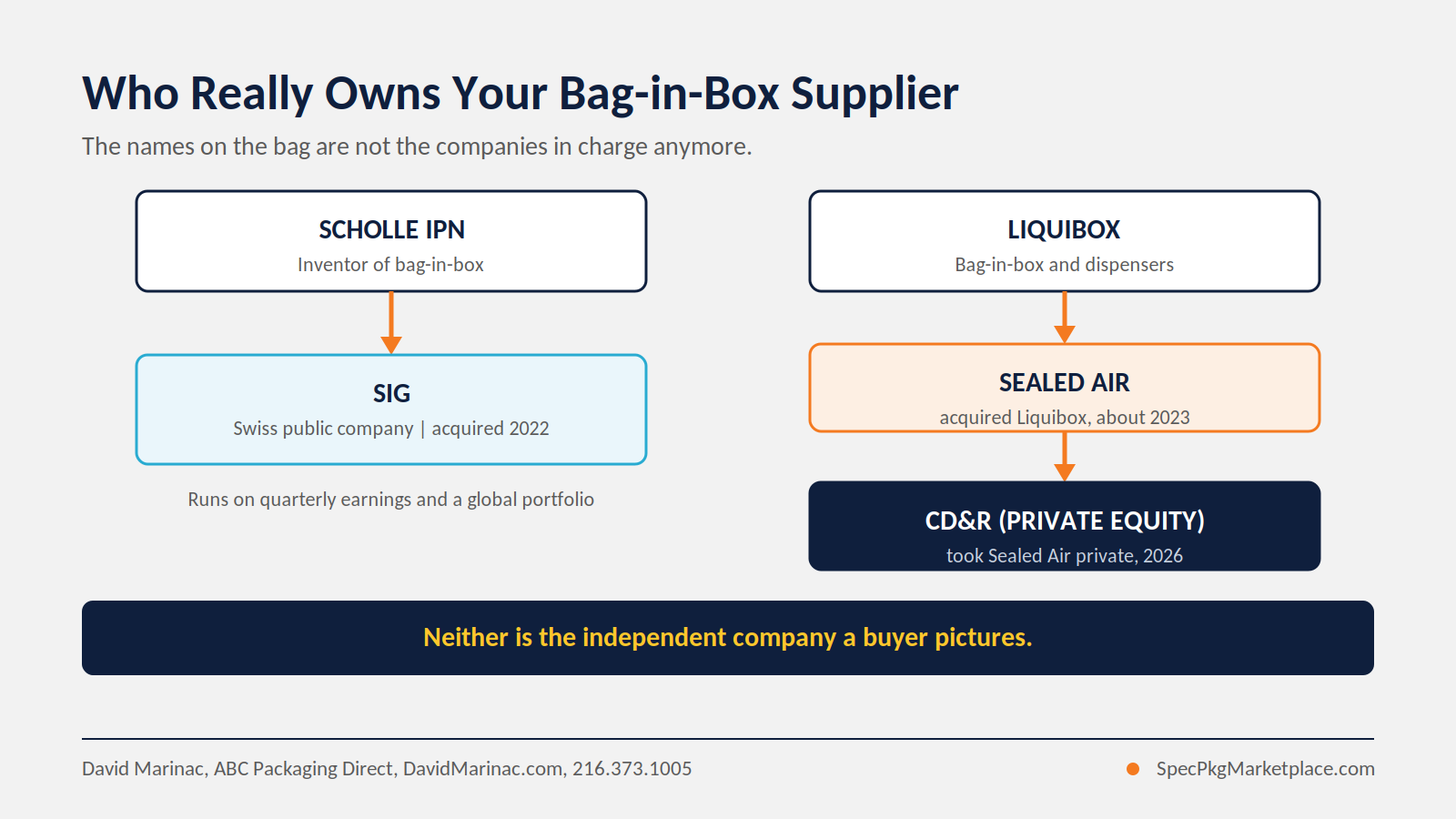
Scholle IPN, the company that invented bag-in-box, is no longer independent. According to SIG's own announcements, SIG, a Swiss aseptic-carton company founded in 1853 and listed on the Swiss stock exchange, acquired Scholle IPN in 2022 in a deal worth roughly 1.05 billion euros. Scholle now operates as Scholle IPN, a SIG company.
So when First Wave and others link out to sig.biz for bag-in-box, that is Scholle, now inside a global public company that answers to shareholders every quarter. The fitments and films you know are still there. The owner setting the strategy is not the one you started buying from.
Who actually owns Liquibox now?
The other side of the comparison moved twice. According to Sealed Air's own announcements, Sealed Air, the Charlotte company behind Cryovac and Bubble Wrap, acquired Liquibox in a deal worth about 1.15 billion dollars, completed in early 2023. Liquibox was founded in 1961 and is a recognized leader in bag-in-box and the fitments and dispensers that go with it.
Then it moved again. According to multiple reports and Sealed Air's filings, in April 2026 Sealed Air itself was taken private by the investment firm CD&R in a deal worth 10.3 billion dollars, and its stock was removed from the New York Stock Exchange. So Liquibox now sits inside Sealed Air, which is now owned by a private equity firm.
Read that twice. The Liquibox side of your comparison is now two layers removed from the company whose name is on the bag.
Why does it matter who owns your supplier?
It was never about price. It was about who picks up the phone, how fast your order ships, and whether your account matters to the people setting priorities. Ownership changes all three.
A global public company like SIG runs on quarterly earnings and a worldwide portfolio. Your mid-market line competes for attention against far larger accounts and far bigger categories. That is not a knock. It is how a public conglomerate is built to operate.
Private equity ownership runs a different way. When the deal that took Sealed Air private was announced, it named tens of millions in planned cost savings, and the financing carried heavy debt. That is the normal shape of these deals. The honest read for a buyer is simple. A company carrying that kind of debt and chasing cost synergies is focused on cash and efficiency. That focus is set far above the desk of anyone who knows your product.
None of this means your bag gets worse. The technology on both sides is still strong. It means the priorities behind your supplier are now set by owners who have never seen your plant, and a mid-market account is not where giants point their best service.
Does the merger change the product itself?
Be fair here, because the honest answer protects you. The core technology on both sides remains capable. Scholle's fitments and films and Liquibox's bag-in-box and dispensers are still industry-grade. The change is not the package. The change is the org chart, the priorities, and the service posture above the product. Judge the product on its merits. Judge the relationship on who now controls it.
What should a mid-market buyer actually do with this?
Qualify, do not switch. The move is not to panic and rip out a supplier. The move is to understand your real leverage and stop assuming your current supplier is your only supplier.
Ask who owns the company you are buying from, and ask what that owner's priorities are this year. Ask where your volume ranks inside their book. Ask what your lead time looks like when a larger account needs the same line. And build a real second source before you need one, so the answer to a stumble is a phone call and not a crisis.
The deal you never made does not show up on your P and L. Neither does the leverage you never used.
When does this not matter to you?
If you are a large, high-volume account, you may sit near the front of the line inside one of these giants, and the global reach and deep research are real advantages. If you value the broadest portfolio and the heaviest R&D, the scale that comes with SIG or Sealed Air is a feature, not a bug. This piece is not an argument to leave. It is an argument to know who you are dealing with, so you negotiate from facts instead of a name on a bag.
Is Scholle still Scholle after SIG bought it?
Yes, in name and product. According to SIG's announcements, Scholle operates as Scholle IPN, an SIG company. The fitments and films are the same line. The strategy and priorities are now set by SIG.
Who owns Liquibox now?
Liquibox is owned by Sealed Air. According to Sealed Air's filings and multiple reports, Sealed Air itself was taken private by the investment firm CD&R in 2026, so Liquibox now sits inside a private-equity-owned company.
Should I switch suppliers because of the mergers?
No, not on the news alone. The right response is to qualify alternatives and build a second source, not to switch in a panic. Use the ownership reality to ask sharper questions and to know your leverage.
The bottom line
A buyer typing "Scholle vs Liquibox" thinks the choice is between two packaging companies. It is really a choice between a Swiss public conglomerate and a private-equity-owned business, and the priorities for your account are set far above the people who know your product. The package is still good on both sides. The relationship is the thing that changed. Know who owns your supplier, ask the hard questions, and never run on a single source you cannot replace.
Compare the two side by side in our honest Scholle vs Liquibox breakdown, see who else can supply you in Alternatives to Scholle and Liquibox, and get the real numbers in What aseptic bag-in-box actually costs.
Scholle vs Liquibox comparison cornerstone
Alternatives to Scholle and Liquibox cornerstone
How Pkg Factory Can Dominate in Aseptic Pkg
Want a straight, independent read on who should actually supply your product? Reach out. No pitch, just thirty-five years of read on where the traps are. dmarinac@davidmarinac.com
David Marinac, ABC Packaging Direct, DavidMarinac.com, 216.373.1005
youtube.com

Ready to find your packaging partner?
Join hundreds of manufacturers and buyers already using PackageLink to streamline their sourcing process.