
Why Aseptic Bag-in-Box Fails: Swelling, Seal Leaks, and Spoilage
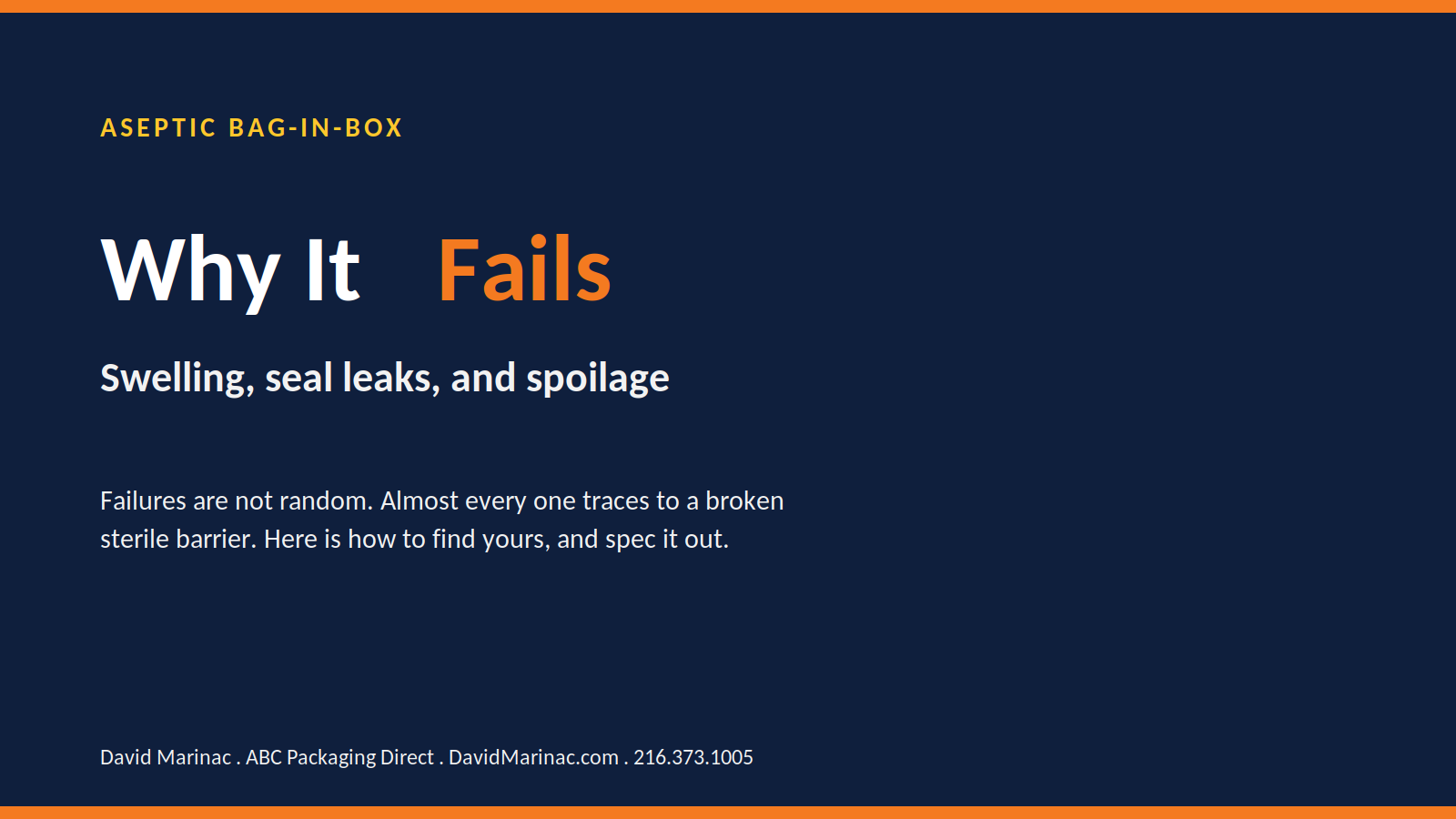
A swollen bag or a spoiled run is one of the worst calls a processor gets. The good news is that aseptic failures are not random. Almost every one traces to a broken sterile barrier, and there are only a few causes. Here is how to find yours, and how to spec so it does not come back.
If you have ever had an aseptic bag swell up on a pallet, or found spoilage in a product that is supposed to sit shelf stable for months, you know the feeling. It is not just a rejected lot. It is the fear of a recall, a customer lost, and no clear answer about what went wrong or whether it will happen again.
Here is the part that should steady you. Aseptic bag-in-box failures are not mysterious and they are not random. Almost every one comes down to the same thing, the sterile barrier was broken somewhere, and there are only a handful of places that happens. I have spent thirty-five years helping processors read these failures. This is how you find the real cause instead of guessing, and how you spec the bag so the failure does not return.
Why is my aseptic bag-in-box swelling or ballooning?
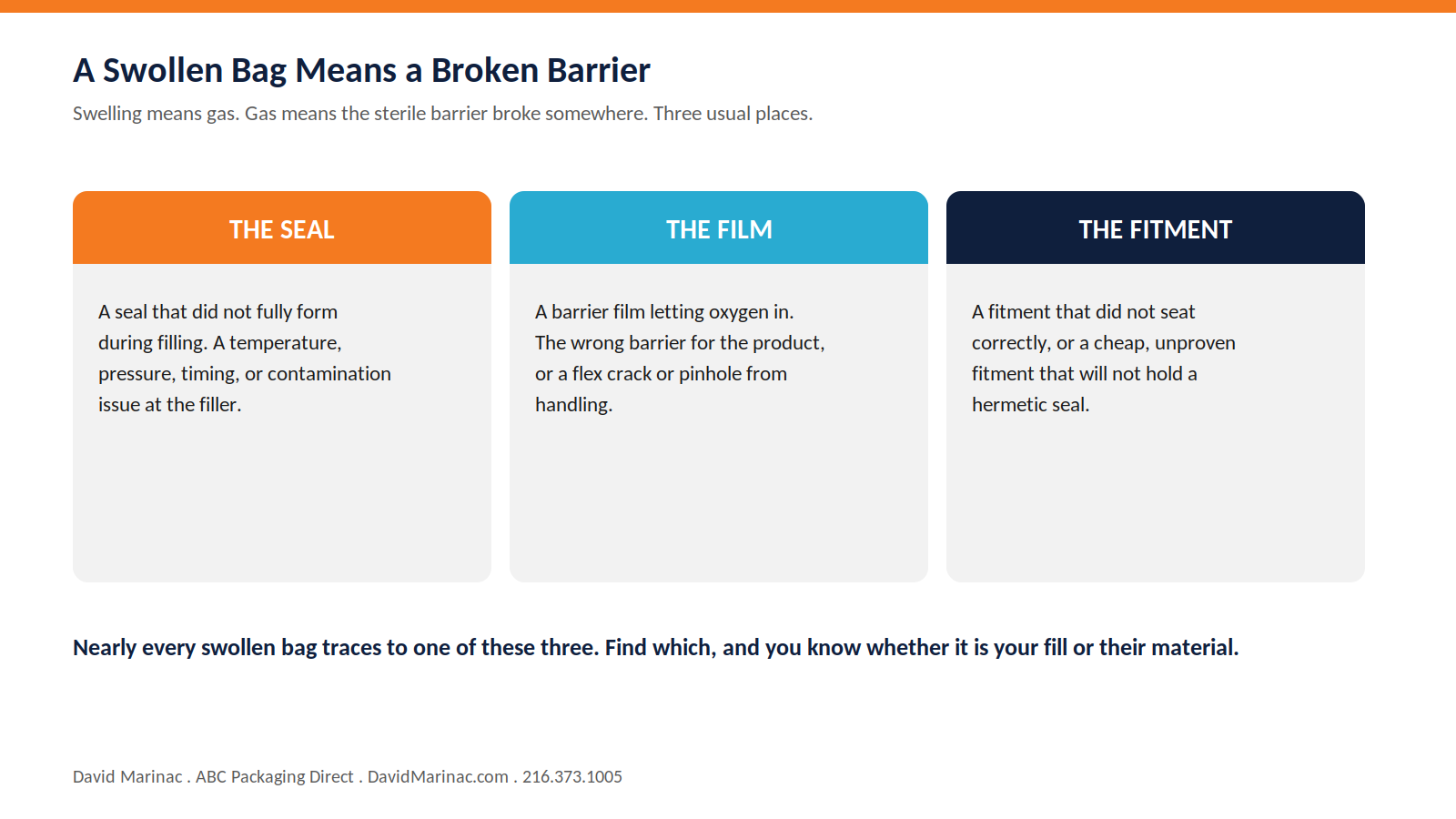
Swelling almost always means gas, and gas almost always means the sterile barrier was broken somewhere and something is growing or getting in. There are three usual causes.
A seal that did not fully form during filling. A barrier film that is letting oxygen in. Or a fitment that did not seat correctly. That is the short list, and nearly every swollen bag traces to one of the three.
The instinct is to blame the bag and call the supplier. Resist it for one more step, because which of the three it is tells you whether the problem is yours or theirs, and that changes everything about how you fix it.
How do I tell a film problem from a fill problem?
This is the single most important question in this whole topic, and almost nobody walks a buyer through it.
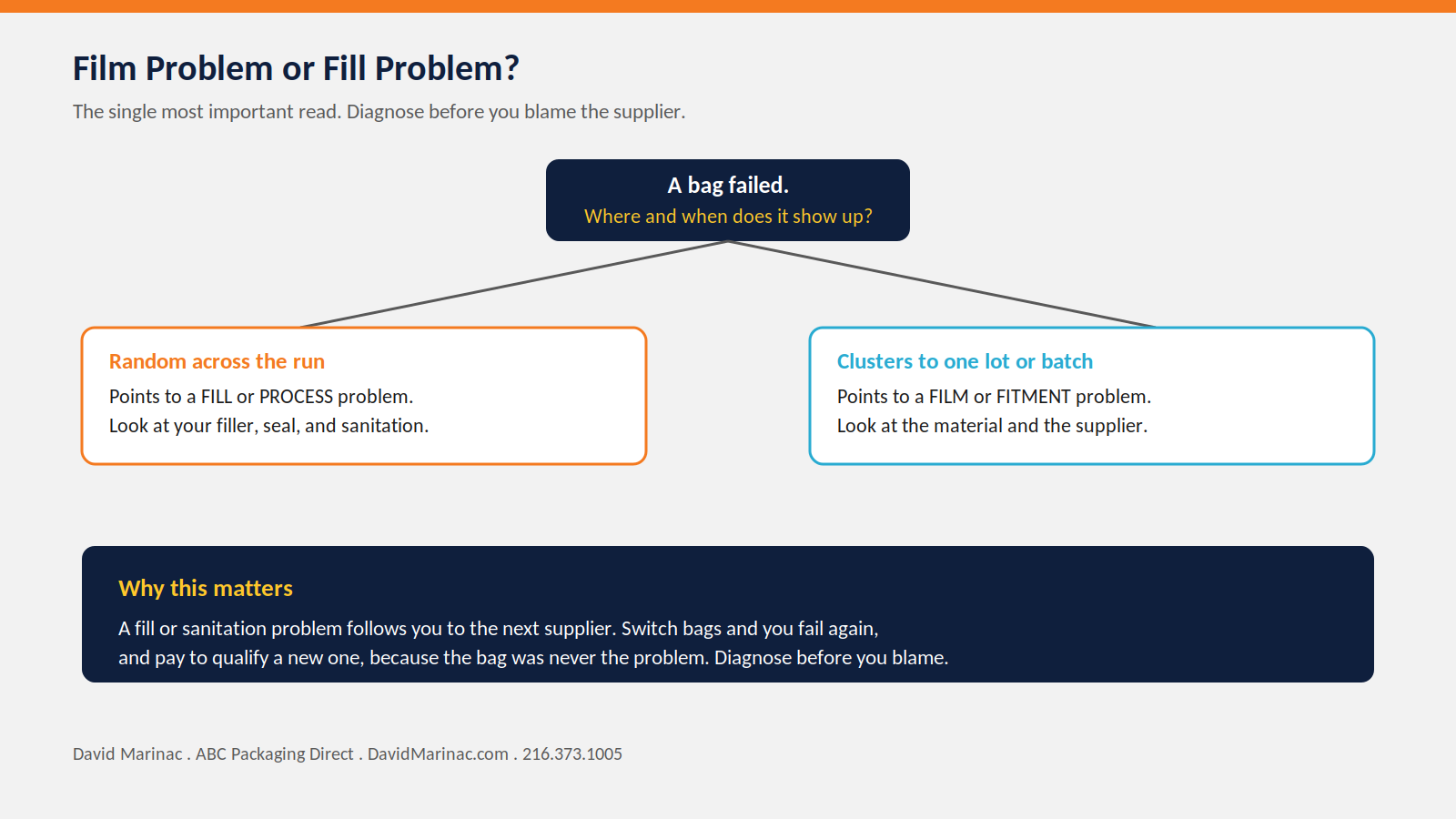
The fastest way to tell them apart is where and when the failure shows up. A fill problem tends to be random across a run, because it comes from something happening at your filler, a seal not forming, a sterilization gap, a sanitation issue. A film or fitment problem tends to track to a specific lot or batch of bags, because it came in with the material.
So before you fire your supplier, diagnose. If the failures scatter randomly across a run, look at your filler and your process first. If they cluster to one lot of bags, look at the material. This matters more than it sounds, because a filling or sanitation problem will follow you right to the next supplier. You will switch, pay to qualify a new bag, and fail again, because the problem was never the bag. Diagnose before you blame.
What causes seal leaks and fitment leaks?
Seals and fitments are the top mechanical failure point in the whole package, so they deserve their own look.
A seal leak usually means the seal did not fully form during filling, from a temperature, pressure, or timing issue at the filler, or from contamination on the seal surface. A fitment leak usually means the fitment did not seat correctly, or the fitment itself is a cheap, unproven design that does not hold a hermetic seal under real handling.
This is where fitment quality earns its keep. A proven bag-in-box tap is engineered to a very low leak rate, on the order of one failure in tens of millions. A bargain fitment that has not been tested to that bar is exactly where a leak, a contamination path, and a swollen bag come from. The fitment is one of the cheapest parts of the package and one of the most expensive to get wrong.
What causes oxygen ingress and barrier failure?
The barrier film is what keeps oxygen out and shelf life in, and when it is wrong for the product or damaged in handling, the product oxidizes, spoils, or goes off flavor before its date.
Three things cause it. The wrong barrier for the product, because water, dairy, high-acid juice, and sensitive products each need a different structure and oxygen transmission rate, and a film that is fine for one can fail another. Physical damage in transit, flex cracks and pinholes from a bag that was not built for the drop and abuse it saw. And a barrier that was simply under-specified to save a few cents, which is a false economy that shows up as a failure months later.
If the product is oxidizing but the seals and fitments are sound, look hard at whether the barrier actually matches the product.
Why is my product spoiling when the bag is supposed to be shelf stable?
Spoilage in a shelf-stable aseptic product means commercial sterility was lost somewhere. That is the whole promise of aseptic, the product and package are sterile and stay sealed, and spoilage means one of those broke.
The usual suspects are a product sterilizer that dropped below temperature during the run, a fitment or bag that was not fully sterilized before filling, a seal that let organisms in, or a barrier failure that let oxygen feed spoilage over time. The diagnostic is the same as before. Random across the run points to the process. Clustered to a lot points to the material.
Why is low-acid dairy harder and more dangerous than high-acid juice?
Not all aseptic products carry the same risk, and this is the part that should command respect.
High-acid products like most juices have a low enough pH that dangerous bacteria struggle to grow even if something slips. Low-acid products, milk and other dairy above a pH of about 4.6, do not have that natural protection. If sterility is lost in a low-acid product, the consequences can be far more serious, which is exactly why low-acid aseptic is harder, more tightly regulated, and less forgiving of a marginal seal or a cheap fitment. If you run low-acid, your tolerance for a questionable spec should be zero.
This is not a place to save money on the bag.
Why did my new supplier's bags fail when the old ones did not?
This is the trap that catches good operators, and it usually has one of two answers.
Either the new bags are not actually the same spec as the old ones, a different film structure, a different fitment, a different barrier, sold to you as equivalent when they were not. Or the bags were never the problem, your fill or sanitation was marginal all along, the old supplier's bags happened to mask it, and the change exposed it.
Both point to the same lesson. Do not switch aseptic suppliers on price and hope. Qualify the new bag against your actual filler and product before you move volume, so you find the mismatch on a trial, not on a recall. Qualify, do not switch.
How do I prevent aseptic bag-in-box failures, and what should the spec say?
Prevention is a spec problem, not a luck problem. A tight spec closes the doors the failures come through.
Match the barrier to the product, with a defined oxygen transmission rate for your specific liquid, not a generic film. Match the fitment to your filler and to a proven leak-rate standard, not to the lowest quote. Specify the film plies and the drop and flex durability for the real shipping and handling the bag will see. Confirm the fitment and seal sterilization your filler actually achieves. And write it all down as a real spec, so an equivalent bag is judged against your numbers, not a salesperson's word.
Then qualify any new bag or supplier against that spec on a trial run before you commit. A failure found on a trial is a lesson. A failure found in the market is a recall.

Is a swollen aseptic bag dangerous?
Treat a swollen or ballooning bag as a failed, potentially unsafe unit and pull it, especially with low-acid products, because swelling signals gas from a broken sterile barrier. Do not ship it, and diagnose the cause before you run more.
Can I fix a failure by switching suppliers?
Only if the failure was actually a material problem. If it was a fill or sanitation problem, switching suppliers just moves the same failure to a new bag and costs you a qualification on top. Diagnose film versus fill first.
What is commercial sterility?
It is the condition where the product is free of the microorganisms that could grow and spoil it under normal, unrefrigerated storage, and free of anything of public-health significance. Aseptic packaging exists to reach and hold that condition, and a failure is that condition being lost.
How do I know if it is the film or the fill?
Look at the pattern. Failures scattered randomly across a run point to your filler and process. Failures that cluster to one lot or batch of bags point to the material. That single read tells you where to look first.
The bottom line
An aseptic bag-in-box failure feels like chaos, but it is not. Swelling means gas, gas means a broken sterile barrier, and the barrier breaks in only a few places, the seal, the film, or the fitment. Read where and when the failure shows up to tell a fill problem from a film problem, fix the real cause instead of blaming the bag, and write a spec tight enough that the failure cannot come back. It was never about the bag. It was about knowing where sterility broke, and closing that door for good.
Had a failure, or want to prevent one? That is exactly the conversation I have, no pitch. For the money side, see what aseptic bag-in-box actually costs, and if you are weighing a supplier change, read our honest Scholle vs Liquibox breakdown and the guide to alternatives before you move.
CLICK: Complete Aseptic Buyer's Guide
CLICK: What Aseptic Bag-in-Box Actually Costs
CLICK: Scholle vs Liquibox comparison
CLICK: Alternatives to Scholle and Liquibox
Reach out for a straight read on a failure or a spec. No pitch, just thirty-five years of read on where the traps are. dmarinac@davidmarinac.com
David Marinac . ABC Packaging Direct . DavidMarinac.com . 216.373.1005



Ready to find your packaging partner?
Join hundreds of manufacturers and buyers already using PackageLink to streamline their sourcing process.