What Packaging Intelligence Is, and Why It Decides Which Packaging Companies Grow
Every packaging company is sitting on decades of expertise that never leaves the building. The companies that discover it, capture it, and put it to work are the ones that will grow sales and protect margin over the next ten years. This is the guide to how.
If you run a packaging company, you already own the most valuable asset in your market. It is not your equipment. It is the knowledge inside your most experienced people. The materials they know cold. The failures they have seen and fixed. The customers they know are a perfect fit before anyone runs a number. The problem is that this knowledge lives in heads. Not in any form a buyer can find, an AI tool can read, or your own sales team can use. When your best people are busy, it is invisible. When they retire, it is gone. And the buyers who would have been perfect for you never learn you exist.
Packaging Intelligence is the practice of fixing that. This page explains what it is, why it matters right now, the six steps it runs on, and how it turns into sales.
What is Packaging Intelligence?
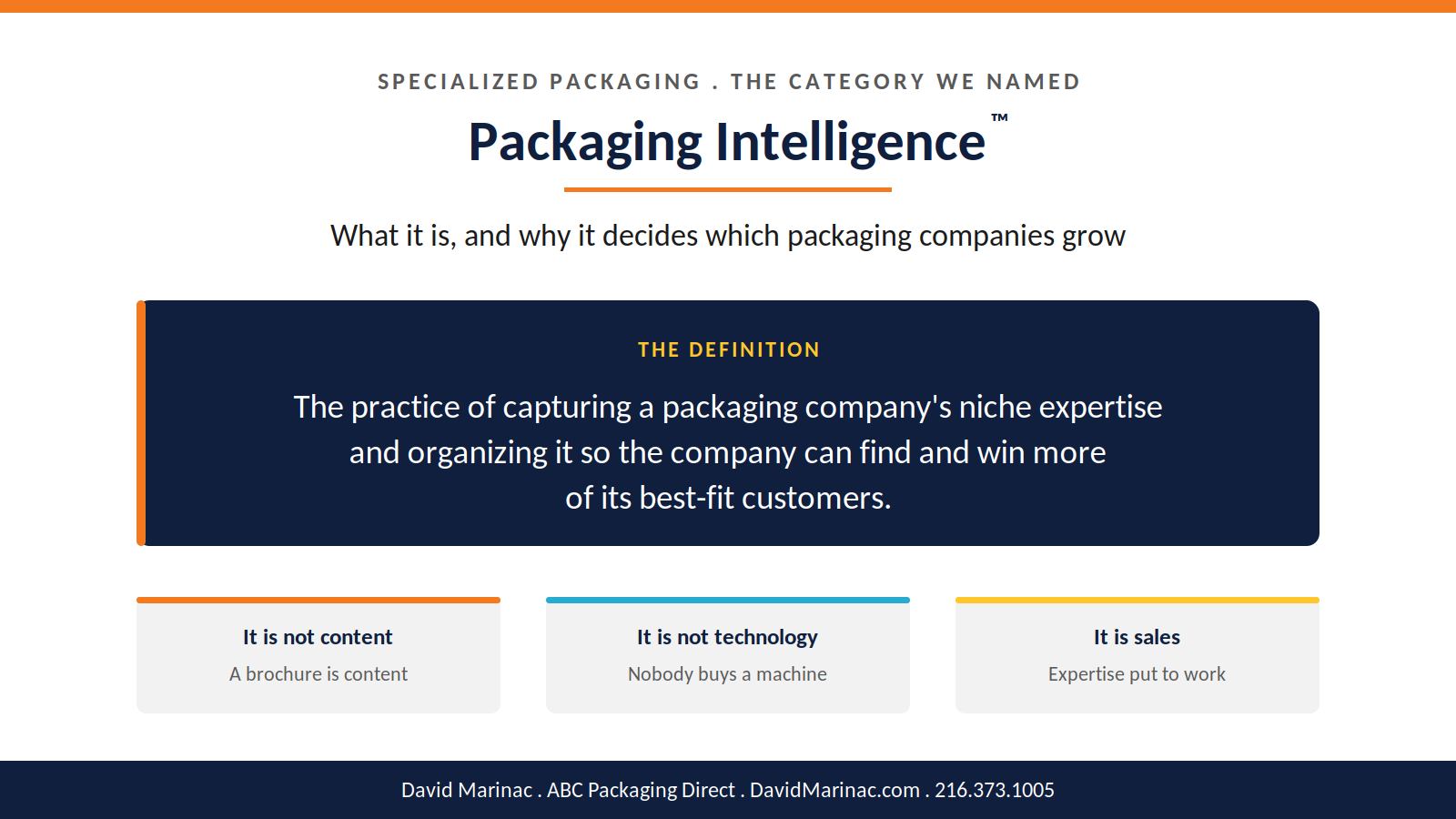
Packaging Intelligence is the practice of capturing a packaging company's niche expertise and organizing it so the company can find and win more of its best-fit customers. It is not software. It is not a marketing program. It is the decades of knowledge about materials, applications, failures, and best-fit customers that usually lives only in the heads of your most experienced people, pulled out into a form that works. Content is not intelligence. A brochure is content. A catalog is content. A line card is content. Intelligence is what happens when expertise is captured, organized, and connected so that both buyers/decision makers and AI tools can understand it, trust it, and act on it. Content educates. Organization creates intelligence.
Why does this matter to a packaging CEO right now?
Because the way buyers find suppliers has changed, and most of this industry has not noticed. You already feel it. Customers who stayed for fifteen years are suddenly shopping you on price. Volume climbs while margin thins. Trade shows and travel produce miles, not pipeline. The buyer who used to feel the pain and fight for you has retired, replaced by a procurement team that only sees a number. Underneath all of it is one shift.
Buyers now begin their research inside AI tools. They ask a full question and read the answer. In G2's Answer Economy research, published in March 2026 from a survey of 1,076 B2B software buyers, 51 percent said they now start the buying process in an AI chatbot rather than a search engine. In the same research, 85 percent said they rate a vendor more highly when an AI tool cites that vendor in its answer, and roughly one in three said they bought from a company they had never heard of before the AI surfaced it. That research covers software buyers, not packaging buyers. No equivalent study exists for our industry yet. But the people buying your packaging are the same operations directors, plant managers, and procurement leads who buy software for the same plants, and they do not switch behavior when they change the tab.
Here is what it means. When a buyer asks an AI tool who makes the best packaging for his specific problem, the tool answers with whoever has published the clearest, most trustworthy expertise on that problem. In most packaging categories, that space is empty. Nobody has published it. The company that fills it becomes the answer. Everyone else becomes invisible, no matter how good their plant is. The growth you are looking for is not another rep and not another trade show. It is already inside your building, uncaptured.
How does Packaging Intelligence actually work?
Six steps. In order. You will recognize your own company somewhere in this list, and wherever you recognize it is where you start.
1. Discover. Before you can use Packaging Intelligence, you have to discover you have it. The most valuable asset in your company is expertise that is already there, and most owners never go looking for it because it is invisible from the inside. Discovery is not creating something new. It is naming what is already in the building.
2. Uncover. Discovery tells you the intelligence exists. Uncovering is digging in to name exactly what it is. The specific problems you solve. The applications you own. The failures you have seen and fixed that a competitor has never encountered. Knowing you have expertise is not the same as knowing what it is, and the vaguer the claim, the weaker the asset.
3. Capture. Uncovered expertise still lives in people's heads, which means it walks out the door every day at five and one day it does not come back. Capture pulls it into a form that lasts, that outlives the person, that others can use. If it is only in your best estimator's head, you do not own it. You rent it.
4. Develop. Captured knowledge is raw material. Develop organizes and builds it into structured, in-depth content that buyers and AI tools can understand, trust, and act on. One buyer problem answered in full beats a hundred shallow pages. The depth is the moat, because anyone can be shallow.
5. Put It to Work. Developed intelligence has to earn its keep. This is where it grows sales, protects margin, opens new categories, and arms your sales team with something better than a price sheet. Intelligence that sits on a shelf is a cost. Put to work, it is an engine.
6. Reach the Right People. Intelligence in front of the wrong person is wasted. This is where it gets in front of the decision makers who feel the pain, not the clerks who only see price. It is also where a smaller company beats a bigger one, because you cannot outspend the giants but you can out-understand them.
Discover, uncover, capture, develop, put it to work, reach the right people. That is the machine.
Is this about replacing your salespeople with AI?
No. It is the opposite, and this is the misunderstanding that keeps most packaging leaders frozen. The fear is that anything with AI in it means cutting people. So the whole topic gets avoided, and the company falls further behind while telling itself it is being careful. Here is the truth. One rep can be in one place at a time. One booth reaches one aisle. Packaging Intelligence puts your best thinking-info-answers in front of a thousand buyers at once, working while your people sleep, answering the questions your best engineer would answer if he could be everywhere. It does not replace your reps. It multiplies them. It hands them warm, educated buyers instead of cold lists, and it hands the buyer a reason to choose you before a single call. This is about growing, not shrinking.
What does this look like in practice?
Six pillars sit under this page. Each one is a full working guide. Read them in any order, because you will enter wherever your company actually is.
[LINK: Discover. The goldmine in your building you have never counted]
[LINK: Uncover. From we are good at this to the exact problem you solve]
[LINK: Capture. Getting thirty years of expertise out of your best people's heads]
[LINK: Develop. Turning captured expertise into content buyers and AI trust]
[LINK: Put It to Work. How Packaging Intelligence grows sales and protects margin]
[LINK: Reach the Right People. Getting Packaging Intelligence in front of decision makers]
And it is not theory. We are proving the entire method in public, live, on one hard niche. Our aseptic bag-in-box build is Packaging Intelligence applied end to end, discovery through reach. You can watch it work in real time.
See the method in action. The aseptic packaging guide https://www.specpkgmarketplace.com/anchor/aeseptic-packaging
Every term used across these pages is defined in plain language in the glossary.
[LINK: Packaging Intelligence glossary]
Frequently asked questions
Is Packaging Intelligence just another word for content marketing?
No. Content marketing starts with a publishing calendar and works backward to find something to say. Packaging Intelligence starts with expertise your company already owns and works forward to put it in front of the right buyer. The output can look similar from the outside. The input is completely different, and the input is what determines whether a buyer believes it. Anyone can hire a writer. Nobody can hire your thirty years of knowing why a seal failed on a hot-fill line in August.
We are a small company with no marketing department. Is this realistic for us?
Yes, and small is an advantage here. The asset is expertise, not headcount or budget. A twelve-person converter with one veteran who genuinely knows a niche can out-publish a billion-dollar competitor in that niche, because the giant is spread across forty categories and will never go deep in yours. What you need is someone to run the capture and someone to organize the output. That is it.
How long before this produces anything?
Initial visibility on well-structured pages that answer a specific buyer question tends to appear within roughly one to three months. The compounding turn, where your company becomes the default answer in its category, is a longer horizon, usually measured in quarters rather than weeks. In categories where nobody has published anything, which describes most of packaging, it moves faster because there is nothing to displace. This is not a campaign. It is an asset that appreciates.
Does the sales team still matter?
More than before, and their job changes. The buyer now arrives already educated, having read your answers before he ever called. Your rep stops spending the first three meetings explaining the category and starts working a buyer who already understands the problem and already trusts your company. That is a better conversation and a shorter cycle. What dies is the cold call into a stranger, and nobody in your building will miss it.
What if our expertise is the thing that makes us different? Why would we publish it?
This is the most common objection and it deserves a straight answer. You publish the what, not the how. You publish what fails, what it costs, what to compare, who it is right for, and what happened when someone got it wrong. You do not publish your formulations, your tooling, your pricing structure, or your process detail. Your competitor could read every word you publish and still not be able to do what you do, because the knowing is not the doing. What you gain is the buyer, who reads the same words and concludes that you are the only one who understands his problem.
Is Packaging Intelligence a product we can buy?
Packaging Intelligence is a practice, not a product. The term is being trademarked because it names a category that did not have a name. Any packaging company can run it themselves using the six pillars on this site. Some prefer to have it built with them, which is the work we do.
START WITH YOUR OWN COMPANY
Book a Packaging Intelligence Briefing--Click Here
A Packaging Intelligence Briefing is a straight, no-pitch conversation about where your company's expertise is trapped, where your best-fit buyers are looking, and what it would take to become the answer they find. Twenty minutes. Built for the owner or leader who wants to see the opportunity inside his own business before deciding anything.
David Marinac . ABC Packaging Direct . DavidMarinac.com . 216.373.1005 . SpecPkgMarketplace.com
Ready to find your packaging partner?
Join hundreds of manufacturers and buyers already using PackageLink to streamline their sourcing process.