
Put It to Work: Most Companies Publish the Thing and Then Never Use It Again
This is the step where the asset starts producing money, and it is the step almost everybody skips. Not because it is hard. Because nobody was ever assigned to it.
Packaging Intelligence is the practice of capturing a packaging company's niche expertise and organizing it so the company can find and win more of its best-fit customers.
A company I know published twelve good pieces. Real ones, built out of what their people actually knew, specific enough that no competitor could have written them.
Six months later the owner told me content does not work.
So I asked his best salesman a question. Have you ever sent one of these to a customer?
He had not read them. Nobody had told him they existed. Twelve pieces of the best thinking in that building, sitting on a blog, while the man closest to the money was still emailing a capabilities deck and a price.
That is not a content failure. That is an activation failure, and it is the most common way this whole thing dies quietly.
An asset that nobody uses is not an asset
There is an assumption buried in how most companies think about this. Publish it, and it works on its own. Buyers find it, buyers read it, buyers call.
Some of that happens, and it is worth having. But the part that shows up fastest on the P and L is not the stranger who found you. It is what happens when the material you built gets wired into the selling you were already doing.
Same asset. Two jobs. One works while you sleep. The other works in the room, tomorrow morning, on a deal that is already live.
Five ways it goes to work
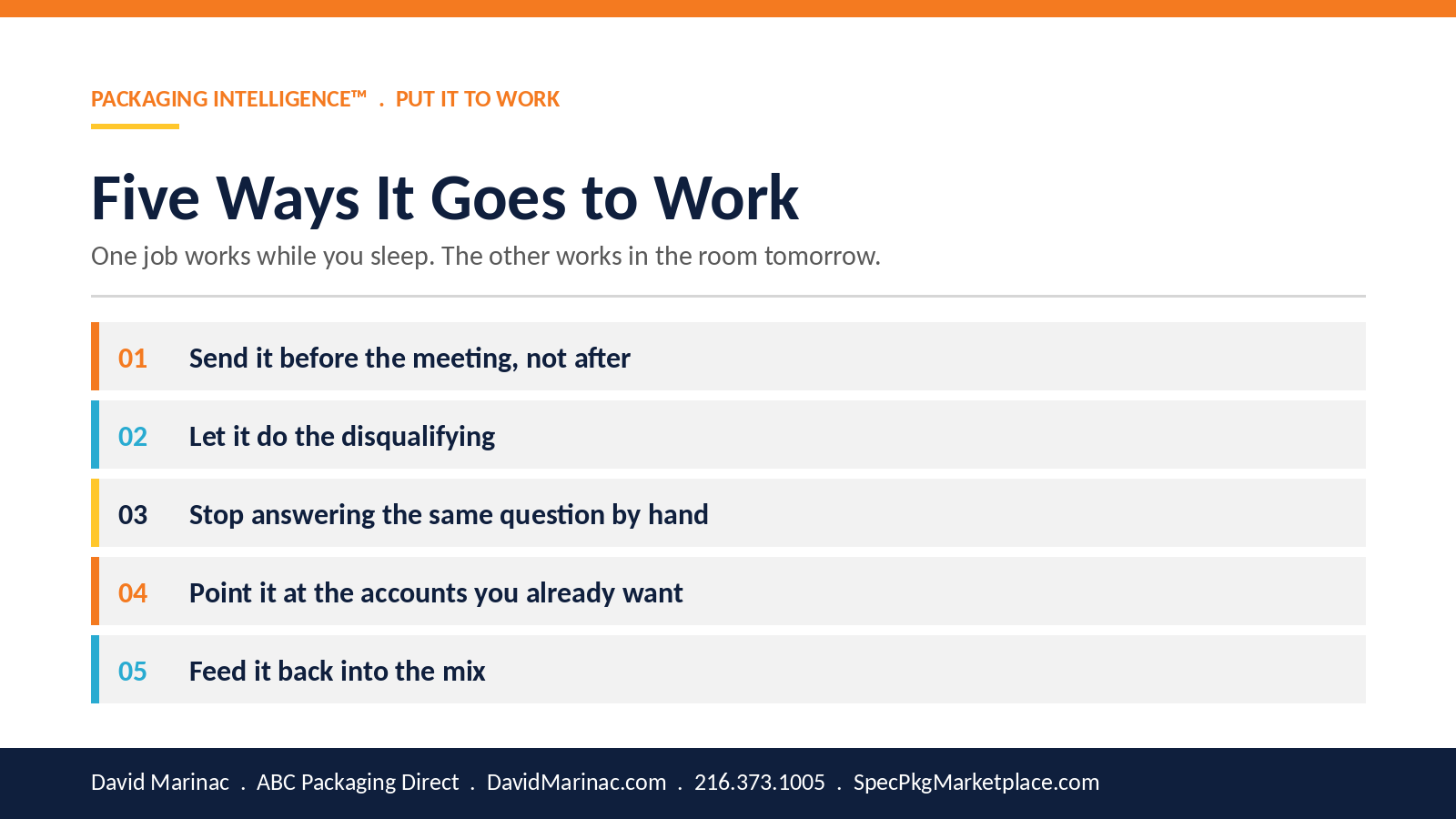
1. Send it before the meeting, not after
The standard move is to have the call and then follow up with material. Reverse it.
Send the piece that answers his exact problem the day before you talk. He shows up having read the clearest explanation in the industry with your name on it, and the first meeting starts where the third meeting used to start.
Your rep stops spending an hour teaching the category and starts working a buyer who already understands it.
2. Let it do the disqualifying
The honest piece, the one with the uncomfortable part left in, screens people out before they cost you anything.
A prospect who reads what this is wrong for and calls anyway is a prospect who fits. A prospect who reads it and disappears just saved you a sample run, three calls, and a quote.
That is not lost business. That is business you were going to lose later, more expensively.
3. Stop answering the same question by hand
Your people answer the same eight questions every week, one email at a time, each one a little different and each one a little worse than the last.
That is not selling. That is retyping.
Answer each one properly, once, and let the reps send the answer and spend the recovered hour on something that actually requires a human.
4. Point it at the accounts you already want
You have a list of companies you have been trying to get into for years.
Take the piece that speaks to that exact application and use it as the reason to make contact. Not a check-in. Not a touching base. A specific, useful thing about a problem they have, which is the only cold approach that has ever worked on a serious person.
5. Feed it back into the mix
This is the slow one and the biggest one.
Publish into the niche where your margin is best and your fit is strongest, and over time the shape of your inbound changes to match. You are not buying more volume. You are changing which work finds you.
A shop at capacity should be choosing its jobs, and this is how the choosing gets done upstream instead of at the quote.
What this does to the price conversation
When a buyer cannot tell two suppliers apart, price is the only lever he has left, and he will pull it. That is not a procurement problem. It is a sameness problem showing up at the quote stage, weeks after it was actually created.
A buyer who has already read your explanation of why his application fails, written by the man who has fixed it four hundred times, is not running the same comparison anymore. He is not choosing among four vendors. He is deciding whether to hire the one who clearly understands the problem.
I am not going to hand you a percentage, because nobody honestly has one. What I will say is that volume rising while margin thins is the signature of a company being compared on price alone, and the cause of that sits upstream of the quote, not inside it.
It was never about price. It was about being indistinguishable.
The internal part nobody plans for
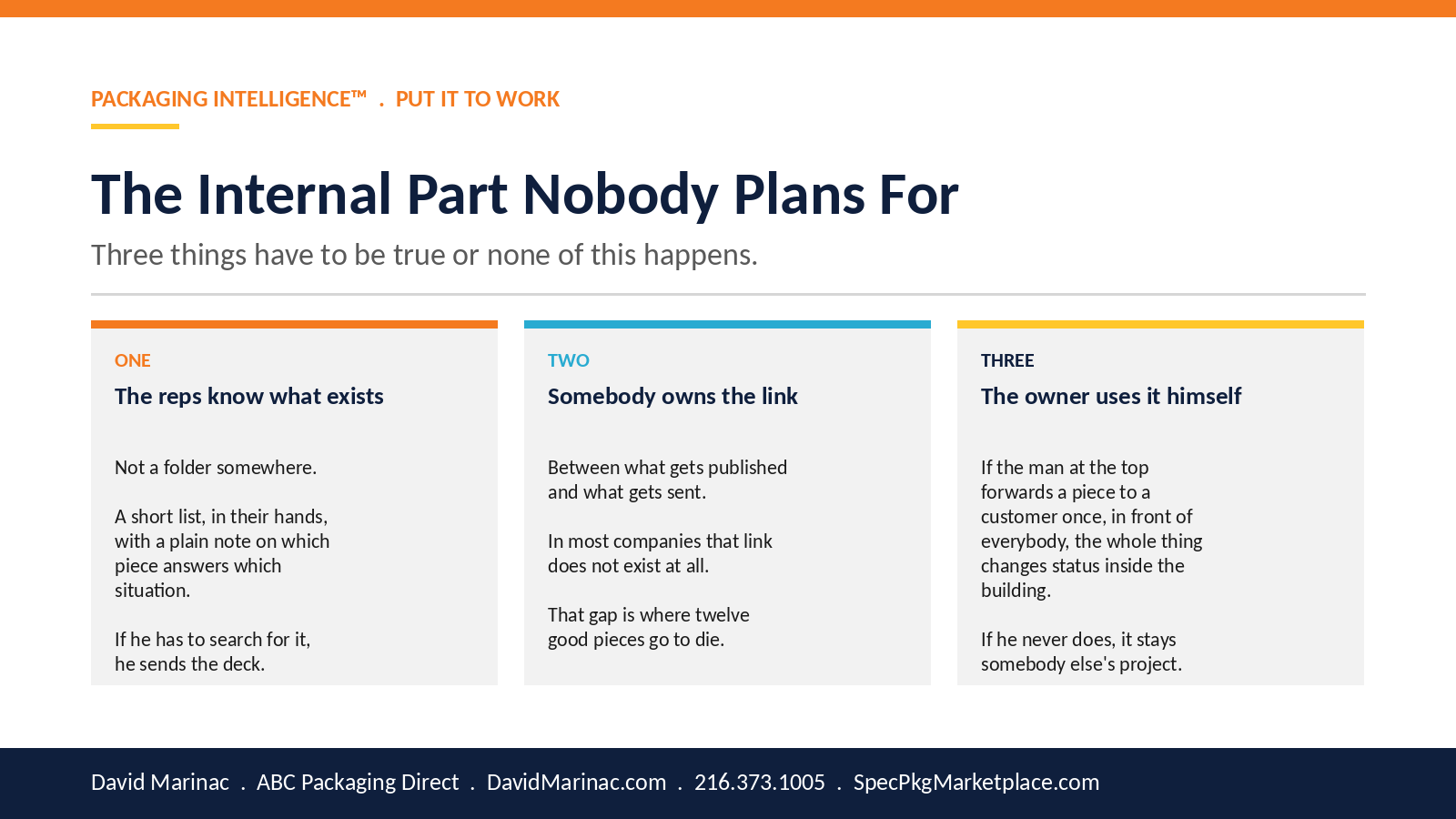
Three things have to be true or none of this happens.
Truth One: Your sales team has to know what exists
Not a folder somewhere. A short list, in their hands, with a plain note about which piece answers which situation.
If a rep has to search for it, he will send the deck instead. Every time.
Truth Two: Somebody has to own the link between what gets published and what gets sent
In most companies that link does not exist at all. One group publishes, another group sells, and the two never touch.
That gap is where twelve good pieces go to die.
Truth Three: The owner has to use it himself
If the person at the top forwards a piece to a customer once, in front of everybody, the whole thing changes status inside the building.
If he never does, it stays somebody else's project, and everybody can tell.
How you know it is working
Ignore traffic. Watch three things instead.
Whether buyers are arriving further along than they used to, which your reps will tell you before any dashboard does.
Whether the questions on the first call have moved up a level, from what is this to how would you handle mine.
And whether any conversation this quarter started with somebody nobody in your building has ever met. That last one is the real signal. It means the asset found somebody your people could not have.
What this step is not
This is not outbound. Nothing here is about building a target list, finding the right decision maker, or getting in front of a company that does not know you exist.
That is the sixth step, Reach the Right People, and it is last for a reason. Aim before you fire.
Most companies do it backwards. They buy a list first, and end up sending the same forgettable message to two thousand people who had no reason to care.
The one thing to do this week
Pick the deal on your desk right now that is closest to a decision.
Find the piece your company has that speaks directly to that buyer's problem. Send it to him today, with one line: this is how we think about what you are dealing with, no reply needed.
Then watch what the next conversation sounds like compared to the last one.
That is the whole argument for this step, and it takes about four minutes to run yourself.
Go deeper on Put It to Work:
Send it before the meeting, not after
How the honest piece disqualifies the wrong buyer for free
The eight questions your team answers by hand every week
It was never about price: what sameness costs at the quote stage
Why the owner has to forward the first one himself?
LINK: CLICK HERE AND START WITH YOUR OWN COMPANY
Find what makes you irreplaceable
If you have material sitting unused and a sales team still leading with a price sheet, start with the Packaging Intelligence Audit. A straight read on where your expertise is trapped and where your best buyers are already looking.
David Marinac . ABC Packaging Direct . DavidMarinac.com . 216.373.1005 . SpecPkgMarketplace.com
PREVIOUS AND NEXT PILLAR LINKS
LINK: What Is Packaging Intelligence?
LINK: Discover Packaging Intelligence
LINK: Uncover Packaging Intelligence
LINK: Capture Packaging Intelligence
LINK: Develop Packaging Intelligence
LINK: Packaging Intelligence FAQs
LINK: Packaging Intelligence Glossary
LINK: Reach the Right People
VIDEO



Ready to find your packaging partner?
Join hundreds of manufacturers and buyers already using PackageLink to streamline their sourcing process.