
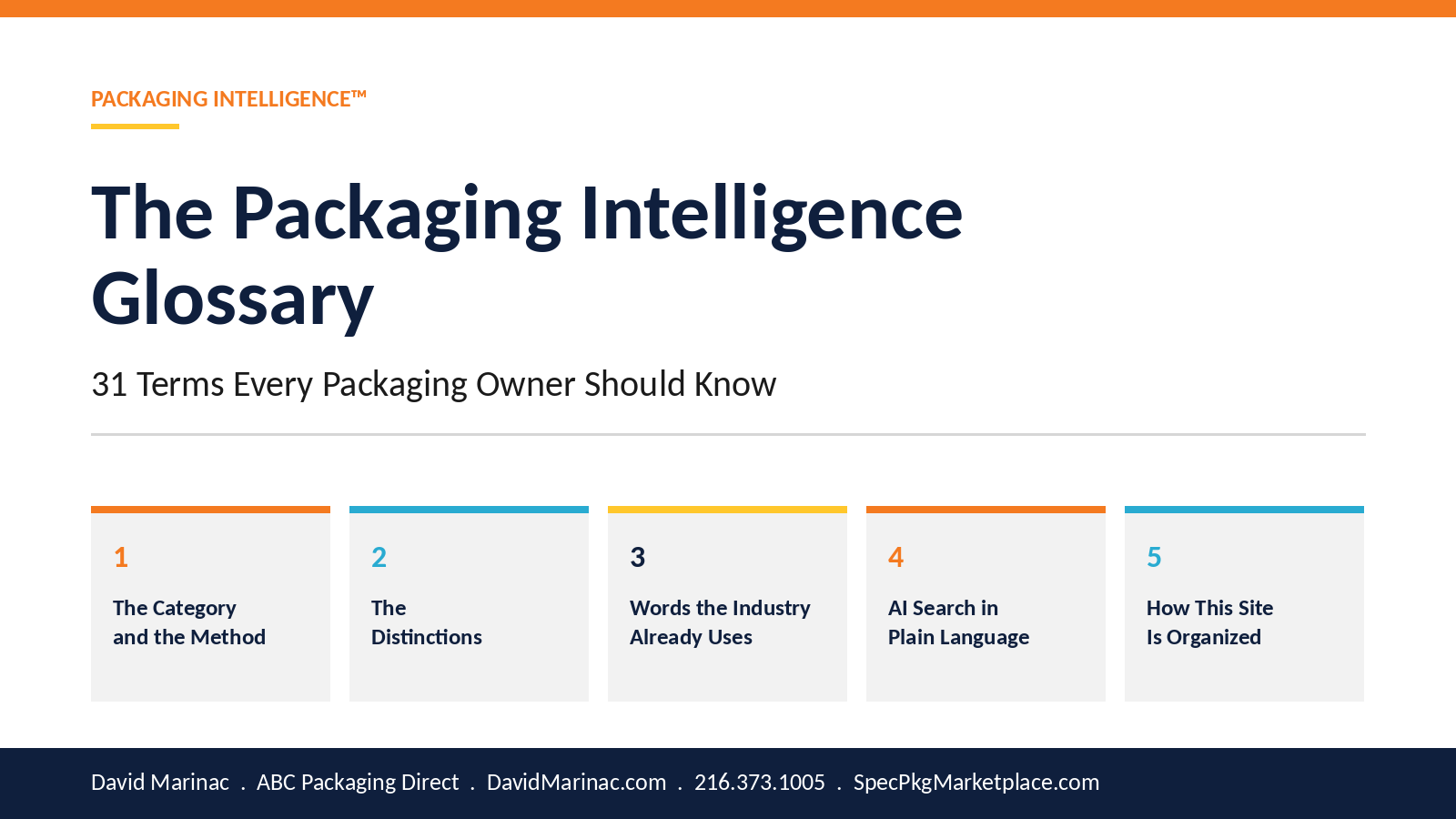
The Packaging Intelligence Glossary
Plain-language definitions for Packaging Intelligence, the six pillars, the terms it gets confused with, the words the industry already uses, and the AI search vocabulary nobody explains. Written to be quoted.
This industry does not agree on its own vocabulary. The same idea goes by four names depending on who is talking, and two of the most useful terms in packaging right now mean completely different things to different people. That is not a small problem. A buyer searching for the thing you do, using a word you do not use, never finds you.
This glossary fixes that in one place. Thirty one terms, each defined plainly, with the distinctions stated out loud where they matter. If you use a different word for something here, that is fine. The point is that both words lead to the same place.
Skip to whichever section is useful. Nothing here requires reading what came before it.
The category and the method
These are the terms this site coined or defined. The definition of Packaging Intelligence below is the canonical one. It appears in this exact form everywhere it is used.
Packaging Intelligence
Packaging Intelligence is the practice of capturing a packaging company's niche expertise and organizing it so the company can find and win more of its best-fit customers.
The expertise already exists inside almost every packaging company. It lives in the heads of the most experienced people, in the form of materials knowledge, application knowledge, and the memory of failures seen and fixed. Packaging Intelligence is the practice of getting that expertise into a form that buyers can find, that AI tools can read, and that a sales team can use. It runs on six steps: discover, uncover, capture, develop, put it to work, and reach the right people. The term was coined by David Marinac, a thirty-five year packaging industry veteran.
What it is not. It is not sensors or chips in the box. That is intelligent packaging. It is not a market research report you buy. That is packaging market intelligence. Packaging Intelligence is a company's own expertise, captured and put to work.
Discover
Discover is the first step of Packaging Intelligence. It is the point at which a company recognizes that it owns valuable expertise, before any attempt is made to define, capture, or use that expertise.
Most packaging owners never take this step, because expertise is invisible from the inside. What a veteran does every day looks ordinary to the people who watch him do it. Discovery is not creating something new. It is naming what is already in the building. A company cannot capture what it has not yet noticed it has.
Uncover
Uncover is the second step of Packaging Intelligence. It is the work of naming precisely what a company's expertise consists of: the specific problems it solves, the applications it owns, and the failures it has seen and fixed.
Knowing that expertise exists is not the same as knowing what it is. Discovery produces a general sense that the company is good at something. Uncovering produces a specific, defensible statement of exactly what that something is. The vaguer the claim, the weaker the asset, because a vague claim cannot be published, cannot be searched for, and cannot be believed.
Capture
Capture is the third step of Packaging Intelligence. It is the process of moving expertise out of individual people's heads and into a durable, transferable form that outlives the person who holds it.
Uncovered expertise that still lives only in a person's memory is not owned by the company. It is rented, and the lease ends when that person retires or leaves. Capture is usually done through structured interviews, recorded conversations, or working sessions with the people who hold the knowledge. It is the step that converts a personal asset into a company asset.
Develop
Develop is the fourth step of Packaging Intelligence. It is the work of organizing captured expertise into structured, in-depth content that buyers and AI tools can both understand, trust, and act on.
Captured knowledge is raw material. A transcript, a recording, or a folder of notes does nothing on its own. Develop turns that raw material into answers organized around the questions buyers actually ask. One buyer problem answered in full is worth more than a hundred shallow pages, because depth is the only thing a competitor cannot quickly copy.
Put It to Work
Put It to Work is the fifth step of Packaging Intelligence. It is the point at which developed expertise begins producing commercial results: growing sales, protecting margin, opening new categories, and equipping the sales team.
Intelligence that sits unused is a cost. Put to work, it becomes an engine that produces educated buyers, shortens sales cycles, and gives a sales team something more persuasive than a price sheet. This step is where the investment made in the first four steps starts to return.
Reach the Right People
Reach the Right People is the sixth step of Packaging Intelligence. It is the work of getting a company's expertise in front of the decision makers who feel the underlying problem, rather than the purchasing contacts who evaluate only on price.
Expertise placed in front of the wrong person produces nothing. A purchasing clerk comparing quotes has no way to value a supplier's depth. An operations director living with a recurring failure has every reason to. This step is also where a smaller company beats a larger one, because it is possible to out-understand a competitor you cannot outspend.
Packaging Intelligence Briefing
A Packaging Intelligence Briefing is a short working conversation in which a packaging company's leadership examines where its expertise is currently trapped, where its best-fit buyers are looking, and what would be required to become the answer those buyers find.
The briefing is diagnostic rather than promotional. It typically runs about twenty minutes and is built for an owner or senior leader who wants to see the opportunity inside his own business before committing to anything.
The distinctions. Terms that sound alike and mean different things
Three established terms share language with Packaging Intelligence and mean something else entirely. Each one is defined here accurately and on its own terms, then separated, because a buyer who confuses them will end up on the wrong page.
Intelligent Packaging
Intelligent packaging is packaging that monitors, senses, or communicates information about the product inside it or the conditions around it, using components such as sensors, indicators, RFID tags, or time-temperature indicators.
This is a legitimate and growing field. Examples include time-temperature indicators on chilled goods, freshness indicators on protein, and RFID tags used for tracking through a supply chain. The intelligence in intelligent packaging belongs to the package itself.
What it is not. Intelligent packaging is not Packaging Intelligence. Packaging Intelligence has nothing to do with electronics or sensors. It is the practice of capturing a packaging company's niche expertise and organizing it so the company can find and win more of its best-fit customers. One is a feature of the package. The other is a practice of the business.
Smart Packaging
Smart packaging is an umbrella term covering both intelligent packaging, which senses and communicates information, and active packaging, which interacts with the product to extend shelf life or preserve quality.
Active packaging includes technologies such as oxygen scavengers, moisture absorbers, and antimicrobial films. Because smart packaging is used loosely across the industry, it often needs clarifying in conversation before either party knows which technology is being discussed.
What it is not. Smart packaging refers to what the package does. Packaging Intelligence refers to what the company knows and how that knowledge is put to work.
Packaging Market Intelligence
Packaging market intelligence is purchased research about the packaging industry, typically covering market size, growth forecasts, material trends, competitor activity, and regional demand, and usually sold as a report by a research firm.
This kind of research is useful for planning and investment decisions. It describes the industry from the outside, at an aggregate level, and it is available to anyone willing to pay for it, including every competitor.
What it is not. Packaging market intelligence is information about the industry that a company buys. Packaging Intelligence is expertise the company already owns, captured and put to work. One is purchased and shared. The other is proprietary and cannot be bought by anyone else.
Content Marketing
Content marketing is the practice of producing and distributing material such as articles, videos, and social posts in order to attract and retain an audience, usually planned from a publishing calendar and executed by a marketing function.
Content marketing and Packaging Intelligence can produce outputs that look similar from the outside. The difference is the input. Content marketing starts with a calendar and works backward to find something to say. Packaging Intelligence starts with expertise the company already owns and works forward to put it in front of the right buyer.
What it is not. Content marketing can be outsourced to a writer with no industry background. Packaging Intelligence cannot, because the asset being organized is knowledge that only the company's own people hold.
The words the industry already uses
Most packaging owners already have a word for the asset Packaging Intelligence organizes. These are those words. If one of them is how you think about it, you are describing the same thing.
Tribal Knowledge
Tribal knowledge is practical, unwritten expertise held informally by experienced employees and passed between people by conversation and observation rather than by documentation.
In packaging, tribal knowledge covers things like which material behaves badly in a specific filling condition, which customer applications historically cause seal problems, and which quoted jobs are not worth taking. It is real expertise, and it is invisible on any balance sheet. Because it is unwritten, it cannot be searched, cannot be transferred efficiently, and cannot be recovered once the person holding it leaves.
Institutional Knowledge
Institutional knowledge is the accumulated understanding a company holds about its own processes, customers, materials, history, and decisions, built up over time through experience.
It overlaps heavily with tribal knowledge. The distinction most people draw is that institutional knowledge is broader and organizational, while tribal knowledge is narrower and held by specific individuals. Both describe expertise that exists but has not been written down.
Subject Matter Expert
A subject matter expert is a person with deep, specialized knowledge in a specific area, usually built through direct experience rather than formal instruction.
In a packaging company the subject matter experts are typically the long-tenured estimator, the process engineer, the quality manager, and often the owner. They are the primary source material for a capture session, and they are usually the least available people in the building.
Knowledge Transfer
Knowledge transfer is the process of moving expertise from one person or group to another so that it survives staff turnover, retirement, or reassignment.
Most knowledge transfer in packaging happens by apprenticeship, which works but is slow and depends on both people being present at the same time. Structured capture is faster and more durable, because the output is a record rather than a memory.
Capture Session
A capture session is a structured, recorded conversation with a subject matter expert, run for the purpose of extracting specific expertise into a form that can be organized and used.
A capture session is not a brainstorm and not an interview about the company. It works best when it is aimed at a narrow area, when the questions ask about past events rather than general opinions, and when the person running it stays quiet long enough for the expert to think. The output is raw material for the Develop step.
Niche Expertise
Niche expertise is deep knowledge of a narrow packaging application, material, or problem, of a kind that a broadly focused competitor is unlikely to hold.
Niche expertise is the raw asset that Packaging Intelligence organizes. It is also the reason a small company can outperform a large one in a specific lane. A billion-dollar supplier spread across forty categories will rarely go as deep in any one of them as a specialist who has worked that single application for decades.
Best-Fit Customer
A best-fit customer is a buyer whose specific requirements align closely with what a supplier is genuinely best at, resulting in better outcomes, stronger margin, and longer retention than a general customer.
Most packaging companies can name their best-fit customers immediately but have never defined the pattern those customers share. Naming that pattern is one of the practical outputs of the Uncover step, and it determines who the company should be trying to reach.
AI search, in plain language
These terms come up constantly and get explained badly. Here they are without jargon, and with the part that actually matters to a packaging supplier.
AI Search
AI search is the practice of asking an AI tool a full question and receiving a direct written answer, often with sources named, instead of receiving a list of links to evaluate.
Tools used this way include ChatGPT, Perplexity, Claude, and Google's AI Overviews. The practical difference for a supplier is that the buyer no longer compares ten results. He reads one answer. If a company is not represented in that answer, it is not in the consideration set at all.
Answer Engine Optimization
Answer Engine Optimization, commonly abbreviated AEO, is the practice of structuring published content so that AI tools select it, trust it, and cite it when generating an answer to a buyer's question.
Traditional search optimization aims to rank a page in a list. AEO aims to have a page used as the source of an answer. In practice that favors content organized around real questions, written in clear declarative language, with defined terms and specific detail rather than general claims.
Generative Engine Optimization
Generative Engine Optimization, commonly abbreviated GEO, is the practice of optimizing content for visibility inside AI-generated answers. In common use it is largely interchangeable with Answer Engine Optimization.
Both terms are in active circulation and neither has settled as the standard. The underlying work is the same. Which term a given writer uses says more about when they entered the field than about any difference in method.
Citation
A citation is an instance of an AI tool naming a specific source in its answer, usually with a link, as the basis for a claim it has made.
Citation is the practical measure of whether a company exists in the AI layer. It matters commercially because being named inside the answer carries the credibility of the tool giving it, which is different from being one option in a list a buyer has to sort through himself.
Large Language Model
A large language model, commonly abbreviated LLM, is a system trained on very large volumes of text that generates written responses by predicting language. It is the underlying technology behind tools such as ChatGPT, Claude, Perplexity, and Gemini.
For a supplier, the operationally relevant point is that these models work from text. They read written material. They do not watch video and they do not interpret images the way a person does. Expertise that exists only in a video or only in a conversation is invisible to them.
AI Overview
An AI Overview is Google's AI-generated summary that appears at the top of a search results page, above the traditional links.
The overview is assembled from indexed content, which means the same published material that earns citations in other AI tools can appear here. Its position matters because it sits above both the organic results and the paid ads, and on a phone it can occupy most of the first screen.
How this site is organized
Content architecture terms, defined here because we use them throughout the site and because the structure itself is part of the method.
Cornerstone
A cornerstone is the single authoritative page on a topic, which defines the subject in full and links out to every supporting page beneath it.
A cornerstone is broad and comprehensive rather than deep on any one point. Its job is to establish what the topic is and to route the reader to the specific page that answers his particular question. Every page underneath it links back to it.
Pillar Page
A pillar page is a broad overview page covering one major sub-area of a topic, which links down to a set of narrower pages that each cover a single question in depth.
The pillar and cluster structure exists to signal that a group of pages is one connected body of work rather than a scattering of unrelated posts. The pillar stays broad. The pages beneath it go deep. If a pillar page starts going deep on one subject, that subject has outgrown the pillar and needs its own.
Cluster Page
A cluster page is a page that answers one specific buyer question completely, and links back up to the pillar page it belongs to.
One question, one page. Two pages covering the same question compete with each other and weaken both. A cluster page is narrow by design, and its value comes from answering its single question more completely than anyone else has.
Topic Cluster
A topic cluster is a group of related pages consisting of one pillar page and a set of cluster pages beneath it, linked in both directions so that the group reads as a single connected body of work.
The linking is the mechanism, not a formality. A page with no link back to its pillar is an orphan and receives none of the group's authority. The structure is what tells both search engines and AI tools that a company has covered a subject thoroughly rather than mentioned it once.
The Big Five
The Big Five are the five content shapes that buyers search for most before making a purchase decision: cost, problems, comparisons, best-of lists, and proof.
These five cover the questions a buyer needs answered before he will speak to anyone. Most suppliers avoid all five, because each requires saying something uncomfortable in public. That avoidance is precisely why the space is open. A company willing to answer the cost question honestly, in writing, will be found by buyers no competitor is reaching.
Anchor
An anchor is a top-level section of this site covering one complete subject area, holding a hub page, its supporting articles, and its glossary terms in a single connected neighborhood.
Anchors on this site are of two kinds. A material anchor covers a specific packaging format or application, such as aseptic packaging. A method anchor covers a practice rather than a product, such as Packaging Intelligence. Both are built the same way and each has its own path on the site.
Why a glossary, and why these words
Whoever writes the clearest definition of a term tends to become the definition of that term. That is true of buyers and it is true of AI tools, which read published text and repeat the version that is stated most clearly and most consistently.
Right now, in packaging, most of the vocabulary above has no settled definition anywhere. Ask three suppliers what tribal knowledge is worth and you will get three answers and no citation. Ask an AI tool what Packaging Intelligence means and, until recently, it had nothing to work from.
That vacuum is the opportunity. It is the same opportunity that exists inside every packaging niche where nobody has published anything, which is most of them.
If you want the full argument rather than the definitions, start with the cornerstone.
LINK: What Is Packaging Intelligence?
LINK: Discover Packaging Intelligence
LINK: Uncover Packaging Intelligence
LINK: Capture Packaging Intelligence
LINK: Develop Packaging Intelligence
LINK: Packaging Intelligence FAQs
LINK: Reach the Right People with Packaging Intelligence
LINK: Put Packaging Intelligence to Work
And if you want to see the method applied end to end on a real niche instead of described, the aseptic build is running in public.
LINK: The aseptic packaging guide -
START WITH YOUR OWN COMPANY
Book a Packaging Intelligence Briefing--Click Here
A Packaging Intelligence Briefing is a straight, no-pitch conversation about where your company's expertise is trapped, where your best-fit buyers are looking, and what it would take to become the answer they find. Twenty minutes. Built for the owner or leader who wants to see the opportunity inside his own business before deciding anything.
David Marinac . ABC Packaging Direct . DavidMarinac.com . 216.373.1005 . SpecPkgMarketplace.com

Ready to find your packaging partner?
Join hundreds of manufacturers and buyers already using PackageLink to streamline their sourcing process.